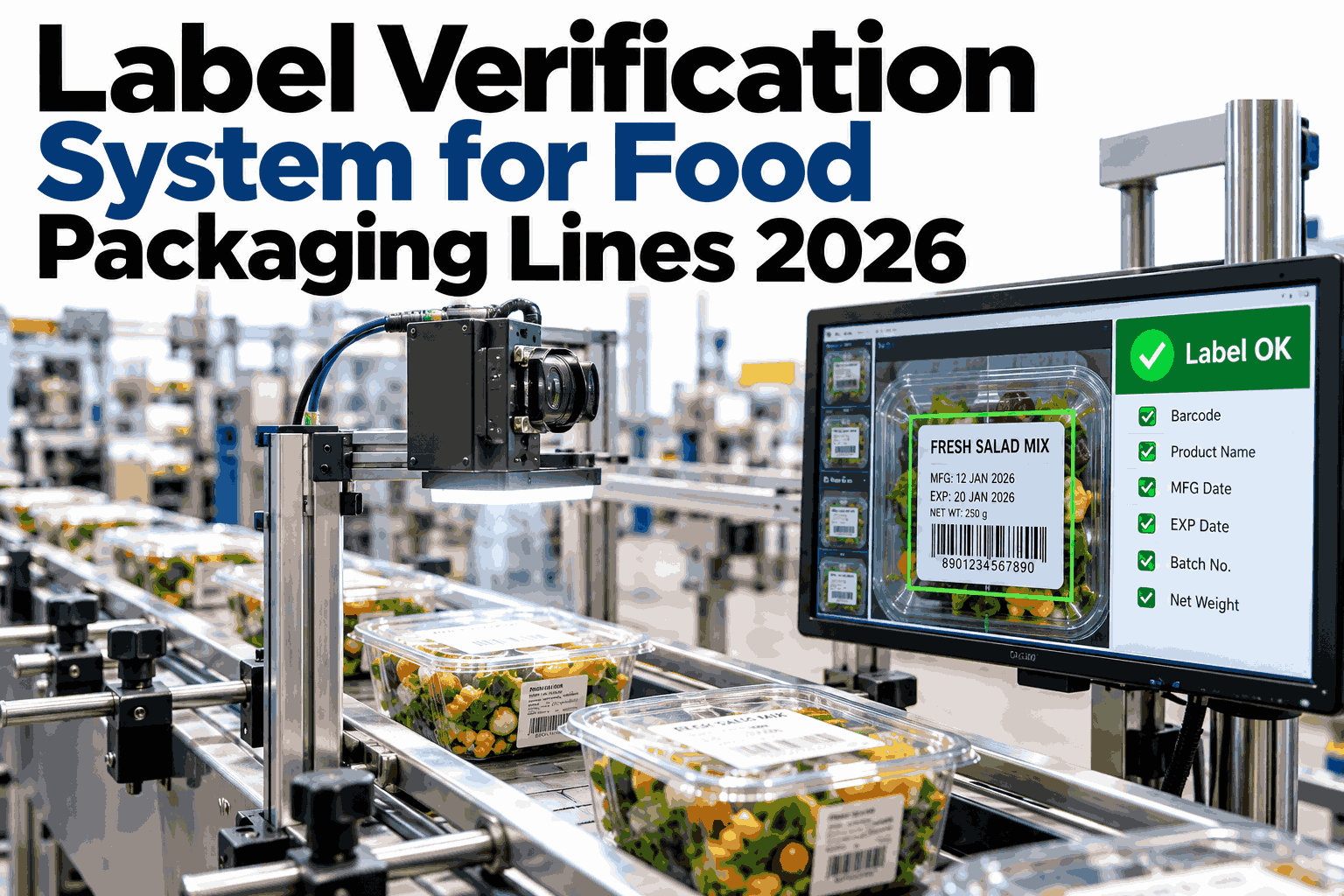
A missing straw is not a defect in the way a torn seal or a smeared date code is. There is nothing wrong on the package to point a camera at, because the problem is something that should be there and is not. Proving an absence is a different vision task from spotting a flaw, and food lines that treat the two as the same problem tend to catch neither well. Plants ready to see the difference on their own components can walk through a presence-verification setup on their actual packaging in a short session.
Catching What Is Not There Is a Different Problem Than Catching What Is Wrong
iFactory AI verifies presence, not just appearance, so a missing straw, spoon, lid, insert, or scoop gets caught at line speed instead of by a customer.
Why Absence Is Harder to See Than a Flaw
A torn label, a crooked cap, or a smeared print all give a camera something concrete to find. Pixels look wrong in a place they should look right, and the system flags the difference. That is a comparison against a known-bad pattern, and vision models are generally good at exactly that kind of comparison.
A missing component gives the camera nothing extra to find. The package may look entirely normal, sealed correctly, labeled correctly, shaped correctly, and still be missing the one small item inside or attached to it that the customer actually needed. The system has to confirm a positive, that the item is there, rather than simply notice that something looks off.
Think about what a human quality inspector actually does differently for the two checks. Spotting a defect is a scan: the eye moves across the package looking for anything that interrupts an otherwise uniform expectation. Confirming a presence is a count: the eye has to find a specific object and register that it exists, which is a slower, more deliberate act even for a trained person, let alone a camera running at line speed.
That slower, more deliberate act is exactly what gets skipped under time pressure, which is the human version of the same gap a poorly matched vision system has. Nobody decides to stop checking for the spoon. The check simply never gets the dedicated attention a true presence verification needs, and it quietly erodes until a complaint brings it back into focus.
Not All Missing Components Are Equally Hard to Catch
Where a component sits on or in the package changes how hard it is to verify its presence. Three categories cover most food packaging components, each with a different level of difficulty.
Attached, Visible Components
A spoon sealed under a clear lid film, a straw taped to the outside of a juice box. The item sits in a fixed, visible position, so a presence check can look at one known region and confirm something fills it.
Loose, Variable-Position Components
A scoop placed loosely into a protein tub, a toy tossed into a cereal box. The item can land anywhere inside the container, so the check has to confirm presence somewhere in a volume, not at one fixed spot.
Hidden or Under-Wrap Components
An insert or sachet placed under shrink wrap or inside a sealed carton before the outer package closes. The camera cannot see the item directly, so the check has to infer presence from weight, shape, or a secondary signal.
Most plants start a presence-verification program on the easy tier, because the win is immediate and the setup is simple. The components that actually drive the most chargebacks and complaints, though, tend to sit in the harder two tiers precisely because nobody built a reliable check for them yet.
A promotional run makes the middle tier worse than usual. A limited-time toy or sample packed loosely alongside the regular product is new to the line, often supplied by a different vendor on a tight timeline, and the position it lands in has never been studied the way a core SKU's layout has. That is exactly the combination, a new object and an unstudied position range, that a presence check is most likely to miss if it is treated as an afterthought on the promotional launch checklist.
Techniques That Actually Prove Presence
A single technique rarely covers all three tiers. The right approach follows from where the component sits, not from whichever method is already installed on the line.
It helps to name the failure mode each technique is actually guarding against, because the three tiers fail in genuinely different ways on the line. A fixed-region check fails when the component shifts just outside its expected slot. A whole-container detection check fails when the component lands in an unusual spot the training data never covered. A weight-based check fails when ordinary product variation overlaps the weight range a missing component would also produce.
| Component Tier | Typical Technique | What It Actually Confirms |
|---|---|---|
| Attached, visible | Fixed-region presence check | The known slot is filled, not empty |
| Loose, variable position | Whole-container object detection | The item appears somewhere in the frame, wherever it landed |
| Hidden, under-wrap | Weight check or secondary signal | An indirect proxy consistent with the item's presence |
The hidden tier is worth sitting with for a moment, because it is the one case where vision alone cannot finish the job. A sachet under shrink wrap may be visible as a faint outline under the film, but a system that relies on seeing that outline is fragile against film thickness, lighting, and print underneath it. A checkweigher tuned to the expected weight delta the component should add is often the more reliable partner here, with vision confirming everything else about the pack.
The weight signal works because the component has a known, fairly consistent mass, so a pack running light by roughly that amount is a strong indicator something is missing even though no camera ever saw it directly. The harder design question is where to set the tolerance band, since normal product-weight variation and a missing small component can sit close enough together that too tight a band produces false rejects and too loose a band lets real misses through.
Find Out Which Tier Your Components Actually Sit In
Bring your component list and iFactory AI will map each one to the technique that actually proves it is there.
Where a Missing Component Actually Costs Money
A missing straw or spoon rarely triggers a safety recall. It triggers something slower and just as expensive: a customer who cannot use the product as sold, and a retailer who remembers which supplier shipped it that way.
Retailer Chargebacks
A retail partner that receives complaints about incomplete packs can charge the cost back to the supplier, often well beyond the value of the product itself.
Return and Replacement Cost
A customer who cannot use a product without its component returns it or demands a replacement, and the shipping and handling cost usually dwarfs the missing item's own value.
Review and Reputation Damage
An online review mentioning a missing spoon or scoop is public and permanent, and it reaches every future buyer who reads it, not just the one affected.
Lost Shelf Confidence
A retail buyer who sees repeated incomplete-pack complaints on a SKU has a reason to shrink its shelf space or cut it at the next planning cycle.
What a Missed Component Looks Like From the Customer's Side
The plant sees a reject rate and a complaint count. The customer sees something much simpler: a product they cannot use the way it was sold to be used.
A protein tub without its scoop means the customer either hunts for a kitchen substitute or guesses at the serving size, and either way the brand's promise of a measured, convenient product has quietly failed on the first use. A cereal box without its promised toy is a disappointment aimed squarely at a child, which is a different and sharper kind of brand damage than an adult simply noticing a minor inconvenience.
A beverage carton without its straw is perhaps the mildest version of the failure in isolated cost, since most households have a spare straw somewhere, and yet it is also the version most likely to be photographed and posted, because it is instantly legible to anyone scrolling past. A missing component does not need to be expensive to replace in order to be expensive in attention, and attention is exactly the currency a brand cannot easily buy back once it has been spent on a bad post instead of a good one.
Building a Presence-Verification Program
A program that actually works starts with an honest inventory, not a camera purchase. Four steps, in order, keep the setup matched to the real risk.
A fifth, often skipped step is deciding who owns the ongoing accuracy of each check once it is live. A model that was accurate at launch can drift as packaging materials, lighting, or line speed shift gradually over months, and a program with no clear owner for noticing that drift tends to find out about it the same way it found out about the original problem, from a customer.
The order matters because the easiest components to verify are rarely the ones costing the most in chargebacks and returns. A plant that builds its program by ease of setup instead of by complaint history ends up excellent at catching the problem it almost never has.
Complaint data is also usually an undercount of the real problem. A customer missing a spoon is more likely to simply not finish the product and quietly switch brands than to file a formal complaint, so the visible complaint volume is a lower bound on how often the failure actually happens, not the true rate. A plant basing its priority list only on filed complaints is, in effect, basing it on whichever failure happens to annoy customers enough to write in, which is not the same ranking as whichever failure is actually most frequent.
What Makes a Presence Check Reliable, Not Just Present
Standing up a camera on a line is the easy part. A few operating habits decide whether the check actually holds up once volume and variation show up.
These habits matter more for presence checks than for defect checks, because a defect is usually visually obvious once you know to look for it, while an absence can hide behind a model that was only ever tested against the one tidy example it was built from.
Trained on the Real Variation
A spoon can sit at a slight angle, a scoop can land upside down. The model needs examples of the normal range of positions, not just one ideal placement.
Tested Against Partial Presence
A broken spoon handle or a torn-open sachet corner is neither a clean pass nor an obvious absence, and the check needs a defined answer for that middle case.
Re-Checked After Packaging Changes
A new film supplier, a redesigned carton, or a repositioned slot can quietly move the component just enough to confuse a check tuned to the old layout.
Logged With the Reason, Not Just the Reject
A reject count with no record of which component and which tier failed cannot tell a plant whether the problem is the check or the line.
Where iFactory AI Fits
iFactory AI builds the presence check to match the tier each component actually sits in, rather than forcing every component through one generic vision model.
Tier-Matched Detection
Fixed-region checks for attached items, whole-container object detection for loose items, and weight-based verification where the item is hidden from view.
Position-Tolerant Training
Models learn the real range of how a component lands, not one idealized placement, so a normal angle does not read as an absence.
Partial-Presence Handling
A broken, torn, or partially visible component gets its own defined outcome instead of forcing a pass or fail that does not fit.
Reason-Coded Rejects
Every reject logs which component, which tier, and which check failed, so a rising reject rate points straight at its cause.
A Short Self-Check Before Your Next Run
Run these against your own component list. A no points directly at the next gap worth closing.
Frequently Asked Questions
Why can't our existing defect-detection camera also catch missing components?
A defect check is tuned to notice something wrong on a package it expects to look correct otherwise. Presence verification has to confirm a positive, that an item is actually there, which is a different detection task even when it runs on the same camera. Most defect-focused systems were never trained or evaluated on whether they can reliably prove an absence, so adding that capability usually needs its own model, not just a setting change.
How do you verify a component we cannot actually see, like one hidden under shrink wrap?
Vision alone struggles here, so the more reliable approach pairs a checkweigher tuned to the expected weight the component adds with whatever visual signal is available, such as a faint outline under film. See this paired approach on your own hidden components in a short walkthrough.
What happens when a component is present but damaged, like a broken spoon?
A damaged component is neither a clean presence nor a clean absence, so the check needs its own defined outcome for that case rather than forcing it into a binary pass or fail. Most plants choose to treat a damaged component as a reject alongside a missing one, since the customer experience is similar either way, but that choice should be made deliberately rather than left to whatever the model happens to output. Recording that distinction in the reject data also makes it possible to tell later whether the real problem is a supplier's component quality or the line's own handling.
Which components should we verify first if we can only start with one?
Start with whichever component shows up most often in your actual complaint and chargeback history, not whichever is easiest to set up. An attached, visible component is simpler to verify, but if your real losses are coming from a loose scoop or a hidden insert, solving the easy problem first leaves the expensive one untouched. Ask support how to match your complaint data to a component tier.
What data do we need before setting up presence verification?
The core is a list of every component by SKU and its typical position, a set of sample images or packs covering the normal range of placement, and complaint or chargeback history by SKU if available. Most plants already have the components and packaging on hand even if the list has never been written down formally. The early weeks of a rollout focus on capturing that real variation so the model does not mistake a normal placement for an absence.
Prove What Is There Before It Reaches a Customer
iFactory AI matches the right presence-verification technique to each component's actual difficulty tier, so a missing straw, spoon, lid, insert, or scoop gets caught at line speed. Book a walkthrough on your own packaging.