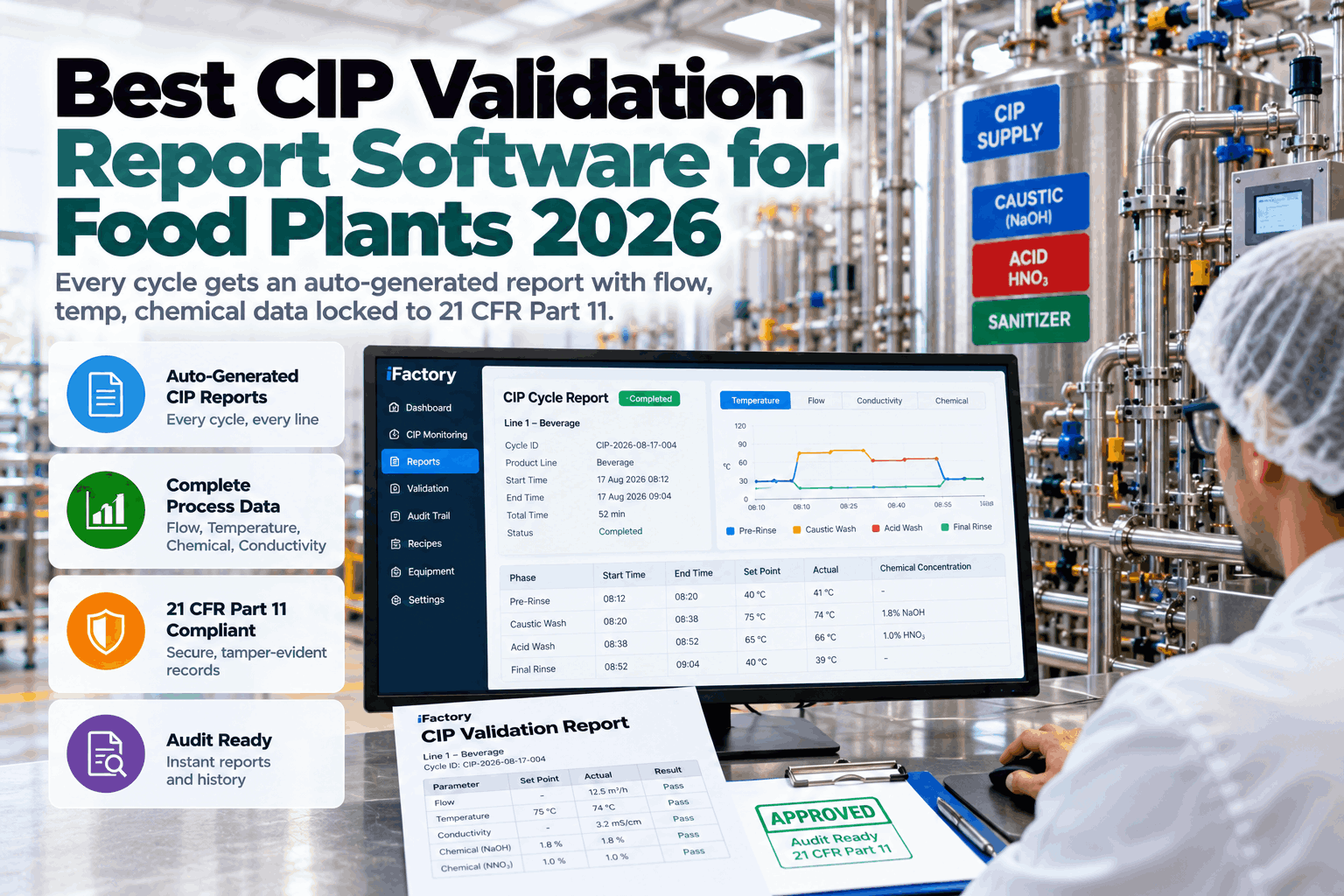
When an auditor asks for last March's CIP records, many food plants still go hunting for paper charts. An automatic report for every cycle fixes that: real values, a proper signature, and no quiet changes afterwards. To see a sample report built from your own skid data, book a CIP records demo.
CIP Validation Report Software for Food Plants
An automatic report for every CIP cycle, showing what each phase achieved, who reviewed it and whether it passed, kept with a secure audit trail and ready the moment an auditor asks.
- What every CIP cycle report should hold
- Where 21 CFR Part 11 applies, and where it does not
- How records turn into validation evidence
- 1Who, where, when. Plant, circuit, date and time, and the lot that follows the clean.
- 2Actual values. Real minimum temperature, flow and strength, not just "done".
- 3Pass or fail per phase. Against limits from your validated recipe.
- 4Verification. The result that shows the clean worked.
- 5Signature with meaning. Name, time and what the signature stands for.
Names, values and limits here are examples. Your report shows your own recipe limits and verification method.
Why CIP Records Are Hard to Defend
The clean usually happened. Proving it, months later, is the hard part.
CIP data lives in a skid controller, a chart recorder, a paper log and a QA spreadsheet. Each holds part of the story, and none holds all of it. When an auditor or a customer asks about one cycle, someone has to stitch it back together by hand, and gaps show. Our CIP support team can help you map where your records live today.
Scattered sources
Skid trends, paper logs and swab results are kept in different places, by different teams, in different formats.
Values not kept
Logs say "CIP done", but not the temperature or strength the cycle actually reached, so nobody can tell a good cycle from a weak one.
Late sign-off
Records are signed hours or days later, in a batch, which weakens them and hides problems until it is too late to act.
Easy to change
Spreadsheets can be changed without a trace, so nobody fully trusts them, least of all an auditor.
Weak records rarely mean the clean failed. They mean you cannot show it worked. In an audit, a recall or a customer complaint, that difference matters a great deal.
Who reads your CIP records
Certification audits
Want a sample of cycles, with values and sign-off, at short notice, often for dates they pick themselves.
Supplier audits
Often ask for allergen changeover cleans and the proof they worked.
Inspections
Expect records that are accurate, made at the time and signed by the person responsible.
Investigations
Need cycle history fast when a swab fails or a complaint comes in.
What a Good CIP Cycle Report Holds
Enough detail to show the work. Nothing a reviewer has to guess.
The US preventive controls rule sets a sensible floor for any food safety record. A CIP report built on it holds the actual values reached, is made at the time of the cycle, and names the plant, the date and time, and the person responsible. To compare your current records with that floor, book a records gap check.
A record written up after the event is a memory, not a measurement. Reports built straight from skid data at the moment each phase ends carry the real values, with a real time stamp, and leave nothing to recall or retype.
Good reports are
- Made at the time. Not typed up later.
- Values, not ticks. Real numbers for each phase.
- Readable. One page an auditor can follow.
- Linked. To the lots before and after.
Weak reports are
- A tick box saying "CIP complete"
- Signed in a batch at week's end
- Missing the verification result
- Kept where anyone can change them
A Week of CIP Records, Two Ways
Here is the review time for one site's CIP records, checked by hand against checked by exception. The same 56 cycles, the same QA team.
21 CFR Part 11: When It Applies to CIP Records
Part 11 is not automatic for food plants. But its controls are good practice anyway.
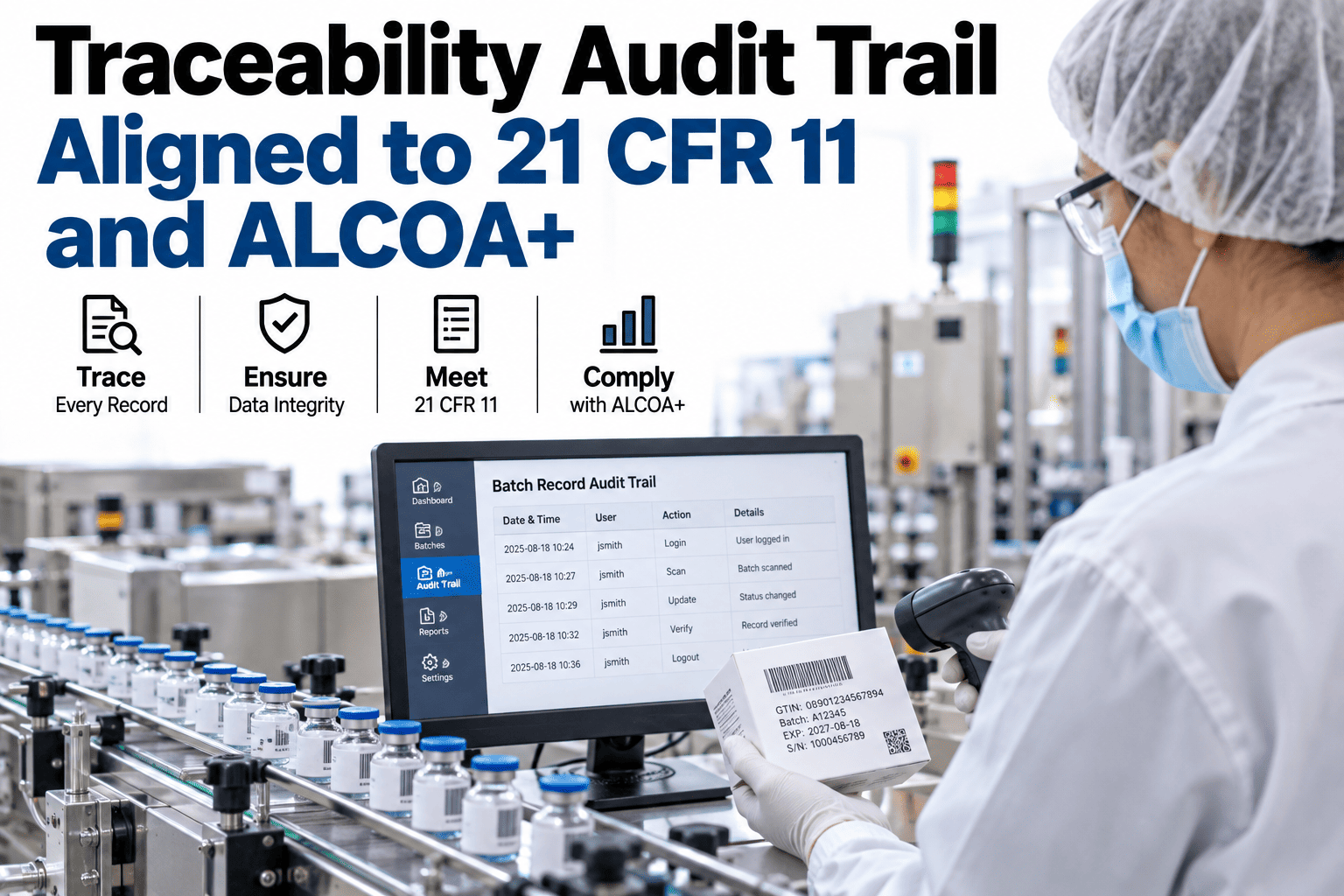
Part 11 sets FDA's rules for electronic records and signatures. For most US food plants, records kept only to meet the preventive controls rule are exempt from it. Records that another FDA rule also requires stay covered. Many plants choose Part 11-style controls anyway, because customers and auditors trust them. If you are unsure which applies, our team can help you think it through with your regulatory lead.
Usually exempt from Part 11
- CIP records kept only for your food safety plan under the preventive controls rule
- These still must meet the record rules in §117.305
May be covered by Part 11
- Records another FDA rule also requires you to keep
- Sites that make products under other FDA rules
- Customer contracts that ask for Part 11 controls
Part 11-style controls worth having either way
Named logins
Only authorised people can review, sign or change limits, each with their own login. Shared logins undo the whole point.
Every change kept
Secure, time-stamped records of who changed what and when, without hiding the original.
Name, time, meaning
Each signature shows who signed, when, and what it means, such as reviewed or approved.
Full, readable copies
Any record can be produced in full for an inspector, on screen or on paper, without special tools.
Validated software
Evidence the system records data accurately and works as intended, kept current after changes.
Software alone is not compliance
Part 11 also covers your procedures and training. No tool makes a site compliant by itself, whatever its sales sheet says.
From Cycle Records to Validation Evidence
Monitoring, verification and validation are three different questions.
Monitoring asks whether this cycle ran as designed. Verification asks whether this cycle actually cleaned. Validation asks whether the design itself works, every time, on your worst soil. Good cycle reports feed all three, as long as they are complete and trusted. Gaps in monitoring records weaken verification and validation too. To plan how your records support validation, book a validation planning call.
Did it run right?
Every cycle: time, temperature, flow and strength against recipe limits. This is what the automatic report does best.
Did it clean?
Routine checks such as ATP, swabs or rinse tests, recorded with the cycle they belong to.
Does the design work?
Evidence, built over many cycles and worst-case soils, that the recipe cleans reliably. Repeat it when equipment or recipes change.
Validation should cover your hardest cleaning job: the longest run, the stickiest product, the lowest flow circuit. Reports from those cycles are the most valuable ones you keep, so tag them clearly when they happen.
How iFactory Produces Every CIP Report
The cycle runs. The report follows. QA only looks at what needs a look.
iFactory reads each cycle from your CIP skids, splits it into phases, and checks every value against the limits in your validated recipe. It adds the verification result and the lots before and after, then sends the report for review. Passing reports get a quick sign-off. Flagged ones go to QA with the reason, and the follow-up is recorded on the same report. Questions on fit go to our support desk.
Capture
Phase-by-phase values read from the skid as the cycle runs.
Check
Each phase judged against your recipe limits. Exceptions flagged.
Assemble
Verification, lots and equipment details joined into one report.
Sign and keep
Reviewed, signed with meaning, and kept with a secure audit trail.
What QA sees each morning
- Overnight cycles, passed or flagged
- The reason behind every flag
- Reports waiting for a signature
- Any limit changes made since yesterday
What an auditor can ask for
- Every cycle on one circuit, for any month
- All failed or re-cleaned cycles
- The audit trail for a single report
- Allergen changeover cleans and their checks
Regulatory points on this page summarise US FDA rules as we understand them. They are not legal advice. Confirm what applies to your products and site with your regulatory lead.
Turnkey AI: Delivered, Connected and Live in 6–12 Weeks
You do not build this. It arrives ready.
iFactory ships as a pre-configured NVIDIA AI server, racked and ready, with the software pre-loaded. Rack it, plug in power and Ethernet, and the AI is live on your network.
Our team handles cabling, network setup, PLC and SCADA integration, operator training and 24×7 remote monitoring. The server sits inside your own network, so CIP and quality records stay on site. For a scope matched to your plant, request a turnkey quote.
Ship, network and data
Server installed. CIP skids, verification and production records connected. Recipe limits loaded.
Model training and pilot
Reports running on one circuit alongside your current records. QA reviews both and agrees the format.
Go-live and training
Reports live on all circuits. QA and sanitation staff trained. 24×7 remote monitoring begins.
Frequently Asked Questions
Do food plant CIP records need to meet 21 CFR Part 11?
Often not. Electronic records kept only to meet the US preventive controls rule are exempt from Part 11 under §117.305(g). Records that another FDA rule also requires remain covered. Check with your regulatory lead which applies to your site. Many plants choose Part 11-style controls anyway, because they make records easier to trust.
What should a CIP cycle report include?
The plant, circuit and equipment, date and time of each phase, actual flow, temperature and strength, pass or fail against recipe limits, the verification result, the lots before and after, and a review signature. If a phase was outside its limits, the report should also show what was done about it.
Is a CIP report the same as validation?
No. A report shows one cycle ran as designed and cleaned. Validation shows the recipe works reliably, including on your worst soils. Many good reports, gathered over time, are part of the evidence for validation, alongside worst-case trials.
Can automatic reports replace paper chart recorders?
Sometimes, but check first. Some product rules, such as those for Grade A dairy, have their own expectations for recording. Run the electronic reports alongside your current records until your regulator or auditor accepts them, and keep that agreement on file.
What is a tamper-evident CIP log?
One where any change after the fact is recorded, with who made it, when and why, and the original value stays visible. It does not stop corrections. It makes every correction plain to see, which is exactly what an auditor wants.
How long should we keep CIP records?
The preventive controls rule asks for at least two years. Customer standards, other rules or your own policy may ask for longer. Set the period once, in the system, so nothing is lost early and nothing is kept by accident for ever.
Does iFactory make our site Part 11 compliant?
No software can do that alone. iFactory provides the technical controls, such as named logins, audit trails, signatures with meaning and full copies on screen or paper. Your procedures and training complete the picture. To talk through your set-up, contact our team.
Be Ready for the Next CIP Audit
In thirty minutes we look at how your CIP records are kept today, compare them with what a strong report holds, and show a sample built from data like yours. You keep the notes whether or not you go further with iFactory.
- 1A sample of current CIP records
- 2Your validated recipes and limits
- 3How verification results are kept
- 4Recent audit findings on records
- 5Any customer record requirements