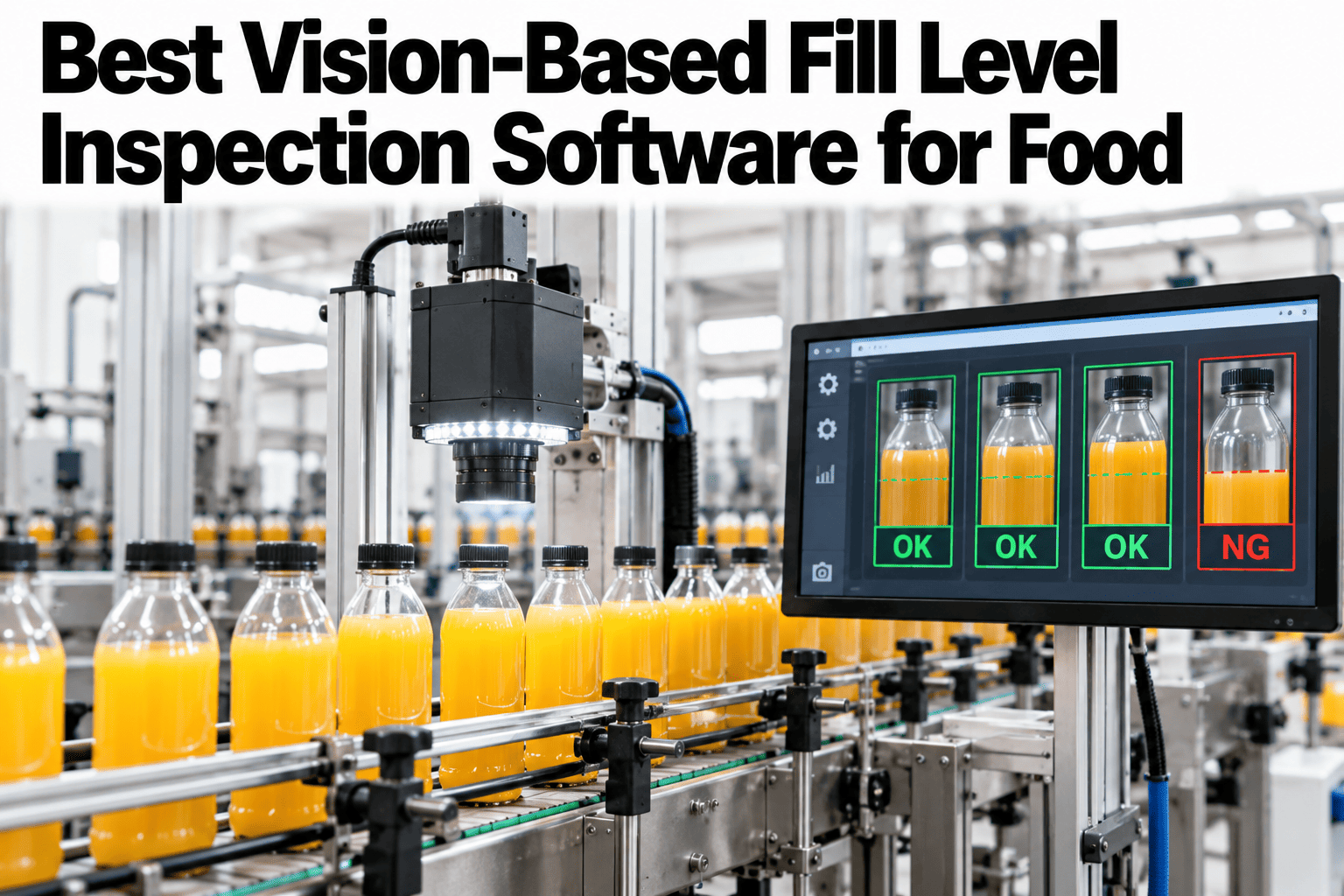
A bottle can look full and still be short, because a squeezed wall or a dented can changes the volume inside without changing the level much. Fill inspection that ignores package shape misses these cases. Food plants can see fill level and container shape checked in the same frame with iFactory AI.
Check the Level and the Container Together
iFactory AI vision reads fill level against the container itself, so dented, squeezed and leaning packs are caught, not passed.
What “Best” Should Mean for a Fill Level System
The best system is not the one with the longest feature list. It is the one that proves net content, protects margin and does not send good product to the reject bin. This guide gives you the criteria to judge any platform fairly.
Protect the customer
Packs must carry the amount the label promises, every time and not only on average.
Protect the margin
Overfill is free product given away, thousands of times a shift on a fast line.
Protect the brand
Shoppers notice half-empty looking packs, dented cans and leaning bottles.
Protect the audit
Every reject and every pass has an image and a time stamp behind it.
The Rule Behind the Label
In the United States, the National Institute of Standards and Technology publishes the method that weights and measures officials use to check packaged goods. Its public FAQ gives the idea in plain terms. Rules in other countries differ, so check your own markets.
Which Technology Fits Which Container
No single method suits every pack. Honest buyers compare technologies by container and product, then use more than one when it makes sense.
| Technology | How it reads fill | Fits best | Limits to know |
|---|---|---|---|
| Machine vision, backlit | Camera sees the liquid level through the wall | Clear or translucent bottles and jars at speed | Needs a see-through wall and clean optics |
| Machine vision, reflected light | Camera reads a surface, a headspace or a fill mark | Open containers, trays and some opaque packs | Glare, product color and texture matter |
| X-ray | Beam shows level through metal or thick walls | Cans and other opaque containers | Higher cost, shielding and safety controls |
| Checkweigher | Scale reads gross or net weight | Any pack in which weight tracks content | Does not see level, cap or label defects |
| Capacitive or ultrasonic sensors | Sensor reads a level signal near the container | Simple level checks on set shapes | Sensitive to foam, shape and position changes |
A Quick Container Guide
Backlit vision is a strong first choice, and it can check caps and labels at the same station.
Look at X-ray for level, and a scale for net weight, with vision for seams and codes.
Weight and seal vision usually work together, since level in a flexible pack means little.
The Package Deformation Problem
A label promises a volume, but most systems read a height. Height turns into volume only if the container keeps its shape. When the shape changes, the same level can hide a different amount of product.
Squeezed PET wall
A pressed bottle can sit at the right level and hold less, or rise high and hold the same.
Dented can or tin
Dents cut internal volume and may also hint at a damaged seam.
Hot-fill panel pull-in
Vacuum panels move as product cools, which changes the headspace and the apparent level.
Bulging pack
Pressure caused by carbonation or spoilage pushes walls outward and lifts the level.
Leaning container
A tilted bottle makes a flat level look sloped and shifts the reading.
Pouch slump
Flexible packs change shape on the belt, so a simple height says very little.
How Vision Can Read Level Against the Container
The fix is to measure level against the container, not against a fixed pixel on the screen. Five steps show the pattern.
Locate the container edges and key features, such as neck finish, shoulder and base.
Measure level relative to those features, so a pack shifted or tilted on the belt reads correctly.
Compare the outline with the good-pack model, and flag dents, bulges and lean.
Use the container's measured geometry to turn level into an estimated volume for each SKU.
Reject under, over and deformed packs for separate reasons, each with its own image.
Compare with scale data, so the vision model is tested against real net weight.
Foam, Glare and Other Reading Traps
See Fill Level and Shape Checked Together
Book a 30-minute session and iFactory AI will walk through level, deformation and cap checks on your own containers and products.
Why Fill Levels Drift in the First Place
Inspection catches the result, but a good program also looks at causes. Most drift traces back to a short list of filler and product conditions.
Filler valve wear
Worn seals and springs change flow and cut-off, and one head starts to drift to its own level.
Product temperature
Warm product is thinner and expands, so the same dose reaches a different level.
Supply pressure and level
A falling tank or a pressure swing changes flow to every head at once.
Line speed changes
Ramp-ups and slow-downs after jams change fill time and splash.
Container variation
Bottles made in different molds or by different suppliers hold slightly different volumes at the same level.
Gas and foam
Dissolved gas and trapped air produce foam that lifts the apparent level.
Stop SKU Changes Breaking the Model
Food plants change products often, and every change is a chance for a vision model to go wrong. A little discipline avoids most of it.
Pair Vision With the Scale
Vision and weighing answer different questions. Used together, they check each other and cover each other's blind spots.
| Question | Vision answers | Scale answers |
|---|---|---|
| Is the level right? | Yes, for visible containers | Indirectly, through weight |
| Is the net weight right? | Only as an estimate | Yes, directly |
| Is the container damaged? | Yes, using the outline and surface | No |
| Is the cap or seal right? | Yes | No |
| Is the label or code right? | Yes | No |
| Which filler head is drifting? | Yes, if packs are tracked by head | Yes, if packs are tracked by head |
Who Does What on the Line
Line Operator
Watches the reject count, clears jams and reports odd patterns early.
Quality Engineer
Owns tolerances, test sets and the false reject target.
Maintenance Planner
Acts on filler-head trends before they become stoppages.
Automation Lead
Keeps cameras, lights, timing and the reject gate in range.
Production Manager
Sets the giveaway target and reviews the spread each week.
Regulatory Lead
Confirms net content rules and signs off on tolerances.
A Simple Calibration Routine
Start each shift with a known good pack, a known low pack and a known high pack, and confirm that the system calls all three correctly. Wipe the lens, check the light level and log the result. Repeat after any jam, camera knock or SKU change. This five-minute habit catches most drift before it ships, and it gives auditors a dated record that the inspection itself was in control.
Your Buyer Scorecard
Ask these questions in every demo, and ask for a live answer on your own packs. Teams can ask support for a one-page version of this scorecard to take into reviews.
| Criterion | Why it matters | Ask the vendor |
|---|---|---|
| Level against a container reference | Tilted or shifted packs must not cause false reads | How is level measured relative to the pack? |
| Deformation detection | Dents and bulges change volume and signal damage | Is shape checked, and logged as its own reason? |
| Per-SKU setup effort | Changeovers are frequent in food plants | How many sample packs and how much time per new SKU? |
| Speed proof | Claims must hold at your line speed | Can we test at full speed with seeded defects? |
| Scale and filler link | Cross-checks catch drift early | Can scale and filler-head data sit in the same view? |
| Image and reject history | Audits and root-cause work need evidence | Is every reject stored with image, reason and time? |
| Self-checks and drift alerts | Dirty lenses and moved cameras must not pass product | What happens when image quality falls? |
| False reject control | Good product in the bin costs real money | How is the false reject rate measured and tuned? |
Demo Day Checklist
Prove It at Speed Before You Buy
Demo videos show the best case. A short validation on your line shows the real one. Use the same steps for every supplier you test.
Build a test set
Collect packs with known fill, known weight and known damage, and label each one.
Run at line speed
Feed the test set in random order at full speed, with good packs mixed in.
Score the result
Count caught defects, missed defects and false rejects, split by defect type.
Stress the edges
Repeat with foam, wet packs, tilted packs and a changed light level.
What the Giveaway Really Costs
Tight fill control pays back because overfill is invisible in the cost report. Finance teams can book a session to model giveaway on a real line.
Measures to Track Every Week
| Measure | What it shows | Owner | Review rhythm |
|---|---|---|---|
| Average and spread of fill | Giveaway and risk of short packs | Quality manager | Daily |
| Rejects by reason | Under, over, deformed, cap and label split out | Line supervisor | Daily |
| Rejects by filler head | Which head is drifting | Maintenance planner | Weekly |
| False reject rate | Good product removed by mistake | Quality engineer | Weekly |
| Vision against scale agreement | Whether the model still matches real weight | Quality engineer | Weekly |
| System health checks passed | Lens, light and timing stay in range | Automation lead | Daily |
How iFactory AI Fits
iFactory AI vision reads fill level and package condition at the line. Models run on an on-site server, rejects are logged with image, reason and time, and results link to filler-head and shift trends. It works with existing PLCs, scales and quality systems. Scope, container fit and timing are confirmed in a line trial.
Level Against Container
Read the fill relative to the pack, not a fixed spot.
Shape and Damage Checks
Flag dents, bulges and lean as separate reasons.
Cap, Label and Code
Check closure and print in the same pass.
Reject Evidence
Store an image with every reject and every hold.
Filler-Head Trends
See which head or shift drives the drift.
Self-Checks
Hold product when image quality or timing moves out of range.
A 90-Day Starting Plan
Pick the line
Choose one line, list its SKUs and containers and set the fill and shape tolerances.
Install and learn
Mount cameras and lights, collect packs and run shadow mode against the scale.
Tune and prove
Set thresholds, test seeded defects at speed and measure the false reject rate.
Go live and widen
Turn on auto reject, review weekly and plan the next line.
Frequently Asked Questions
Is vision better than X-ray for fill level?
It depends on the container. Vision suits clear or translucent packs and can check caps and labels at the same station. X-ray suits cans and thick-walled or opaque containers. Many plants use both on different lines, so judge each by container, product, speed and cost.
Can vision tell if a pack is short when it is dented?
It can flag the dent and estimate volume using the pack's measured shape, but a scale remains the direct check on net weight. Use both for a stronger answer. Book a session to see shape and level checked together on a dented pack.
How long does it take to add a new SKU?
It depends on how different the container and product are. Expect to collect a set of labeled sample packs, train or tune the model, and run a short shadow check before auto reject. Ask each vendor for a time estimate per SKU and test it on one of your own.
What if our product foams?
Foam is a common trap. Options include a settling stretch before the camera, a different inspection point, special lighting and combined rule-based and AI checks. Test on your real product at line speed. Support can help plan a foam trial before you commit.
Does this replace our checkweigher?
No. A checkweigher gives direct net weight, while vision sees level, shape, caps and labels. Together they cross-check each other and explain rejects better. Keep the scale for packs with a weight-based label, and add vision when visible defects or deformation drive complaints.
Stop Guessing What Is Inside the Pack
iFactory AI vision gives food lines a fast, recorded check on level and container condition. Book a walkthrough on your own packs.