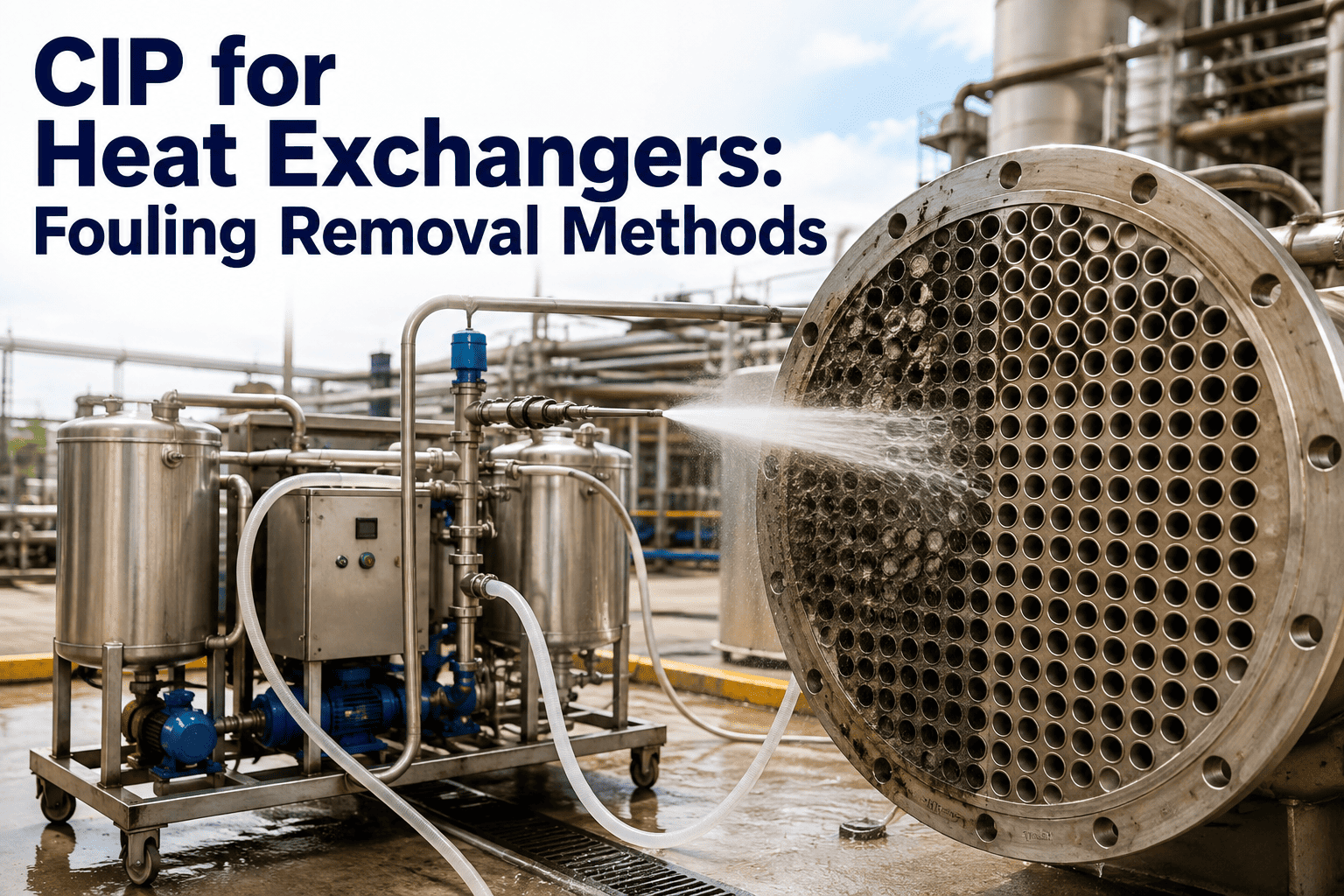
Heat exchangers lose efficiency long before anyone notices a cleaning problem, because fouling builds up gradually on the internal surfaces where the product contacts the plates or tubes, quietly forcing the system to run hotter, longer, or with more pumping pressure just to hit the same thermal target. By the time a plant operator flags a heat exchanger as underperforming, the fouling layer is often thick enough that a standard CIP cycle can no longer fully remove it, and the unit needs a more aggressive intervention or physical disassembly to recover. Catching fouling early, and matching your CIP protocol to the specific exchanger design and product, is what keeps a heat exchanger running at rated efficiency instead of slowly drifting toward a costly manual clean, and a free CIP protocol review is a good place to start if your exchangers haven't been re-evaluated recently.
Food & Beverage · Heat Exchanger CIP
CIP for Heat Exchangers: Removing Fouling Before It Costs You Efficiency
Plate and tubular heat exchangers foul differently and need different CIP protocols. Here's how to match your cleaning cycle to the equipment and the product.
Plate vs Tubular: Different Geometry, Different Fouling Behavior
Plate heat exchangers and tubular heat exchangers foul in fundamentally different patterns because their internal geometry channels flow differently, and a CIP protocol tuned for one will often underperform on the other if applied without adjustment.
Plate Heat Exchangers
Narrow channels foul faster and more unevenly
Corrugated plate pattern creates turbulence that helps CIP penetration
Gaskets are the most common weak point for cleaning bypass
Easier to disassemble for physical inspection when needed
Tubular Heat Exchangers
Larger internal diameter tends to foul more slowly
Laminar flow zones near tube walls resist cleaning turbulence
Tube-to-tubesheet joints are the most common bypass risk
Harder to inspect internally without specialized tools
Fouling Types and What Drives Them
Protein Fouling
Common in dairy and beverage products with protein content, protein denatures and adheres to hot surfaces, forming a layer that thickens with every production run if not fully removed each cycle.
Mineral Scale
Hard water and certain product formulations deposit mineral scale on heat transfer surfaces, requiring an acid cycle in addition to the standard alkaline wash to fully dissolve.
Fat and Oil Fouling
High-fat products leave residue that resists standard alkaline detergent unless temperature and concentration are high enough to fully emulsify and remove it from the surface.
Burnt-On Residue
Overheating during processing can bake residue onto the surface, creating a layer that standard CIP cycles cannot remove and that often requires manual intervention.
How Much Efficiency Is Fouling Already Costing You?
Our team can review your exchanger's thermal performance trend against its cleaning schedule, at no cost.
Setting the Right CIP Frequency
CIP frequency for heat exchangers should be driven by product type and observed fouling rate, not a single fixed schedule copied across every unit in the plant. A high-fat dairy product run continuously may need a full CIP cycle every eight hours, while a lower-fouling beverage product might safely run twice as long between cleanings, and the only reliable way to set the right interval is to track thermal performance over time and clean based on when efficiency actually starts to drop.
| Product Category | Typical Fouling Rate | Suggested CIP Interval | Cycle Type Needed |
|---|
| High-fat dairy (cream, cheese) | Fast | Every 6-8 hours | Alkaline + acid rinse |
| Milk and standard dairy | Moderate | Every 10-14 hours | Alkaline wash |
| Juice and beverage | Slow to moderate | Every 16-20 hours | Alkaline wash |
| High-mineral water applications | Moderate (scale) | Weekly acid pass | Acid descale cycle |
Verifying the Clean Actually Worked
Because heat exchanger interiors are not visually accessible during normal operation, verification has to rely on indirect signals rather than a simple visual check the way a tank or open surface might be inspected. Thermal performance monitoring is the most reliable ongoing signal — if the outlet temperature for a given flow rate and inlet condition starts drifting from its baseline, fouling is very likely building up faster than the current CIP schedule is removing it, even if every individual cycle appears to complete normally on paper.
1
Baseline the exchanger when new or freshly cleaned, recording outlet temperature at a known flow rate and inlet condition.
2
Track pressure drop across the exchanger, since rising differential pressure at a constant flow rate is a strong fouling indicator.
3
Compare post-CIP performance to baseline after every cleaning cycle to confirm the exchanger is returning close to its original efficiency.
4
Schedule periodic disassembly for plate units specifically, since visual inspection remains the only way to catch gasket-related bypass.
When to Escalate Beyond Standard CIP
If thermal performance doesn't recover to baseline after several consecutive CIP cycles, continuing to run the same cycle is unlikely to fix the problem and typically means the fouling layer has crossed a threshold where chemical circulation alone can no longer reach or dissolve it. At that point, plate exchangers usually need physical disassembly and manual cleaning of individual plates, while tubular units may need a more aggressive descaling chemistry pass or mechanical tube cleaning. Catching this transition early, before the exchanger has fouled to the point of needing full disassembly, is almost always cheaper than the alternative in both downtime and labor.
Frequently Asked Questions
How do we know if our heat exchanger needs an acid cycle in addition to alkaline?
If your water supply has moderate to high hardness, or your product formulation includes minerals that can precipitate on hot surfaces, a periodic acid descale cycle is usually necessary in addition to the standard alkaline wash. A drifting thermal performance trend that alkaline-only cycles fail to fully correct is a strong signal that mineral scale, not organic soil, is the remaining fouling layer.
Why is our plate heat exchanger still fouling even though the CIP cycle completes without any alarms?
A cycle completing without alarms only confirms that flow, temperature, and time parameters were met — it doesn't guarantee every channel between every plate received adequate solution contact. Gasket wear, channel blockage from partial fouling, or uneven flow distribution across plates can all leave localized areas undercleaned even while the overall cycle looks normal on the control system.
How often should plate exchangers be physically disassembled for inspection?
This depends heavily on product and fouling rate, but many high-fouling dairy applications schedule a physical disassembly and plate-by-plate inspection on a quarterly basis, while lower-fouling applications may extend that to twice a year. Thermal performance trending is the best guide for adjusting this interval up or down based on your actual equipment.
Can tubular heat exchangers be cleaned entirely through CIP without ever opening them up?
Many tubular exchangers run for extended periods on CIP alone, but periodic physical inspection is still recommended to catch tube-to-tubesheet joint issues and confirm the CIP program is reaching every tube evenly, since flow distribution across a tube bundle can become uneven over time in ways that aren't always visible in aggregate thermal data.
What's the fastest way to tell if our current CIP schedule for a specific exchanger needs adjusting?
Tracking outlet temperature and pressure drop over time against a known baseline is the most reliable indicator, and a consistent downward trend in thermal recovery after each cycle usually means the interval needs shortening or the chemistry needs revisiting. Book a
free consultation to review your exchanger's performance data with our team.
Don't Let Fouling Quietly Erode Your Thermal Efficiency
Our team can help you build a CIP schedule matched to your specific exchangers and products, at no cost.