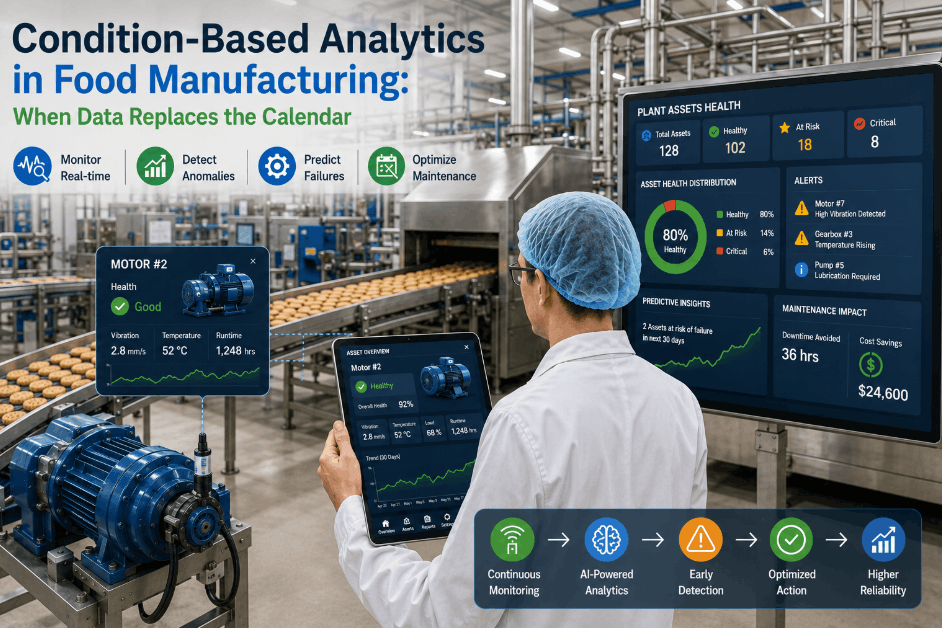
Condition-based analytics in food manufacturing is fundamentally reshaping how reliability engineers approach equipment maintenance across processing lines. For decades, food plants have operated on calendar-based preventive maintenance schedules — changing oils every 90 days, inspecting bearings every quarter, and performing vibration checks on fixed intervals regardless of actual equipment condition. This rigid approach wastes labor, misses developing failures, and creates compliance blind spots that no spreadsheet can resolve. Today, AI-driven condition monitoring for food equipment replaces the calendar with continuous, sensor-driven intelligence — so that every maintenance decision is grounded in real operational data, not elapsed time. Reliability engineers who book a demo with iFactory are finding that condition-based maintenance programs consistently outperform traditional PM schedules on every metric: cost, uptime, and food safety compliance.
Replace Calendar-Based PM with Real-Time Equipment Intelligence
iFactory's platform delivers vibration analysis, thermography, oil analysis, and ultrasonic testing analytics purpose-built for food manufacturing reliability engineers focused on uptime, compliance, and cost reduction.
Why Calendar-Based Maintenance Is Failing Food Manufacturing Plants
Calendar-based preventive maintenance was designed for a simpler era — when production volumes were predictable and equipment ran at fixed loads. Modern food manufacturing is none of these things. Seasonal demand swings and continuous production pressures mean a conveyor motor running double shifts in October is nowhere near the same condition as one running light duty in February — yet both receive identical maintenance intervals. Over-maintained assets waste labor; under-maintained ones fail between PM windows, creating contamination risk, HACCP traceability gaps, and recall exposure that dwarfs the repair cost. Reliability-centered maintenance programs that shift to condition-based analytics close this gap by tying every intervention to measured equipment health, not elapsed calendar time.
The Four Pillars of Condition-Based Monitoring in Food Processing
Effective condition-based maintenance for food manufacturing relies on four analytically distinct monitoring technologies, each targeting different failure modes across different equipment classes. Understanding which pillar applies to which asset class is the foundation of a structured CBM deployment — reliability engineers who schedule a strategy session with iFactory typically discover that two or three of these techniques are already partially deployed in their facilities, but siloed and disconnected from a unified analytics layer.
Vibration Analysis for Food Equipment
Continuous accelerometer monitoring on conveyor drives, mixers, pumps, and compressors detects imbalance, misalignment, and bearing defect frequencies weeks before failure. In food plants where washdown and temperature cycling accelerate wear, a single undetected bearing failure can halt an entire line for 6–12 hours. AI-driven analytics establish asset-specific baselines and alert only on genuine deviations — eliminating false alarms and missed faults simultaneously.
Rotating Equipment · Bearings · Drive Systems · PumpsInfrared Thermography in Food Plants
Fixed infrared sensors detect hot spots in motor control panels, VFDs, switchgear, and bus connections — faults that cause fires or shutdowns with zero mechanical warning. In food processing, thermography extends to heat exchangers and pasteurizers, where uneven heat distribution signals fouling or element failure long before a temperature alarm triggers. Continuous monitoring replaces annual camera surveys with real-time, facility-wide thermal visibility.
Electrical Panels · Heat Exchangers · Pasteurizers · OvensOil Analysis in Food Plant Gearboxes and Compressors
Oil sampling reveals wear metal concentrations, viscosity degradation, and contamination levels — each a leading indicator of a specific failure mode. Rising iron particles in a gearbox sample signals gear tooth wear; elevated copper in a compressor sample points to bearing cage degradation. Unlike vibration, oil analysis detects subsurface fatigue failures before any mechanical signature appears. For food-grade lubricants, it also provides the documented contamination traceability that food safety compliance requires.
Gearboxes · Compressors · Hydraulics · Food-Grade LubricantsUltrasonic Testing in Food Manufacturing
Airborne ultrasound detects compressed air leaks, steam trap failures, and valve seat leakage below the audible threshold of a running plant. Structure-borne ultrasonic monitoring also captures early bearing lubrication starvation before the fault appears in the vibration spectrum. Ultrasonic leak surveys in food plants routinely identify 15–25% compressed air waste — savings that frequently cover the entire CBM sensor deployment cost.
Compressed Air · Steam Traps · Early Bearing Faults · Valve SeatsMapping CBM Techniques to Critical Food Processing Equipment Classes
Not every condition monitoring technique is equally applicable to every asset. Deploying CBM effectively in a food manufacturing environment requires matching the right technology to the right failure mode on the right asset class. The matrix below represents the prioritization framework that iFactory uses with reliability engineers during CBM program scoping — plant engineers considering a data-driven analytics transition regularly book a demo to map this framework against their specific equipment inventory before committing to sensor deployments.
| Equipment Class | Vibration Analysis | Thermography | Oil Analysis | Ultrasonic | Primary Failure Mode Detected |
|---|---|---|---|---|---|
| Conveyor Drive Motors | Primary | Secondary | — | Secondary | Bearing defect, imbalance, misalignment |
| Mixer Gearboxes | Primary | — | Primary | Secondary | Gear tooth wear, oil degradation, bearing fatigue |
| Refrigeration Compressors | Primary | Secondary | Primary | Secondary | Valve wear, liquid slugging, oil migration |
| Pasteurizer Heat Exchangers | — | Primary | — | Secondary | Fouling, scaling, thermal channel blockage |
| Packaging Line Pneumatics | — | — | — | Primary | Compressed air leakage, valve seat wear |
| MCC / Electrical Switchgear | — | Primary | — | Secondary | Loose connections, overloaded circuits, insulation fault |
| Centrifugal Pumps | Primary | Secondary | — | Secondary | Cavitation, impeller wear, seal degradation |
| Industrial Fans & Blowers | Primary | Secondary | — | — | Blade imbalance, bearing wear, housing resonance |
Building a Data-Driven CBM Program: The iFactory Implementation Roadmap
Transitioning from calendar-based maintenance to a condition-based analytics program in a food manufacturing environment is not a single-step technology deployment — it is a structured program development process that moves through four phases over a 6–12 month implementation horizon. Each phase builds analytical capability on top of operational data, progressively replacing schedule-driven decisions with condition-triggered ones.
Asset Criticality Ranking and Sensor Baseline
Rank equipment by failure consequence on throughput, food safety, and maintenance cost. Deploy continuous sensors — accelerometers, thermal probes, oil sample ports — on the highest-criticality assets first. A 4–8 week data collection period establishes machine-specific baselines that the AI models use as the reference state for all future deviation detection.
Fault Pattern Library Development and Alert Calibration
AI pattern matching begins against known fault signatures for food processing equipment — bearing defect frequencies, gear mesh harmonics, and thermal envelopes. Alert thresholds are calibrated to each asset's individual baseline, not fixed industry standards. This eliminates the chronic false alarm problem that causes teams to disable alert systems, and reliably surfaces early-stage degradation that calendar PM would miss entirely.
Work Order Integration and Condition-Triggered PM Execution
iFactory integrates with SAP PM, Maximo, or equivalent CMMS to auto-generate condition-triggered work orders when asset health metrics cross action thresholds. Planners receive fault-type context, remaining useful life estimates, and recommended intervention type — enabling repair scheduling into planned production windows rather than emergency breakdowns. For food plants that book a consultation with active CMMS systems in place, this integration typically completes within 2–3 weeks.
Continuous Model Refinement and Reliability KPI Reporting
A mature CBM program is a learning system — every confirmed fault detection improves the AI model's predictive accuracy for that asset class and failure mode. Phase 4 establishes the closed-loop feedback mechanism: every completed work order feeds actual failure findings back into the model, refining the fault signature library over time. Monthly reliability KPI dashboards track Mean Time Between Failures (MTBF), planned vs unplanned maintenance ratio, and PM labor hours per production unit — giving plant management the data-driven evidence needed to benchmark CBM program ROI against legacy calendar-based costs. For reliability engineers building internal business cases, this reporting layer converts technical performance gains into the financial language that operations and finance leadership require to sustain program investment.
CBM and Food Safety Compliance: The HACCP Dimension of Predictive Maintenance
Condition-based maintenance in food manufacturing is not only an operational efficiency program — it is a food safety risk management strategy. HACCP plans require documented control of critical equipment conditions at defined critical control points. Calendar-based maintenance creates inherent HACCP compliance gaps: if a pasteurizer heat exchanger begins fouling between quarterly cleaning visits, the thermal performance deviation that represents a food safety risk goes undetected and undocumented until the next scheduled inspection. AI-driven condition monitoring addresses this gap at the system level — continuous thermography on heat exchangers and pasteurizers provides a real-time, auditable record of thermal performance that demonstrates HACCP control far more rigorously than interval-based manual checks.
Continuous Temperature Monitoring
Automated thermal data logging creates an immutable HACCP temperature record for every production hour, eliminating the manual log sheet gaps that account for the majority of food safety audit findings related to equipment condition monitoring.
Predictive Deviation Alerting
Rather than alarming after a critical limit has been breached, AI trend analytics identify equipment performance trajectories heading toward HACCP critical limits — providing 15–45 minutes of intervention time before a food safety deviation occurs.
Corrective Action Documentation
Every condition-triggered maintenance event automatically generates a digital corrective action record linked to the HACCP control point, creating the documented evidence trail that regulators and third-party auditors require during BRCGS, SQF, and IFS certification audits.
Lubricant Contamination Traceability
Oil analysis records for food-grade lubricant applications provide documented evidence that lubricant condition and identity were continuously monitored — a specific requirement in NSF H1 food-grade lubricant compliance programs that calendar-based oil change schedules cannot satisfy.
The Financial Case: Quantifying ROI from Condition-Based Analytics in Food Plants
The economic argument for condition-based analytics in food manufacturing is grounded in four measurable value streams that compound over time. Reliability engineers building internal capital justification cases for CBM program investment regularly find that the financial model is dominated by avoided catastrophic failures — single events whose cost frequently exceeds the annual platform cost — supplemented by cumulative gains in labor efficiency, energy reduction, and compliance risk avoidance. Teams finalizing ROI projections who want a facility-specific analysis are encouraged to schedule a session with iFactory's engineering team before finalizing their business case.
Condition-triggered interventions prevent catastrophic failures that cause multi-shift production stops, eliminating the highest single cost driver in most food plant maintenance budgets.
Eliminating unnecessary scheduled interventions on healthy assets concentrates maintenance labor on confirmed degradation, reducing total PM labor hours per production unit.
Ultrasonic leak detection surveys identify compressed air losses that are invisible to production teams, with identified savings frequently funding the entire CBM sensor deployment.
Combined savings from avoided failures, labor efficiency gains, and energy reduction deliver complete platform investment payback within a single production season for most food facilities.
Condition-Based Analytics in Food Manufacturing — Frequently Asked Questions
How does continuous vibration monitoring differ from periodic route-based vibration analysis?
Periodic route-based vibration measurements provide a snapshot of equipment condition at the moment of measurement — typically every 30 to 90 days. Continuous monitoring captures the full time history of vibration behavior, including transient fault events that occur between route visits and gradual trend changes that only become visible over weeks of continuous data. For food processing equipment running multiple shifts, continuous monitoring also correlates vibration signatures with production load conditions, identifying faults that only manifest under specific operating states.
Can CBM analytics integrate with existing CMMS systems like SAP PM or Maximo?
Yes. iFactory's platform is designed for direct CMMS integration via standard API connections to SAP PM, IBM Maximo, and equivalent systems. Condition-triggered alerts automatically generate work order requests in the existing CMMS workflow, complete with fault type classification, asset health context, and recommended intervention type — eliminating the manual translation step between condition monitoring alert and maintenance planning action.
What is the minimum sensor infrastructure needed to start a CBM program in a food plant?
Most food plants already have partial sensor infrastructure — motor current monitoring in MCCs, process temperature sensors, and some vibration data from existing PLCs. A typical initial CBM deployment adds targeted sensors at bearing housings on the 10–15 most critical rotating assets, supplemented by thermal sensors on high-value electrical panels and gearboxes. The total hardware investment for an initial CBM scope is typically far lower than reliability engineers expect when they begin the assessment process.
How does AI-driven CBM handle the noisy, wet environment typical of food processing?
iFactory's AI models are specifically trained on food processing equipment data, which means they account for the ambient noise, temperature variation, and production-state changes that cause generic vibration analysis systems to generate chronic false alarms in food plant environments. Sensors deployed in washdown zones use IP69K-rated enclosures, and the analytics models apply adaptive filtering that distinguishes between background noise changes and genuine equipment degradation signals.
How long does it take to establish a reliable condition baseline for a food processing asset?
Baseline establishment for most rotating equipment takes 4–8 weeks of continuous data collection under normal production conditions. The AI platform accelerates this process by referencing equipment class templates for common food processing asset types, allowing preliminary fault detection to begin within days of sensor deployment while the full machine-specific model continues to develop in the background.
Does condition-based maintenance require additional full-time reliability staff to operate?
No. iFactory's platform is designed to reduce the cognitive burden on existing reliability staff, not add to it. The AI analytics layer handles continuous data processing, baseline comparison, and fault classification autonomously. Maintenance engineers interact with a prioritized alert dashboard and condition summary reports rather than raw sensor data — shifting their role from manual data collection to data-informed decision making, typically within their existing staffing structure.
Ready to Replace Your Maintenance Calendar with Real Equipment Intelligence?
iFactory's condition-based analytics platform gives food manufacturing reliability engineers the continuous equipment health visibility needed to eliminate unplanned downtime, reduce maintenance costs, and build audit-ready compliance records — all from a single mobile-accessible dashboard.