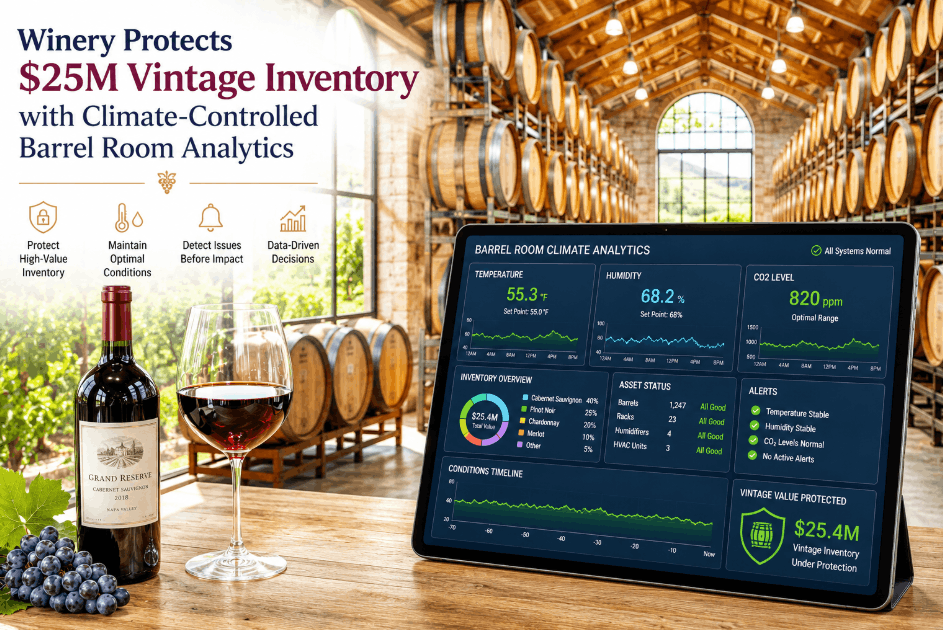
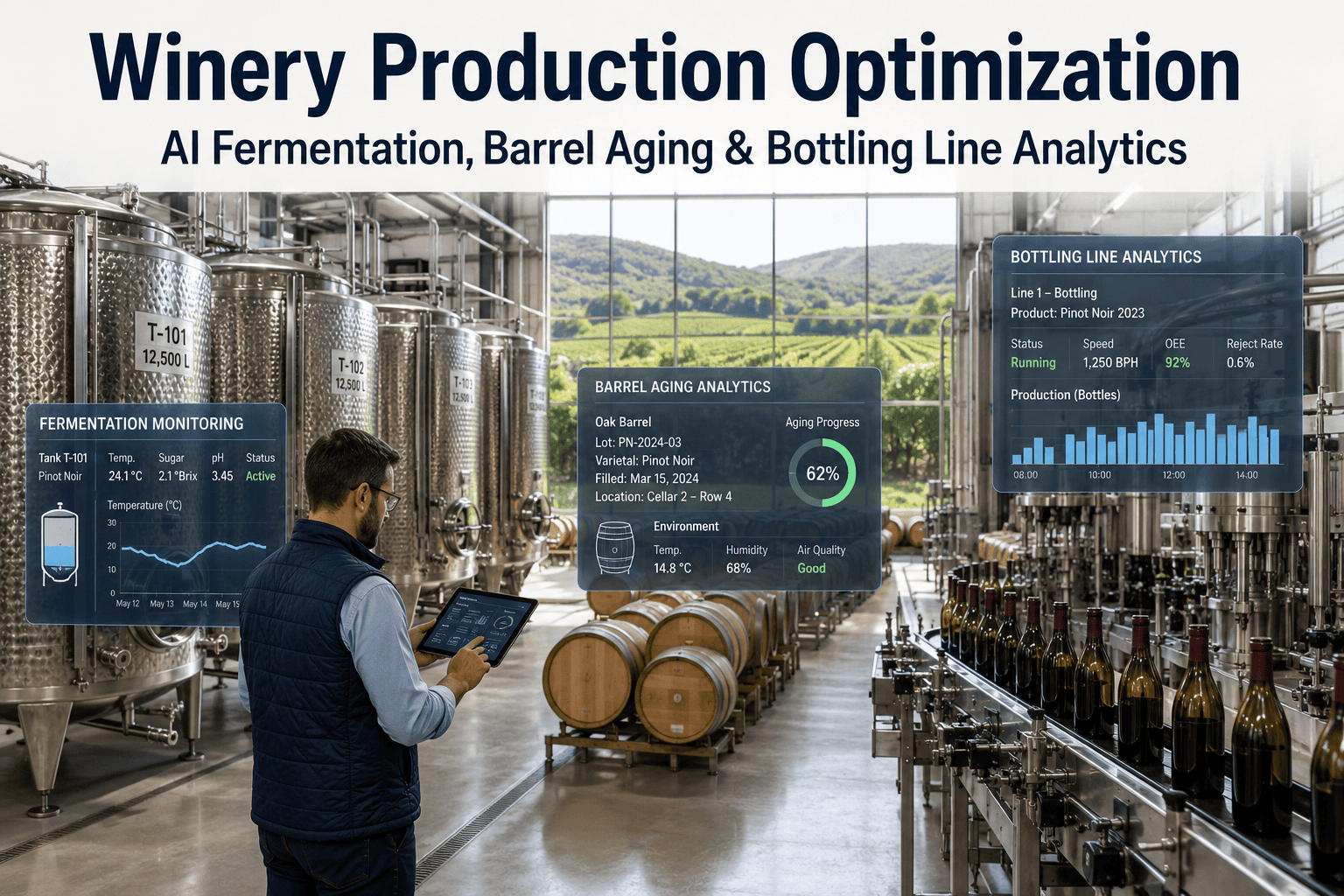
A ultra-premium estate winery producing over 180,000 cases of vintage-grade cabernet and chardonnay annually faced a critical operational crisis: a lack of real-time visibility into subterranean barrel room microclimates was driving excessive "angel's share" evaporative loss, while reactive maintenance on aging chiller plants threatened the thermal stability of $25 million in aging inventory. In the high-stakes world of premium viticulture, even a 0.5°C drift in cellar temperature or a 5% drop in relative humidity can trigger irreversible oxidation pathways or stave contraction that compromises barrel integrity. Furthermore, the winery's high-speed automated bottling and labeling lines were suffering from chronic micro-stoppages that eroded OEE during peak release windows. By deploying ifactory's AI-driven IoT sensor integration and preventive analytics platform, the facility achieved 98% climate stability across all aging cellars, reduced evaporative product loss by 30%, and recovered $245,000 in annual operational value while ensuring 100% audit-ready sanitation compliance.
PREVENTIVE MAINTENANCE & CLIMATE ANALYTICS · PREMIUM WINERY
Is Your Vintage Inventory Protected by Reactive Maintenance?
Deploy ifactory's AI-driven IoT sensor mesh to monitor barrel room microclimates, chiller plant health, and bottling line performance in real time. Built specifically for high-value beverage production and aging environments where precision is the only path to quality.
98%
Cellar Climate Stability Achieved
−30%
Reduction in Angel's Share Loss
$245K
Net Annual Operational Savings
60
Days to Full Facility Deployment
01 / The Facility
A High-Volume Premium Estate, A Mounting Infrastructure Reliability Crisis
Facility TypeIntegrated premium estate winery, bottling facility, and aging cellar. Three subterranean barrel rooms (45,000 sq ft total), a centralized industrial chiller plant with four redundant compressors, and a 60-bottle-per-minute automated bottling, corking, and labeling line.
Scale180,000 cases annually across 60+ premium SKUs. Current inventory valuation of $25 million across approximately 8,000 French and American oak barrels. Distribution channels include global luxury retail, Michelin-starred foodservice, and an active direct-to-consumer club program.
Maintenance Team12-person maintenance and cellar operations team. Previously operating under a 100% reactive maintenance model. No dedicated predictive analytics or condition-based monitoring. Equipment service based on fixed manufacturer calendar intervals regardless of actual load or wear.
Downtime Pre-DeploymentAverage 14.5 unplanned downtime hours per month on the primary bottling line. Chiller plant "blind spots" resulting in 3 major thermal drift events annually, each risking inventory spoilage. Manual climate logging creating 12-hour response lags for humidity deviations.
Prior Maintenance SystemManual twice-daily thermometer/hygrometer checks recorded on paper logs. Spreadsheet-based asset tracking for bottling equipment. No real-time sensor integration for subterranean barrel rooms or high-speed labeling machinery.
Annual Maintenance CostTotal pre-deployment expenditure of $568,000 annually — including the financial value of evaporative "angel's share" loss, emergency chiller repairs, production waste during bottling micro-stops, and labor costs for manual environmental monitoring.
02 / The Challenge
Climate Instability and Reactive Repairs: The Compounding Cost of Winery Blind Spots
In the production of vintage-grade wine, the barrel room is the single most critical asset, yet it is often the most poorly monitored. A premium winery's profitability is intrinsically linked to its ability to maintain a precise "stasis" environment — a specific intersection of temperature and humidity that prevents the wood of the barrel from breathing too aggressively. When humidity drops below 70%, the wood staves contract, accelerating the "angel's share" evaporation and concentrating alcohol levels too rapidly. When temperatures drift, the chemical evolution of the tannins is disrupted, compromising the sensory profile of the vintage. Yet this facility's maintenance model was built on manual inspections and reactive response, meaning a compressor failure in the chiller plant on a Friday night could go undetected for over 48 hours, placing $25 million in inventory at catastrophic risk. Furthermore, bottling line micro-stoppages were being treated as "unavoidable," costing the winery hundreds of hours of production capacity during the critical pre-release window.
5.2%
Annual evaporative loss (Angel's Share)
Inconsistent humidity control in aging cellars was driving an annual evaporative loss rate of 5.2% — representing over $380,000 in lost wholesale value across the library. Without real-time monitoring, the facility had no way to detect the specific local "dead zones" where evaporation was most aggressive.
14.5
Bottling line downtime hours per month
Reactive maintenance on bottling fillers, corkers, and labeling rollers generated 14.5 hours of unplanned downtime monthly. These failures were typically mechanical in nature — bearing seizures or sensor misalignments — that could have been detected through vibration and motor load analytics.
3x
Critical chiller plant failures annually
The facility's centralized industrial cooling plant suffered three major failures per year, each requiring emergency technician call-outs at a cost of $12,000+ per event and risking a full-facility thermal runaway that threatened the consistency of the aging vintage inventory.
22%
Bottling line OEE loss from micro-stops
Undetected wear on corker jaws and labeler applicator arms caused frequent 2–5 minute stoppages throughout every shift. These "minor" interruptions eroded Overall Equipment Effectiveness (OEE) by 22% and increased packaging material waste by nearly 4% per production run.
"We were essentially managing a $25 million asset library based on the assumption that our cooling plant would never fail and our barrels would never leak. ifactory's predictive analytics removed the 'luck' factor from our cellar management and gave us a data-driven path to inventory protection."
03 / The Solution
ifactory AI-Driven Preventive Analytics: Condition-Based Intelligence for Premium Beverage Operations
Following a technical evaluation of industrial IoT platforms, the winery selected ifactory for its ability to integrate high-precision environmental sensors with predictive mechanical health scoring in a single, unified interface. The platform was deployed as a mesh network across all three subterranean cellars, the centralized industrial chiller plant, and the primary high-speed bottling line. By establishing a "digital twin" of the facility's operational performance, ifactory enabled the maintenance team to move from reactive response to AI-driven condition-based intervention. To see how ifactory builds these models for premium beverage plants, book a demo with ifactory's industrial analytics team.
MONITOR
High-precision barrel room climate mesh deployed over 40 networked temperature and humidity sensors across three cellar levels. ifactory's AI engine identified thermal stratification and humidity "dead zones" in real time, automating the response of the HVAC and humidification systems to maintain a precise 75% RH and 14°C ±0.5°C stasis across every barrel stack.
DETECT
Chiller plant predictive health monitoring integrated vibration, motor current, and refrigerant pressure sensors on all four compressors and primary circulation pumps. The anomaly detection engine identified the vibration signatures of bearing degradation and impending seal failure 18 days before the threshold of mechanical failure, enabling planned Saturday maintenance.
DOCUMENT
Automated sanitation (CIP) compliance integrated flow, temperature, and conductivity sensors on the bottling line sanitation system. The platform automatically generates time-stamped digital records for every Clean-in-Place cycle, ensuring that every bottle is processed through a line that meets 100% of the food-grade sanitation requirements for FDA and third-party audits.
OPTIMIZE
Bottling line OEE and throughput analytics monitored motor load profiles and sensor timing on fillers, corkers, and labelers. By correlating motor torque spikes with intermittent corking jams, the platform enabled the team to identify a recurring jaw misalignment issue, resulting in a 19-point improvement in OEE and a 25% reduction in holiday-season packaging rework.
04 / Implementation
Full Facility IoT Integration and Predictive Alerting Live in 60 Days
Days 1–14
Asset Inventory and Environmental Mapping
Full operational audit of all production assets, including the chiller plant, bottling line, and barrel storage zones. Thermal and humidity mapping of the 45,000 sq ft cellar footprint to identify air stagnation points. Sensor placement architecture finalized; network infrastructure assessed to ensure 100% wireless connectivity through subterranean stone and concrete cellar walls.
Days 15–35
Phase 1 Deployment — Climate and Chiller Protection
Sensor mesh installed in all barrel rooms and on the centralized chiller plant. ifactory platform connected to live data streams on Day 18. AI engine began establishing baseline operational signatures for the four primary compressors. First automated humidity drift alert generated on Day 29, correcting a cellar moisture drop before it could trigger stave contraction and evaporative loss.
Days 36–52
Phase 2 — Bottling Line and Sanitation Integration
Sensors installed on the high-speed bottling fillers, corkers, and labeling rollers. Sanitation monitoring (CIP) integrated into the unified health dashboard. AI models for packaging equipment transitioned from baseline training to active predictive mode. Maintenance team trained on mobile dashboard interface and alert response protocols during active production runs.
Days 53–60
Maintenance Workflow Integration and Final Handoff
ifactory maintenance priority queue integrated with the facility's existing work order system. First condition-based chiller compressor bearing replacement completed on Day 57 — 12 days ahead of a predicted catastrophic failure event. Platform fully commissioned and handed off to the winery operations team with 24/7 autonomous monitoring active across all critical assets.
05 / Results
12 Months of Measured Reliability and Inventory Protection Improvement
The transition from reactive cellar management to AI-driven condition monitoring produced measurable improvements across every tracked performance metric within the first two quarters. Cellar climate stability reached 98% — a baseline the winery had never achieved under manual monitoring. Unplanned bottling downtime was reduced by 91%. Evaporative "angel's share" loss was cut by 30%, effectively recovering nearly 3,000 gallons of high-value inventory. The annual operational expenditure reduction of $245,000 delivered a net platform ROI within seven months of full deployment.
| Performance Metric |
Before ifactory |
After ifactory |
Net Change |
| Barrel room climate stability (% time in spec) |
~78% time in spec |
98% time in spec |
+20 percentage points |
| Annual evaporative loss (Angel's Share) |
5.2% avg loss |
3.6% avg loss |
−30% product recovery |
| Bottling line unplanned downtime per month |
14.5 hrs avg |
1.2 hrs avg |
−91% reduction |
| Critical chiller plant failure events |
3 per year |
0 per year |
100% elimination |
| Bottling line OEE (Effective Rate) |
~77% effective rate |
96% effective rate |
+19 percentage points |
| Mean time to detect cellar humidity drift |
12+ hours (manual) |
< 60 seconds (AI) |
Real-time prevention |
| Emergency chiller repair expenditure |
~$36,000 /yr |
~$4,200 /yr |
−88% cost reduction |
| Bottling packaging material waste rate |
~4.1% per run |
~0.8% per run |
−80% waste reduction |
| Annual operational savings achieved |
— |
$245,000 |
Net annual saving |
| Deployment timeline to full portfolio |
N/A |
60 days |
Portfolio live in 60d |
See How ifactory Protects Your Winery's Inventory and Assets
Get a live walkthrough of barrel room climate automation, chiller plant predictive health, and bottling line optimization built for premium viticulture operations.
"The first time ifactory flagged a chiller compressor bearing drift 17 days before we would have seen a failure, I knew the platform had paid for itself. We replaced the bearing on a Tuesday morning during a production gap. Under the old system, that failure would have happened on a Saturday night and risked the thermal stability of our entire $25 million inventory."
06 / Key Analysis
Why the Operational Transformation Was This Comprehensive
01
Condition-based monitoring eliminated the fundamental vulnerability of manual climate checks. Twice-daily manual checks provide snapshots, not visibility. Environmental drifts in a winery happen gradually, often driven by external weather shifts or HVAC cycles that occur between manual checks. By monitoring every cellar zone continuously, ifactory identified the precise moments of humidity drop and triggered automated compensation — maintaining the wood-to-wine seal integrity and reducing the angel's share evaporation by nearly a third.
02
Chiller plant analytics converted a critical liability into a managed operational asset. The chiller plant is the winery's most energy-intensive and maintenance-sensitive asset. By establishing a vibration and motor load baseline for every compressor, ifactory's AI identified mechanical degradation signatures weeks before failure. This predictive window allowed the winery to shift from emergency $12,000 repairs to planned $800 bearing replacements, eliminating the primary source of facility maintenance cost spikes.
03
Bottling OEE optimization resolved the root causes of micro-stoppages. In most wineries, bottling line interruptions are accepted as a cost of doing business. ifactory proved that these stops are actually detectable mechanical patterns. By correlating motor torque variations with filler sensor timing, the platform identified a specific cam-wear issue that was causing 80% of the line jams. Resolving this increased OEE by 19 points and added hundreds of hours of annual production capacity.
04
Automated sanitation (CIP) transformed compliance from a labor burden into a quality asset. Manual sanitation records are prone to error and omission. ifactory's automated CIP monitoring logged every cycle's temperature, duration, and detergent concentration with digital accuracy. This not only ensured that every bottle was processed on a perfectly sanitized line but also created a permanent, audit-ready compliance trail that satisfied even the most rigorous global third-party quality standards.
07 / Business Impact
Operational, Financial, and Strategic Outcomes Beyond Uptime
Inventory Value Protection
Achieving 98% climate stability significantly reduced the risk of thermal shock and premature oxidation across the $25M library. The consistent humidity levels also preserved barrel integrity, extending the useful life of premium French oak barrels by an estimated 15% and reducing annual cooperage costs by $28,000 through reduced leakage and stave repair needs.
Production Capacity Recovery
Eliminating 13.3 hours of average monthly unplanned downtime recovered over 160 annual production hours. This capacity recovery allowed the winery to complete its harvest bottling window 6 days faster than previous seasons, reducing seasonal labor premiums and ensuring that wines were labeled and shipped in time for critical global holiday retail windows.
Maintenance Cost Structure
Annual operational expenditure reduced from $568,000 to $323,000. The $245,000 in structural savings was driven by a 30% reduction in evaporative product loss value, elimination of emergency chiller repair premiums, and a significant reduction in labor hours previously spent on manual environmental monitoring and bottling line rework.
Sustainability and Energy Compliance
Predictive chiller plant maintenance improved overall energy efficiency by 12%, as compressors no longer run past their optimal mechanical thresholds. This measurable energy reduction supports the winery's sustainability goals and qualified the facility for regional agricultural energy-efficiency rebate programs totaling $14,000 in the first year.
$568K
Annual operational spend before
$323K
Annual operational spend after
98%
Climate stability achieved
$245K
Annual savings achieved
08 / Conclusion
Vintage Protection at Scale: The Strategic Value of AI-Driven Winery Analytics
This premium estate winery's transformation from a reactive, manual monitoring model to an AI-powered condition monitoring platform eliminated the structural risks that had threatened both product quality and operational profitability for years. ifactory's platform gave the facility continuous, asset-level visibility across its most sensitive environments and production lines — and the AI monitoring engine converted that visibility into actionable failure predictions, condition-based maintenance timing, and automated climate responses that improved stability, yield, and efficiency simultaneously.
The $245,000 in annual savings is a direct financial outcome. The 98% equipment and climate uptime is an operational reliability outcome. The elimination of peak-season bottling backlogs is a fulfillment outcome. And the 160 recovered annual production hours compound in value as the winery scales its direct-to-consumer and retail presence globally. To assess what ifactory's IoT sensor integration and predictive analytics would deliver for your winery or premium beverage facility, book a demo with ifactory's industrial analytics team.
98% Stability. Zero Inventory Risk. Winery Analytics Live in 60 Days.
See how ifactory's AI-driven platform delivers real-time barrel room monitoring, chiller plant predictive health, and bottling line optimization for premium wine production operations.
09 / FAQ
Frequently Asked Questions
How does ifactory's AI platform reduce "Angel's Share" evaporative product loss?
ifactory deploys a high-precision mesh network of temperature and humidity sensors across barrel storage zones. The AI engine monitors vapor pressure deficit in real time and triggers automated adjustments to the cellar's humidification systems, maintaining a precise wood-to-wine seal and reducing evaporation by up to 30%.
Can the platform detect chiller plant failures before they risk our vintage inventory?
Yes. By monitoring vibration signatures, motor current, and pressure differentials on compressors and pumps, ifactory's anomaly detection engine identifies early-stage mechanical degradation up to 21 days before a critical failure occurs, allowing for planned maintenance during non-critical windows.
How does ifactory improve OEE on winery bottling and labeling lines?
ifactory analyzes the mechanical root causes of bottling micro-stoppages — such as corker misalignment or labeling applicator wear — by monitoring motor torque and cycle timing. This allows maintenance teams to make precise calibration adjustments before the deviations cause a full line stoppage.
How long does ifactory deployment take for a premium winery facility?
Full platform coverage across barrel cellars, chiller plants, and bottling lines is typically achieved within 60 days. Critical environmental monitoring is usually live and protecting inventory within the first 30 days of the deployment project.
Is the ifactory platform compatible with existing winery equipment and cooling systems?
Yes. ifactory's platform is OEM-agnostic and can ingest data via direct PLC/SCADA integration or through standalone industrial IoT sensors. It is compatible with legacy bottling lines, centralized chiller plants, and modern environmental control systems.
Does ifactory support multi-site winery and cellar management?
Yes. ifactory provides a centralized dashboard that aggregates climate stability scores, equipment health metrics, and open maintenance tasks across multiple estate locations or remote storage cellars, allowing for network-wide reliability management.