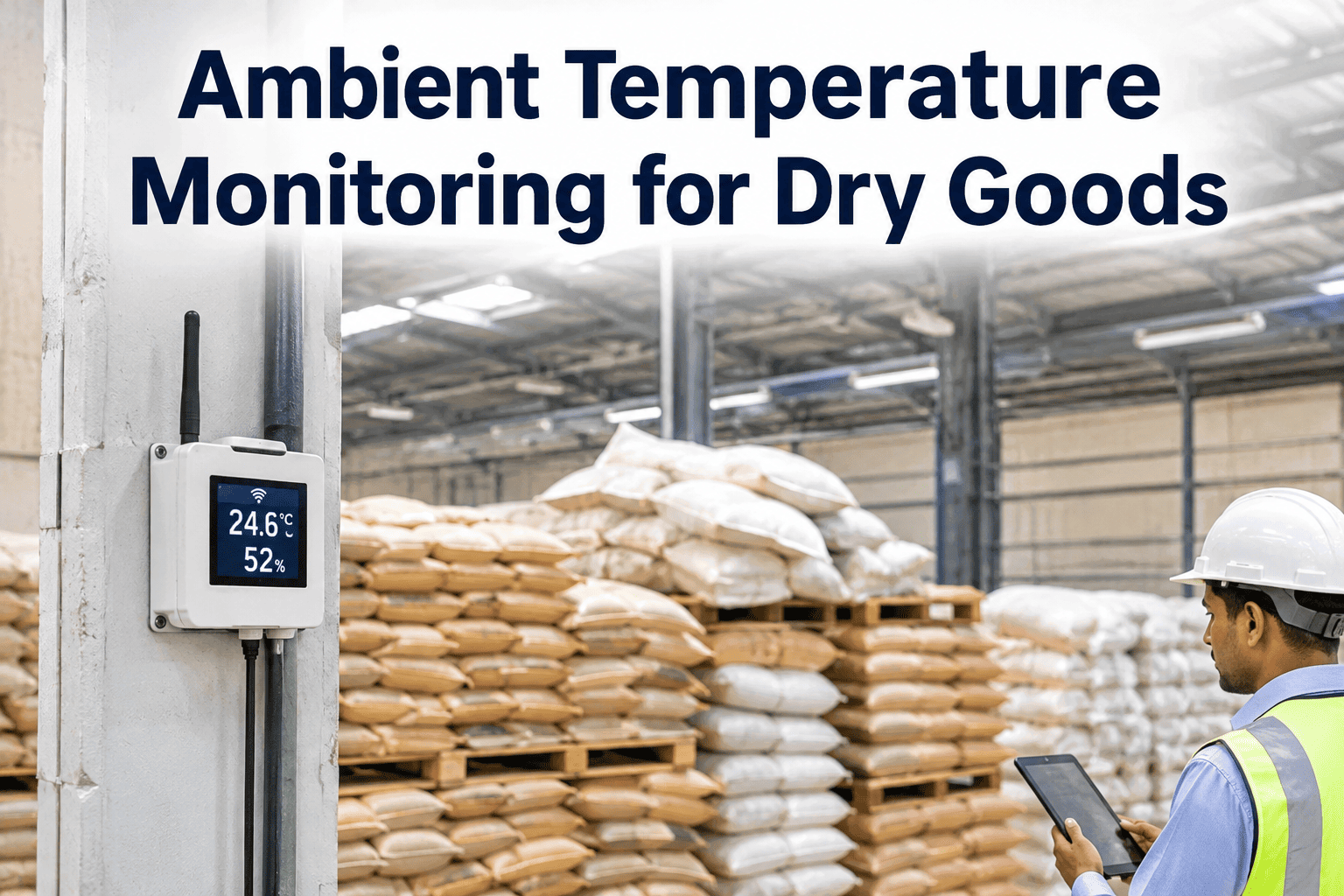
A pallet of chocolate confections sits at the back of a dry storage warehouse through a July heat spike, and by the time anyone notices the sugar bloom on the surface, the entire lot is already unsellable. Dry goods do not need refrigeration, but they are far from indifferent to their environment — shelf-stable products, chocolate, canned goods, and packaged snacks all carry defined temperature and humidity tolerances that most warehouses monitor only by walking the floor once a shift. iFactory turns ambient storage conditions into a continuously tracked, zone-by-zone picture of the warehouse, catching drift before it becomes shrinkage, with the full approach detailed at iFactory support.
Ambient Storage Intelligence · Dry Goods & Shelf-Stable Products
Your Dry Warehouse Isn't Climate-Neutral — It Just Feels That Way Until the Damage Is Done
iFactory monitors temperature and humidity across every zone of a dry goods warehouse continuously, flags drift before it affects product quality, and gives warehouse managers a single dashboard instead of a walked checklist.
Why Dry Storage Still Needs Monitoring
Ambient Does Not Mean Unmanaged
59–70°F
Typical stable range for chocolate and confections before bloom risk rises
Under 50%
Target relative humidity for canned goods to prevent seam corrosion
3–5°F
Common temperature swing between a warehouse ceiling zone and a floor-level zone
Hours, not days
How quickly a heat spike near a loading dock door can affect nearby pallets
Where Conditions Drift
Four Zones That Quietly Fall Out of Spec
01
Dock Door Perimeter
Repeated door cycling during peak receiving hours pulls in outside air, creating a localized hot or humid pocket that spreads several pallet positions deep before ventilation catches up.
02
Upper Rack Levels
Heat rises, and top-level rack positions in a warehouse with high ceilings routinely run several degrees warmer than floor-level storage, a gap most single-point thermostats never capture.
03
Exterior Wall Runs
Product staged against an exterior wall absorbs radiant heat or cold through the structure itself, producing a temperature profile that diverges from the rest of the building even when HVAC readings look normal.
04
Seasonal Humidity Swings
Spring and early summer humidity spikes are the most common trigger for condensation inside sealed cases, a risk that a temperature-only monitoring program misses entirely.
Stop Discovering Damage After the Pallet Is Already Compromised
Continuous zone-level sensing tells you where a warehouse is drifting out of spec while there is still time to move product or adjust HVAC — not after a customer complaint arrives.
Manual Rounds vs. Continuous Sensing
What Changes When Monitoring Runs All Shift, Not Once a Shift
Factor
Manual Walk-Through
iFactory Continuous Sensing
Reading Frequency
Once or twice per shift at a handful of fixed points
Continuous, zone-by-zone readings across the full warehouse footprint
Humidity Tracking
Often skipped or checked separately from temperature
Temperature and humidity logged together per zone in real time
Excursion Detection
Found after product is already visibly affected
Flagged the moment a zone crosses its defined threshold
Documentation
Paper logs prone to gaps and rounding
Continuous digital record ready for audits and claims
Setup Checklist
Five Steps to a Properly Monitored Dry Warehouse
1Map storage zones by product sensitivity, not just physical layout, so chocolate and canned goods get thresholds matched to their actual risk.
2Place sensors at dock perimeters, upper rack levels, and exterior wall runs, the three zones most likely to drift first.
3Set humidity thresholds separately from temperature thresholds, since the two do not always move together.
4Route alerts to the shift lead responsible for that zone, not a general inbox that gets checked once a day.
5Review seasonal trend data quarterly to catch slow HVAC degradation before it becomes a full-blown excursion.
Field Case
Catching Chocolate Bloom Risk Three Weeks Before Peak Season
A confectionery distributor storing seasonal chocolate inventory in a mixed-use dry warehouse had relied on twice-daily manual temperature checks near the office, several hundred feet from the racking closest to the loading dock. After installing zone sensors ahead of a seasonal inventory build, the dashboard surfaced a recurring afternoon heat spike in the dock-adjacent zone tied to a failing HVAC damper, three weeks before the facility's peak shipping period. The damper was repaired during a scheduled maintenance window instead of during a demand surge, and the affected pallets were relocated before any bloom developed.
3 weeksEarly warning before peak season
0Pallets lost to bloom
1HVAC fault found early
Product-Specific Guidance
Ambient Thresholds Aren't One-Size-Fits-All Across a Dry Goods SKU Mix
Most dry warehouses store a mix of products with meaningfully different sensitivity profiles under one roof, and treating them all against a single ambient target is one of the most common blind spots in warehouse quality programs. Chocolate and confectionery items are the most temperature-sensitive category typically found in dry storage, since cocoa butter begins to soften and migrate to the surface well before the warehouse feels uncomfortably warm to a person walking the floor. Canned goods respond more to humidity than to temperature swings, with prolonged exposure above roughly 50 percent relative humidity accelerating can seam corrosion in ways that aren't visible until months later. Packaged snacks and baked goods sit in between, more forgiving of short-term temperature swings but sensitive to humidity-driven staling and packaging seal degradation over extended storage. Building a monitoring program around these differences, rather than a single warehouse-wide setpoint, is what actually protects the SKUs most at risk without over-engineering thresholds for products that can tolerate more variation.
Chocolate & Confections
Tightest thresholds, both temperature and humidity, with rapid alerting since bloom risk develops quickly once conditions drift.
Canned Goods
Humidity-weighted thresholds with longer alert windows, since corrosion risk builds over sustained exposure rather than short spikes.
Packaged Snacks
Moderate thresholds balancing both factors, with attention to packaging integrity in high-humidity zones.
Compliance Backdrop
Why Ambient Monitoring Increasingly Shows Up in Audit Checklists
Food safety audits under FSMA's preventive controls framework increasingly expect warehouse operators to demonstrate active environmental monitoring rather than relying on a written procedure that assumes conditions stay within range. Third-party certification bodies auditing against GFSI-benchmarked schemes have moved in the same direction, treating documented, continuous storage condition records as stronger evidence of control than periodic manual checks. For distributors and co-packers storing product on behalf of brand owners, ambient monitoring records are also increasingly requested directly by customers during supplier qualification and periodic reviews, particularly for categories like chocolate and confectionery where a single bad storage cycle can trigger a costly customer complaint or return. Facilities that already have continuous digital records in place tend to move through these audits and customer reviews faster, since the evidence is ready to export rather than assembled after the fact from scattered paper logs.
Frequently Asked Questions
Ambient Monitoring — What Warehouse Managers Ask First
Do shelf-stable products really need active monitoring?
Shelf-stable does not mean condition-proof. Chocolate, confections, and many packaged snacks have defined temperature ranges where quality holds, and outside those ranges you get bloom, texture changes, or accelerated staling well before an expiration date is reached. Canned goods are similarly sensitive to humidity, since prolonged exposure above roughly 50 percent relative humidity accelerates seam and can corrosion. Active monitoring catches these drifts while product is still within a recoverable window.
Book a Demo to see zone mapping for your specific product mix.
How many sensors does a typical dry warehouse need?
Sensor count depends on square footage, ceiling height, and how many distinct storage zones the facility has, but most mid-size dry warehouses land somewhere between one sensor per 5,000 to 10,000 square feet in stable zones, with denser coverage near dock doors, exterior walls, and high racking where drift is most likely. A site walkthrough during onboarding identifies the zones that actually need coverage rather than applying a blanket sensor count across the whole footprint.
Can this replace our current manual temperature log for audits?
Yes — continuous digital logging generally exceeds what manual rounds can provide for audit purposes, since it captures every reading rather than a handful of snapshots per shift, and the record cannot be altered or backfilled the way a paper log sometimes can be. Reports can be exported in formats suited to internal quality audits or third-party certification reviews.
Contact support to review documentation formats.
What happens when a zone crosses its threshold?
An alert routes immediately to the designated contact for that zone, typically a shift lead or warehouse manager, with the specific reading, location, and how long the condition has persisted. This lets staff make a fast call on whether to relocate product, investigate an HVAC issue, or simply monitor if the excursion is brief and within an acceptable tolerance band defined during setup.
How long does installation take for a single warehouse?
A standard single-site installation with wireless sensors typically takes one to two weeks from site survey to live dashboard, depending on warehouse size and how many distinct zones need separate threshold configuration. Larger multi-building campuses generally take three to five weeks to fully map and calibrate.
Book a Demo for a timeline specific to your facility.
See Every Zone of Your Warehouse the Way Your Most Sensitive Product Experiences It
Continuous temperature and humidity monitoring across every dry storage zone, live in as little as one week.