A single missed part in a Cleaning Out of Place program is enough to fail a third-party audit, and it happens more often than most food plants would like to admit. Pumps get disassembled, impellers get pulled, valve bodies come apart into six or seven pieces, and every one of those components has to be washed, inspected, and verified before it goes back into the line — yet COP is consistently the weakest link in food plant sanitation because it depends on people doing the same careful sequence correctly, shift after shift, without the automated consistency that CIP systems provide. Plants that treat COP as an afterthought to their CIP program are the ones that show up in FDA 483 observations for residue on disassembled parts, and the fix is rarely about buying new equipment — it is almost always about building a verifiable, repeatable COP station discipline, which is exactly what a free COP program review can help you establish.
Food & Beverage · COP Program Design
COP Cleaning Out of Place: Building a Program That Actually Passes Audits
Disassembled parts washing is where most food plants lose points on GFSI and FDA audits. Here is how to structure parts washer selection, soak procedures, and manual verification so nothing slips through.
COP vs CIP: Why This Distinction Matters
Cleaning Out of Place refers to any component that has to be removed from the line, taken apart, and washed manually or in a parts washer, as opposed to Cleaning in Place, where cleaning solution circulates through fixed piping without disassembly. Every plant has a mix of both, but the ratio matters more than most sanitation managers realize — the more COP a facility relies on, the more human variability enters the sanitation program, and variability is exactly what auditors are trained to find.
Cleaning in Place (CIP)
Automated, closed-loop circulation
Time, temperature, and flow are logged automatically
Consistent every cycle regardless of operator
Best suited to tanks, pipelines, and fixed vessels
Cleaning Out of Place (COP)
Manual disassembly, soaking, and hand cleaning
Verification depends on visual and analytical checks
Outcome varies by operator training and fatigue
Required for pumps, valves, hoses, and fittings
Where COP Programs Break Down
01
Incomplete disassembly
Operators skip disassembling components that look clean from the outside, leaving product residue trapped inside gaskets, threads, and internal cavities that never contact the wash solution.
02
Overloaded soak tanks
Parts stacked on top of each other block solution contact on shielded surfaces, and detergent concentration drops as more soil load enters the same bath without replacement.
03
No time-based tracking
Soak duration is judged by the clock on the wall or operator memory rather than logged start and end times, making it impossible to prove minimum contact time during an audit.
04
Verification skipped under time pressure
When the line needs to restart, visual inspection becomes a glance rather than a systematic check of every surface, and swab verification gets deprioritized entirely.
Selecting the Right Parts Washer Setup
Not every component belongs in the same wash station, and matching the washer type to the part geometry and soil type is the first decision that determines whether the rest of the program can succeed. Small hardware and gaskets typically need ultrasonic or agitated soak tanks that can reach internal threads and crevices, while larger housings and frames often need a cabinet-style spray washer with enough pressure to break down baked-on residue without damaging seals.
| Component Type | Recommended Method | Typical Soak Time | Key Risk Area |
| Pump impellers and housings |
Agitated soak tank + brush |
15-20 minutes |
Internal vane cavities |
| Valve bodies and seats |
Ultrasonic cleaning |
10-15 minutes |
Seat grooves and O-ring channels |
| Gaskets and small hardware |
Basket soak, low agitation |
10-15 minutes |
Surface cracking from harsh chemistry |
| Hoses and flexible fittings |
Cabinet spray washer |
Continuous cycle |
Interior lining residue buildup |
| Filter housings and screens |
Ultrasonic + manual brush |
15-20 minutes |
Mesh clogging and micro-tears |
Is Your COP Station Set Up to Pass an Unannounced Audit?
Our team can walk your COP stations with you and flag the gaps auditors are most likely to catch, at no cost.
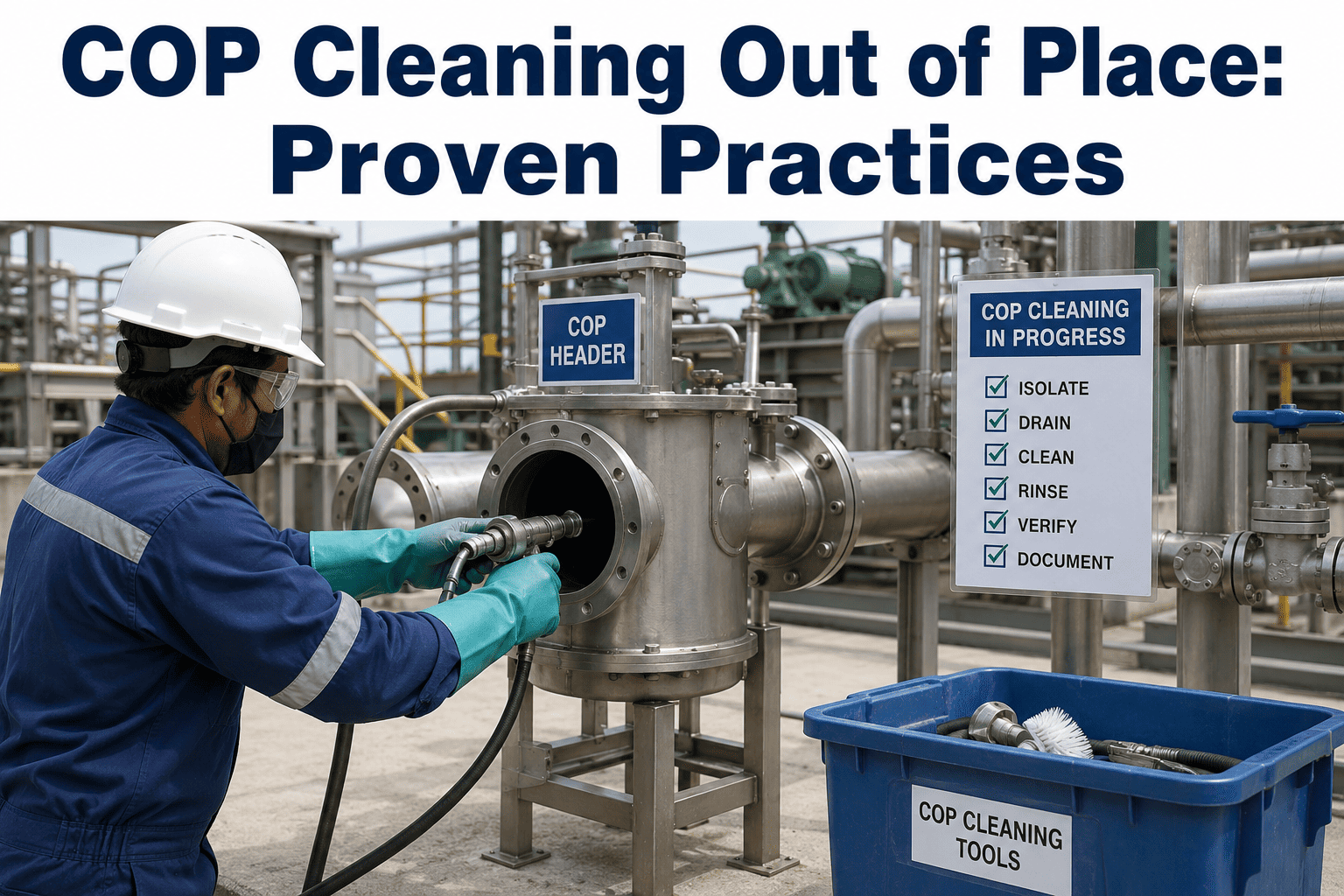
The Standard COP Procedure, Step by Step
1
Full disassembly
Every component that can trap residue is removed to its smallest practical piece, including gaskets, seals, and any threaded fittings that create a shielded surface during production.
2
Pre-rinse
Gross soil is removed with a low-pressure rinse before parts enter the wash solution, preventing rapid detergent exhaustion and reducing cross-contamination between batches of parts.
3
Timed soak or wash cycle
Parts are submerged or run through the washer for a documented minimum time at a verified temperature and detergent concentration, with start and end times logged against a batch or line identifier.
4
Manual brushing of shielded surfaces
Threads, internal cavities, and gasket grooves are brushed by hand even after a wash cycle, since mechanical washing alone rarely reaches every shielded surface on complex geometries.
5
Final rinse
Potable water rinse removes detergent residue, and rinse water quality is checked periodically to confirm it isn't reintroducing contamination from a poorly maintained supply line.
6
Visual and analytical verification
Every part is visually inspected under adequate lighting, and a sample of parts is swabbed or ATP-tested on a rotating basis to confirm the visual check is catching what matters.
7
Air dry and reassembly
Parts are air dried on a designated clean rack, never wiped with a shared cloth, and reassembled only once fully dry to prevent moisture from supporting microbial growth before startup.
Manual Cleaning Verification That Holds Up
Visual inspection is necessary but never sufficient on its own, because residue that is invisible to the eye can still support microbial growth or trigger an allergen reaction in the next product run. A defensible COP verification program layers three checks together: a documented visual inspection against a checklist, ATP swabbing on a statistically meaningful sample of parts, and periodic environmental or allergen swabbing at defined intervals rather than only when something goes wrong.
Visual Inspection
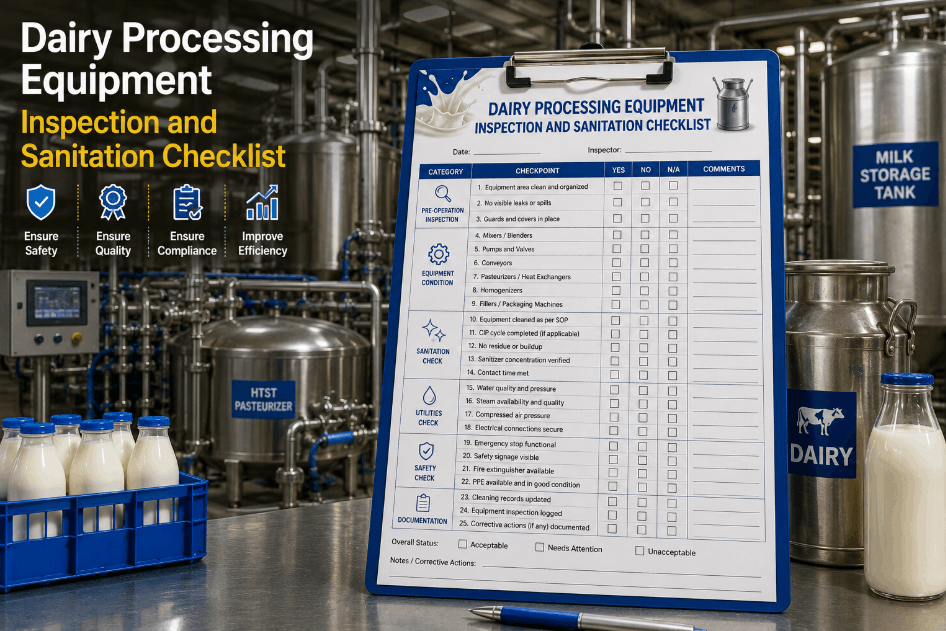
Every part, every time, checked under white light against a documented checklist that specifies what "clean" looks like for that specific component.
ATP Swabbing
A rotating sample of parts is swabbed after washing to catch organic residue that visual inspection alone would miss, with results logged against a pass threshold.
Allergen Verification
Parts used in allergen changeovers get an additional targeted swab for the specific protein in question before the line is released back to production.
Building a COP Log That Survives an Audit
The single biggest gap auditors find in COP programs is not dirty parts — it's missing documentation for parts that were probably clean but can't be proven clean. A defensible COP log captures the part identifier, disassembly time, soak or wash start and end time, temperature and concentration readings where applicable, the name of the operator who performed the wash, the name of the operator who verified it, and the outcome of any swab test performed. Paper logs are still common, but they are also the easiest thing for an auditor to poke holes in, since gaps, illegible entries, and inconsistent timestamps are exactly what draws follow-up questions during a facility walkthrough.
Training That Keeps the Program Consistent
COP quality drops the fastest on second and third shifts, on weekends, and whenever a regular operator is out and someone less experienced covers the station. The most durable fix is not a longer training manual — it's a laminated, component-specific checklist posted directly at the wash station, paired with periodic re-certification where a supervisor observes the full procedure rather than just asking whether the operator remembers the steps. Plants that rotate a second person through a brief verification check, separate from the person who did the washing, catch a meaningfully higher share of missed spots before product runs into a line with residual soil on a reassembled part.
Frequently Asked Questions
How is COP different from just washing dishes by hand?
COP is a structured, documented sanitation process, not informal washing. It requires defined disassembly steps, verified soak times and temperatures, manual brushing of shielded surfaces, and a documented verification step before parts are approved for reassembly. The distinction matters legally and operationally, because an auditor will ask for records proving each of those steps happened, not just evidence that the part looks clean today.
What detergent concentration should we be using in soak tanks?
Concentration depends on the detergent chemistry and soil type, and your supplier's technical data sheet is the authoritative source, but concentration should always be verified with test strips or titration rather than assumed from a fixed dosing pump setting. Soak tanks lose concentration as soil load accumulates, so a tank that tested correctly at the start of a shift may fall below effective concentration by the end of it if it isn't checked periodically.
How often should COP soak tanks be changed out?
Most plants change soak solution at least once per shift, or sooner if visible soil load or a failed concentration check indicates the bath is exhausted. A good practice is to set both a time-based interval and a visual turbidity threshold, whichever comes first, and document the change on the same log used for tracking soak cycles for individual parts.
Do we need ATP swabbing on every single part we wash?
No — swabbing every part is rarely practical and isn't what most GFSI schemes require. A statistically representative rotating sample, combined with targeted swabbing after allergen changeovers or following a known process upset, gives auditors the verification trail they're looking for without creating an unsustainable workload. Reach out to
our support team for help setting a sampling plan sized to your part volume.
Can COP data actually be tracked digitally instead of on paper?
Yes, and moving COP logging to a digital format is one of the fastest wins available for plants preparing for GFSI or FDA audits, since it removes illegible handwriting, missing timestamps, and after-the-fact backfilling as failure points. Book a
free consultation to see how a digital COP log can integrate with your existing sanitation schedule.
Your COP Program Is Only as Strong as Its Weakest Wash Station
Let our team review your current COP procedures against GFSI and FDA expectations, and identify exactly where the gaps are before an auditor does.