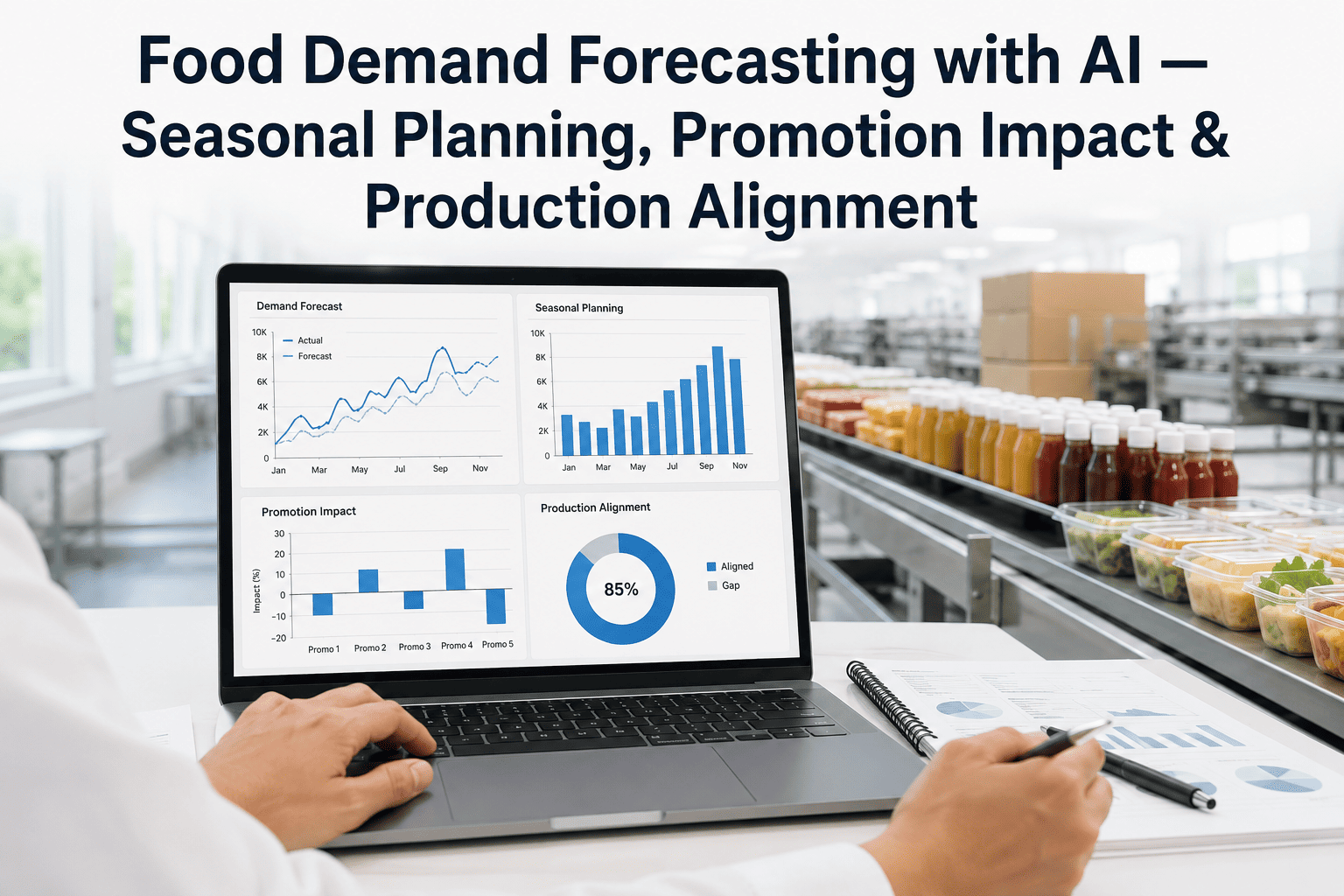
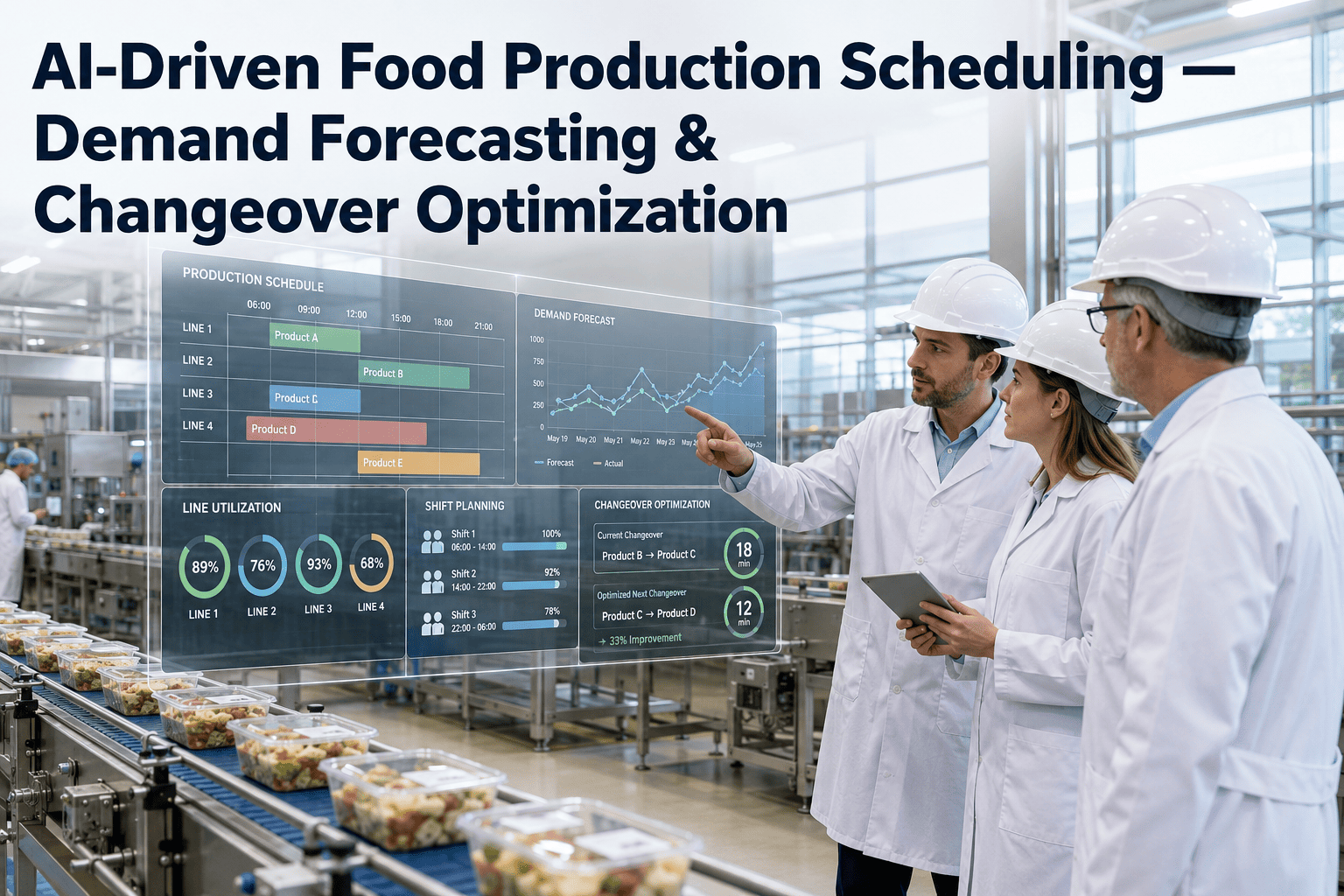
Food manufacturers planning production against demand forecasts built in a spreadsheet routinely discover the gap only after the fact: a promotional spike that overwhelms a production line, a seasonal swing that leaves finished goods sitting in a warehouse, or a new product launch forecast built entirely on gut feel because no comparable history exists. Traditional statistical forecasting struggles with the volatility specific to food products, where weather, holidays, promotional calendars and shelf-life constraints all interact in ways a simple moving average cannot capture. The result is production plans built on forecasts that miss by 20-35% during peak seasonal periods, forcing expensive last-minute schedule changes or costly overproduction. iFactory's AI demand forecasting platform models seasonal patterns, promotional uplift and new product launches together, giving production planners a forecast accurate enough to align schedules with confidence. Book a demo to see AI forecasting run against your own historical sales data.
Forecast Accuracy Improvement Over the First Six Months
Spreadsheet Forecasts Miss Seasonal Spikes by 20-35%. AI Doesn't.
iFactory models seasonal demand, promotional uplift and new product launches together, giving planners a forecast that actually reflects how food demand behaves.
How iFactory Builds a Forecast Production Can Actually Plan Against
Most food demand forecasting tools treat every SKU the same way, applying a generic statistical model regardless of whether a product has ten years of stable history or launched last quarter with no comparable data. iFactory tailors the modeling approach to what data actually exists for each product. See how the model handles your specific SKU mix and promotional calendar.
Seasonal Demand Modeling
AI identifies seasonal patterns specific to each product category, accounting for holiday timing shifts year to year rather than assuming fixed calendar dates.
Promotional Uplift Prediction
Historical promotion performance trains models to predict uplift magnitude and duration for planned promotions before they run, not after.
New Product Launch Forecasting
Launch forecasts draw on comparable product histories and category trends, replacing pure guesswork for SKUs with no sales history of their own.
Weather-Sensitive Category Modeling
Products with weather-linked demand incorporate forecast weather data, adjusting production plans ahead of temperature swings that shift demand.
Production Plan Alignment
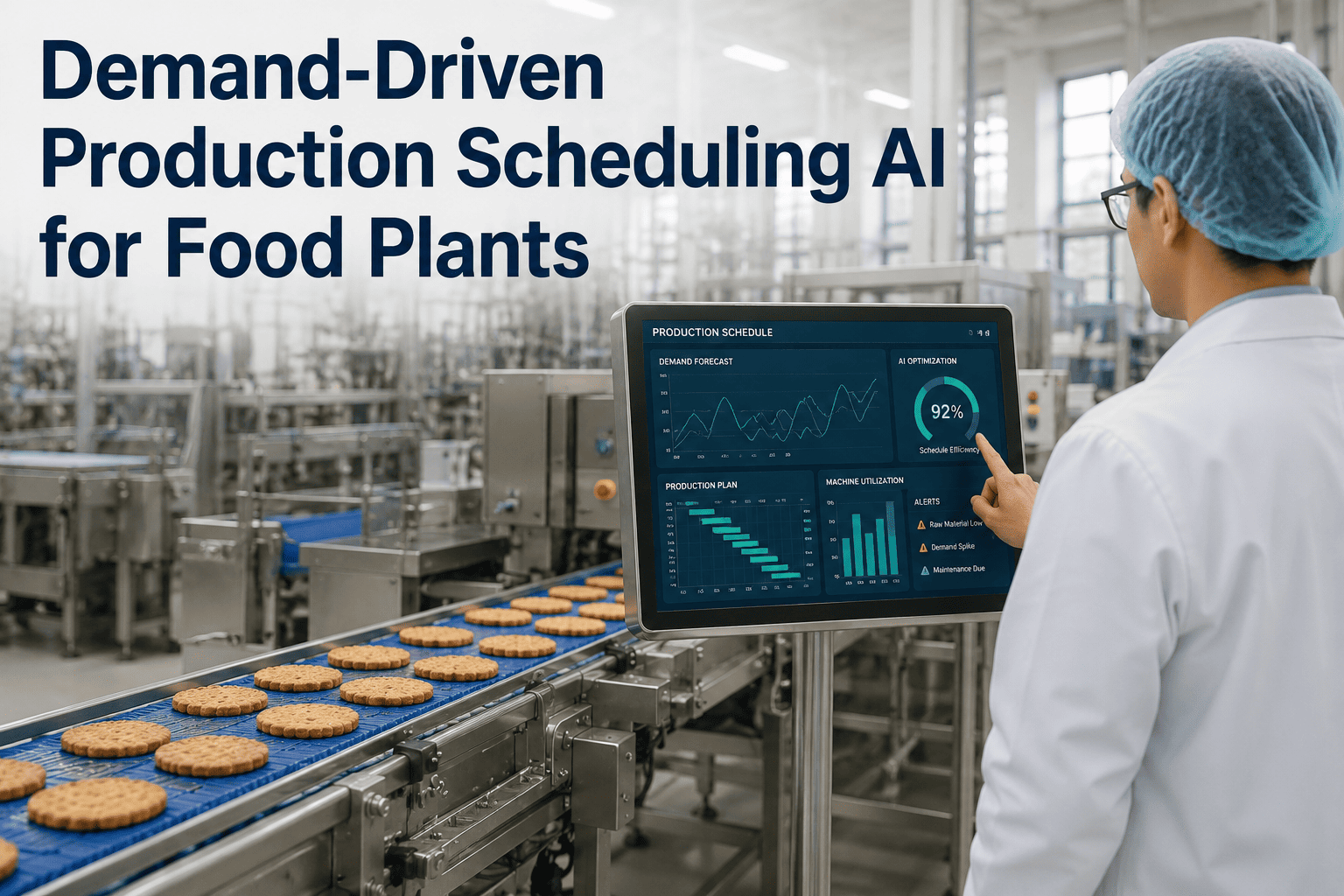
Forecasts translate directly into recommended production schedules and raw material ordering quantities, not just a demand number in isolation.
Continuous Forecast Retraining
Models retrain automatically as actual sales data comes in, improving accuracy every cycle rather than requiring manual model rebuilds.
Spreadsheet Forecasting vs. AI-Driven Demand Planning
Here is how traditional spreadsheet-based forecasting compares to AI demand planning built specifically for food manufacturing volatility. Compare your current forecasting process against AI-driven planning directly.
| Capability | Spreadsheet Forecasting | iFactory AI Demand Planning |
| Seasonal Accuracy |
Fixed calendar assumptions miss holiday date shifts year to year. |
Seasonal patterns adjust to actual holiday timing and category-specific behavior. |
| Promotional Planning |
Uplift estimated from gut feel or a flat percentage applied to every promotion. |
Uplift predicted from historical promotion performance specific to each product. |
| New Product Forecasts |
Built on analyst judgment with no comparable data reference. |
Modeled against comparable product histories and category trend data. |
| Forecast Accuracy Typical Range |
65-75% accuracy on stable SKUs, 40-55% during seasonal peaks. |
85-95% accuracy on stable SKUs, 75-85% during seasonal peaks. |
| Production Plan Translation |
Manual conversion from demand forecast to production schedule. |
Direct translation into recommended schedules and material orders. |
| Model Maintenance |
Manual model updates required periodically by an analyst. |
Continuous automatic retraining as new sales data arrives. |
Rollout Path to AI Demand Forecasting
Deployment builds forecasting accuracy in stages, starting with your highest-volume SKUs before extending coverage across the full product portfolio.
1
Historical Data Integration
Sales history, promotional calendars and category data are consolidated from existing ERP and sales systems.
2
Baseline Model Training
Initial models train on top-volume SKUs, validated against recent actuals before wider rollout.
3
Promotional & Seasonal Layer
Promotional uplift and seasonal adjustment models are layered on top of the baseline forecast.
4
Production Plan Integration
Forecasts connect to production scheduling and material ordering workflows for direct plan alignment.
5
Full Portfolio Coverage
Remaining SKUs, including new product launches, are added using the validated modeling approach.
6
Continuous Retraining
Models retrain automatically each cycle, improving accuracy as actual sales data accumulates.
Start With Your Highest-Volume SKUs. Prove Accuracy Before Expanding.
Baseline models validate against your recent actuals before promotional and seasonal layers or full portfolio coverage are added.
Results From Food Manufacturers Running AI Demand Forecasting
These figures reflect deployments currently running iFactory's demand forecasting platform. Request the case study closest to your product category.
Frozen Foods Manufacturer
Seasonal Overproduction Cut by 40%
A frozen foods manufacturer regularly overproduced ahead of seasonal peaks to buffer against forecast uncertainty, resulting in excess inventory and markdown losses each quarter. AI demand forecasting improved seasonal accuracy from roughly 50% to 82% within five months, cutting seasonal overproduction by 40% and reducing markdown losses correspondingly while maintaining service levels during actual peak periods.
40%
Seasonal overproduction reduction
82%
Seasonal forecast accuracy achieved
5 months
Time to reach improved accuracy level
What Operations Directors Say
Our seasonal forecast used to be a spreadsheet formula nobody fully trusted, so we overproduced as a safety net every year. Watching accuracy climb month over month gave us confidence to trim that buffer.
Operations Director
Frozen Foods Manufacturer, Minnesota
New product launches used to be a coin flip on production quantities. Now the model gives us a defensible number based on comparable launches, and we've stopped either running short or sitting on excess stock.
Demand Planning Manager
Snack Producer, Illinois
Frequently Asked Questions
How much sales history is needed before the model produces useful forecasts?
Established SKUs with 18-24 months of sales history typically produce reliable baseline forecasts within the first deployment cycle. New product launches with no history of their own use comparable product and category trend data instead, which is less precise than a mature SKU forecast but still substantially better than unassisted analyst judgment.
How does the model account for promotions that have never run before?
For a genuinely new promotion type, the model draws on the closest comparable historical promotions by mechanic, discount depth and product category to estimate expected uplift, flagging the estimate as lower-confidence until actual results refine it. Accuracy on novel promotion types improves after the first one or two runs feed back into the model.
Can forecasts integrate directly with our production scheduling system?
Yes. Forecasts translate into recommended production quantities and raw material ordering levels that connect to existing scheduling and ERP systems, removing the manual step of converting a demand number into an actual production plan. Integration specifics depend on your current planning system and are scoped during the deployment discovery phase.
How long until forecast accuracy improves meaningfully?
Most plants see baseline accuracy improvements within the first two to three months as models train on historical data, with seasonal and promotional layers adding further accuracy over four to six months as the model observes actual seasonal cycles and promotional events.
Book a demo to see accuracy trajectories from comparable deployments.
Does this replace our demand planning team or change their role?
The platform is designed to remove manual spreadsheet modeling work, not replace planner judgment. Planners review and adjust AI-generated forecasts based on market knowledge the model doesn't have access to, such as a known competitor stockout or a customer-specific order pattern, shifting their time from data assembly toward exception review and strategic decisions.
Stop Planning Production Against a Forecast Nobody Fully Trusts.
iFactory's AI demand forecasting models seasonal patterns, promotions and new launches together, giving planners a forecast that translates directly into production schedules.
85-95% forecast accuracy on stable SKUs
Seasonal overproduction cut by up to 40%
New product launch forecasts grounded in comparable data
Direct integration into production scheduling