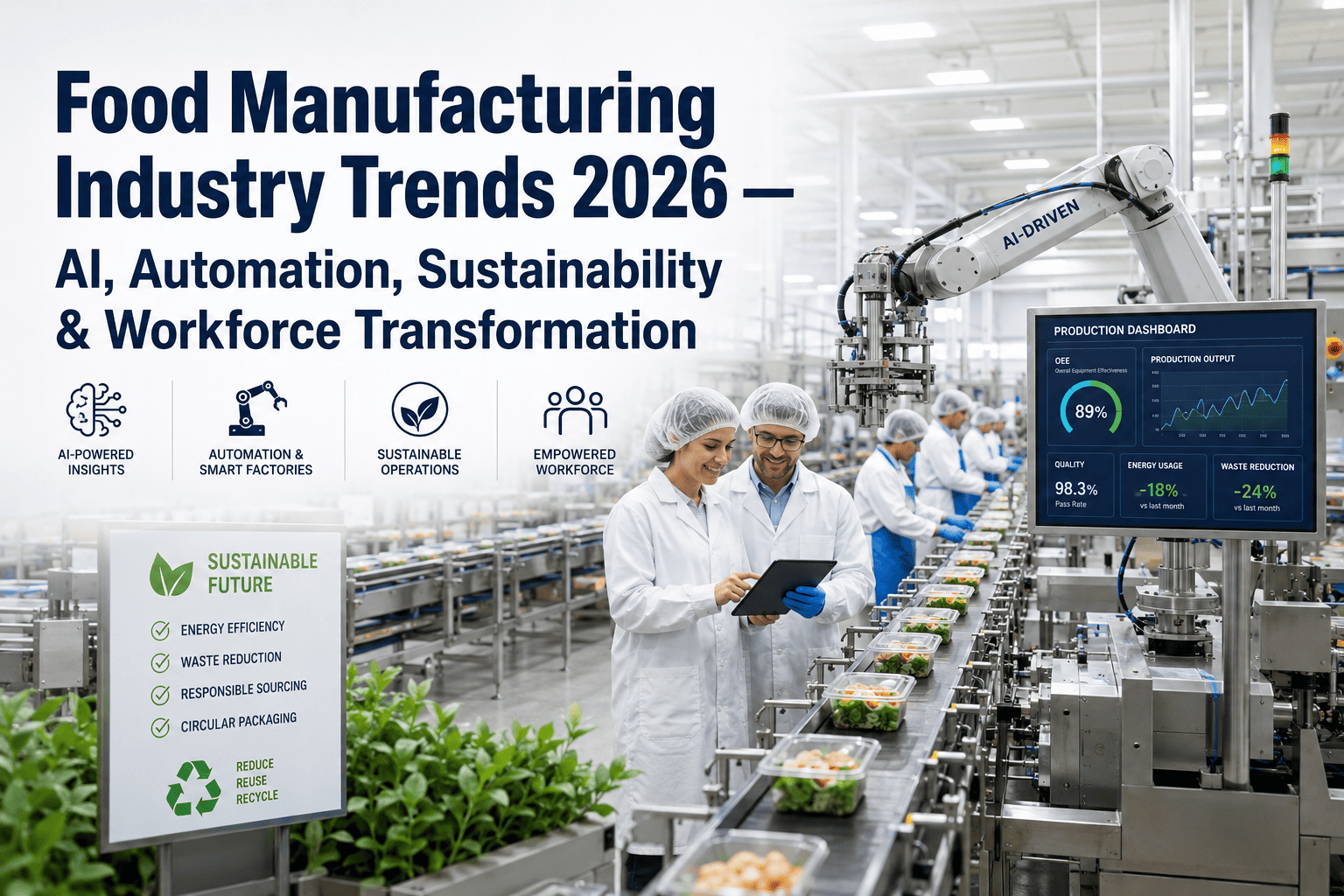
The food manufacturing industry is undergoing a profound transformation as we approach 2026, driven by converging forces of artificial intelligence, automation, sustainability imperatives, and a rapidly evolving workforce. For VP Operations and strategic leaders, understanding these trends is not optional—it is the foundation for competitive survival and growth. AI adoption in food manufacturing is projected to reach a 45% implementation rate among mid-to-large enterprises by the end of 2026, up from 22% in 2023, according to a recent industry report. Robotics deployment in packaging and palletizing is expected to double, while sustainability mandates from both regulators and consumers are pushing manufacturers to reduce carbon footprints by at least 30% within the next three years. Workforce evolution adds another layer of complexity: the average age of skilled maintenance technicians is 56, creating an urgent need for digital upskilling and automation-friendly roles. This comprehensive guide unpacks each of these critical trends, providing actionable data, real-world deployment statistics, and strategic frameworks to help you navigate the shifting landscape. Whether you are planning capital investments, redesigning production lines, or rethinking your talent strategy, the insights here will equip you to make informed decisions. For a deeper dive into how these trends can be operationalized in your facility, explore our support resources and connect with industry experts.
2026 Food Manufacturing Trends: The Strategic Landscape
A data-driven overview of AI, automation, sustainability, and workforce shifts reshaping the industry.
Future-Proof Your Operations Today
Leverage 2026 trends to build a resilient, efficient, and sustainable manufacturing ecosystem. Let our experts guide your transformation.
AI in Quality Control
Machine vision systems powered by deep learning now detect contaminants and defects with 99.7% accuracy, reducing recall risks by 60%. Deployment costs have dropped 35% since 2023, making AI accessible to mid-sized plants.
Robotic Palletizing & Packaging
Collaborative robots (cobots) now handle up to 30% of packaging tasks, with ROI under 18 months. Flexible grippers enable rapid changeovers, cutting downtime by 40%.
Predictive Maintenance
IoT sensors and AI analytics reduce unplanned downtime by 55%. Food manufacturers using predictive maintenance report 25% lower maintenance costs and 20% longer equipment life.
Sustainable Sourcing & Production
Blockchain traceability and renewable energy integration are becoming standard. 68% of consumers now prioritize brands with transparent sustainability practices.
Timeline of Key Milestones (2024-2026)
AI pilot projects in quality control expand to 30% of large manufacturers. Early adopters report 20% yield improvement.
Regulatory push for Scope 1 & 2 emissions reporting. Cobot installations surpass 50,000 units in food facilities globally.
AI adoption reaches 45%. Sustainability mandates require 30% carbon reduction. Workforce upskilling programs become standard.
Align Your Strategy with 2026 Trends
Data-driven insights and technology investments are the keys to staying competitive. Let us help you implement the right solutions.
Technology Investment Comparison (2024 vs 2026)
| Technology | 2024 Adoption | 2026 Projected Adoption | Average Investment |
|---|---|---|---|
| AI Quality Control | 22% | 45% | $150k-$500k |
| Robotic Palletizing | 30% | 60% | $200k-$800k |
| Predictive Maintenance | 28% | 55% | $80k-$300k |
| Blockchain Traceability | 15% | 35% | $50k-$200k |
| Renewable Energy Integration | 20% | 40% | $500k-$2M |
Workforce Evolution: Skills and Roles in 2026
The aging workforce and digital transformation are creating new roles and skill requirements. By 2026, 40% of food manufacturing employees will need upskilling in digital tools. Key emerging roles include Automation Technicians, Data Analysts, and Sustainability Managers. Companies investing in training programs see 30% higher retention and 25% faster problem resolution.
Automation Technician
Demand up 50% by 2026. Requires PLC programming, cobot operation, and IoT troubleshooting skills.
Data Analyst
Critical for interpreting AI outputs and optimizing production parameters. 35% job growth projected.
Sustainability Manager
Oversees carbon tracking, renewable energy projects, and regulatory compliance. 40% increase in roles.
Frequently Asked Questions
What are the biggest challenges to AI adoption in food manufacturing?
The primary challenges include high initial investment costs, which can range from $150,000 to $500,000 for AI quality control systems, and the need for specialized data science talent that is scarce in the industry. Integration with legacy equipment also poses technical hurdles, as many plants operate on 20-year-old machinery that lacks digital interfaces. Data quality is another critical issue—AI models require clean, labeled datasets that many manufacturers do not yet have. However, these barriers are decreasing as cloud-based AI solutions and modular sensors become more affordable. For a detailed roadmap on overcoming these challenges, explore our implementation guides and case studies.
How can small and mid-sized manufacturers afford robotics automation?
Small and mid-sized manufacturers can leverage collaborative robots (cobots) that start at $25,000 per unit, far lower than traditional industrial robots. Leasing models and Robotics-as-a-Service (RaaS) options have also emerged, requiring no upfront capital and offering predictable monthly payments. Additionally, government grants and tax incentives for automation in food processing are available in many regions. The ROI for cobots in packaging and palletizing is typically under 18 months, making them a financially viable entry point. To evaluate which automation solution fits your budget, visit our cost analysis tools and speak with an automation specialist.
What sustainability mandates will affect food manufacturers in 2026?
Key mandates include Scope 1 and Scope 2 emissions reporting requirements from the SEC and EU Corporate Sustainability Reporting Directive (CSRD), which apply to companies with over 500 employees. Many large retailers like Walmart and Tesco now require suppliers to disclose carbon footprints and set reduction targets. In addition, single-use plastic bans are expanding, pushing manufacturers toward compostable and recyclable packaging. Compliance costs can be substantial, but early adopters often gain preferential shelf placement and pricing. For a compliance checklist and timeline, refer to our sustainability resources.
How is the workforce shortage affecting food manufacturing operations?
The workforce shortage is most acute in skilled maintenance roles, where the average technician age is 56, and 35% of the current workforce is expected to retire by 2028. This shortage leads to increased downtime, as plants struggle to find qualified personnel to repair automated equipment. In response, manufacturers are investing in cross-training programs, partnering with vocational schools, and implementing augmented reality (AR) remote support tools that allow junior technicians to receive guidance from experts. Upskilling existing employees in digital literacy and automation maintenance is proving to be the most cost-effective strategy. Discover training programs and partnership opportunities through our workforce development portal.
What is the expected ROI for predictive maintenance in food manufacturing?
Predictive maintenance typically delivers an ROI of 200% to 500% within the first two years, according to industry benchmarks. The primary savings come from a 55% reduction in unplanned downtime, 25% lower maintenance costs, and 20% longer equipment lifespan. For a mid-sized plant with 50 critical assets, this translates to annual savings of $500,000 to $1 million. Implementation costs range from $80,000 to $300,000 depending on sensor density and software complexity. To calculate your potential savings, use our ROI calculator and schedule a consultation with our predictive maintenance experts.
Transform Your Operations for 2026
Stay ahead of the curve with strategic technology adoption and workforce planning. Partner with Ifactory to build your future-ready food manufacturing facility.