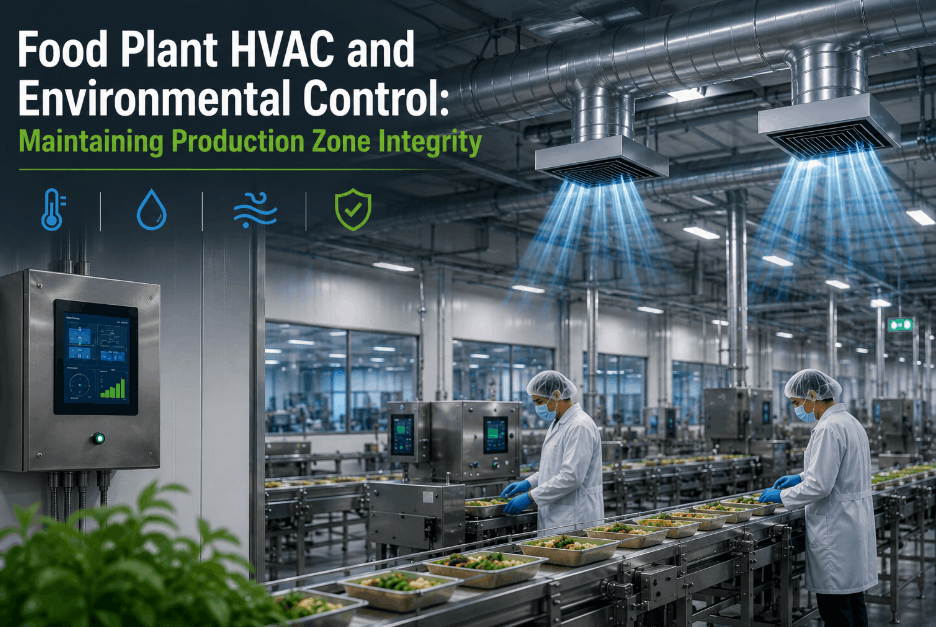
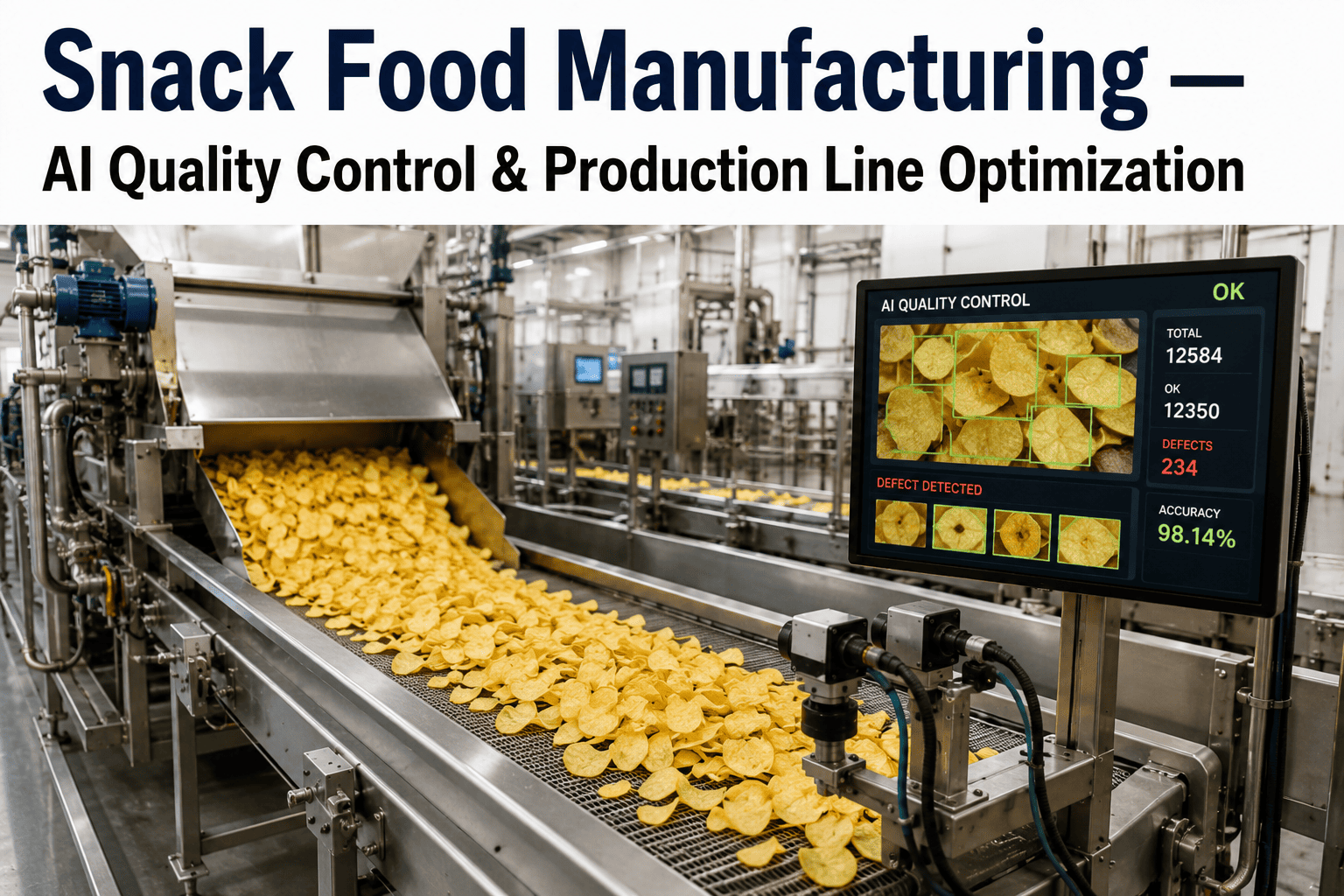
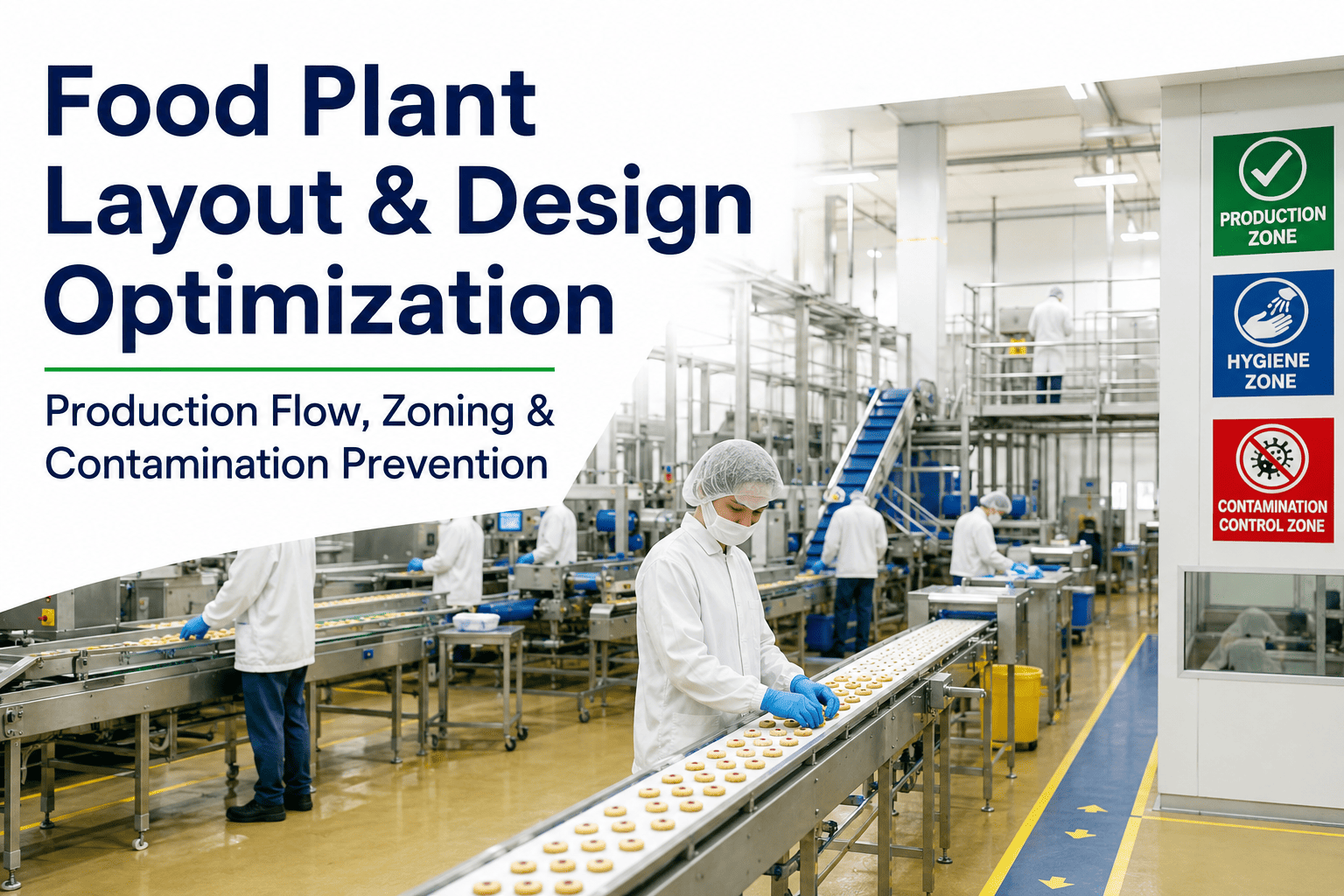
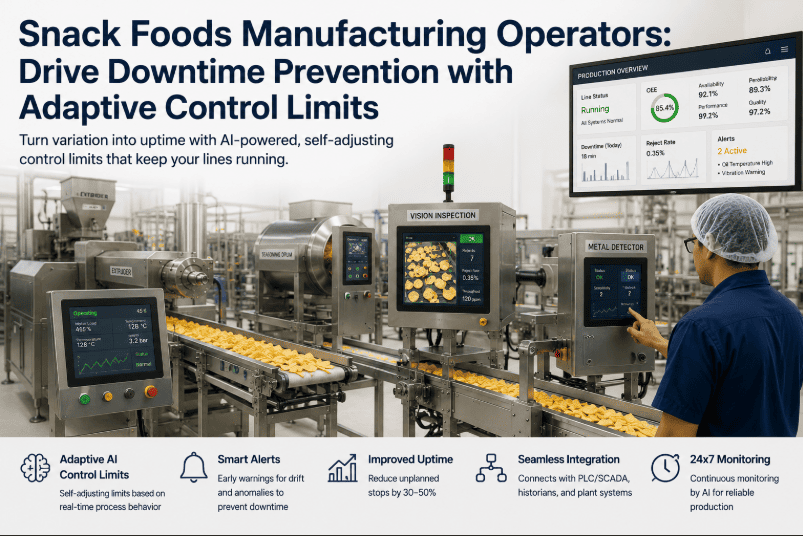
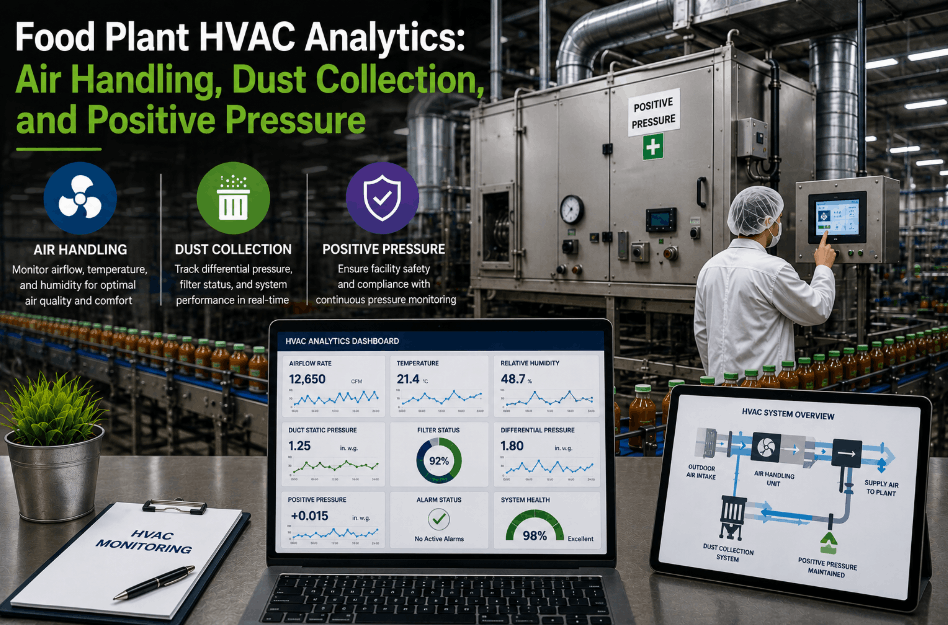
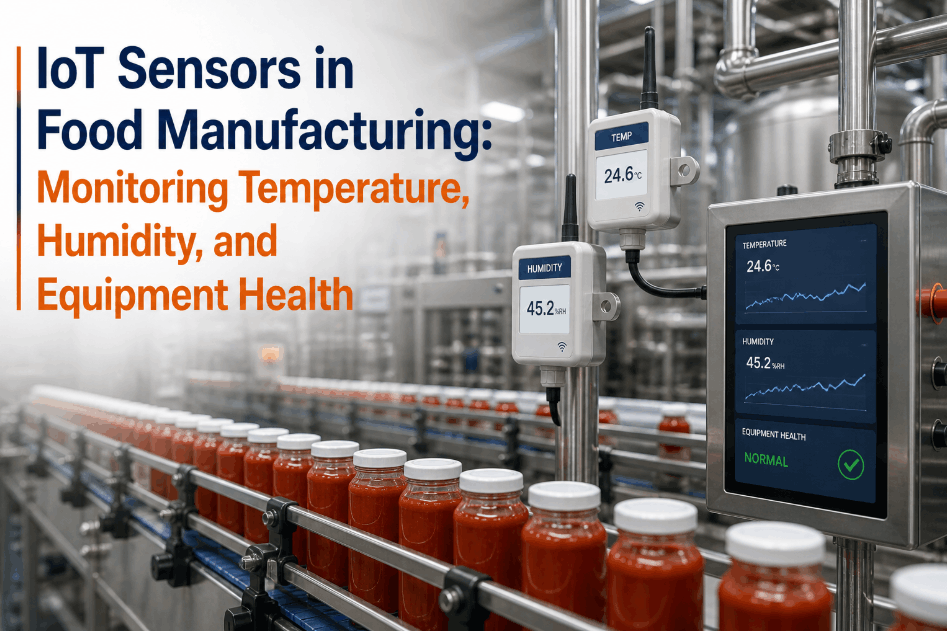
In food manufacturing, the difference between a compliant, high-yield production zone and a contaminated, shutdown-risk environment often comes down to one invisible force: the air. Food plant HVAC and environmental control systems govern temperature, humidity, air pressure, and particulate levels across every production zone — from raw material intake to finished goods packaging. When these systems drift out of specification, the consequences range from failed food safety audits to product recalls costing millions. The most competitive facilities are deploying AI-driven environmental monitoring to maintain positive pressure differentials, execute precision temperature mapping, and prevent cross-contamination before it ever reaches the product line. To see how preventive analytics keeps your production zones in full compliance, Book a Demo with the iFactory team today.
ENVIRONMENTAL CONTROL · FOOD ZONE INTEGRITY
Is Your Production Zone HVAC Audit-Ready in 2026?
Deploy AI-driven temperature mapping, positive pressure monitoring, and automated HVAC compliance logs. Purpose-built for high-throughput food manufacturing environments.
30–40%
Of food safety audit failures are linked to uncontrolled environmental conditions in production zones
±0.5°C
Required temperature mapping tolerance in critical food processing zones per FSMA guidelines
15–25 Pa
Recommended positive pressure differential for clean-zone protection against contamination ingress
18 Mo
Typical ROI period for AI-driven HVAC preventive maintenance in food manufacturing facilities
Why Environmental Control Is the Foundation of Food Production Zone Integrity
Food production environments are classified zones where temperature, relative humidity, air changes per hour (ACH), and differential air pressure must remain within strict tolerances — not occasionally, but continuously throughout every production shift. Regulatory frameworks including FSMA, HACCP, and FDA 21 CFR Part 117 all mandate documented evidence that environmental conditions were controlled during manufacturing. A single unmonitored temperature excursion in a high-care zone or an unmaintained HVAC unit that allows positive pressure to lapse can expose a facility to everything from a major audit non-conformance to a full product recall. For food manufacturers looking to close environmental compliance gaps before the next inspection, Book a Demo to see iFactory's real-time zone monitoring in action.
Positive Pressure Systems in Food Production Zones: How They Work and Why They Fail
Positive pressure is the first line of mechanical defense against airborne contamination in food production environments. By maintaining a higher air pressure inside a high-care or high-risk zone relative to adjacent areas, food manufacturers ensure that any air movement at doorways, penetrations, or transitions flows outward — away from the product — rather than inward, carrying pathogens, allergens, or particulates from lower-classification zones. Positive pressure failures typically result from three root causes: clogged AHU filters that reduce supply air volume, degraded door seals that allow pressure equalization, or HVAC control systems that drift out of calibration without triggering an alert. Food plants that want to eliminate this risk can Book a Demo to see iFactory's automated differential pressure tracking and alert escalation workflow.
| Zone Classification |
Pressure Requirement |
Temperature Range |
Relative Humidity |
Min. Air Changes/Hr |
Key Risk |
| High-Risk / High-Care Zone |
+15 to +25 Pa above adjacent |
2°C – 8°C (chilled) or controlled ambient |
45% – 65% RH |
20+ ACH |
Pathogen cross-contamination from lower zones |
| Processing / Production Zone |
Neutral to slight positive |
10°C – 18°C (product dependent) |
50% – 70% RH |
15+ ACH |
Condensation, mold growth, allergen drift |
| Packaging / Wrapping Zone |
+5 to +10 Pa above corridors |
15°C – 22°C |
40% – 60% RH |
10+ ACH |
Airborne particle ingress, label integrity loss |
| Raw Material Intake / Low-Care |
Neutral or slight negative |
Ambient or product-specified |
Up to 75% RH |
6–10 ACH |
Bioburden introduction, ambient contamination |
| Dry Storage / Ingredient Zone |
Slight positive to ambient |
15°C – 21°C |
Below 55% RH |
4–8 ACH |
Humidity spikes causing caking, mycotoxin risk |
Temperature Mapping in Food Manufacturing: Compliance Requirements and Best Practices
Temperature mapping is the systematic process of measuring and documenting temperature distribution throughout a production zone using calibrated data loggers placed at defined locations. In food manufacturing, temperature mapping is a regulatory requirement under FSMA, a prerequisite for BRC, SQF, and FSSC 22000 certification, and a cornerstone of HACCP plan validation. A properly executed study must account for worst-case conditions — maximum production load, summer peak ambient temperatures, and door-open cycles — because food plants that map zones once during a mild season and reuse that data for years are building a false safety record. To see how iFactory automates temperature mapping validation across all production zones, Book a Demo with our food safety engineering team.
Critical Temperature Mapping Failure Points in Food Plants
01
Dead Zones Near Loading Doors
Frequent door openings during material transfer create thermal intrusion events that spike local temperatures by 3–8°C. Without sensors near entry points, these excursions go undetected and undocumented, creating audit exposure and real pathogen risk in adjacent high-care areas.
02
HVAC Supply Air Stratification
Cold supply air from overhead AHUs stratifies before it reaches floor-level product zones, creating vertical temperature gradients of 4–6°C between ceiling and work surface. Mapping only at mid-height produces false compliance data that fails a rigorous inspector review.
03
Equipment Heat Load Underestimation
Processing equipment like pasteurizers, fryers, and heat sealers generate substantial localized heat. When new equipment is installed without updating the zone's thermal map, the HVAC system operates on outdated parameters and the zone consistently runs above specification during peak production.
04
Seasonal Calibration Drift
Temperature sensors and HVAC control setpoints drift over time, particularly when subjected to washdown chemicals, high moisture, or seasonal thermal cycling. Annual calibration intervals miss months of progressive drift that accumulate into significant measurement error and compliance risk.
Humidity Control in Food Plants: Preventing Condensation, Mold, and Allergen Cross-Contact
Relative humidity control in food production environments is a direct food safety issue. When humidity levels exceed 70% RH — a threshold easily breached in facilities with inadequate HVAC capacity, open CIP drains, or high-moisture processes — the risk of surface condensation on walls, ceilings, and overhead structures rises sharply. Condensation dripping onto exposed product or product-contact surfaces is a recognized route of microbiological contamination and has been the root cause of multiple Listeria outbreaks in ready-to-eat food facilities. In allergen-segregated zones, elevated humidity also accelerates the dispersion of allergenic dust particles, creating cross-contact risk between production runs that no cleaning protocol alone can resolve.
Food Plant HVAC Preventive Maintenance Schedule: Every Interval Explained
HVAC systems in food manufacturing environments operate under conditions far more demanding than commercial buildings. Frequent washdowns introduce moisture into air handling units, food dust and particulates accelerate filter loading, and 24/7 production schedules leave minimal maintenance windows. Without a structured, interval-based preventive maintenance program, food plant HVAC systems degrade in ways that are invisible until an audit or a contamination event makes them catastrophically visible.
Verify differential pressure readings across all production zone boundaries
Inspect AHU pre-filters for loading and bypass risk
Log temperature and humidity at all zone sensor points
Check condensate drain pans for standing water and blockage
Weekly pressure and condensate checks are the primary defense against contamination ingress and mold initiation
Replace or inspect HEPA and bag filters per pressure drop threshold
Inspect door seals and air curtains for degradation
Verify humidity controller setpoints and sensor readings
Clean supply and return air grilles of food dust accumulation
Audit environmental log completeness for compliance records
Filter integrity and door seal maintenance prevent the two most common positive pressure collapse scenarios
Quarterly
Licensed Technician
Calibrate all temperature and humidity sensors against traceable reference
Inspect and clean AHU coils, blower wheels, and drain pans internally
Verify refrigerant charge levels and compressor operating pressures
Test zone damper actuators for full range of motion and control response
Quarterly coil cleaning recovers 5–8% of HVAC capacity lost to food-environment fouling
Semi-Annual
Licensed Technician
Full HEPA filter integrity test (DOP/PAO challenge test)
Air balance verification — measure actual ACH versus design specification
Inspect ductwork internally for debris, mold, or structural gaps
Validate BMS alarm and control sequences under simulated fault conditions
Review and update zone thermal maps for any equipment or layout changes
Semi-annual air balance verification catches ACH drift before zones fail microbial environmental monitoring
Annual
Certified Inspector
Full temperature mapping study across all zone classifications
Complete HVAC system commissioning report versus design standards
Comprehensive refrigerant leak detection and documentation per EPA 608
Microbiological swab verification post-HVAC maintenance works
Deliver audit-ready HVAC compliance package to QA and facilities management
Annual full mapping and commissioning review is the cornerstone of BRC, SQF, and FSSC 22000 HVAC compliance evidence
Cross-Contamination Prevention Through HVAC Air Handling Design and Maintenance
Airborne cross-contamination between food production zones is one of the most technically complex contamination routes to control — and one of the most frequently underestimated. Unlike surface contamination, airborne pathogen or allergen transfer through an HVAC system leaves no visible trace until a product test or environmental swab returns a positive result. Dedicated air handling units for high-care zones, combined with monitoring that continuously confirms AHU dampers, pressure differentials, and filter integrity remain within specification, is the only reliable defense. Food manufacturers managing multi-allergen production schedules can Book a Demo to learn how iFactory tracks HVAC separation integrity across every zone in real time.
The Five HVAC Design Principles That Prevent Production Zone Cross-Contamination
01 — Zone Pressure Cascade
Establish a deliberate pressure hierarchy from highest-care to lowest-care zones, so all uncontrolled airflow moves from clean to dirty — never the reverse. Every zone boundary must have a verified and monitored pressure differential, not an assumed one based on design intent alone.
02 — Dedicated AHU Per Zone Classification
High-care and high-risk zones must be served by dedicated air handling units with no shared return air pathways to lower-classification areas. Shared systems that rely on filtration alone for separation are an inherent contamination risk that no filter maintenance program can fully eliminate.
03 — HEPA Filtration at Zone Entry Points
H14 HEPA filters at AHU supply to high-care zones provide the last line of particulate and bioaerosol defense. These filters must be integrity-tested semi-annually using a DOP or PAO challenge — visual inspection alone cannot confirm seal integrity and is not acceptable to food safety auditors.
04 — Air Curtain and Vestibule Airlocks
Physical transitions between zone classifications must be protected by air curtains, airlocks, or pressure-maintained vestibules. These prevent single door-open events from causing immediate pressure equalization and contamination ingress — a requirement that is often present in facility design but allowed to degrade through inadequate maintenance of curtain motors and seal integrity.
05 — Continuous Environmental Monitoring Program
Mechanical design without continuous monitoring is a compliance liability. Real-time sensor networks that track temperature, humidity, differential pressure, and particulate count — with automated alerts and data logging — provide the documented proof that environmental conditions were controlled during every production run.
AI-Driven HVAC Monitoring: How Preventive Analytics Protects Production Zone Integrity
Traditional food plant HVAC maintenance operates on fixed calendar schedules that ignore the actual operating condition of the equipment. AI-driven HVAC monitoring eliminates this inefficiency by using real-time sensor data — differential pressure across filters, zone temperature and humidity trends, AHU motor amp draw — to predict maintenance needs based on actual equipment condition, not calendar assumptions. By monitoring the relationship between outdoor ambient conditions, zone set points, and actual zone conditions, an AI model can identify that an AHU is losing cooling capacity weeks before the zone temperature breaches its upper limit — transforming HVAC maintenance from a reactive, shutdown-risk activity into a planned, scheduled correction.
iFactory Preventive Analytics for HVAC Compliance
Stop Discovering Environmental Failures at Audits
iFactory deploys continuous zone monitoring, AI-driven maintenance triggers, and automated compliance documentation — so your HVAC program is always audit-ready, not audit-panic-ready.
HVAC Compliance Documentation: What Food Safety Audits Actually Require
Environmental control documentation is frequently the first area reviewed during a BRC, SQF, FSSC 22000, or FDA inspection in a food manufacturing facility. Auditors are not looking for proof that your HVAC system was designed correctly — they are looking for continuous, timestamped evidence that it performed correctly during production. The documentation gap between what facilities believe they have and what auditors expect to see is one of the primary drivers of major audit non-conformances in the environmental management category.
01
Continuous Environmental Log
Timestamped records of temperature, relative humidity, and differential pressure for every controlled production zone, covering every production shift. Must demonstrate the zone operated within specification for the duration of each run and include documented responses to any out-of-specification event.
02
Temperature Mapping Study Reports
Validated mapping studies for each zone classification showing sensor placement rationale, worst-case test conditions, measured temperature distribution, and sign-off by a qualified food safety professional. Studies must be revalidated whenever layout, equipment, or HVAC configuration changes.
03
Filter Change and Integrity Records
A complete log of every filter replacement, HEPA integrity test result (with challenge test data), and filter differential pressure reading at the time of change. Missing these records triggers immediate questions about HEPA boundary integrity from any experienced auditor.
04
Sensor Calibration Certificates
Traceable calibration records for every temperature, humidity, and pressure sensor in the environmental monitoring network. Calibration must be performed against a NIST-traceable reference instrument and documented with as-found and as-left values at a minimum quarterly frequency.
05
Corrective Action Records
For every environmental out-of-specification event, a documented corrective action record must exist showing the deviation detected, immediate containment action taken, root cause investigation, and preventive measure implemented. Auditors treat undocumented deviations as evidence of a non-functioning monitoring program.
06
HVAC Preventive Maintenance Work Orders
Completed work orders for every scheduled HVAC maintenance task, including the name and qualification of the technician, the date performed, findings, and actions taken. Overdue or skipped PM work orders are a direct audit finding and can trigger questions about zone control effectiveness during the gap period.
Common HVAC Compliance Violations in Food Manufacturing and How to Prevent Them
| Violation |
How It Happens |
Consequence |
Prevention |
| Undocumented Pressure Differential Lapses |
No real-time monitoring — positive pressure collapses during peak production door cycles and is never recorded |
Major audit non-conformance; potential product quarantine for all production during the unmonitored period |
Continuous differential pressure logging via iFactory — automated alert triggers work order when pressure drops below threshold |
| Overdue HEPA Filter Integrity Tests |
Semi-annual DOP/PAO challenge tests are not scheduled in CMMS — visual inspection accepted as adequate |
High-care zone classified as unverified — all product produced during the overdue period may require disposition review |
Asset-level HVAC PM scheduling in iFactory tracks HEPA test due dates per unit with automated escalation to facility manager |
| Temperature Exceedances Without Corrective Action Records |
Temperature sensor alarms acknowledged and reset — exceedance logged in BMS but no formal corrective action document created |
Demonstrates non-functional food safety management system — auditor questions effectiveness of all environmental controls |
iFactory auto-generates corrective action work orders from BMS alarm data — links exceedance to resolution with timestamped evidence |
| Expired Sensor Calibration Certificates |
Annual calibration contracted externally — certificates filed in paper archives and never linked to the sensor asset record |
All environmental monitoring data collected since last valid calibration is considered unverified — complete records gap for audit |
Digital certificate vault in iFactory — calibration documents linked per sensor asset ID with expiry alert 60 days in advance |
| Outdated Temperature Mapping Studies |
New processing equipment installed in zone without triggering a mapping revalidation — original study is two years old |
Zone operating under invalid parameters — thermal hot spots from new equipment heat loads go undetected and undocumented |
iFactory equipment change management workflow flags HVAC revalidation requirement whenever new asset is added to a controlled zone |
Frequently Asked Questions: Food Plant HVAC and Environmental Control
How often is temperature mapping required in food production zones?
The frequency of temperature mapping revalidation is not universally fixed by a single regulation, but leading food safety standards including BRC Issue 9 and FSSC 22000 require revalidation whenever a significant change occurs in the zone — new equipment installation, layout modification, or HVAC system alteration — and as a minimum on an annual basis as part of the HVAC commissioning review. Dynamic AI-driven monitoring supplements static mapping studies by continuously detecting temperature distribution changes between formal revalidation cycles, reducing the risk of operating on outdated mapping data.
What is the correct positive pressure differential for a food production high-care zone?
Industry guidance and food safety standards typically recommend a positive pressure differential of 15 to 25 Pascals between a high-care or high-risk zone and adjacent lower-classification areas. The exact target depends on zone classification, door design, and air change rate. The critical compliance requirement is not just achieving the target differential at a point in time, but continuously maintaining and documenting it during all production hours — which requires real-time sensor monitoring, not periodic manual checks.
How does AI-driven HVAC monitoring differ from a standard building management system?
A standard Building Management System (BMS) monitors and controls HVAC setpoints and logs data — but it typically operates in isolation from the maintenance management system and has limited predictive capability. AI-driven HVAC monitoring, as deployed through iFactory, layers predictive analytics on top of BMS data to identify degradation patterns before faults occur, automatically generates maintenance work orders when anomalies are detected, and links environmental monitoring data to production run records for full audit traceability.
Can humidity control failures trigger a food recall?
Yes. In ready-to-eat food production environments, sustained high humidity promotes condensation that provides a growth medium for Listeria monocytogenes on overhead structures and equipment. In allergen-managed facilities, excessive humidity accelerates the aerosolization and migration of allergenic dust across zone boundaries through HVAC systems, creating undeclared allergen cross-contact risk — one of the most common categories of food recall in the United States and EU.
What qualifications are required to perform food plant HVAC maintenance?
Weekly visual checks and filter monitoring can typically be performed by trained facility staff following documented procedures. Quarterly calibration, refrigerant handling, and combustion analysis require licensed HVAC technicians with relevant certifications — refrigerant work in particular requires EPA 608 certification in the United States. Semi-annual HEPA integrity testing and annual air balance commissioning should be performed by qualified specialists with documented food-industry HVAC experience. A CMMS like iFactory tracks technician certifications alongside work order records to provide auditors with proof that every task was performed by a qualified individual.
Full HVAC Compliance Automation for Food Manufacturing
Every Zone. Every Sensor. Every Maintenance Record — Automatically Documented.
iFactory builds your food plant HVAC maintenance schedule into automated work orders — weekly through annual — with zone-level environmental tracking, calibration management, and audit-ready documentation that satisfies BRC, SQF, FSSC 22000, and FDA inspectors.