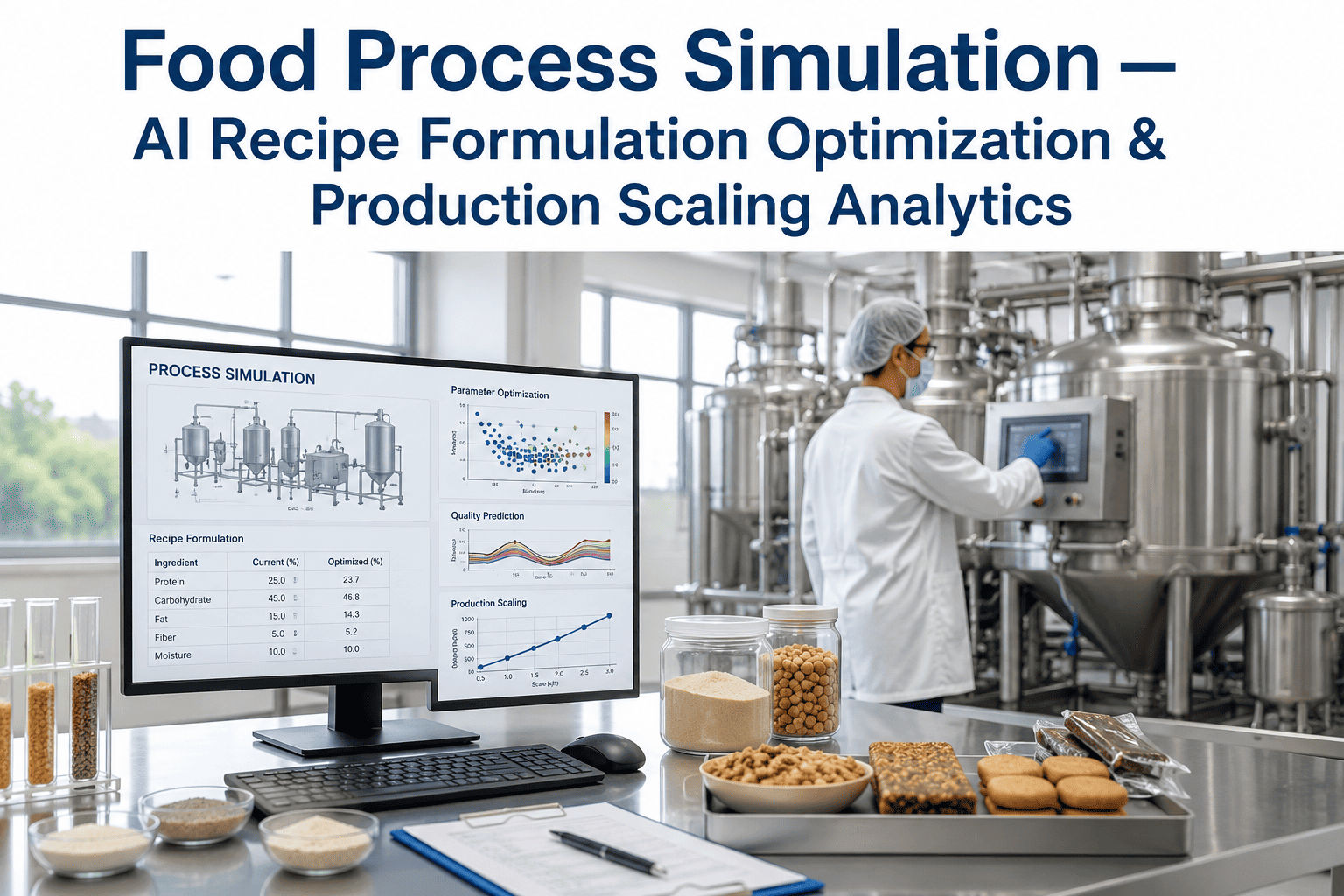
Food process simulation has become a cornerstone of modern food engineering, enabling R&D teams to model, test, and optimize recipes and production parameters without costly physical trials. By leveraging AI-driven analytics, process engineers can now predict how ingredient substitutions affect texture, shelf life, and yield, while also scaling formulations from lab bench to full production with precision. This article explores how AI transforms recipe reformulation, production scaling, and process parameter optimization, providing actionable insights for food manufacturers seeking efficiency and innovation. The integration of machine learning models with historical production data allows for real-time adjustments, reducing waste and accelerating time-to-market. Whether you are reformulating for cost reduction, nutritional improvement, or clean label goals, AI-powered simulation offers a competitive edge. Book a Demo to see how iFactory can streamline your food process simulation.
Transform Your Process Engineering
Simulate, optimize, and scale your food formulations with AI. Reduce trial costs and accelerate innovation.
Recipe Reformulation Modeling
AI models analyze existing recipes and predict outcomes when ingredients are replaced or ratios adjusted. For example, reducing sodium by 30% while maintaining flavor profile can be simulated using neural networks trained on sensory data. This approach cuts weeks of trial-and-error and ensures consistent product quality.
Production Scaling Calculations
Scaling from lab to pilot to full production introduces variables like heat transfer, mixing times, and viscosity changes. AI simulation models these parameters using historical batch data, predicting optimal scale-up factors and identifying potential bottlenecks before they occur.
Ingredient Substitution Prediction
AI predicts how substituting one ingredient with another (e.g., replacing butter with plant oil) affects texture, flavor, and shelf life. Models trained on rheological and chemical data provide substitution recommendations with confidence scores, enabling rapid clean label or allergen-free reformulation.
- Predicts texture changes with 92% accuracy
- Recommends optimal substitution ratios
- Reduces sensory panel iterations by 60%
Process Parameter Optimization
Optimizing parameters like temperature, pressure, and mixing speed is critical for yield and quality. AI algorithms analyze sensor data to find optimal setpoints, balancing energy consumption with product consistency. Real-time adjustments reduce downtime and improve throughput.
| Parameter | Before AI | After AI | Improvement |
|---|---|---|---|
| Temperature (C) | 180 +- 5 | 178 +- 1 | +12% Yield |
| Mixing Time (min) | 12 | 9 | +25% Throughput |
| Pressure (bar) | 2.5 | 2.3 | -8% Energy |
Accelerate Your R&D Pipeline
Leverage AI to simulate, optimize, and scale food processes with confidence. Reduce time-to-market and improve product consistency.
Data Integration
Connect your lab and production data to AI models for continuous learning. Automatically ingest recipe databases, sensor logs, and quality metrics to refine predictions.
Integration Readiness: 95%Real-Time Monitoring
Deploy simulation models to production lines for real-time parameter adjustments. AI detects deviations and recommends corrections before quality drifts.
Uptime: 88%Collaborative Workspace
Enable cross-functional teams to access simulation results, annotate findings, and approve changes. Version control ensures traceability.
Adoption Rate: 78%Data Collection
Gather historical recipe, process, and quality data from lab and production records. Clean and structure for AI training.
Model Training
Train machine learning models to predict outcomes of recipe changes and process adjustments. Validate against known results.
Simulation & Optimization
Run simulations for target recipes or scale-up scenarios. Use optimization algorithms to find best parameter sets.
Deployment & Monitoring
Deploy models to production environment. Continuously monitor performance and retrain with new data.
Case Study: Clean Label Reformulation
A major bakery aimed to replace artificial preservatives with clean label alternatives without affecting shelf life. Using AI simulation, the team tested 150+ substitution combinations in silico, narrowing to 5 candidates for physical trials. The final formulation achieved 12-month shelf life with natural ingredients, reducing development time by 60% and ingredient cost by 15%.
Frequently Asked Questions
How does AI simulate food recipes?
AI models are trained on large datasets of ingredient properties, processing conditions, and sensory outcomes. They learn complex relationships between inputs and outputs, allowing them to predict how changes in a recipe will affect attributes like texture, flavor, and shelf life. For example, a neural network can model the effect of replacing eggs with flaxseed gel in a cake formulation, predicting crumb structure and moisture retention. Book a Demo to see our simulation engine in action.
What data is needed for production scaling simulation?
To accurately simulate production scaling, you need historical batch data from lab, pilot, and full-scale runs. Key parameters include mixing speeds, heat transfer coefficients, viscosity measurements, and final product quality metrics. AI models use this data to identify scaling laws and predict how process parameters should be adjusted at larger volumes. Even with limited data, transfer learning techniques can provide useful predictions. Book a Demo to discuss your data readiness.
Can AI predict ingredient substitutions accurately?
Yes, when trained on relevant chemical, physical, and sensory data, AI models can predict substitution outcomes with high accuracy (often >90%). The key is having a comprehensive dataset that includes rheological properties, flavor compounds, and shelf life measurements. AI can also recommend optimal substitution ratios and flag potential issues like off-flavors or texture changes. Book a Demo to explore our substitution prediction module.
How long does it take to implement AI process simulation?
Implementation timelines vary based on data availability and complexity. A typical pilot project takes 4-8 weeks, including data integration, model training, and validation. Full deployment across multiple product lines may take 3-6 months. Our team provides a structured onboarding process with milestones and training. Book a Demo to get a tailored implementation plan.
What are the cost benefits of AI simulation in food processing?
Cost benefits come from reduced physical trials (saving ingredients, labor, and energy), faster time-to-market (increasing revenue), and optimized yields (reducing waste). Clients typically see ROI within 6-12 months, with average savings of 15-25% on R&D costs and 10-20% on production waste. Book a Demo to calculate your potential savings.
Start Simulating Smarter Today
Empower your process engineering team with AI-driven simulation. Reduce costs, improve quality, and scale faster.