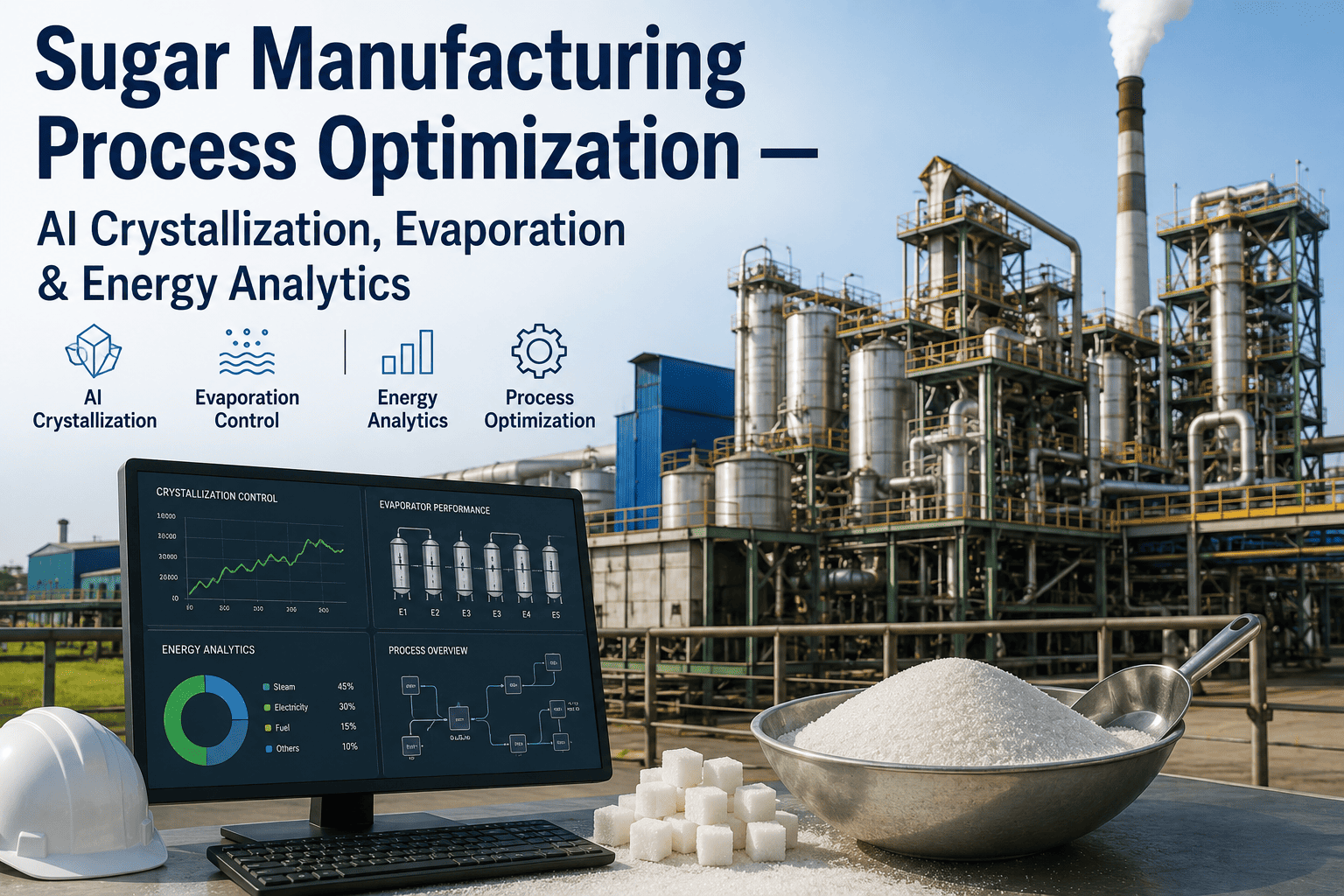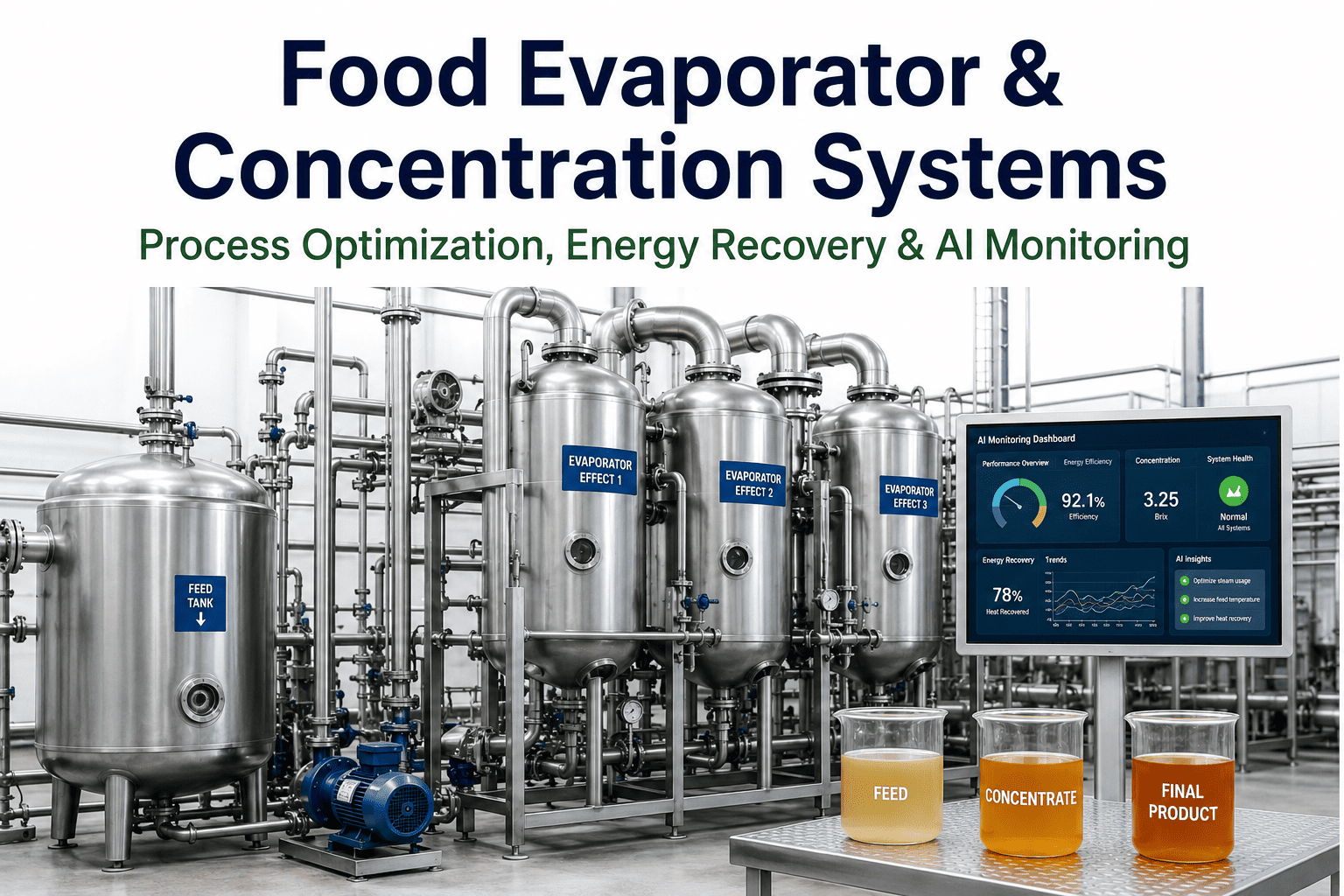
In the competitive landscape of food processing, evaporator and concentration systems are the backbone of product quality and operational cost. Whether you are concentrating fruit juices, dairy products, sugar solutions, or specialty ingredients, the efficiency of your multiple-effect evaporator (MEE) or mechanical vapor recompression (MVR) system directly impacts energy consumption, final product Brix, and overall throughput. Yet many process engineers still rely on manual adjustments and reactive maintenance, leading to suboptimal performance, frequent fouling, and inconsistent quality. Advanced AI-driven optimization is now transforming how these systems are monitored and controlled. By integrating real-time analytics, predictive fouling models, and automated endpoint control, food manufacturers can achieve unprecedented energy savings and product consistency. Book a Demo to see how AI can revolutionize your evaporation process.
Maximize Evaporator Efficiency with AI-Powered Concentration Control
Reduce energy costs by up to 25% and improve Brix accuracy to within 0.1% using real-time machine learning models.
Multiple-Effect Evaporator Optimization
Modern MEE systems can have 3 to 7 effects, each operating at different temperatures and pressures. Traditional control schemes use fixed steam pressure and feed rates, ignoring dynamic changes in feed composition, ambient temperature, and fouling. AI models continuously learn the heat transfer coefficients of each effect, adjusting steam distribution and feed flow to maximize total evaporation rate while minimizing energy per kilogram of water removed. This dynamic optimization can reduce steam consumption by 15-25% compared to static setpoints.
MVR Energy Recovery Intelligence
Mechanical vapor recompression systems reuse vapor from the last effect by compressing it to a higher pressure and temperature, then feeding it back as heating steam. The compressor speed and suction pressure are critical for energy recovery. AI algorithms predict the optimal compressor speed based on real-time vapor flow, temperature lift, and power consumption, ensuring the system operates at its best specific power consumption (kWh per ton of water removed). This reduces electrical energy usage by up to 30% compared to fixed-speed operation.
Brix Endpoint Control with AI
Achieving the exact final Brix is essential for product quality and consistency. Traditional control uses a single refractometer with a PID loop, which often overshoots or undershoots due to process lag. AI models use multi-sensor data including temperature, viscosity, and flow to predict the final Brix in real-time, allowing the system to adjust the evaporation rate before the product reaches the target. This reduces batch-to-batch variation and eliminates reprocessing, saving both energy and time.
Fouling Prediction and Prevention
Fouling in evaporator tubes reduces heat transfer, increases pressure drop, and forces frequent cleaning cycles. AI models analyze historical data of temperature differences, flow rates, and product composition to predict the onset of fouling days in advance. Operators receive alerts to adjust cleaning schedules, optimize chemical dosing, or modify process conditions to slow fouling. This proactive approach reduces downtime by 40% and extends the life of heat transfer surfaces.
Transform Your Evaporation Line Today
Stop wasting energy and product. Our AI platform integrates seamlessly with your existing DCS or PLC to deliver real-time optimization.
Implementation Roadmap for AI-Driven Evaporator Control
Data Collection and Sensor Integration
Install additional temperature, pressure, flow, and Brix sensors at key points across the evaporator train. Connect all data to a centralized historian. Typical setup includes 15-20 data points per effect.
Model Training and Calibration
Use 3-6 months of historical data to train machine learning models for heat transfer coefficient prediction, fouling rate estimation, and Brix trajectory forecasting. Validate against manual lab samples.
Closed-Loop Control Implementation
Deploy the AI models in a soft sensor layer that outputs setpoints to the existing control system. Initially run in advisory mode, then gradually move to closed-loop control for steam pressure, feed flow, and compressor speed.
Continuous Monitoring and Model Retraining
Set up automated dashboards for operators and engineers to monitor model performance. Retrain models monthly or after any major process change to maintain accuracy.
Comparative Analysis of Evaporator Types and AI Impact
| Evaporator Type | Typical Energy Use (kWh/ton water) | AI Energy Reduction Potential | Brix Control Precision | Fouling Frequency |
|---|---|---|---|---|
| Single Effect | 2200 | 10-15% | ±0.5% | Every 2 weeks |
| Double Effect | 1100 | 15-20% | ±0.3% | Every 3 weeks |
| Triple Effect | 733 | 18-25% | ±0.2% | Every 4 weeks |
| MVR (Mechanical Vapor Recompression) | 150 | 20-30% | ±0.1% | Every 6 weeks |
Frequently Asked Questions
How does AI optimize multiple-effect evaporator performance?
AI models use real-time data from temperature, pressure, and flow sensors across all effects to dynamically adjust steam distribution and feed rate. Unlike traditional PID controllers that maintain fixed setpoints, AI continuously learns the heat transfer characteristics of each effect, compensating for fouling, feed composition changes, and ambient conditions. This results in a 15-25% reduction in steam consumption and more consistent product concentration. For a deeper dive into the algorithms, visit our Support page where we provide technical whitepapers and case studies.
What sensors are needed for AI-based Brix endpoint control?
A minimum setup includes an inline refractometer (preferably with automatic cleaning), temperature probes at the evaporator outlet and feed inlet, a flow meter for feed and concentrate, and a density meter for additional validation. The AI model fuses these signals with historical lab data to predict Brix in real-time with an accuracy of ±0.1%. For a complete sensor list and installation guide, check our Support documentation which covers integration with major PLC brands.
Can AI predict evaporator fouling before it affects production?
Yes, by analyzing trends in heat transfer coefficient, pressure drop across effects, and temperature differences, AI can detect the early signs of fouling 24-48 hours before it causes a significant performance drop. The system sends alerts to operators with recommended actions such as changing cleaning cycles or adjusting process parameters. This proactive approach reduces unplanned downtime by up to 40%. Learn more about our predictive maintenance models on the Support page.
What is the typical ROI for implementing AI on an MVR evaporator?
Typical ROI ranges from 6 to 12 months, driven by energy savings of 20-30%, reduced cleaning chemical costs, and increased throughput. For a medium-sized dairy evaporator processing 50 tons per hour, this translates to annual savings of $200,000 to $500,000. The exact figure depends on current efficiency and local energy prices. For a personalized ROI calculation, Book a Demo and our team will analyze your specific system.
How long does it take to deploy an AI optimization solution?
The deployment timeline typically spans 8 to 12 weeks. The first 2-3 weeks are dedicated to sensor installation and data collection, followed by 3-4 weeks of model training and validation. The remaining time is used for system integration, operator training, and a phased transition from advisory to closed-loop control. We provide full support throughout the process. For a detailed project plan, visit our Support page.
Ready to Achieve Peak Evaporator Performance?
Join leading food manufacturers who have reduced energy costs by 25% and improved product consistency with our AI platform.