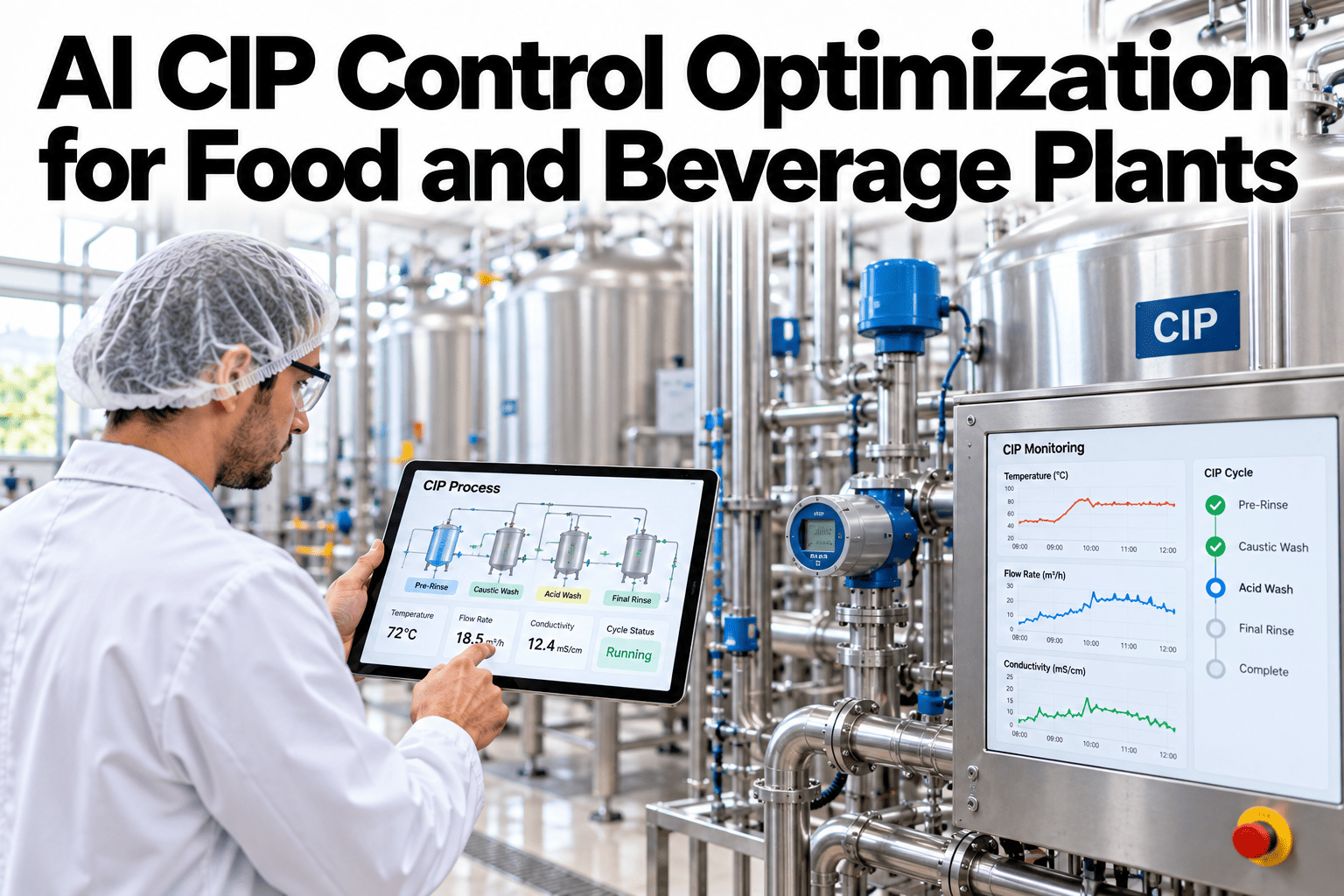
Most clean-in-place cycles run on a timer, not on actual cleanliness. A sanitation engineer sets the chemistry concentration, temperature and cycle length once, usually with a wide safety margin, and every cycle after that runs the same regardless of how dirty the line actually was or how it responded that day. The result is a CIP process that's either running longer than it needs to on an easy day or, more rarely and more dangerously, not quite long enough on a hard one, with nothing in between the two except an operator's manual judgment call. Plant engineers can see how iFactory AI adapts CIP chemistry, temperature and cycle length to what the line actually reads before the next sanitation review.
AI CIP Control Optimization for Food and Beverage Plants
End the cycle when the line actually reads clean, not when a fixed timer says it should be.
Why a Fixed Timer Is Always Wrong, Just Not by Much
A fixed-duration CIP cycle has to be set conservatively, for the dirtiest, hardest-to-clean condition the line might ever see. That means most runs, which aren't that dirty, run longer than necessary.
A run after a short product campaign cleans fast, but still runs the full fixed cycle time regardless.
Close to what the fixed timer was designed for, with limited waste either way.
The exact condition the margin was built for, and the only day the fixed cycle genuinely needs its full length.
A fixed timer can only be right for one of these conditions at a time, which means it's wasting chemistry, water, energy or line time on most of the others.
What Adaptive Control Actually Changes
Three variables respond to real conditions instead of a preset schedule, each with its own cost and quality implications.
| Variable | Fixed Approach | Adaptive Approach |
|---|---|---|
| Chemistry concentration | Set to a conservative level regardless of soil condition | Adjusted based on conductivity or turbidity readings during the cycle |
| Temperature | Held at a fixed setpoint for the full cycle duration | Managed to the minimum needed for effective cleaning at that soil level |
| Cycle length | Runs for a predetermined duration regardless of progress | Ends once return-line readings confirm the line is actually clean |
See What Adaptive CIP Would Look Like on Your Own Line
Book a 30-minute session and iFactory AI will walk through how your current fixed CIP cycle compares against an adaptive one using your own soil and return-line data.
The Signals That Tell the System the Line Is Clean
Ending a cycle early requires trustworthy evidence, not a guess. These are the signals an adaptive system typically relies on.
Tracks chemistry concentration in the return line, showing when rinse water is running clean.
Measures residual soil suspended in the return stream as a direct cleanliness indicator.
Confirms the cleaning solution is actually reaching and contacting every part of the circuit.
Where the Manual Adjustment Habit Actually Hurts
Operators do sometimes adjust CIP parameters manually when they notice something unusual, but that habit introduces its own inconsistency.
Validating the Approach Before Trusting It Fully
Adaptive CIP control touches food safety directly, which means the rollout path matters as much as the technology itself. Confirm any change against your own validated cleaning procedures and regulatory requirements before implementation.
Baseline current cycles
Record existing fixed cycle performance and actual cleanliness outcomes.
Run adaptive in parallel
Test adaptive control alongside the existing process without replacing it yet.
Validate against standards
Confirm cleanliness outcomes meet or exceed existing validated criteria.
Transition with documentation
Move to adaptive control with full records supporting the change.
Plants that successfully adopt adaptive CIP control are the ones that run it in parallel with their existing validated process for a meaningful period before switching over, rather than treating the new system as a drop-in replacement on day one. Cleaning validation in food and beverage manufacturing exists for good reason, and a system that ends a cycle early needs to prove, with logged evidence, that it reached the same or better cleanliness outcome every single time, not most of the time. Build that evidence base deliberately, with your quality and food safety teams involved from the start, rather than after the system is already running on its own.
Where iFactory AI Fits
iFactory AI reads conductivity, turbidity, flow and pressure signals during CIP cycles, adjusting chemistry, temperature and cycle length to match what the line actually needs.
Real-time signal reading
Conductivity, turbidity, flow and pressure are monitored continuously through each cycle.
Adaptive parameter control
Chemistry, temperature and cycle length adjust to match actual soil conditions, not a fixed preset.
Full cycle documentation
Every adjustment and end-of-cycle decision is logged for validation and audit purposes.
Ask in plain language
Ask how much a specific line's CIP cycles vary from the fixed baseline this month and receive a direct answer.
Frequently Asked Questions
Is it safe to end a CIP cycle earlier than the fixed timer specifies?
It can be, but only when the decision is based on validated signals like conductivity and turbidity that reliably confirm the line is actually clean, and only after that approach has been tested and validated against your existing cleaning standards. This is not a shortcut to take without proper validation work first. You can watch adaptive CIP control demonstrated on sample line data in a live session.
How do we validate adaptive CIP control before relying on it?
Run the adaptive system in parallel with your existing fixed-cycle process for a meaningful period, comparing cleanliness outcomes against your validated standards before making the switch, with your quality and food safety teams involved throughout. To plan this validation process, request a validation planning session with the iFactory AI team, or ask support what sensor data is needed.
What sensors does adaptive CIP control typically rely on?
Conductivity and turbidity readings in the return line are the most common cleanliness indicators, often combined with flow and pressure monitoring to confirm the cleaning solution actually reached every part of the circuit, not just that the chemistry was theoretically correct. A short product tour of the signal monitoring setup shows how these work together.
Does adaptive control replace the role of sanitation staff?
No, it changes what they're doing day to day, from manually adjusting cycles based on judgment to reviewing logged, data-driven decisions and handling genuine exceptions, which tends to make their expertise more valuable, not less. See how sanitation teams work alongside adaptive control in a guided walkthrough.
How much variation is typical between a light soil day and a heavy soil day?
It varies significantly by product, line design and soil type, which is exactly why a single fixed cycle time struggles to fit every condition well, and the real answer for your own lines only comes from measuring actual cycle data over time. Schedule a walkthrough of cycle variation analysis to see what this looks like on your own data.
Clean on What the Line Tells You, Not a Timer
iFactory AI adapts CIP chemistry, temperature and cycle length to real line conditions, with every decision logged for validation. Book a walkthrough to see it built around your own CIP process.