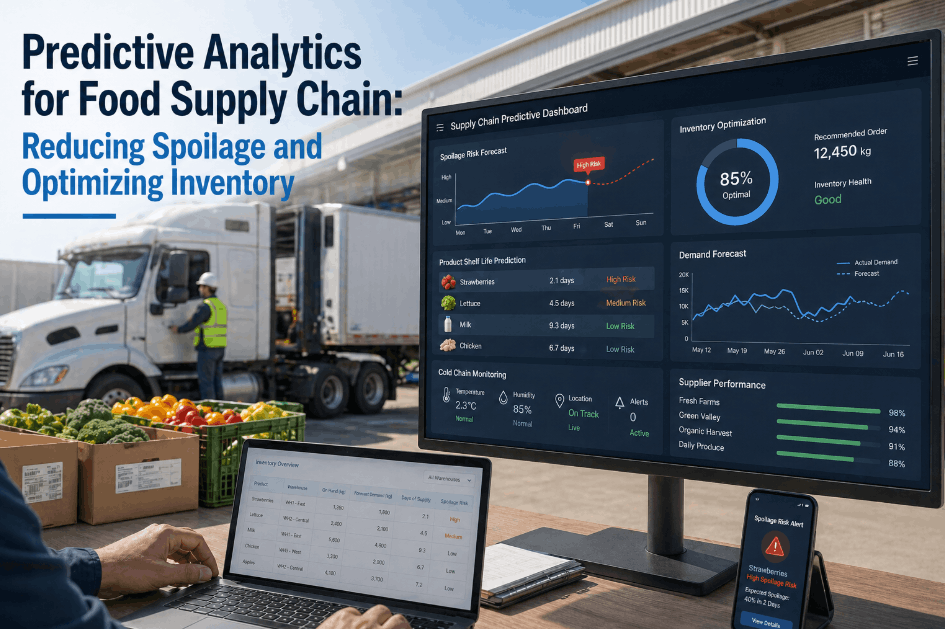
Predictive analytics for food supply chain management is no longer a competitive advantage reserved for the largest global manufacturers — it is rapidly becoming the baseline capability that separates profitable, resilient food businesses from those absorbing preventable losses every quarter. In 2026, supply chain directors who deploy AI-driven demand forecasting, shelf-life prediction, and spoilage reduction systems are eliminating the two costliest inefficiencies in food logistics: excess inventory that expires before it ships, and understocked SKUs that miss demand windows entirely. The financial stakes are precise — global food waste costs the industry over $1 trillion annually, and a significant portion originates inside the supply chain, not at the consumer level. To see how AI-powered supply chain optimization performs inside a live food manufacturing environment, Book a Demo with the iFactory team today.
Why Traditional Food Supply Chain Management Creates Compounding Loss
The Structural Failure of Reactive Inventory Control in Food Logistics
Most food supply chains are still governed by static reorder points and demand plans built from historical sales averages — a methodology that is now actively destructive in a market defined by SKU complexity, compressed shelf lives, and volatile consumer demand. Traditional supply chain software cannot convert operational data into forward-looking inventory decisions fast enough to prevent spoilage events, stockouts, or cold chain failures before they occur. Predictive analytics solves this by replacing lagging indicators with leading signals from machine learning models trained on asset condition, supplier reliability, and perishability curves.
How Predictive Analytics Transforms Food Inventory Optimization
From Historical Averages to Forward-Looking Demand Intelligence
The core shift that AI-driven demand forecasting introduces is the move from consumption history to predictive demand modeling — systems that identify which SKUs are approaching shelf-life thresholds, which distribution nodes are accumulating excess inventory, and which supplier changes are likely to create downstream stockout exposure before they appear on any dashboard. Supply chain directors exploring this capability can Book a Demo and review live demand models built from real food distribution network data.
Six Ways Predictive Analytics Reduces Spoilage Across the Food Supply Chain
Where AI Inventory Management Eliminates Perishable Loss at Every Node
Spoilage reduction requires predictive intelligence applied simultaneously at procurement, the warehouse level, cold chain transit, and the distribution endpoint. To assess which spoilage categories represent the highest financial risk in your network, Book a Demo for a live inventory gap analysis with the iFactory supply chain team.
Core Capabilities of AI-Powered Food Supply Chain Analytics Platforms
What Predictive Intelligence Actually Delivers for Supply Chain Directors
An enterprise-grade predictive analytics platform is not an upgrade to your existing WMS — it is a connected intelligence layer integrating demand signals, inventory positions, cold chain telemetry, and supplier performance into a single decision-support framework that no spreadsheet or standard ERP process can replicate.
Predictive Analytics vs. Traditional Supply Chain Planning: Capability Comparison
Evaluating Food Supply Chain Optimization Platforms for 2026 Operational Requirements
The table below maps critical capability dimensions across three tiers of food supply chain management — from spreadsheet-based planning to purpose-built AI platforms designed for predictive inventory control and spoilage prevention.
| Supply Chain Capability | Spreadsheet / Manual | Standard ERP/WMS | AI Predictive Platform |
|---|---|---|---|
| Demand Forecasting Method | Historical Average | Static Statistical Model | Multi-Variable AI Forecast |
| Shelf-Life Risk Tracking | Manual / FIFO Only | Batch Expiry Date Only | Real-Time Expiry Risk Scoring |
| Cold Chain Monitoring | Post-Trip Logging | Alert at Threshold Only | Predictive Deviation Modeling |
| Spoilage Early Warning | Not Available | Expiry Date Trigger Only | 30–90 Day Predictive Alerts |
| Seasonal Demand Adaptation | Manual Adjustment | Seasonal Index Only | Dynamic Real-Time Recalibration |
| Network Rebalancing Intelligence | Not Available | Manual Planning Only | Automated Transfer Recommendations |
| Supplier Risk Visibility | Not Available | Manual Reporting | Continuous Reliability Scoring |
| Financial Spoilage Exposure Forecast | Post-Write-Off Only | Retrospective Reporting | Predictive Revenue Risk Modeling |
Measured Results: Predictive Analytics in Food Supply Chain Operations
Documented Financial Outcomes Across AI-Driven Food Logistics Deployments
Building the Business Case for Predictive Analytics Investment
Translating Food Supply Chain Intelligence Into Executive Financial Language
The fastest path to executive approval is grounding the business case in three scenarios every CFO recognizes: the value of perishables written off last year, the annual cost of emergency procurement from forecast failures, and revenue lost to seasonal stockouts. In virtually every mid-to-large food distribution operation, these three numbers generate a payback calculation that outpaces platform investment within the first year. Supply chain directors ready to build this case can Book a Demo for a live ROI analysis mapped to their specific network.
Implementation: Deploying AI Predictive Analytics in Food Supply Chains
Integration Architecture Without Operational Disruption
Purpose-built food supply chain AI platforms layer over existing ERP, WMS, and cold chain monitoring infrastructure through standard data protocols — without replacing any validated operational configuration. The standard deployment delivers live demand forecasting and shelf-life risk scoring within six to eight weeks: phase one ingests historical inventory and sales data, phase two activates predictive models on cold chain telemetry, and phase three connects supplier performance analytics to procurement workflows. To begin with a deployment timeline built around your existing systems, Book a Demo with the iFactory engineering team.
Frequently Asked Questions
What is predictive analytics in food supply chain management?
It uses machine learning models trained on demand data, inventory positions, cold chain telemetry, and supplier performance to forecast inventory requirements and identify spoilage risk before it materializes — enabling proactive decisions rather than reactive damage control.
How does AI demand forecasting reduce food spoilage?
By generating accurate SKU-level procurement quantities aligned with predicted consumption windows, AI eliminates over-procurement. Combined with dynamic shelf-life risk scoring, it enables proactive distribution decisions that move high-expiry-risk inventory to high-velocity channels before write-offs occur.
How quickly can food supply chain operations expect ROI?
Most deployments deliver measurable financial outcomes within the first operating quarter — with spoilage reduction and emergency procurement savings appearing within 60 to 90 days. Full platform payback is typically achieved within 9 to 14 months.
Does predictive analytics require replacing existing ERP or WMS systems?
No. AI platforms layer over existing systems through standard integration protocols — adding predictive intelligence without modifying any validated operational configuration. Most food supply chain integrations complete within six to eight weeks with zero live disruption.
What data is required to get started?
Core requirements include historical sales and inventory records, an active SKU catalog with perishability parameters, supplier lead time data, and cold chain telemetry. Most operations have sufficient data for initial model training within the first two weeks of deployment.
How does AI handle seasonal demand variability?
AI forecasting models incorporate production schedules, weather patterns, and promotional calendars alongside real-time demand signals — automatically adjusting procurement quantities and safety stock buffers to reflect seasonal intensity without manual intervention.
Can predictive analytics work across multi-site food distribution networks?
Yes. Multi-site deployments unlock network-level inventory rebalancing — AI identifies inter-facility transfer opportunities that reduce spoilage at overstocked nodes while protecting availability at undersupplied points, typically delivering 12 to 18 percent additional spoilage reduction.