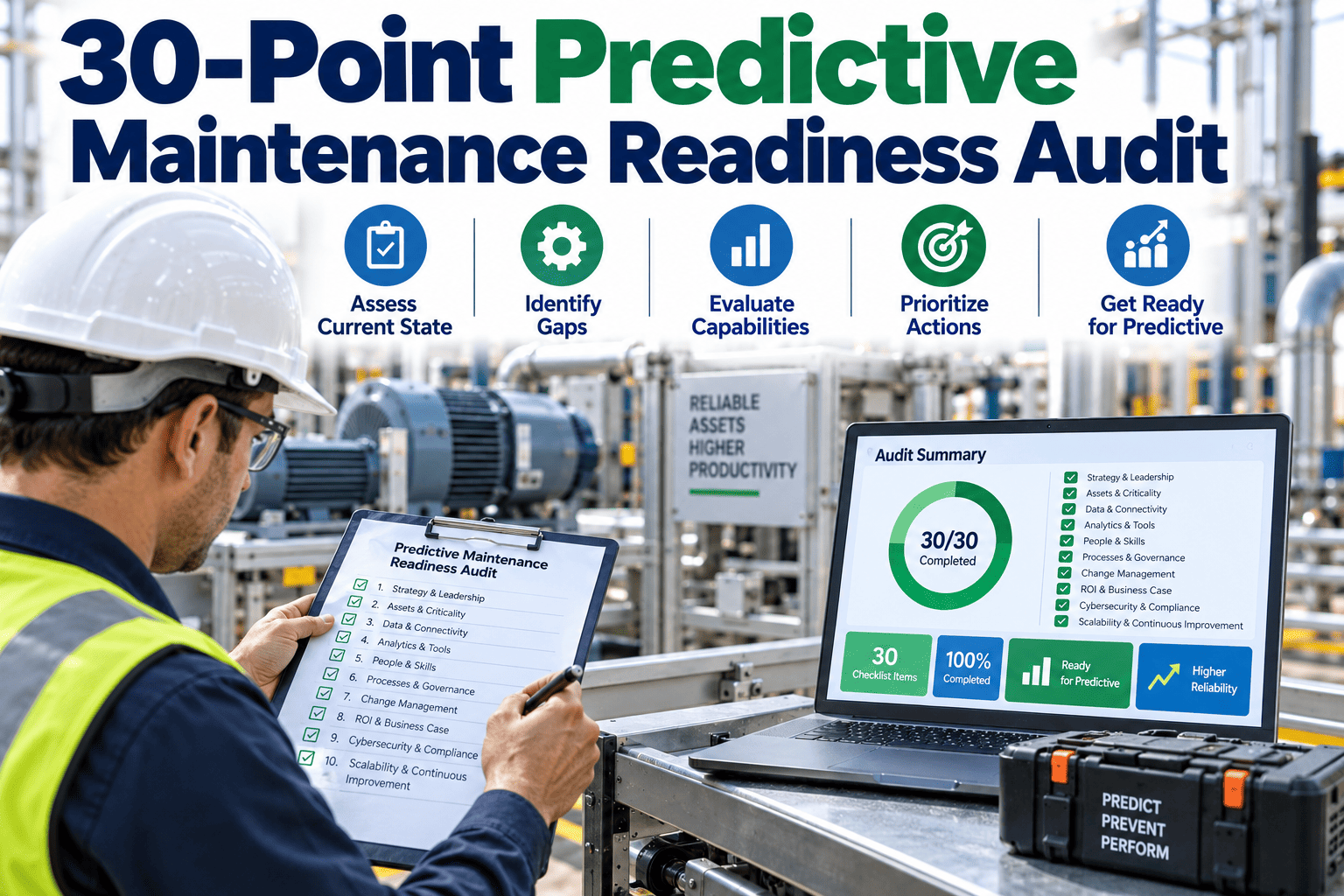
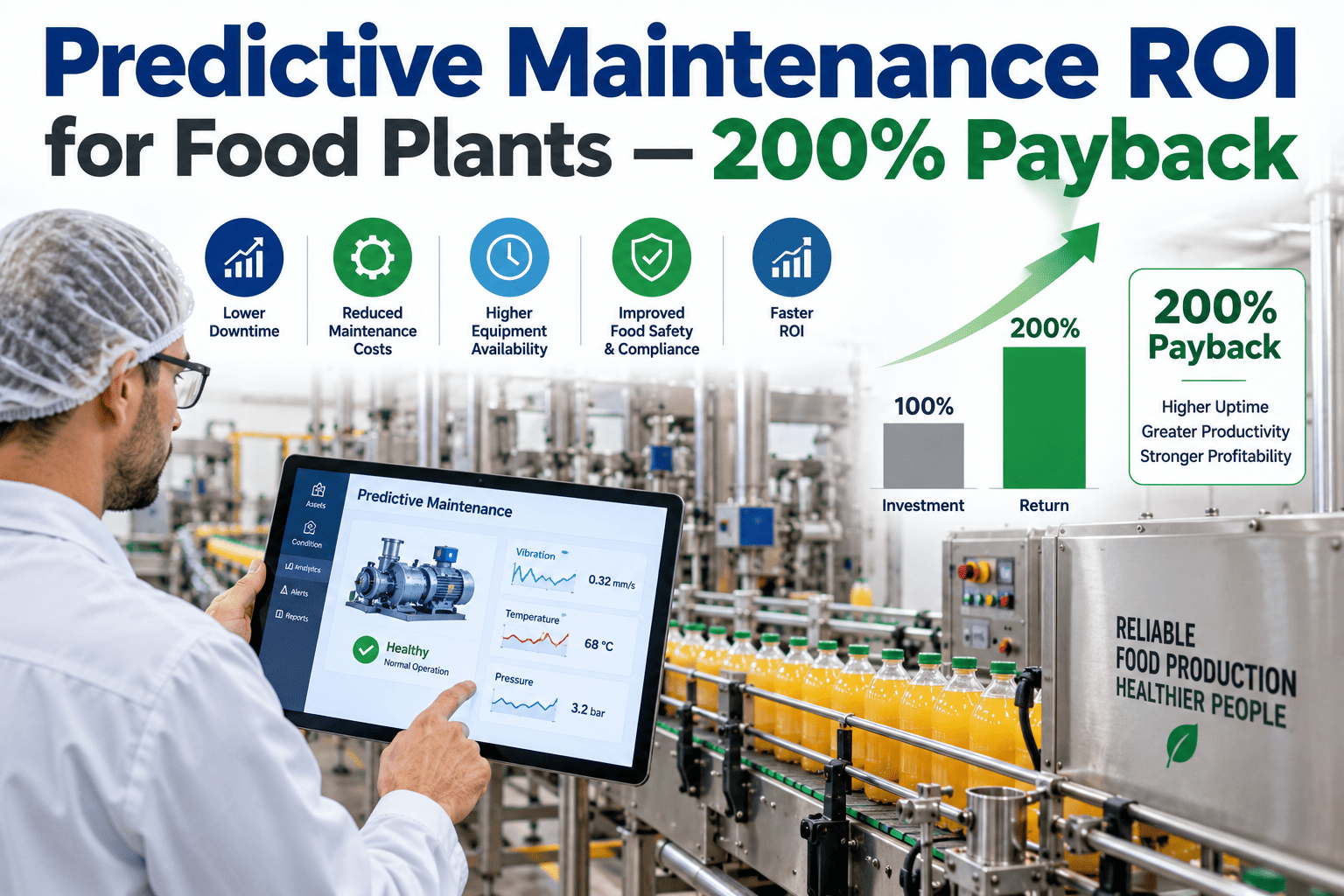
Most predictive maintenance projects don't fail because the algorithms were wrong, they fail because the plant wasn't actually ready for them in ways nobody checked before signing the purchase order. A model can be technically excellent and still produce nothing useful if the sensor data feeding it is unreliable, if there's no clean historical failure record to validate against, or if the maintenance team has no process for actually acting on an alert once it arrives. None of these gaps are visible from a vendor demo, and all of them are exactly the kind of thing a structured readiness assessment is built to surface before real money gets committed. A thirty-point audit across sensor coverage, data infrastructure, model capacity, and organizational readiness gives you an honest score instead of a hopeful guess. If you want to know where your plant actually stands before you commit to a rollout, book a demo to run the full assessment.
FOOD & BEVERAGE · PREDICTIVE MAINTENANCE READINESS
Know Your Score Before You Spend the Budget
iFactory's 30-point readiness audit scores your plant across sensor coverage, data infrastructure, model capacity, and organizational readiness, so you know exactly what to fix before a predictive maintenance rollout, not after.
EXAMPLE SCORE: 22 / 30 — CONDITIONALLY READY
FOUR CATEGORIES, THIRTY POINTS
What Actually Gets Scored
The thirty points split evenly enough across four categories that a weak score in any single area is enough to sink a rollout, regardless of how strong the other three look. That's deliberate, since a predictive maintenance program is only as reliable as its weakest link.
8 PTS
Sensor Coverage
Are the right sensor types installed on the right failure modes, with adequate environmental protection for your actual plant conditions?
8 PTS
Data Infrastructure
Is sensor data actually flowing reliably, stored consistently, and structured in a way a model can train against?
7 PTS
Model Capacity
Is there enough clean historical failure data to validate a model against, and a realistic plan for the training timeline it needs?
7 PTS
Organizational Readiness
Does the maintenance team have a defined process for acting on an alert, and does leadership understand the realistic timeline for results?
SAMPLE QUESTIONS FROM THE AUDIT
A Preview of What Gets Assessed
1Are sensors matched to specific failure modes rather than deployed generically across all equipment?
2Do sensors carry an environmental rating appropriate for washdown or thermal exposure zones?
3Is sensor data flowing continuously with a documented uptime rate above 95%?
4Does at least twelve months of structured failure history exist in a CMMS or equivalent system?
5Are failure codes applied consistently across technicians and shifts?
6Is there a defined escalation path from an AI-generated alert to an actual work order?
7Has leadership been briefed on the realistic 90-180 day model training timeline?
8Is there a named owner accountable for the program's success beyond the initial rollout?
Get your plant's actual readiness score
iFactory can run the full 30-point audit against your plant and hand you a category-by-category breakdown.
WHAT THE SCORE ACTUALLY MEANS
Three Readiness Bands
0-14
Foundational Work Needed
Significant gaps in one or more categories mean a rollout now would likely underperform. Address sensor and data gaps first.
15-23
Conditionally Ready
Strong in some categories, with specific, fixable gaps in others. A targeted remediation plan ahead of rollout is worth the delay.
24-30
Ready to Deploy
Sensor coverage, data infrastructure, model capacity, and organizational buy-in are all strong enough to move directly into rollout.
AUDITED VS UNASSESSED ROLLOUT
What Changes When You Check First
| Factor |
Unassessed Rollout |
Audited, Staged Rollout |
| Sensor gaps |
Discovered mid-deployment, causing delays |
Identified and fixed before deployment starts |
| Data quality issues |
Surface as unreliable model predictions later |
Caught and remediated in the audit stage |
| Leadership expectations |
Often misaligned with the real training timeline |
Set correctly from day one |
| Organizational buy-in |
Assumed, sometimes incorrectly |
Verified with a defined alert-to-action process |
| Overall project risk |
Higher chance of a stalled or underperforming rollout |
Substantially reduced through upfront gap closure |
TURNKEY DEPLOYMENT
How the Audit and Remediation Process Works
What Gets Delivered
A full 30-point score with category-level breakdowns
A specific, prioritized remediation list for any gaps found
A realistic rollout timeline based on your actual starting score
A leadership-ready summary for capex or steering committee review
A re-audit option once remediation items are addressed
Audit Timeline
Week 1: On-site and remote assessment across all four categories
Week 2: Scoring, gap analysis, and remediation plan delivered
Ongoing: Remediation support and re-audit once ready
FREQUENTLY ASKED QUESTIONS
What Plants Ask About the Readiness Audit
What happens if our plant scores low, does that mean predictive maintenance won't work for us?
A low score means specific, identifiable gaps need to be addressed first, not that predictive maintenance is a poor fit for your plant in general, and the audit's real value is telling you exactly which gaps those are rather than leaving you to discover them the hard way mid-rollout. Most plants that score low in one category score reasonably well in others, and the remediation plan is built around closing the specific gaps found rather than treating the whole program as a failure before it's even started.
Book a demo to see what a remediation path looks like for a lower initial score.
How long does the actual audit take to complete?
The core assessment across all four categories typically completes within a single week, combining on-site review of sensor and equipment conditions with a remote review of your existing CMMS data, work order history, and organizational processes. The scoring and detailed remediation plan follow shortly after, generally within a second week, giving you a complete picture with specific next steps well within a month of starting rather than an open-ended engagement.
Contact our support team to schedule an audit against your specific timeline needs.
Can we run this audit ourselves using the sample questions, or does it need to be done by your team?
The sample questions shown give a genuine preview of what's assessed and can absolutely be used as an informal internal gut-check before committing to a formal audit, but the full thirty-point assessment involves technical verification, actual sensor uptime data review, data structure analysis, that goes well beyond what a self-assessment checklist can reliably capture on its own. Most plants find the formal audit valuable specifically because it catches gaps that looked fine on a self-assessment but reveal themselves under closer technical review.
Book a demo to see the difference between a self-assessment and the full technical audit.
Does organizational readiness really matter as much as the technical categories?
Yes, and this is one of the most commonly underestimated categories, since even a technically flawless sensor and data setup produces zero value if there's no clear process for a maintenance team to actually act on an alert once it's generated. Plants with strong technical scores but weak organizational readiness frequently end up with a system that works exactly as designed technically while sitting unused operationally, because nobody was assigned ownership of reviewing alerts or the escalation path from alert to work order was never actually defined.
Contact our support team to discuss how organizational readiness gets assessed and addressed.
How often should a plant re-run this audit once a program is already underway?
An annual re-audit is a reasonable cadence for most plants once a program is operating, since sensor coverage, data quality, and organizational processes can all drift over time even after an initial successful deployment, the same way a maintenance schedule itself can drift without periodic review. A re-audit sooner than that makes sense specifically after a major change, a new production line, a significant equipment addition, or a leadership transition that might affect organizational buy-in and process discipline.
Book a demo to discuss a re-audit cadence appropriate for your specific program.
KNOW WHERE YOU STAND BEFORE YOU SPEND
Get Your Plant's Real Readiness Score
iFactory's 30-point audit scores your plant across sensor coverage, data infrastructure, model capacity, and organizational readiness, so your rollout starts from an honest baseline.