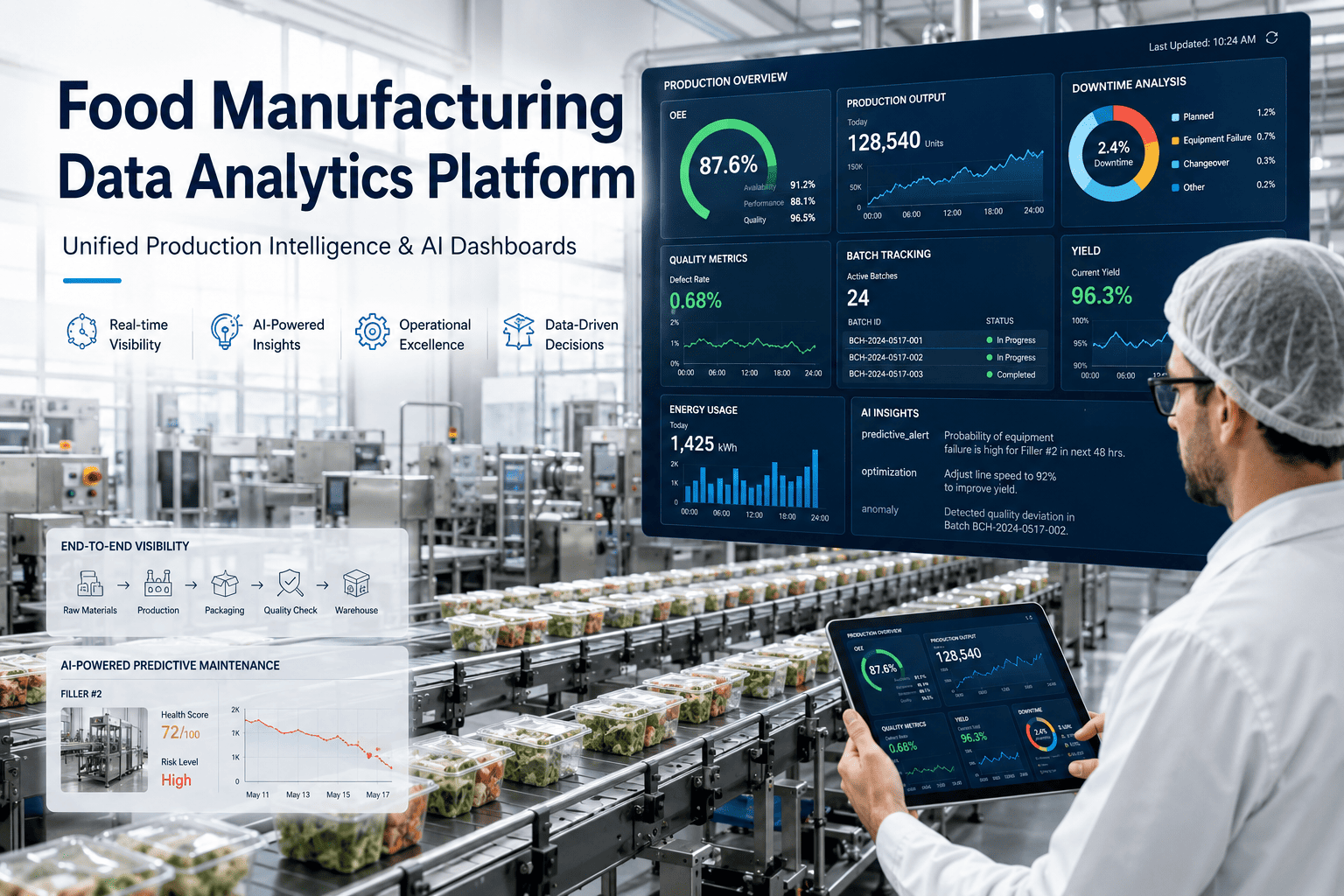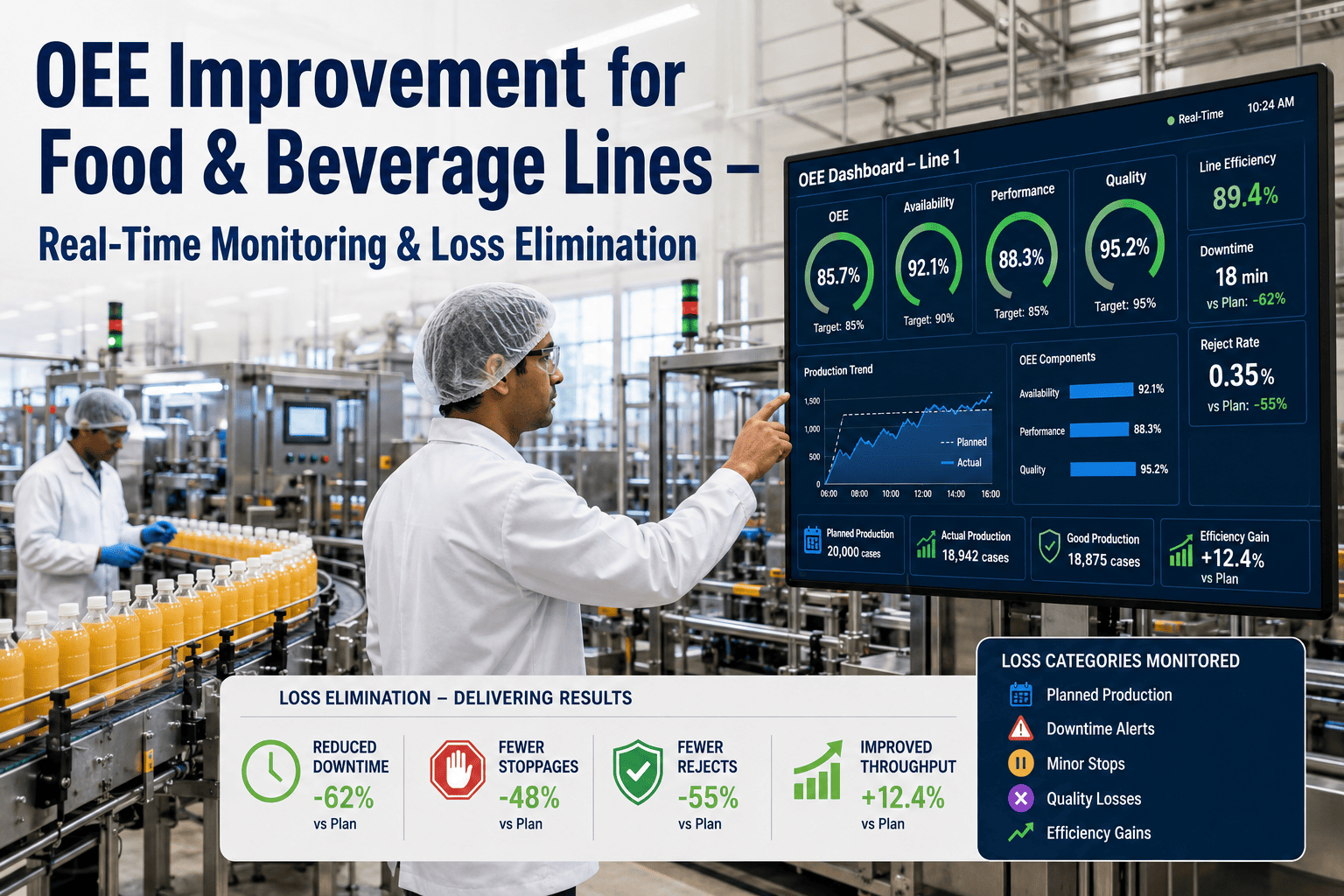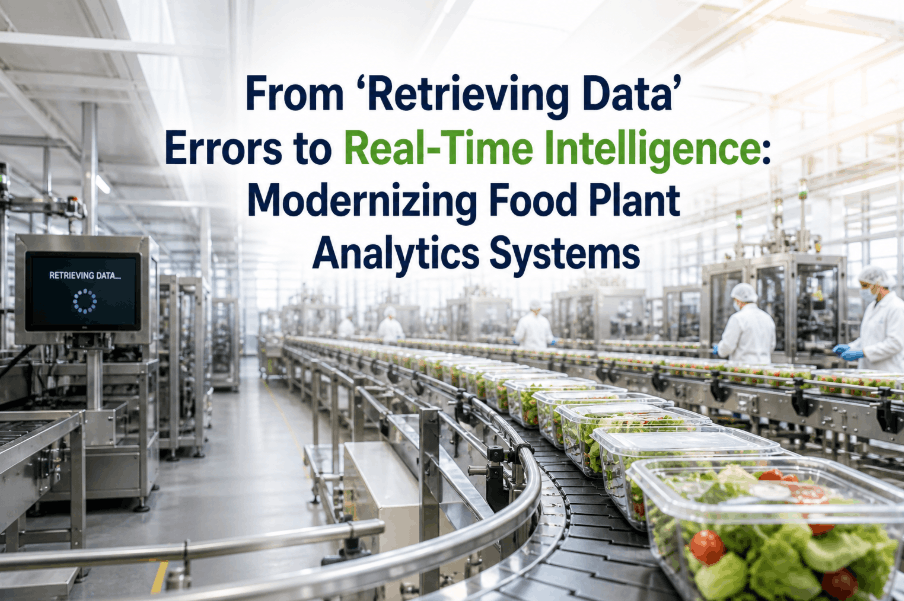
Legacy analytics systems in food manufacturing plants are no longer a manageable inconvenience — they are a direct liability. When operators encounter persistent "Retrieving Data…" errors, frozen dashboards, or multi-minute report delays, the plant is flying blind at the exact moment real-time intelligence is most critical. In 2026, modernizing food plant analytics systems from brittle legacy infrastructure to AI-powered, real-time production intelligence is not a roadmap item — it is an operational imperative. This guide breaks down the root causes of legacy analytics failure in food plants, maps the technical architecture of a modern AI integration layer, and outlines a practical modernization path for plant directors and OT/IT leaders ready to eliminate data retrieval failures for good. If you want to see how iFactory eliminates these exact failure modes in live food plant environments, Book a Demo with our manufacturing intelligence team today.
Why Legacy Analytics Systems Fail Food Plants in 2026
The Technical Root Causes Behind "Retrieving Data" Errors
The "Retrieving Data" error message is not a bug — it is a symptom. Legacy analytics systems in food manufacturing were architected for polling cycles measured in minutes, not the millisecond-level event streams that modern production environments generate. When a pasteurizer temperature sensor fires 40 data points per second, a system designed to query a historian every 60 seconds is structurally incapable of surfacing that signal in real time. The result is the frozen dashboard, the spinning indicator, the stale report — and in regulated food environments, the compliance gap.
Four distinct failure modes account for the vast majority of legacy analytics data retrieval problems in food plants. Understanding each one is prerequisite to selecting the right modernization architecture.
The Cost of Unresolved Legacy Analytics Data Issues in Food Manufacturing
Quantifying the Financial Impact of "Retrieving Data" Failures on Food Plant Operations
Legacy analytics system data retrieval failures are not simply an IT inconvenience — they translate directly into production losses, compliance exposure, and maintenance cost escalation. When predictive analytics intelligence is unavailable because the underlying system is stuck in a retrieval loop, maintenance teams cannot act on early-stage asset degradation signals. A bearing failure that a modern real-time asset monitoring platform would have flagged 14 days in advance becomes an unplanned breakdown event costing $40,000 to $180,000 in a food plant operating three-shift production. You can Book a Demo to see how iFactory's real-time intelligence stack eliminates these failure windows on live food plant equipment.
Beyond maintenance, compliance risk is the hidden cost that most food plant operations leaders underestimate when quantifying legacy analytics limitations. FSMA 204 traceability mandates require complete lot-level data capture at every production stage. A legacy analytics system that drops data during network interruptions or historian polling gaps creates traceability record gaps that regulators treat as documentation failures — not IT incidents. The financial exposure from a single FDA audit finding linked to traceability gaps can dwarf the entire annual cost of a modern predictive analytics intelligence platform.
What Real-Time Asset Monitoring Actually Means for Food Plant Analytics
Beyond Dashboards: The Architecture of Genuine Real-Time Intelligence
The phrase "real-time analytics" has been so widely misapplied in industrial software marketing that food plant decision-makers have become appropriately skeptical of vendor claims. Genuine real-time asset monitoring in a food plant context requires three architectural components working in coordination — and most legacy platforms deliver none of them.
AI Integration Layer: The Technical Bridge From Legacy to Modern Food Plant Analytics
How to Modernize Without Ripping Out Existing Food Plant Infrastructure
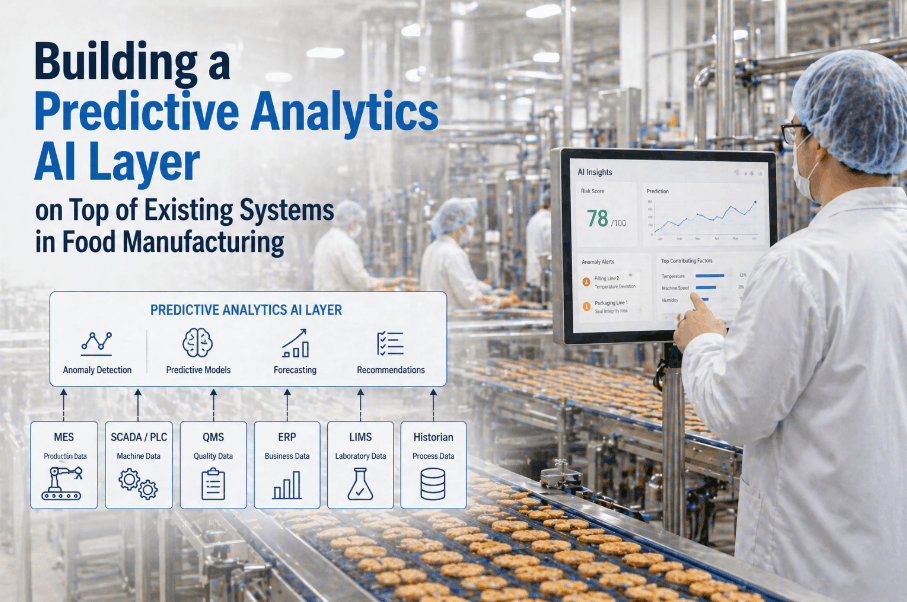
The most common modernization mistake food plant operations leaders make is treating legacy analytics replacement as a full system rip-and-replace project. This framing inflates project cost, extends timeline, and creates organizational resistance that derails deployments before first value is delivered. A modern AI integration layer sits above existing plant systems — connecting to SCADA historians, CMMS databases, and quality management systems via standard APIs — without requiring replacement of the underlying infrastructure. The AI layer normalizes, enriches, and applies machine learning models to data that already exists in the plant, surfacing predictive analytics intelligence that the legacy system was structurally incapable of generating. Food plant IT leaders can Book a Demo to review iFactory's integration architecture against their specific plant system stack before committing to any commercial discussion.
| Capability | Legacy Analytics System | AI Integration Layer (Modern) |
|---|---|---|
| Data Retrieval Architecture | Polling / Batch Export | Event-Driven Streaming |
| OT Network Compatibility | Cloud-Only, No Edge | Hybrid Edge + Cloud |
| Cross-System Data Normalization | Manual Configuration Required | Automated Context Graph |
| Predictive Maintenance Models | Rule-Based Thresholds | FMCG-Trained ML Models |
| Failure Detection Window | Post-Event Alerts Only | 14–60 Day Prediction Window |
| FSMA 204 Traceability | Manual Documentation | Automated Lot-Level Capture |
| Operator Interface | Desktop-Only Reports | Mobile-First AI Copilot |
| Time to First Insight | 6–14 Months | 4–8 Weeks |
5-Step Modernization Roadmap for Food Plant Analytics Systems
A Practical Path From Legacy Data Retrieval Failures to Predictive Intelligence
Modernizing a food plant's analytics infrastructure does not require a single high-risk cutover. The five-step roadmap below has been executed across food and beverage facilities ranging from single-site operations to multi-plant global manufacturers — and is structured to deliver measurable value at each phase rather than deferring ROI to a final deployment milestone.
Selecting the Right Predictive Analytics Intelligence Platform for Your Food Plant
Evaluation Criteria That Separate Genuine AI Capability From Marketing Rebranding
The food plant analytics software market in 2026 is saturated with vendors who have rebranded legacy rule-based alerting systems under AI-forward messaging. The evaluation criteria below are specifically designed to surface genuine predictive analytics intelligence capability versus upgraded dashboards on legacy polling architectures. Apply every criterion as a mandatory evaluation gate — not as a weighted scoring factor.
Frequently Asked Questions
What causes "Retrieving Data" errors in food plant analytics systems?
These errors are caused by polling-based historian architectures, OT/IT network segmentation without edge buffering, schema fragmentation across production systems, and the absence of an AI integration layer capable of resolving cross-system query timeouts. They are structural limitations of legacy analytics design, not network configuration problems that can be patched.
Can a modern AI integration layer work without replacing existing SCADA or CMMS systems?
Yes. A purpose-built AI integration layer connects to existing SCADA historians, CMMS databases, QMS platforms, and ERP systems via standard APIs without requiring infrastructure replacement. Food plants typically achieve first predictive analytics insights within 4 to 8 weeks of data ingestion, while legacy systems remain operational in parallel.
How does real-time asset monitoring differ from legacy SCADA alarm systems?
Legacy SCADA alarm systems fire threshold-based alerts after a process variable exceeds a predefined limit — meaning the anomaly has already occurred. Real-time asset monitoring with predictive analytics intelligence detects degradation patterns in multi-variable sensor data 14 to 60 days before a failure threshold is crossed, enabling planned maintenance intervention rather than emergency response.
Is predictive analytics intelligence suitable for air-gapped food plant OT environments?
Purpose-built predictive analytics platforms support hybrid deployment — running AI inference models on edge hardware inside the OT zone while synchronizing processed analytics to cloud for cross-site benchmarking. Cloud-only platforms are architecturally incompatible with air-gapped food production environments without unacceptable security compromises.
What ROI should food plant operators expect from analytics modernization?
Documented food plant deployments show 22 to 38 percent reduction in unplanned downtime, 15 to 31 percent OEE improvement, and full platform payback within 6 to 14 months. Outcome-based commercial structures — where the vendor shares a percentage of documented gains rather than charging upfront license fees — are available for plants that require zero-capital-risk deployment models.
How long does it take to eliminate "Retrieving Data" errors after deploying a modern platform?
Most food plants see complete elimination of analytics data retrieval failures within the first 30 days of AI integration layer deployment on targeted production assets. Full plant coverage including FSMA traceability automation and cross-system context graph integration typically completes within 12 to 22 weeks depending on facility complexity and the number of connected production systems.