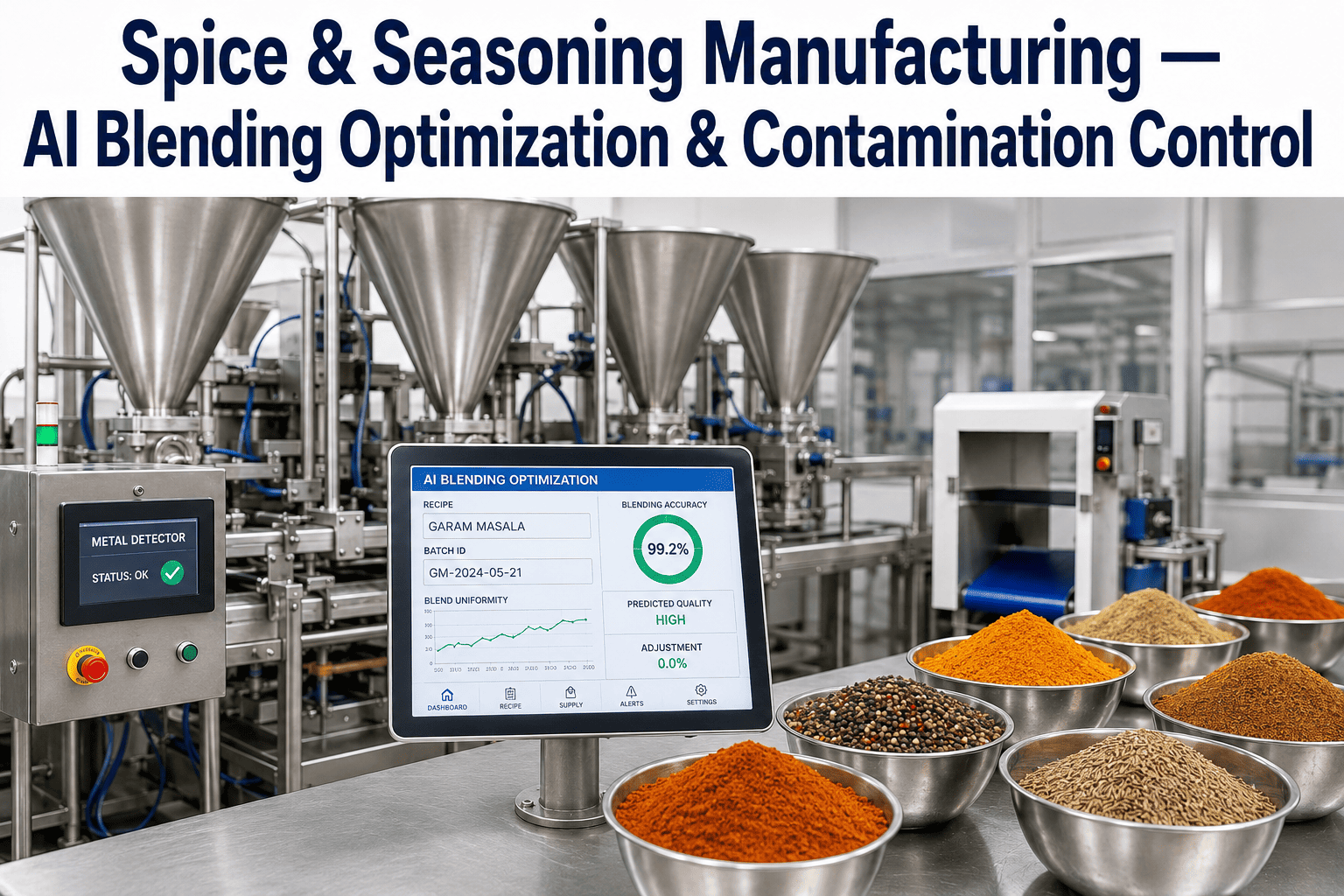
Spice is one of the highest-risk categories in food manufacturing for foreign material and contamination, precisely because it comes from agricultural sources across the world, moves through long supply chains, and gets used in tiny quantities where a small defect is proportionally large. Plant Managers running spice and seasoning blending lines are expected to hold proportioning accuracy, manage cross-contact between allergen-containing blends, and pass micro testing consistently. Book a demo to see how AI-driven blending and detection controls reduce that risk across every batch.
Spice & Seasoning Manufacturing
Consistent Blends, Controlled Contamination Risk, Batch After Batch
AI-driven proportioning, moisture control, and foreign material detection for spice and seasoning blending lines — built to hold consistency across raw materials that vary lot to lot by nature.
Why Spice Carries Elevated Risk
Three Reasons Spice and Seasoning Blending Needs Tighter Controls Than Most Categories
Agricultural Origin, Long Supply Chains
Spices are harvested, dried, and often processed in multiple countries before reaching a blending facility, and each transfer point is an opportunity for foreign material or microbial contamination to enter the supply chain.
Small Usage Rates Magnify Small Errors
Because seasoning blends are used in small proportions in a finished food product, a proportioning error in the blend itself carries forward disproportionately into flavor, and in the case of allergen ingredients, into safety.
Allergen Segregation on Shared Blending Equipment
Facilities producing dozens of seasoning blends on shared equipment need validated cleaning and segregation between allergen-containing and allergen-free runs, and a missed step creates real cross-contact risk.
The Blending Process
Where Controls Need to Sit Across a Typical Spice Line
Raw Material Intake
→
Foreign Material Screening
→
Moisture Verification
→
Proportioned Blending
→
Micro Testing & Release
Foreign material screening and moisture verification both need to happen before blending, not after, because once ingredients are combined, isolating which raw material introduced a problem becomes far harder.
iFactory Screens, Proportions, and Traces Every Blend Automatically
Foreign material detection, moisture-controlled proportioning, and batch traceability configured for your specific blend formulations and allergen segregation needs.
Manual vs. AI-Assisted Blending Control
What Changes When Screening and Proportioning Run Continuously
Category
Manual Process
Continuous AI Control
Foreign Material
Caught by periodic visual sampling of incoming lots
Every incoming lot screened before it reaches blending
Proportioning Accuracy
Verified by weighing finished blend samples after the fact
Each ingredient's dose tracked in real time during blending
Allergen Segregation
Cleaning verification relies on manual sign-off sheets
Changeover steps logged and time-stamped automatically
Batch Traceability
Ingredient lots linked to blends through paper batch tickets
Every ingredient lot linked automatically to the finished blend
We produce close to sixty different seasoning blends on shared equipment, several of which contain allergen ingredients like mustard and celery, and our changeover process relied entirely on operators following a checklist correctly every single time. A missed cleaning verification step on one changeover led to a customer complaint that took us most of a week to fully investigate and resolve. After we put automated changeover logging in place tied to each blend's allergen profile, that same kind of gap gets flagged before the next blend can even start running, and our micro testing pass rate improved along with it.
— Plant Manager, Spice and Seasoning Manufacturer
Frequently Asked Questions
What Plant Managers Ask About AI-Driven Spice Blending Control
How does foreign material detection actually work on raw spice?
Incoming lots are screened using imaging and sensor-based detection tuned to the specific raw material, since foreign material that stands out clearly in a light-colored spice may be far harder to spot in a dark one. The system is configured per ingredient so detection sensitivity matches what that specific spice or seasoning component actually looks like when it is clean.
Can this help with allergen segregation across dozens of different blend formulations?
Yes. Each blend formulation is tagged with its allergen profile, and changeover requirements between runs are tracked against that profile automatically, so a cleaning or segregation step required before an allergen-free blend follows an allergen-containing one is logged and verified rather than left to memory.
Contact support to review how this maps to your specific product list.
Does this replace our micro testing program?
No, it does not replace laboratory micro testing, which remains the verified release check for pathogens like Salmonella. What continuous monitoring adds is tighter control over the conditions, such as moisture content and cross-contact risk, that most often drive a micro testing failure in the first place, which can reduce how often a batch fails testing at all.
How is proportioning accuracy tracked during blending?
Each ingredient's dose is measured as it is added to the blend and compared against the target formulation in real time, so a scale drift or dosing error is caught during the batch rather than discovered afterward through a finished blend assay. This is particularly important for blends where a single ingredient, like a spice extract or colorant, is dosed at a very small percentage of the total batch weight.
What does implementation look like for a facility running many small-batch blends?
Facilities with a high number of blend formulations typically start with the highest-volume or highest-risk blends first, validating detection and proportioning accuracy on those before expanding formulation coverage across the rest of the product list.
Book a demo to talk through a rollout sequence for your specific blend portfolio.
A Blend Used in Small Amounts Still Needs Large-Scale Control Behind It.
Foreign material detection, moisture-controlled proportioning, and allergen-aware batch traceability — configured for your blending lines, reviewed with your quality team before go-live.