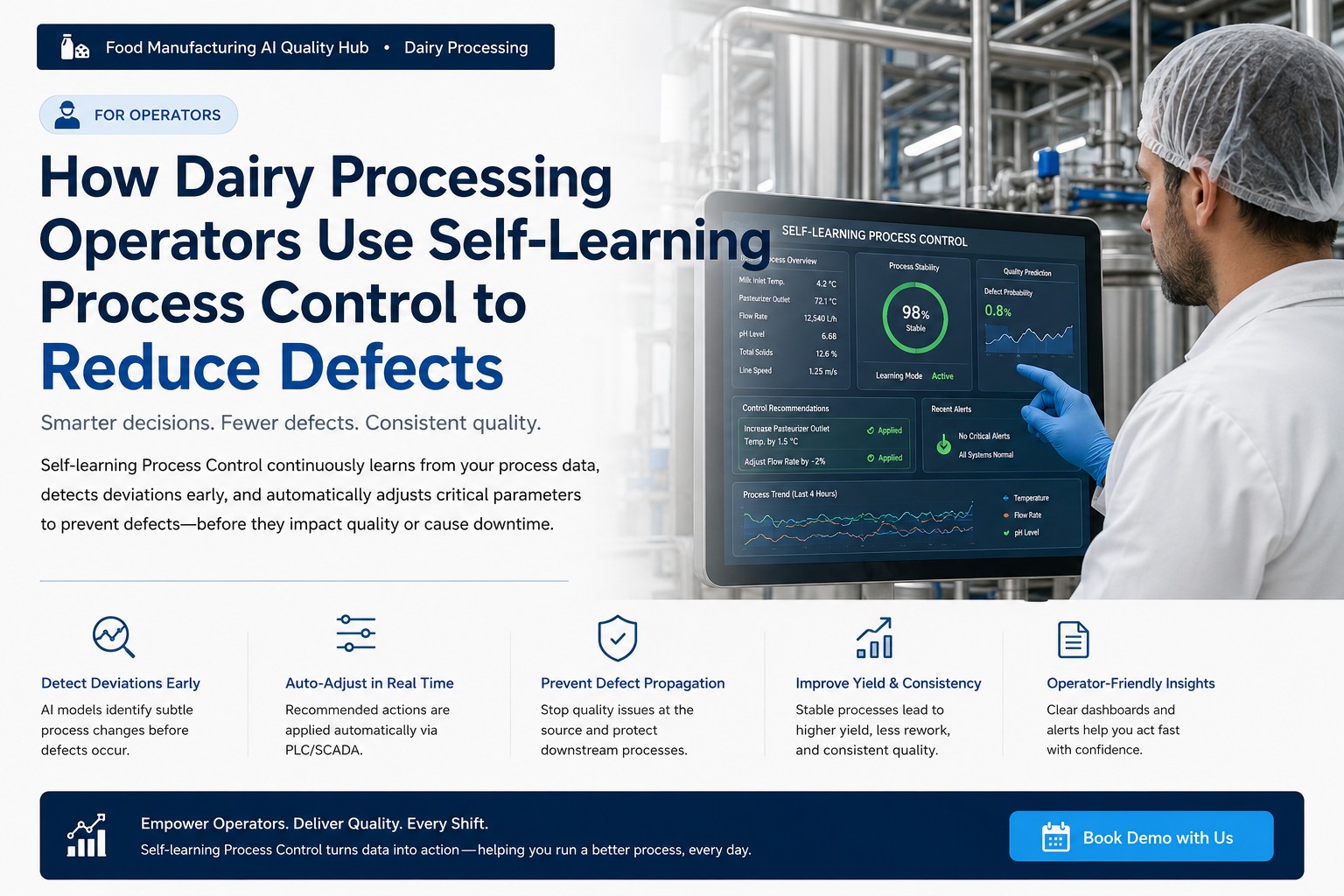
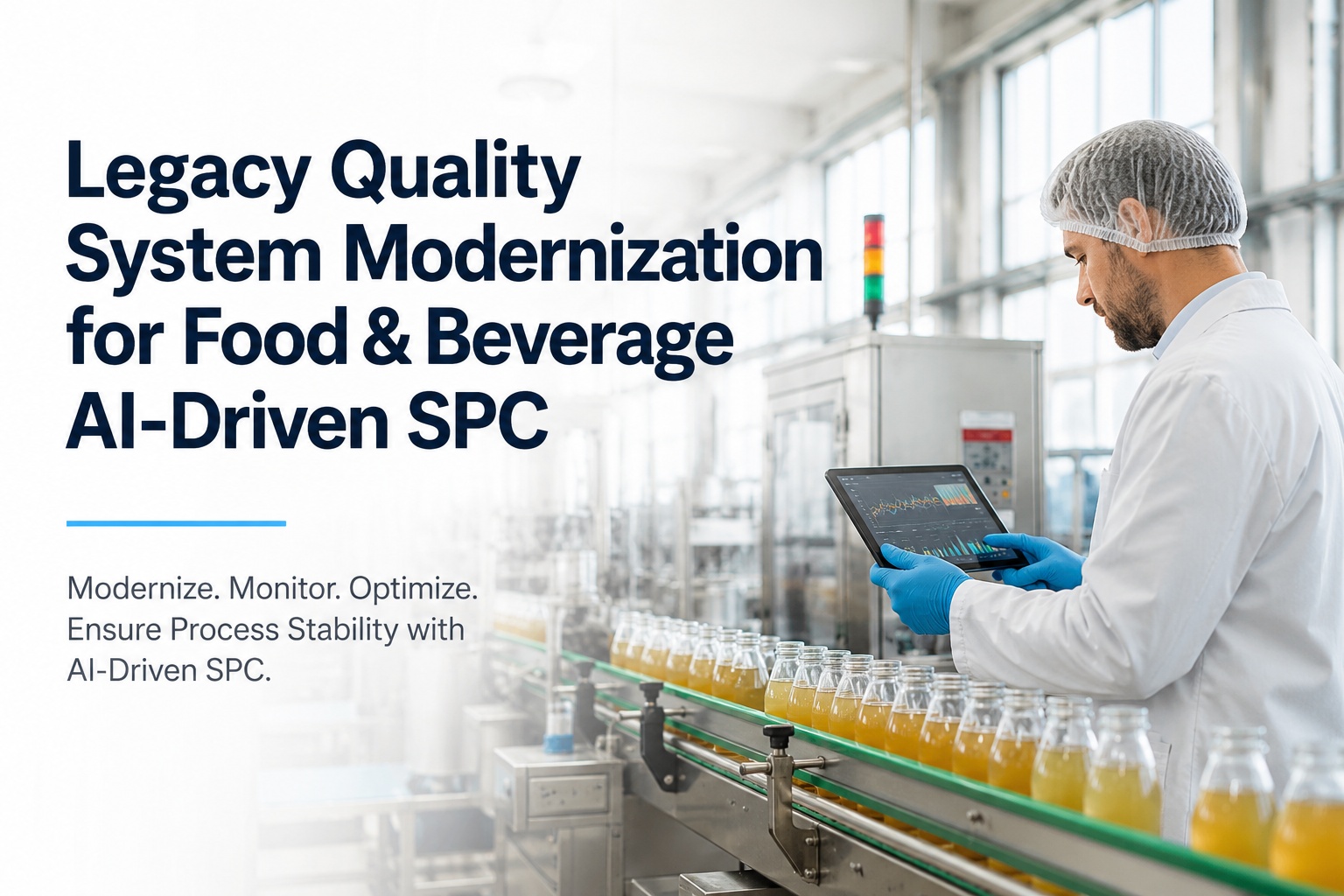
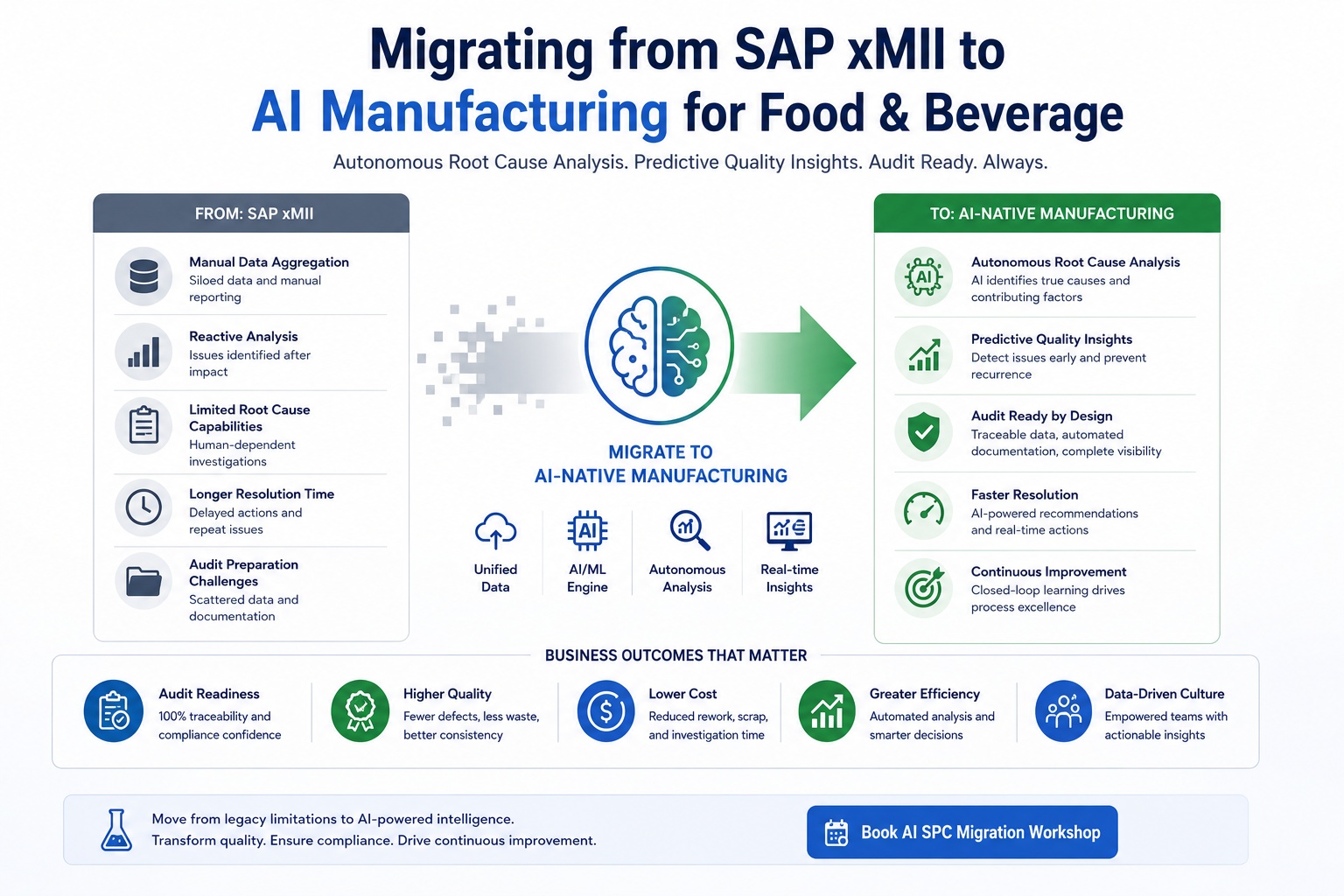
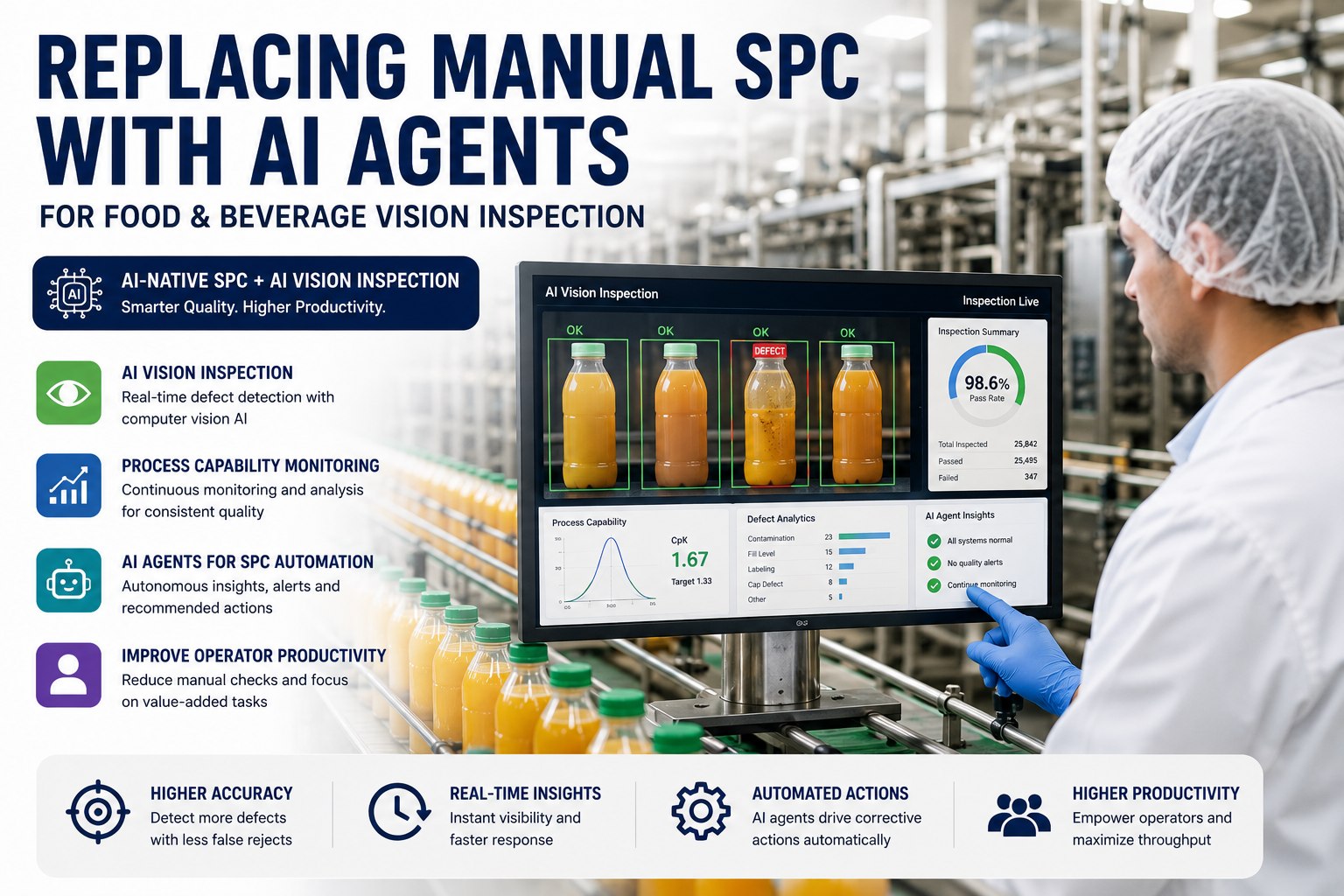
AI-driven software for food and beverage plants is no longer a competitive advantage — it is rapidly becoming the operational baseline for facilities that want to reduce downtime, automate compliance, and maintain consistent product quality at scale. From predictive maintenance to real-time OEE dashboards, AI-powered manufacturing intelligence platforms are fundamentally transforming how food processing plants operate, comply, and compete in 2026. If your plant is still relying on spreadsheets, paper logs, and disconnected systems, you are leaving measurable ROI on the table every single shift.
AI-DRIVEN ANALYTICS
·
FOOD MANUFACTURING
·
OEE IMPROVEMENT
See How AI-Driven Software Transforms Food & Beverage Operations — Live Demo
iFactory's AI-powered platform connects every system in your food plant — from sanitation scheduling and spare parts management to compliance documentation and real-time production analytics — delivering measurable OEE improvement, reduced downtime, and automated audit readiness from day one.
Why Food and Beverage Plants Are Adopting AI-Driven Software in 2026
The food and beverage manufacturing sector faces a convergence of pressures that manual systems simply cannot handle: tighter FDA FSMA enforcement, escalating consumer safety expectations, labor shortages, and margin compression from volatile raw material costs. AI-driven food manufacturing software addresses all of these simultaneously by replacing reactive, human-dependent workflows with intelligent, automated systems that learn, predict, and act in real time.
Plant managers who have deployed AI-powered analytics platforms consistently report three transformative outcomes within the first 90 days: significant reductions in unplanned downtime, measurable improvement in Overall Equipment Effectiveness (OEE), and a dramatic reduction in compliance documentation labor. The ROI case is no longer theoretical — it is documented across hundreds of food and beverage facilities worldwide. To explore what this looks like for your plant, book a demo and see the platform in action.
34%
average OEE improvement in food plants within 6 months of AI platform deployment
62%
reduction in unplanned downtime through AI-powered predictive maintenance scheduling
89%
of food plant managers report faster regulatory audit preparation after AI software deployment
$1.4M
average annual savings per facility from combined downtime reduction and compliance automation
Complete Benefits Overview
Top 15 Benefits of AI-Driven Software for Food and Beverage Plants
These are the proven, measurable benefits that food and beverage manufacturers are realizing after deploying AI-powered manufacturing intelligence platforms. Each benefit is drawn from documented operational outcomes across real food processing facilities.
01
Predictive Maintenance & Reduced Downtime
AI analyzes equipment sensor data to predict failures 72–96 hours in advance, reducing unplanned downtime by up to 62% and extending asset lifespan across production lines.
02
Real-Time OEE Improvement
Live dashboards track Availability, Performance, and Quality simultaneously — exposing hidden efficiency losses and enabling shift supervisors to act in real time instead of reviewing yesterday's data.
03
Automated Sanitation Scheduling
AI optimizes cleaning-in-place (CIP) and sanitation workflows based on production schedules, allergen changeovers, and microbial risk — eliminating manual scheduling errors that create food safety gaps.
04
Intelligent Spare Parts Management
Machine learning forecasts parts consumption based on equipment age, usage cycles, and failure history — preventing stockouts that cause extended downtime and eliminating excess inventory carrying costs.
05
Automated Compliance Documentation
Every CCP record, HACCP log, and corrective action report is generated and timestamped automatically — delivering audit-ready documentation in minutes and eliminating 80%+ of manual compliance labor.
06
AI-Powered Quality Control
Computer vision and sensor fusion detect defects, weight deviations, and fill level variances at line speed — catching quality failures before finished products reach packaging or distribution.
07
End-to-End Lot Traceability
Bidirectional traceability from raw material receipt to finished goods shipment is maintained automatically — enabling sub-10-minute mock recalls and full FSMA 204 compliance without manual data correlation.
08
Energy Consumption Optimization
AI models identify energy waste patterns across refrigeration, compressed air, and HVAC systems — reducing utility costs by 15–28% without impacting production output or food safety controls.
09
Supplier Risk Monitoring
Automated supplier compliance dashboards track certificate expiration, COA results, and audit scores in real time — blocking non-compliant ingredients from production before they create recall exposure.
10
Production Scheduling Optimization
AI-driven production planning balances demand forecasts, changeover times, allergen sequencing, and equipment availability — maximizing throughput while minimizing costly unplanned changeovers and waste.
11
Environmental Monitoring & Trend Analysis
Continuous pathogen indicator monitoring data is analyzed for trend deviations — flagging emerging contamination risks 3–5 days before they reach positive-test thresholds that trigger shutdown protocols.
12
Labor Productivity Analytics
Real-time labor efficiency tracking across lines and shifts identifies productivity gaps, overtime patterns, and training needs — enabling plant managers to optimize workforce deployment without adding headcount.
13
Waste & Yield Optimization
AI correlates raw material variability, processing parameters, and yield outcomes to identify root causes of giveaway and waste — typically recovering 1.5–4% of production yield within the first quarter of deployment.
14
Recall Risk Detection & Prevention
Machine learning scans across quality, traceability, supplier, and CCP data simultaneously to flag recall-triggering risk patterns before contaminated product reaches distribution — protecting brand equity and recall costs.
15
Continuous Improvement & Benchmarking
AI platforms generate performance benchmarks against industry standards and historical baselines — turning every production shift into a structured continuous improvement opportunity with measurable, data-driven KPIs.
Deep Dive
How AI-Driven Software Delivers ROI for Food Manufacturing Plants
Understanding AI-driven ROI in food processing requires looking beyond individual feature lists to the compounding effect of integrated intelligence across your entire operation. When predictive maintenance eliminates an unplanned line stoppage, that single intervention typically prevents $18,000 to $45,000 in lost production, overtime labor, and emergency parts costs. Multiply that across a 250-day production year, and the financial case becomes undeniable.
Downtime Reduction: The Highest-Impact AI Benefit for Food Plants
Unplanned equipment failure is the single largest source of recoverable loss in food and beverage manufacturing. The average food plant loses 8–12% of annual production capacity to unplanned downtime — a figure that AI-powered predictive maintenance consistently cuts by more than half. By continuously analyzing vibration signatures, temperature trends, motor current draw, and cycle count data, AI platforms identify failure precursors that human operators and scheduled maintenance intervals consistently miss.
Plant managers who want to see exactly how predictive maintenance analytics would perform against their current equipment baseline can book a demo with our engineering team for a facility-specific ROI projection.
OEE Improvement: Measuring What AI Actually Changes
Overall Equipment Effectiveness is the North Star metric for food manufacturing efficiency, but most facilities calculate it retrospectively using data that is 24 to 72 hours old. AI-driven OEE monitoring changes this fundamentally by calculating Availability, Performance, and Quality scores in real time — at the line level, machine level, and shift level simultaneously. When a filling machine begins running at 94% of target speed due to a worn seal, the AI platform flags the performance loss, correlates it with maintenance history, and generates a work order before the machine drops below 85% — preserving OEE before it degrades.
AI-Driven vs. Traditional Food Plant Operations — Performance Comparison 2026
Compliance & Food Safety
AI-Driven Food Safety Compliance: FSMA 204, HACCP, and GFSI Automation
Food plant compliance automation is one of the most immediately measurable benefits of AI-driven software — and one of the most underappreciated before deployment. The average food and beverage plant dedicates 14 to 22 hours of skilled labor per week to compliance documentation: HACCP records, CCP monitoring logs, corrective action reports, supplier verification records, and environmental monitoring summaries. AI platforms eliminate this labor by capturing every data point automatically, timestamping every event, and generating formatted compliance reports on demand.
FSMA 204
FDA Food Traceability Rule Compliance — Automated
AI platforms automatically capture all Critical Tracking Events (CTEs) and Key Data Elements (KDEs) required under FSMA Section 204 — maintaining electronic records for every transformation, shipping, and receiving event in a searchable, FDA-accessible format. Lot identification that previously took 18+ hours is delivered in under 8 minutes, exceeding the 24-hour regulatory requirement by a factor of 180.
HACCP
Automated HACCP Monitoring and Corrective Action Documentation
Every CCP monitoring record — temperature readings, metal detector verification, pH measurements, water activity values — is automatically captured, linked to the specific lot codes produced during that monitoring window, and stored in a tamper-evident digital record. When a critical limit deviation occurs, the AI platform automatically generates a corrective action record, flags affected lots, and escalates to supervisors — all without human intervention.
GFSI
SQF, BRC, and FSSC 22000 Audit Readiness — Continuous
GFSI certification schemes require documented evidence of traceability system performance, including timed mock recalls. AI platforms maintain continuous audit readiness by automatically logging every production event, supplier interaction, and quality outcome — generating the complete documentation package required for SQF, BRC, and FSSC 22000 audits in minutes rather than days of pre-audit scramble.
Implementation
How to Deploy AI-Driven Software in a Food and Beverage Plant — Getting Started
Modern AI-driven food manufacturing platforms are designed to layer on top of existing infrastructure through API connections and sensor integrations — delivering measurable results within 45 days without operational disruption. If you are evaluating where to start, book a demo for a custom implementation roadmap built around your current systems.
Audit & System Discovery
Document every existing data system — LIMS, ERP, SCADA, WMS, maintenance software. Map all data flows and identify critical integration gaps creating traceability or compliance blind spots.
Outcome: Full data ecosystem map with prioritized integration roadmap
Equipment Connectivity & OEE Baseline
Connect production equipment sensors and PLCs to the AI platform. Establish real-time OEE dashboards tracking Availability, Performance, and Quality — and set the performance baseline for improvement measurement.
Outcome: Live OEE visibility across all production lines within 30 days
Quality, Traceability & Compliance Integration
Integrate LIMS quality data, CCP monitoring records, and lot traceability into the central platform. Configure automatic production holds for out-of-spec results and FSMA 204 electronic recordkeeping for all Critical Tracking Events.
Outcome: Sub-10-minute lot traceability and real-time contamination detection
Predictive Analytics & Continuous Improvement
Activate AI predictive maintenance models, supplier risk monitoring, energy optimization, and yield analytics. Configure automated risk scoring and escalation workflows to flag pre-recall and pre-failure conditions proactively.
Outcome: Continuously recall-ready, audit-ready, and downtime-minimized operation
Real-World Result
A mid-size beverage plant operating three high-speed filling lines deployed an AI-driven manufacturing platform and within 60 days achieved a 28% reduction in unplanned stoppages, recovered 2.3% of annual production yield through AI-optimized filling parameters, and reduced pre-audit compliance documentation labor from 22 hours per week to under 2 hours. Their GFSI certification renewal — previously a month-long documentation project — was completed in four days. The plant's OEE improved from 61% to 79% within the first quarter. Plant managers looking for similar outcomes can
book a demo to see a facility-matched case study.
Frequently Asked Questions — AI-Driven Software for Food and Beverage Plants
What is AI-driven software for food manufacturing?
AI-driven food manufacturing software uses machine learning, real-time sensor analytics, and predictive modeling to automate production monitoring, quality control, compliance documentation, and maintenance scheduling — replacing manual, reactive processes with intelligent, proactive systems.
How quickly can a food plant see ROI from AI-driven software?
Most food and beverage plants achieve measurable ROI within 45–90 days through downtime reduction and OEE improvement alone. Full platform ROI, including compliance automation and yield recovery, is typically realized within 6–9 months of deployment.
Does AI-driven software replace existing ERP or LIMS systems?
No. Modern AI platforms integrate with existing ERP, LIMS, SCADA, and warehouse management systems through API connections — creating a unified analytics layer on top of current infrastructure without requiring system replacement or operational disruption.
How does AI improve food safety compliance documentation?
AI platforms automatically capture every CCP monitoring event, corrective action, and supplier verification record — generating formatted HACCP logs, FSMA 204 traceability records, and GFSI audit documentation on demand, eliminating 80%+ of manual compliance documentation labor.
What equipment data does AI-driven predictive maintenance require?
AI predictive maintenance analyzes vibration, temperature, motor current, pressure, and cycle count data from existing sensors and PLCs. Most modern food processing equipment already generates sufficient data — the AI platform aggregates and interprets it rather than requiring new hardware investment.
Can small and mid-size food plants benefit from AI-driven software?
Yes. AI-driven platforms are available in scalable configurations suited to single-facility operations with 50 employees through multi-site enterprises. The ROI fundamentals — downtime reduction, OEE improvement, and compliance automation — apply equally regardless of facility size.
34% OEE IMPROVEMENT
·
62% LESS DOWNTIME
·
FSMA 204 READY
Deploy AI-Driven Software at Your Food Plant — Start Reducing Downtime This Quarter
iFactory's AI-powered manufacturing platform delivers all 15 benefits outlined above — from predictive maintenance and OEE improvement to automated compliance documentation and recall risk prevention — in one integrated system built specifically for food and beverage operations.