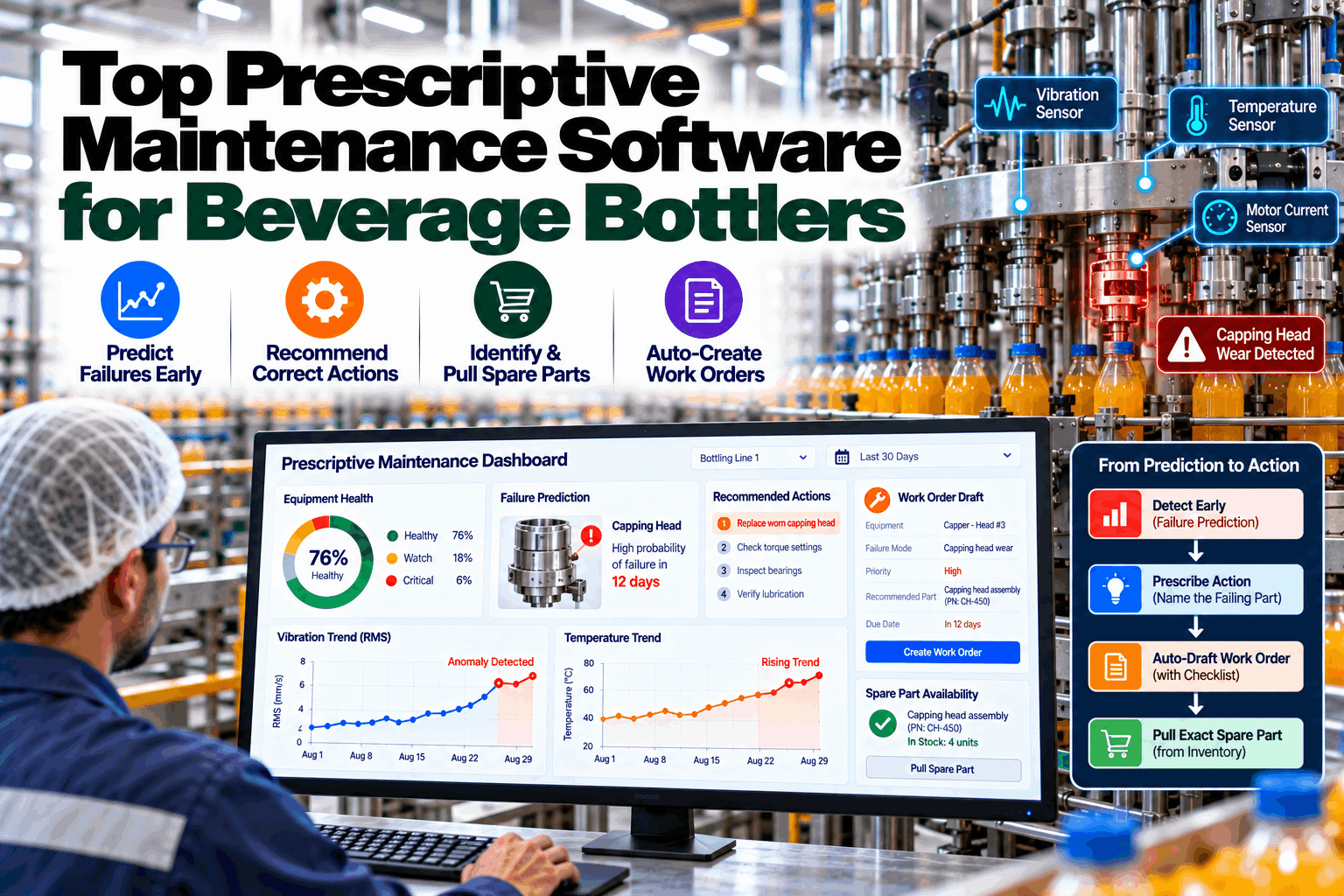
Predictive maintenance tells a bottling plant that something is going to fail. Prescriptive maintenance tells it what to do about it: which part is failing, why, what the fix is, when to do it without hurting the line, and which spare to pull from stores. On a high-speed bottling line, where a blow molder, filler, capper, labeller and packer all depend on each other, that difference decides whether an alert becomes a planned ten-minute job or a debate in the control room. This article explains what prescriptive maintenance really involves, what it needs underneath, and how bottlers close the loop from fault to fix. Our engineers can show it running on a bottling line.
Prescriptive Maintenance for Beverage Bottlers: From Fault to Fix, Work Order and Spare Part
Beyond predicting failures: naming the failing part, recommending the fix, generating the work order and reserving the exact spare, with a technician approving every step.
Predictive Versus Prescriptive Maintenance
Maintenance analytics mature in steps that mirror analytics in general: descriptive (what happened), diagnostic (why it happened), predictive (what will happen) and prescriptive (what should be done). Most plants that run predictive maintenance stop at the third step. An alert says a bearing or valve is degrading, and a person has to work out the rest: which part, what cause, what fix, what timing, which spare.
- Asset 4 vibration is outside its normal band
- Estimated time to failure: two to three weeks
- A person diagnoses the cause
- A person decides the fix and timing
- A person raises the work order and finds the part
- Capper head 6 chuck insert is wearing; confidence and evidence shown
- Recommended fix: replace insert at the next planned stop
- Work order drafted with steps, tools and safety
- Spare insert reserved in stores
- Result verified after the job and fed back
Prescriptive maintenance does not remove people from the decision. It removes the slow, repetitive part of getting from an alert to a ready-to-execute job, so technicians and planners spend their time on judgment. Our team can show the difference on real alerts.
Why Bottling Lines Need Prescriptions, Not Just Predictions
A bottling line is a chain of tightly coupled machines: blow molder, filler, capper, labeller, packer and palletizer, joined by conveyors and accumulation. Lines are usually designed with the filler as the pace-setting machine and the machines around it running a little faster, so short stops are absorbed by accumulation. That design is efficient and fragile at the same time. A problem that takes 20 minutes to diagnose on a downstream machine can starve or block the filler long before anyone fixes it.
Bottling lines also generate many small, similar alerts: individual filling valves, capping heads, blow molder cavities and labeller stations. Turning each one into the right action by hand is slow. Prescriptions make the volume manageable: each alert arrives with its fix, its timing relative to the line schedule, and its parts. Siemens’ True Cost of Downtime 2024 puts the cost of an hour in FMCG plants at about $36,000, which is why minutes of diagnosis matter. Ask our engineers about your line.
The Closed Loop: From Fault to Verified Fix
Condition data from the machine crosses a learned band: a valve’s fill deviation, a capper head’s torque profile, a blow molder cavity’s pressure curve.
The fault is matched against a failure mode library for that machine type, with the evidence and a confidence level.
The recommended action is chosen from proven fixes for that failure mode, with timing set against the production schedule and planned stops.
A complete work order is drafted in the CMMS: asset, position, steps, tools, safety requirements and estimated duration.
The exact spare is checked in stores and reserved; if it is out of stock, the prescription says so and proposes alternatives.
A planner or technician approves the prescription; the job is done in the recommended window.
Post-repair data confirms the fix, and the outcome feeds back into the prescription rules.
Timing is where prescriptions add the most value on a bottling line. A worn capper insert found at 10:00 does not need an immediate stop if the line has a changeover at 14:00 and the torque trend shows several days of margin. A leaking blow molder valve with a steep trend may justify a short planned stop within the shift. The prescription weighs the rate of degradation against the production schedule and proposes the least disruptive safe window.
Each step depends on data most bottlers already have, spread across machine PLCs, the CMMS and the stores system. Connecting them is the core of the work, which our specialists scope with you.
What Prescriptive Maintenance Needs Underneath
| Foundation | What it provides | Common gap in bottling plants |
|---|---|---|
| Condition data per position | Signals for each valve, head, cavity and station, not just the machine | Data averaged at machine level |
| Failure mode library | Known failure modes, signatures and proven fixes per machine type | Knowledge held in a few technicians’ heads |
| Asset and parts structure | Bill of materials linking each position to its spare parts | Spare parts not mapped to specific positions |
| CMMS integration | Work orders created, tracked and closed automatically | Alerts and work orders in separate systems |
| Stores integration | Stock levels, locations and reservations visible | Stock checked manually at the stores counter |
| Production schedule | Planned stops, changeovers and priorities | Maintenance timing decided without schedule context |
| Feedback | As-found condition and outcome recorded | Close-out notes too thin to learn from |
Plants rarely have all of these in place at the start. A good program builds them in order, beginning with the most critical machines. We can assess yours in a short workshop.
What Prescriptions Look Like Across a Bottling Line
| Machine | Typical fault | Detected by | Prescription |
|---|---|---|---|
| Blow molder | High-pressure blowing valve leak on one cavity | Cavity pressure curve and blowing air consumption | Replace valve on that cavity at the weekly stop; check preform heating profile after |
| Blow molder | Heating lamp failure | Oven zone power and preform temperature | Replace lamp in the named module at the next format change |
| Filler | Filling valve seal wear | Per-valve fill deviation and fill time | Disable valve now; replace seal kit at the next changeover |
| Capper | Chuck insert or clutch wear | Per-head torque profile | Replace insert on the named head at the next stop |
| Labeller | Vacuum drum seal wear | Vacuum level and label placement by position | Replace drum seal at shift change |
| Packer and palletizer | Chain or gearbox wear | Drive current and vibration | Inspect and replace chain in the planned weekend stop |
| Conveyors | Motor rotor or bearing fault | Current signature and vibration | Swap motor in the next planned stop; spare reserved |
Many bottling lines already run blow molding air at high pressures, commonly up to around 40 bar, which makes valve and compressed air faults both a reliability and an energy issue. Prescriptions address both. Our engineers can map your line.
Keeping Technicians in Charge
Prescriptive maintenance only works if technicians trust it, and trust comes from transparency. Every prescription should show its evidence, its confidence and the reasoning behind the recommended action. Technicians must be able to reject or modify it, and their decisions must feed back into the rules.
Every prescription carries the trends, thresholds and history that support it.
High-confidence prescriptions can be approved quickly; low-confidence ones prompt inspection first.
Technicians approve, modify or reject, and their reasons are recorded to improve future prescriptions.
How approval workflows fit your teams can be reviewed with our specialists.
A Prescription in Practice
See how prescriptions would look on your own line in a guided demo.
How iFactory Delivers Prescriptive Maintenance for Bottlers
Valves, heads, cavities and stations monitored individually.
Faults, signatures and proven fixes for each machine type.
Prescriptions timed to changeovers and planned stops.
Complete jobs drafted with steps, tools and safety.
Exact spares checked and reserved automatically.
Technician decisions and outcomes improve future prescriptions.
It integrates with your existing CMMS, ERP stores and line controls rather than replacing them. Ask our team about your systems.
See Prescriptions on Your Own Bottling Line
Share a line’s condition data, CMMS history and spare parts list. We show which faults can be prescribed today, what the work orders look like and which foundations to build next.
Valve seal wear diagnosed from fill level and valve timing. Work order drafted with steps and the seal kit reserved.
How Deployment Works
iFactory ships as a pre-configured NVIDIA AI server, racked and ready with the prescriptive maintenance models loaded. Rack it, plug in power and Ethernet, and the AI is live on your network. Our scope covers sensor and PLC/SCADA integration, cabling and network setup, operator and technician training, and 24×7 remote monitoring.
Server installed, sensors and controllers connected, historical work orders and failure history loaded.
Baselines learned per asset, alerts piloted on the first line with your maintenance team reviewing every finding.
Rollout to the agreed assets, technician training, CMMS hand-off and 24×7 remote monitoring in place.
Most bottlers start with one line and two or three machines with good condition data, usually the filler and capper, then extend prescriptions as the failure mode library and parts mapping grow. The rollout is agreed on a scoping call.
Where Prescriptive Maintenance Pays
Prescriptive maintenance builds on those savings by shortening every step between alert and repair. Your case can be modeled with our specialists.
Frequently Asked Questions
Predictive maintenance forecasts that an asset will fail. Prescriptive maintenance goes further: it identifies the failing part, recommends the fix and timing, drafts the work order and reserves the spare. See it in a demo.
No. Technicians approve, modify or reject each prescription, and their decisions improve future recommendations. The system removes the slow steps between alert and job. Talk to our team.
Position-level condition data, a failure mode library with proven fixes, spare parts mapped to assets, CMMS and stores integration, and the production schedule. Ask for a readiness check.
Yes, when integrated with your stores or ERP system. It checks stock, reserves the exact part and flags alternatives if the part is unavailable. Our engineers can review your integration.
Machines with many identical positions, such as fillers, cappers, blow molders and labellers, benefit most, because prescriptions handle a high volume of position-level alerts. Map your line in a workshop.
Typical programs go live in 6–12 weeks on the first machines, with prescriptions expanding as the library and parts mapping grow. Plan it with our support team.
From Alert to Approved Job in Minutes
iFactory names the failing part, recommends the fix, drafts the work order and reserves the spare, so every fault on your bottling line becomes planned work your technicians approve.
Each low score comes with a named part, a prescribed fix and a spare check.