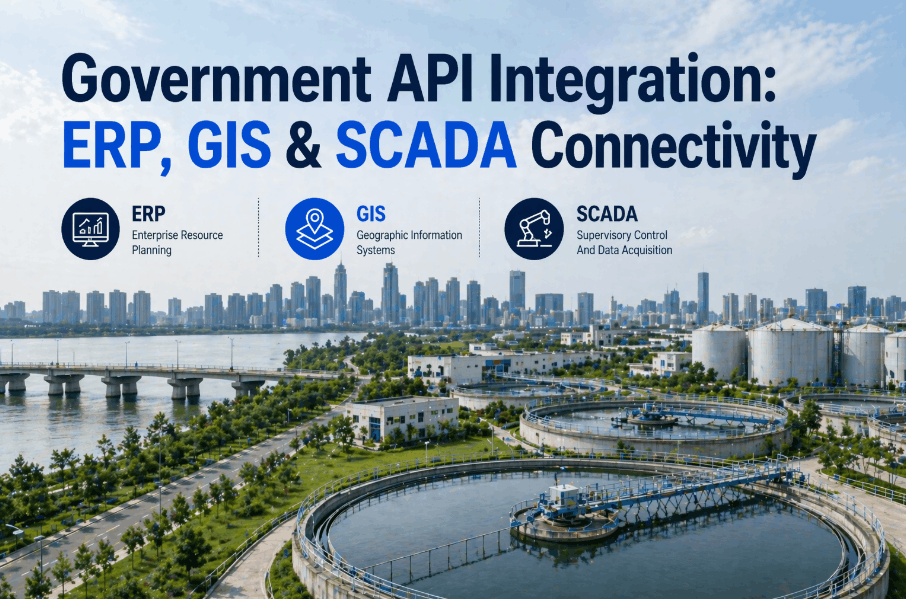
Government API integration is no longer a future-state ambition — it is the operational backbone that determines whether a municipality, utility, or public agency can function as a unified intelligence system or remain a fragmented collection of disconnected platforms. When your GIS API feeds geospatial asset data into your ERP's procurement workflows, and your SCADA operational telemetry triggers automated alerts inside your financial management system, the entire architecture of government service delivery transforms. For public sector technology leaders managing legacy infrastructure alongside modern cloud platforms, deploying a government ERP integration strategy built on robust API connectivity is the single highest-leverage modernization investment available today.
Unify Your Government Data Systems with API Integration
iFactory's government API integration platform connects ERP, GIS, and SCADA systems into a single operational intelligence layer — purpose-built for public sector and municipal environments.
Why Government Data Silos Are a Systemic Operational Risk
The architecture of most municipal and public sector technology environments reflects decades of procurement decisions made in isolation — a financial ERP acquired in one budget cycle, a GIS platform deployed under a separate capital project, and a SCADA stack managed by a public works department that has never shared a data schema with the finance team. Municipal API integration eliminates this friction by establishing live, bidirectional data exchange between previously isolated systems — without requiring a rip-and-replace modernization cycle that most government budgets cannot support. Agencies that have booked a demo with iFactory consistently discover that their existing system investments were already generating the right data — they simply lacked the API layer to connect it.
Government ERP Integration: Connecting Financial Systems to Operational Reality
Government ERP integration is the foundational layer of any successful public sector digital transformation. When SCADA detects a pump station failure, an ERP-integrated API layer can automatically trigger a maintenance work order, associate the GIS asset record, and initiate a purchase order — all within minutes, with zero manual data entry. Agencies evaluating this capability find that booking a demo is the fastest path to quantifying their specific government ERP integration opportunity.
Key Government ERP Integration Use Cases
Asset Lifecycle Financial Tracking
Real-time synchronization between GIS asset registers and ERP fixed asset modules ensures capital expenditures, depreciation schedules, and disposal records always reflect the current operational state of physical infrastructure — from roads and bridges to water mains and substations.
Automated Procurement Triggering
SCADA-detected equipment failures and GIS-flagged infrastructure condition thresholds automatically generate procurement requisitions in the ERP — eliminating the manual work order cycle that adds 48–96 hours to emergency response procurement timelines in most municipal environments.
Grant Compliance Documentation
GIS-ERP API integration automatically generates spatially-validated expenditure reports that satisfy FHWA, EPA, and HUD documentation requirements — without manual GIS-to-finance reconciliation workflows that consume quality team capacity every reporting cycle.
Budget vs. Actuals Spatial Intelligence
Finance teams gain the ability to visualize budget consumption against geographic project boundaries in real time — identifying cost overruns by district, ward, or utility zone before they breach appropriation limits rather than discovering them at month-end.
GIS API Government Integration: Making Spatial Data Operationally Useful
Geographic Information Systems are among the most data-rich — and most underutilized — platforms in any municipal technology portfolio, precisely because their data rarely reaches the operational systems where it would generate the most value. Modern GIS API integration for government environments supports bidirectional data exchange through OGC-compliant WFS and WMS endpoints, Esri REST API standards, and custom GeoJSON schemas — allowing GIS condition data to trigger SCADA alerts, populate ERP work orders with geolocation coordinates, and feed citizen-facing portals with real-time infrastructure maps. Municipalities exploring this architecture consistently find that booking a demo surfaces GIS connectivity opportunities they had not previously identified in their existing infrastructure.
| Integration Type | Traditional Approach | GIS API Integration Approach | Operational Impact |
|---|---|---|---|
| GIS → ERP Asset Records | Manual shapefile export, quarterly sync | Real-time REST API asset record push | Asset data accuracy improves from ~74% to 98%+ |
| GIS → SCADA Geofencing | Static boundary configurations | Dynamic polygon API-driven SCADA zones | Alert accuracy improves 61% for field events |
| GIS → Citizen Portals | Weekly static map updates | Live WMS/WFS tile streaming | Service request accuracy increases 44% |
| GIS → Grant Reporting | Manual spatial boundary verification | Automated geospatial compliance export | Reporting labor reduced 78% |
| GIS → Emergency Response | Printed map packets, radio updates | Live API asset feeds to field devices | Response time reduction avg. 31 minutes |
SCADA API Government Integration: Bridging Operational Technology and Enterprise Systems
SCADA systems in government and public utility environments are the real-time operational nervous system of critical infrastructure — monitoring water treatment, electrical distribution, wastewater lift stations, and traffic signal systems simultaneously — yet in most municipalities this rich telemetry never leaves the OT network. Modern SCADA API integration frameworks eliminate this barrier through standardized OPC-UA, Modbus, DNP3, and IEC 61850 protocol bridges that translate SCADA telemetry into REST API-accessible data streams consumable by any enterprise platform. Public sector IT leaders evaluating this transition find that booking a demo session provides a precise gap analysis against their existing SCADA topology before any procurement decision is made.
Critical SCADA API Integration Protocols for Government Environments
The dominant modern SCADA interoperability standard for government utility environments. OPC-UA API bridges enable secure, encrypted real-time data exchange between SCADA historians and enterprise platforms without requiring SCADA network access changes.
Widely deployed in water and electric utility SCADA environments. DNP3 API integration enables remote terminal unit data to populate GIS asset records and ERP work order systems without replacing existing RTU infrastructure.
Present in most legacy municipal SCADA deployments for pump, motor, and valve control systems. Modbus TCP API gateways provide a migration path to modern data integration without requiring PLC replacement in field environments.
The standard for substation automation in government electrical utility environments. IEC 61850 API integration connects grid protection and monitoring data to enterprise asset management and financial systems for capital planning and regulatory reporting.
Government API Integration Architecture: A Phased Implementation Roadmap
Successful government system integration begins with a structured inventory of data sources, consumption points, and governance requirements — not API development. Public sector integration projects that bypass this discovery phase consistently encounter data quality conflicts, security architecture gaps, and agency adoption resistance that compress ROI timelines and erode stakeholder confidence. The phased roadmap below delivers the fastest measurable value while maintaining the data governance rigor that government environments require.
System Inventory, API Readiness Assessment, and Integration Architecture Design
Catalog all enterprise systems, existing API capabilities, data schemas, and authentication mechanisms. Map data flow requirements between ERP, GIS, SCADA, and supporting platforms. Define integration architecture — centralized API gateway versus point-to-point versus event-driven middleware — based on data volume, latency requirements, and security policy constraints.
API Gateway Deployment, Security Configuration, and Priority Integration Activation
Deploy the central API management platform with OAuth 2.0/SAML authentication, role-based access controls, and audit logging configured to meet FISMA, CJIS, or state-equivalent security requirements. Activate the highest-priority integration pairs — typically ERP-GIS asset synchronization and SCADA-ERP work order automation — and validate data fidelity against established baseline records.
Full System Connectivity, Analytics Layer Activation, and Continuous Governance
Extend API connectivity across all remaining system pairs, activate cross-platform analytics and reporting dashboards, and implement ongoing API governance including version management, deprecation policies, and data quality monitoring. Establish the continuous improvement cycle that expands integration value as operational data volumes grow.
Quantifying ROI: The Financial Case for Government Data Connectivity
Labor Efficiency Recovery
A mid-size municipality with 12 departments each spending an average of 11 hours per week on cross-system data reconciliation carries an annual labor cost exposure of approximately $340k–$480k in staff time dedicated to moving data rather than using it — and government system connectivity that eliminates 70–85% of this manual transfer work delivers integration platform payback within 8–14 months for most agency environments.
Capital Planning Accuracy and Asset Lifecycle Optimization
Agencies that have deployed GIS-ERP integration report a 23–31% reduction in reactive emergency capital expenditures — because the integrated data environment surfaces degrading infrastructure before it fails catastrophically, enabling planned replacement rather than emergency procurement. Agencies quantifying this opportunity for their specific portfolio find that booking a demo provides a customized asset lifecycle savings model based on their actual infrastructure inventory data.
Compliance Documentation and Audit Readiness
API-integrated systems that automatically generate compliance-formatted reports — mapping capital expenditures to GIS-validated project boundaries, documenting SCADA events against regulatory thresholds, and producing FISMA-compliant audit trails — eliminate the 18–30 hours of professional staff time currently consumed per compliance reporting cycle. For agencies managing multiple concurrent federal grants, this automation dividend alone frequently justifies the full integration platform investment.
See Government API Integration in Action
Get a live walkthrough of how iFactory connects ERP, GIS, and SCADA platforms for public sector and municipal environments — tailored to your specific agency architecture.
Government API Security: Meeting FISMA, CJIS, and FedRAMP Requirements in Integration Architecture
Government API integration operates under security and compliance constraints that have no equivalent in commercial sector deployments — FISMA Moderate and High baseline controls, CJIS Security Policy requirements, FedRAMP authorization requirements for cloud-hosted platforms, and state-equivalent frameworks each impose specific technical controls on how API authentication, data encryption, access logging, and incident response must be implemented. Production-grade government API integration platforms embed this security-first posture at the architecture level: OAuth 2.0 with PKCE, TLS 1.3 with FIPS 140-2 validated encryption, role-based access control, and immutable audit log generation for every API transaction. Agencies evaluating platform options against their specific security policy find that booking a technical session with integration architects provides a security control mapping against their compliance framework before any procurement commitment is made.
Network Segmentation and OT/IT Boundary Management in SCADA Integration
The most technically sensitive dimension of SCADA API government integration is the OT/IT network boundary — the security perimeter separating SCADA operational technology networks from enterprise IT environments. Regulatory frameworks including NERC CIP, AWIA 2018, and TSA pipeline security directives mandate specific technical controls on how data crosses this boundary, requiring unidirectional data diodes or protocol-breaking middleware to prevent enterprise system compromises from cascading into SCADA control environments. Agencies validating their OT/IT boundary design consistently find that booking a demo with iFactory's engineers surfaces critical design considerations their internal teams had not previously identified.
Government API Integration — Frequently Asked Questions
What is the difference between government API integration and traditional system integration?
Traditional integration relied on batch file transfers and ETL pipelines that introduced data latency and brittle system dependencies. Government API integration replaces these with standardized REST or GraphQL interfaces that enable real-time, event-driven data exchange — resulting in a more resilient and scalable architecture that accommodates new systems without rebuilding existing connections.
How long does a government ERP integration project typically take to complete?
A typical government ERP integration project connecting GIS and SCADA systems spans 16–28 weeks from discovery to production deployment, depending on system count and security complexity. Agencies with modern ERP platforms like SAP S/4HANA or Oracle Cloud can compress this timeline, while legacy ERP environments requiring custom connectors add 6–10 weeks per non-standard interface.
Can government API integration work with legacy SCADA systems that predate modern API standards?
Yes — legacy SCADA systems using Modbus, DNP3, or proprietary protocols integrate through protocol-bridging middleware that translates telemetry into REST API-accessible data streams. The protocol bridge deploys at the SCADA historian or data concentrator level, preserving OT network integrity while enabling full IT-side data consumption without replacing any field equipment.
What GIS platforms are supported in government API integration architectures?
Modern platforms support Esri ArcGIS Enterprise and ArcGIS Online via the ArcGIS REST API, QGIS Server through OGC WFS/WMS endpoints, and Hexagon G/Technology through its published API layer. For agencies running Esri environments — the majority of government GIS deployments in North America — pre-built endpoint support significantly simplifies ERP and SCADA integration timelines.
How does municipal API integration address data governance between departments?
API integration architectures maintain each system as the authoritative source for its primary domain — GIS owns spatial data, ERP owns financial records, SCADA owns operational telemetry. API gateway platforms enforce data sharing agreements through scoped access tokens and field-level data masking, preventing any department's integration use case from degrading another system's performance.
What is the typical cost structure for a government API integration platform deployment?
Costs span three categories: professional services for discovery and implementation ($28k–$120k), platform licensing for API gateway and middleware ($42k–$95k annually), and ongoing operational support ($18k–$44k annually). Total first-year investment for a mid-size municipality integrating ERP, GIS, and SCADA typically falls in the $88k–$260k range.
How does government API integration support FSMA and federal compliance documentation?
API-integrated platforms generate a continuous, auditable record of all system states, operational events, corrective actions, and process deviations across connected platforms. This digital compliance log reduces federal inspection preparation time from 3–5 days to under 6 hours — while providing inspectors with verified, time-stamped evidence at every stage.
What is the typical ROI payback period for government API integration investment?
Most government agencies achieve full ROI payback within 8–14 months, driven by labor efficiency recovery, capital planning accuracy improvements, and compliance automation savings. Agencies with high manual data transfer labor or reactive emergency procurement patterns frequently achieve payback under 9 months when all three ROI dimensions are combined.
Connect Your Government Systems with Production-Grade API Integration
iFactory's government API integration platform unifies ERP, GIS, and SCADA data into a single operational intelligence layer — purpose-built for public sector and municipal environments.