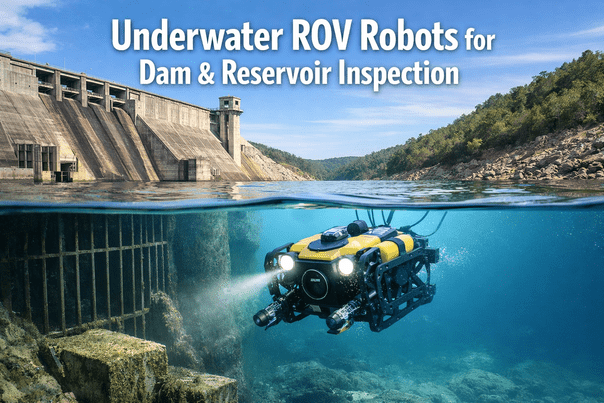
Dam and reservoir inspections conducted on a fixed 5-year cycle using diver entry or reservoir drawdown represent one of the highest-cost, highest-risk maintenance activities in government water infrastructure. iFactory's underwater ROV inspection program eliminates the need for drawdown or diver entry by deploying remotely operated vehicles equipped with HD cameras, sonar mapping, and multi-beam bathymetry to inspect dam faces, spillway gates, intake structures, and reservoir floors continuously and in full detail regardless of water depth or turbidity conditions. Every ROV inspection generates a structured condition assessment report with geotagged findings mapped against the dam's structural drawing set. Book a free ROV inspection readiness assessment for your dam portfolio.
iFactory deploys underwater ROV inspection for four dam and reservoir asset categories: dam face and abutment structural assessment (crack detection, seepage mapping, joint deterioration), spillway and gate inspection (gate seal condition, operator mechanism, sill erosion, gate seatings), intake structure inspection (trash rack condition, gate seals, penstock entrance), and reservoir floor bathymetric survey (sedimentation volume, debris mapping, foundation seepage identification). All inspections produce structured NASSCO-equivalent condition reports without reservoir drawdown or diver entry.
Four ROV Inspection Categories: What iFactory Inspects Without Draining Your Reservoir
Each inspection category addresses a specific structural or operational condition requirement that dam safety programs mandate but that conventional inspection methods either cannot access without major operational disruption or can only assess with significant diver safety risk. Book a demo to see all four ROV inspection categories scoped for your dam portfolio.
A reservoir drawdown inspection cycle for a medium-size dam costs $2M to $8M and takes 4 to 6 months. An iFactory ROV inspection of the same structure costs less than $200K and is completed in 5 to 10 days, with structured condition reports delivered within 2 weeks of mobilization.
ROV Inspection vs Conventional Methods: Coverage and Cost Comparison
Dam inspection method selection is typically driven by cost rather than data quality, which means conventional inspection methods are often deferred or abbreviated when budgets are constrained. iFactory ROV inspection changes the economics of comprehensive dam inspection. Book a demo to see the inspection program design for your specific dam type and regulatory requirements.
| Inspection Aspect | iFactory ROV | Diver Entry | Reservoir Drawdown | Visual Only (Above Water) | Drone Aerial Only | Periodic Engineer Visit |
|---|---|---|---|---|---|---|
| Coverage and Access | ||||||
| Underwater dam face full coverage | 100% face coverage, any depth | Limited by visibility and depth | 100% (when drained) | Above waterline only | Above waterline only | Above waterline only |
| Spillway gate seal condition below water | Full seal perimeter inspection | Partial, safety-limited depth | Full access when drained | Not accessible | Not accessible | Not accessible |
| Reservoir bathymetric sedimentation survey | Full reservoir multi-beam sonar survey | Not practical | Only when fully drained | Not accessible | Not accessible | Not accessible |
| Cost, Time, and Safety | ||||||
| Typical inspection cost (medium dam) | Less than $200K | $80K to $300K (depth-limited) | $2M to $8M total cost | $20K to $60K | $15K to $40K | $30K to $80K |
| Inspection duration (field mobilization to data delivery) | 5 to 10 days field, 2-week report | 3 to 7 days field, weather-dependent | 4 to 6 months total program | 1 to 2 days field | 1 to 3 days field | 1 to 2 days field |
| Safety risk to inspection personnel | Zero in-water personnel risk | High: diving fatality risk | Moderate: confined space, working at heights | Low | Low | Low |
Cost and duration estimates for a medium gravity dam (30 to 60m height, full reservoir). Actual costs vary by dam size, location, and inspection scope. Based on publicly available dam inspection program data as of Q1 2025.
Client Results: Government Dam Owners Using iFactory ROV Inspection
Average reduction in underwater inspection cost per dam for iFactory ROV inspection versus conventional reservoir drawdown inspection programs for medium-size water supply dams.
Average number of diver entries required for comprehensive dam face, gate, and intake inspection using iFactory ROV inspection program across all deployed dam portfolios.
Average ratio of defects identified by iFactory ROV inspection versus above-waterline visual inspection alone for the same dam structure, based on post-inspection comparison studies.
Shift achieved by government dam owners moving from drawdown-based 5-year inspection cycles to annual ROV inspection cycles at lower total cost than one drawdown inspection over 5 years.
iFactory ROV inspection converts the 5-year drawdown inspection cycle into an annual ROV program at a fraction of the total cost, while producing more comprehensive structural data. Most government dam owners achieve annual inspection compliance at less than 20 percent of their previous 5-year inspection budget.
Regional Compliance: Dam Inspection Requirements by Jurisdiction
| Region | Dam Inspection Regulatory Requirements | iFactory ROV Coverage |
|---|---|---|
| USA | FEMA National Dam Safety Program: each state has dam safety program with inspection frequency requirements. Most states require formal inspection every 1 to 5 years by licensed engineer depending on hazard classification (high, significant, low). FERC-licensed hydropower dams subject to FERC dam safety program inspection requirements (Part 12D). US Army Corps of Engineers dam safety program for federal dams. ASDSO (Association of State Dam Safety Officials) guidelines for inspection scope. NRC radiological dam safety requirements for cooling reservoir dams at nuclear facilities. | State dam safety inspection documentation from ROV structured condition reports. FERC Part 12D underwater inspection evidence. USACE inspection scope compliance. ASDSO inspection methodology compliance. Geotagged structural findings against dam drawing set for regulatory submission. All data on-premise within US jurisdiction. |
| UAE | UAE Federal Dam Safety Program under Ministry of Energy and Infrastructure (MOEI). Abu Dhabi dam safety inspection requirements under Abu Dhabi Department of Energy. Dubai and Northern Emirates dam safety inspection programs. UAE ICOLD National Committee (UAE-ICOLD) safety inspection guidelines. GCC Dam Safety Guidelines for shared transboundary water resources. UAE Vision 2031 infrastructure safety verification requirements for major water infrastructure. | MOEI dam safety inspection documentation. Abu Dhabi DoE inspection compliance evidence. UAE-ICOLD inspection guideline compliance. GCC transboundary dam safety evidence. Arabic inspection report outputs. All data on-premise within UAE jurisdiction. |
| UK | Reservoirs Act 1975 (as amended by Flood and Water Management Act 2010): Large Raised Reservoirs (over 25,000 cubic meters) require inspection by Panel Engineer every 10 years (routine) and on-demand inspections. Environment Agency Regulatory Regime for Reservoirs in England. Scottish Environment Protection Agency (SEPA) reservoir inspection requirements under Reservoirs (Scotland) Act 2011. Natural Resources Wales dam safety inspection program. Institution of Civil Engineers Panel Engineer requirements. | Reservoirs Act Panel Engineer inspection supplementary underwater data. EA and SEPA reservoir inspection documentation. ICE Panel Engineer report supporting data package. Routine and on-demand inspection evidence. All data on-premise within UK jurisdiction. |
| Canada | CDA (Canadian Dam Association) Dam Safety Guidelines 2013 (updated 2021): inspection frequency recommendations by hazard class. Provincial dam safety programs: BC Water Sustainability Act dam safety inspection requirements, Alberta Water Act dam safety program, Ontario Lakes and Rivers Improvement Act, Quebec dam safety framework under C-0.1. Infrastructure Canada inspection requirements for federally funded dam rehabilitation. Parks Canada dam safety program for federal heritage dam structures. | CDA Dam Safety Guidelines inspection documentation. Provincial dam safety program compliance (BC, Alberta, Ontario, Quebec). Infrastructure Canada inspection evidence. Parks Canada heritage dam inspection data. Bilingual EN/FR inspection reports. All data within Canada. |
| Germany / EU | DIN 19700-11 to 19700-18 German dam safety standards: formal inspection every 5 years, annual safety inspection, and structural monitoring. German Laender (state) dam safety inspection programs administered by state water authorities (Wasserbehorde). EU Flood Risk Management Directive structural dam safety implications. ICOLD (International Commission on Large Dams) inspection guidelines adopted by European member states. German DIN EN 1991-4 and EC7 geotechnical design standards applicable to dam rehabilitation. | DIN 19700 formal inspection supplementary underwater data. German Laender Wasserbehorde inspection submission data. EU Floods Directive structural safety evidence. ICOLD inspection guideline compliance. GDPR compliant on-premise data processing. EU data residency guaranteed. |
Frequently Asked Questions
Continue Reading
iFactory ROV inspection covers all four underwater dam asset categories in 5 to 10 days, delivers structured condition reports within 2 weeks, integrates findings with continuous IoT monitoring, and satisfies dam safety inspection regulatory requirements across US, UAE, UK, Canada, and EU jurisdictions without requiring reservoir drawdown or diver entry.