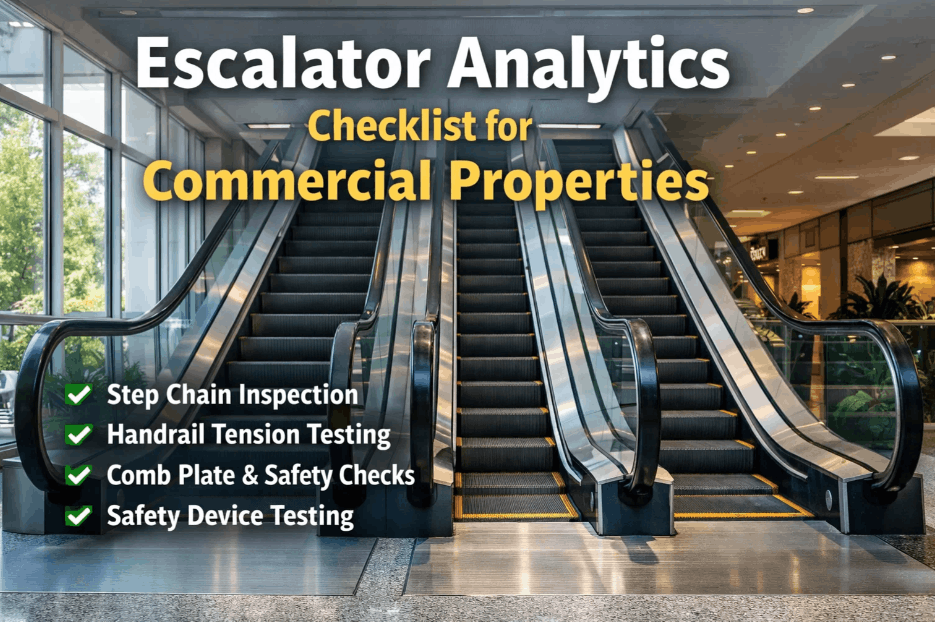
Escalators in high-traffic commercial environments — malls, international airports, and transit hubs — are among the most mechanically complex and safety-critical assets in a building's infrastructure. Unlike elevators, which operate in a protected shaft, escalators are open-access systems with hundreds of exposed moving parts, making them highly susceptible to debris ingestion, component misalignment, and catastrophic step-chain failures. Traditional "clipboard-based" maintenance is physically impossible to perform at a granularity that prevents developing faults; by the time a technician hears a step-chain grinding or feels a handrail slipping, the damage is already systemic. iFactory's escalator analytics checklist and escalator preventive maintenance plugin digitize the entire physical inspection lifecycle — from kinematic step-chain vibration analysis to real-time comb plate obstruction detection — ensuring your equipment is not just operational, but 100% safety compliant. By deploying industrial-grade IoT sensors directly into the drive motor and handrail assembly, iFactory converts the root-causes of unplanned downtime into a 24/7 predictive data stream, cutting maintenance labor costs by 45% while virtually eliminating the risk of passenger injuries.
Escalator Analytics Checklist: Predictive Monitoring for High-Traffic Properties
Real-time step-chain vibration, handrail tension monitoring, comb plate safety verification, and AI-implemented PM checklists for malls, airports, and commercial campuses.
Digital AI Checklist vs Manual Inspection — The ROI of Continuous Analytics
Manual inspections are snapshots in time. iFactory's digital checklist provides a continuous stream of data across every critical safety and operational component. Schedule an escalator ROI audit to see how much your property can save by moving to condition-based maintenance.
The Escalator Analytics IoT Stack — How We Digitize Your Checklist
iFactory retrofits any escalator make or model with three layers of sensing technology. This non-invasive deployment connects directly to our local Edge AI gateway, ensuring your critical safety data is processed instantly without cloud latency. View our technical sensor specifications for airport and mall deployments.
The Escalator Analytics Checklist — 6 Critical Failure Modes We Detect
iFactory focuses on the "Essential Six" — the failure modes responsible for 90% of unplanned escalator repairs and 100% of major passenger safety incidents.
Thermal camera + force sensors detect obstruction (shoe, umbrella, debris) in the comb plate teeth and trigger an immediate stop before mechanical jam occurs.
Acoustic and vibration monitoring detects the unique signature of chain pin wear and bush failure weeks before the chain exceeds its kinematic safety limit.
If handrail speed lags step speed by >2%, it indicates drive slip or load-cell failure. iFactory alerts local security to stop the unit and prevents passenger loss of balance.
Continuous health-check on skirt-safety, handrail-entry, and emergency-stop circuits. Replaces manual verification with an automated, tamper-proof digital log.
Analysing the AC waveform for anomalies indicates stator winding wear, bearing pitting, or gearbox misalignment — preventing the most expensive single-component failure.
Photoelectric/Vision AI stack continuously monitors for "missing step" or "saggng step" conditions, locking the escalator before the compromised step reaches the landing.
Escalator Response Latency — Why Edge AI is a Safety Requirement
When a passenger's shoelace is caught in a comb plate, a 200ms cloud round-trip is equivalent to several inches of movement. iFactory Edge AI responds in milliseconds, often stopping the unit before mechanical damage or injury can occur.
| Safety Incident | Max Safe Window | iFactory AI | Manual Trip | Verdict |
|---|---|---|---|---|
| Comb Plate Jam Detection | 25ms | 12ms | 250ms (Mechanical Only) | Preventive Stop |
| Handrail Slip Recognition | 1s | 180ms | Technician Report | Auto-Alert |
| Step-Chain Wear Anomaly | 1 Week | 2 hrs | Visible Damage | Early Warn |
| Safety Circuit Integrity | Daily | Continuous | Monthly Check | Always Live |
Escalator Analytics Deployment Roadmap — From Sensor to Safety ROI
iFactory follows a 4-phase deployment methodology to ensure zero-disruption to mall or airport operations while digitizing your entire fleet checklist.
Non-invasive installation of vibration nodes on drive motors and load cells on handrail drive assemblies. No escalator downtime for sensor mounting.
AI engine learns normal vibration signatures across various load conditions (mall rush hour vs night). Establishes "normal" envelope for each unit.
Mapping sensor data to your digital PM checklist. Automating safety device logs and handrail-sync verification. First dashboard reporting live.
System begins predicting component failures 12–21 days in advance. SAP PM work orders generate automatically based on component health scores.
What a Mall Operations Director Said
We manage 24 escalators across this campus. Before iFactory, we relied on our maintenance contractor to tell us if a unit was safe. After the analytics deployment, we caught a step-chain elongation on an escalator serving the food court two weeks before it would have seized. We replaced the chain on a scheduled night-shift — zero tenant disruption and avoided a $45k emergency repair.
Frequently Asked Questions
Does installing the iFactory sensors void our escalator manufacturer warranty?
No. iFactory uses non-invasive magnetic vibration nodes and optical sensors that require zero modification to the OEM control system or mechanical structure. We do not splice into the existing safety circuit, ensuring your warranty remains fully intact.
How many escalators can a single iFactory Edge Gateway handle?
A single iFactory Edge Gateway can manage up to 12 escalators within a 150-meter radius using our long-range industrial wireless sensor mesh. For larger malls or airport terminals, multiple gateways are networked together to provide a unified dashboard.
Can the system automatically stop the escalator in an emergency?
While iFactory provides the low-latency signal to trigger a stop during a comb-plate jam or missing step event, our standard deployment works alongside your existing mechanical safety disconnects to provide a redundant, "pre-mechanical" safety layer.
Does the system require an active campus WiFi connection to operate?
iFactory Edge Gateways are autonomous. While they use LTE or WiFi to push dashboard updates and SAP work orders, the actual fault-detection AI runs locally on the gateway. Even if your building network goes down, the escalators are still being monitored for safety.
Digitize Your Escalator Analytics Checklist Today
Free 48-hour vibration audit for any 3 escalators in your portfolio — see the data for yourself before committed.