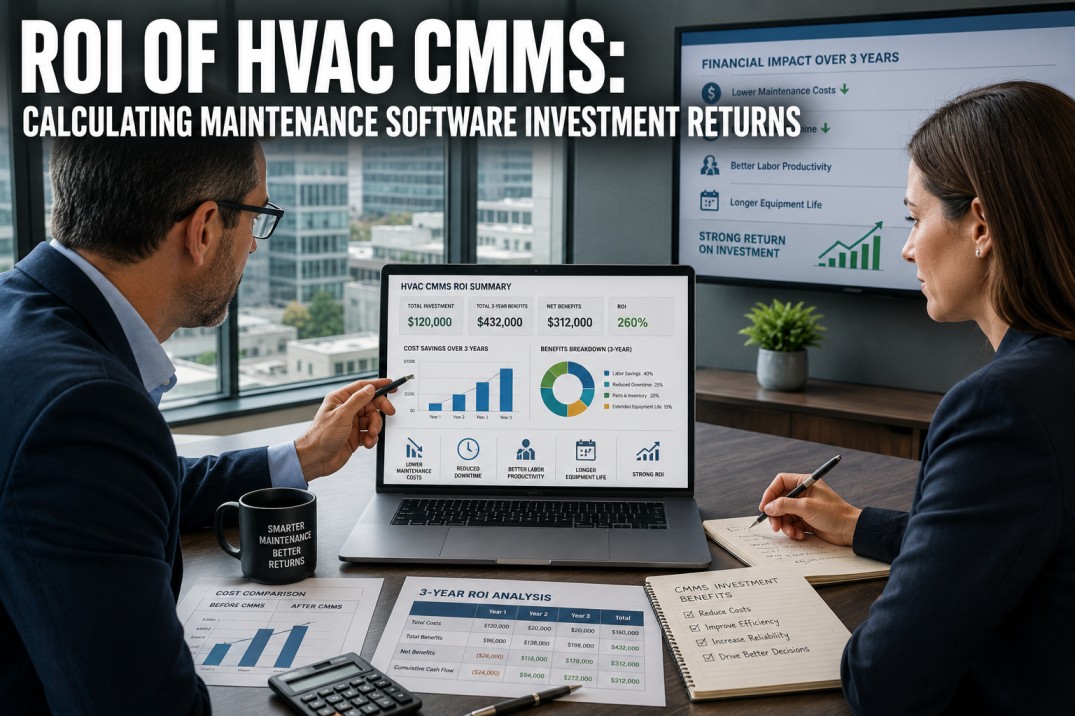
The return on investment for HVAC AI-driven analytics software is one of the most compelling business cases in facility management today, with documented payback periods of 6 to 18 months and year-2-plus returns of 300% to 500%. Understanding how to calculate, present, and track ROI is essential for securing budget approval, setting stakeholder expectations, and measuring ongoing program success. This guide provides a complete framework for calculating HVAC analytics ROI across five value categories: energy savings, maintenance cost reduction, equipment life extension, labor productivity, and avoided failure costs each with documented benchmarks, calculation methods, and real-world examples from commercial buildings, healthcare facilities, schools, and industrial plants.
Calculate Exactly What HVAC Analytics Will Save Your Buildings
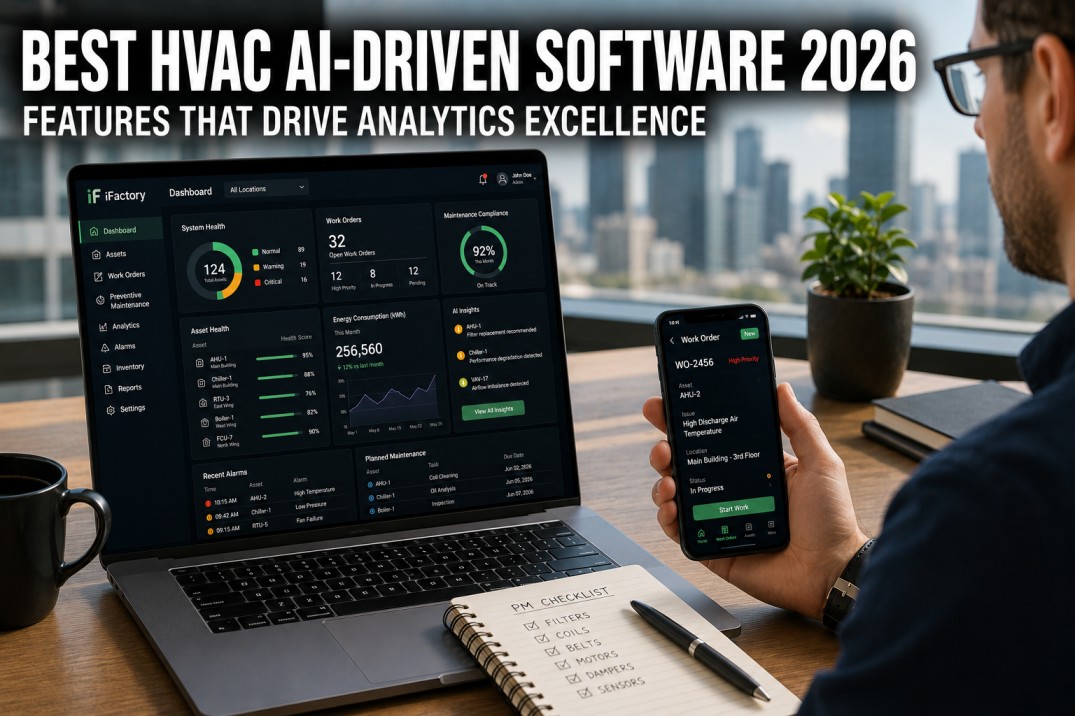
iFactory's Analytics Dashboard includes built-in ROI tracking that measures savings across energy, maintenance, labor, and avoided failures. Book a demo to see how iFactory delivers documented, defensible ROI from day one.
The Five Value Categories of HVAC Analytics ROI
HVAC analytics generates value across five distinct categories, each with independent savings streams.
Energy Savings (12-25%)
FDD corrections fix faults wasting energy (economizer stuck, simultaneous H/C, sensor drift). Schedule optimization reduces unnecessary runtime. Setpoint reset optimization saves 3-7%. Demand-controlled ventilation reduces OA conditioning. Combined: $0.12-0.40/sq ft/yr.
Maintenance Cost Reduction (20-35%)
Emergency to planned maintenance shift: 60:40 to 25:75. Planned repairs cost 40-60% less than emergency. Optimized PM frequency eliminates 25-35% of unnecessary inspections. Parts optimization through planned replacement.
Equipment Life Extension (3-7 years)
Early fault detection prevents cascading failures. Condition-based maintenance keeps equipment operating within design parameters. Run-time balancing across redundant units. Deferred capital expenditure: $50K-200K per 100K sq ft.
Labor Productivity (20-30%)
Remote diagnostics reduces truck rolls 30-50%. Automated FDD eliminates hours of manual data analysis per week. Condition-based PM replaces fixed-interval inspections. Technicians focus on problems, not checklist tours.
ROI Calculation Framework: How to Calculate and Present Analytics ROI
A structured calculation method ensures consistent, defensible ROI projections that stand up to financial scrutiny.
| Value Stream | Annual Savings (per 100K sq ft) | Calculation Method | Confidence Level | Documentation Required |
|---|---|---|---|---|
| Energy | $15K-40K | Baseline energy x 15% avg savings. Adjust for climate, equipment type, baseline efficiency | Medium-High | 12 months utility bills, equipment inventory |
| Maintenance | $10K-25K | Annual maintenance spend x 25% reduction. Include parts, labor, refrigerant, emergency markup | Medium | 12 months maintenance spend by category |
| Labor | $8K-18K | Technician hours x hourly rate x 25% productivity gain. Include overtime premium | Medium | Labor tracking data, overtime records |
| Avoided Failures | $5K-25K | Historical failure rate x average failure cost x 60% reduction. Varies widely by equipment age | Low-Medium | Failure history, replacement cost data |
| Capital Deferral | $15K-50K | Replacement cost + installation x years deferred / total life. Conservative: 2 years deferral | Medium | Equipment age, condition, replacement cost |
Build Your HVAC Analytics Business Case With Real Data
iFactory's platform provides the baseline data, savings tracking, and reporting you need to calculate and present analytics ROI with confidence. Book a demo to see how data-driven ROI projections secure budget approval.
Real-World ROI Case Studies: Published Results by Building Type
Published case studies validate ROI projections and provide benchmarks for building your business case.
Office Building (250K sq ft)
Annual savings: $94,000. Breakdown: energy $46K (18% reduction), maintenance $22K (28% reduction), labor $14K (22% gain), avoided failures $12K. Platform cost: $15,000/yr. Net year-1: $79,000. Payback: 2 months. 5-year NPV at 10% discount: $285,000.
Hospital (500K sq ft)
Annual savings: $210,000. Breakdown: energy $85K (15% reduction), maintenance $55K (32% reduction), labor $32K, avoided failures $38K. Platform cost: $40,000/yr. Net year-1: $170,000. Payback: 4 months. Critical: zero unplanned downtime in ICU and OR zones.
School District (18 buildings, 600K sq ft)
Annual savings: $165,000. Breakdown: energy $62K (16% reduction), maintenance $48K, labor $28K, avoided failures $27K. Platform cost: $32,000/yr. Net year-1: $133,000. Payback: 5 months. Hot/cold calls reduced 65%.
Building the Business Case: Presenting Analytics ROI to Decision Makers
A compelling business case speaks the language of the audience: operations for facility teams, financial terms for CFOs, and strategic value for executives.
Scope & Baseline
Define which buildings, equipment, and value streams are included. Establish baseline by gathering 12 months of energy, maintenance, labor, and failure cost data. Calculate projected savings using published benchmarks adjusted for your specific conditions. Document all cost categories: platform subscription, implementation, sensors, training, and ongoing support.
Financial Modeling
Run three scenarios: conservative at 80% of projected savings, expected, and optimistic at 120%. Calculate payback period, year-1 ROI, and 5-year NPV at your organizations discount rate. Include qualitative benefits: tenant comfort, IAQ improvements, sustainability contributions, risk reduction, and data availability gains.
Presentation & Pilot
Prepare materials for different audiences: a one-page executive summary, detailed analysis with backup data, and a financial pro-forma. Present to facility teams in operational terms, to CFOs in financial terms. Request a pilot budget for a 3-6 month trial on 5-10 critical units with defined success metrics. Plan post-pilot measurement using the same baseline metrics to compare actual vs projected savings.
Tracking ROI After Deployment: Measuring Actual vs Projected Returns
Post-deployment measurement validates projections and identifies opportunities to improve program performance.
Energy Tracking
Weather-normalize using degree days. Compare current year to same month prior year. Account for occupancy changes, equipment changes, and setpoint changes outside analytics control. Target: 12-25% reduction year 1.
Maintenance Spend Tracking
Track emergency to planned ratio. Target: shift from 60:40 to 25:75 within 12 months. Track cost per WO by category. Target: 20-35% reduction in total maintenance spend.
Labor Productivity
Track WOs/tech/day, average time per WO, first-time fix rate, overtime hours. Target: 20-30% improvement in WOs/tech/day. Track before and after deployment with same technician pool.
Program ROI Dashboard
Track: cumulative savings (all categories), cumulative platform cost, net savings, payback status, year-to-date ROI. Update monthly. Review quarterly with stakeholders. Publish results to maintain program visibility and support.
Frequently Asked Questions
What is the typical ROI of HVAC analytics software?
Year-1 ROI: 150-300% (savings 1.5-3x platform cost). Payback: 6-14 months typically, with some organizations achieving payback within 3-6 months. Year-2 ROI: 300-500% (savings grow as models improve and more faults are caught). 5-year NPV: 5-10x total investment. 95% of deployments achieve payback within 18 months.
How do I calculate HVAC analytics ROI for my building?
Use the five value categories: energy savings (12-25%), maintenance cost reduction (20-35%), labor productivity (20-30%), avoided failures (50-80% reduction), and equipment life extension (3-7 years). Gather 12 months of baseline data for each category. Apply conservative adjustment factors (use 80% of published benchmarks). Subtract total platform cost including implementation. Calculate payback period = total investment / annual savings.
What is the fastest path to positive ROI from HVAC analytics?
Focus on the highest-impact value streams first: energy savings from FDD corrections (economizer faults, simultaneous heating/cooling, schedule optimization) deliver the fastest payback, often within 2-4 months. These require no additional sensors, only BMS data connectivity. Add sensor installation for avoided failure savings in year 2 after proving the platform value.
How do I present the analytics business case to my CFO?
Structure the presentation in three layers. Executive summary (1 page): total investment, annual savings, payback period, ROI. Detailed analysis: 5 value categories with calculation methodology, assumptions, and confidence levels. Financial pro-forma: 5-year cash flow projection with conservative, expected, and optimistic scenarios. Include NPV at your organizations discount rate. Lead with energy savings (hardest, most defensible number).
What metrics should I track to measure analytics program ROI?
Essential metrics: energy consumption (weather-normalized, monthly), maintenance cost (by category monthly), emergency to planned maintenance ratio, work orders per technician per day, first-time fix rate, equipment MTBF trend, fault detection rate (faults found per 100K sq ft per month), false positive rate, and cumulative savings vs cumulative platform cost. Review monthly, report quarterly to stakeholders.
Proven HVAC Analytics ROI Backed by Real Results
iFactory's Analytics Dashboard delivers complete ROI tracking from baseline measurement through ongoing savings monitoring. Book a demo to see how documented ROI transforms HVAC analytics from cost to investment.