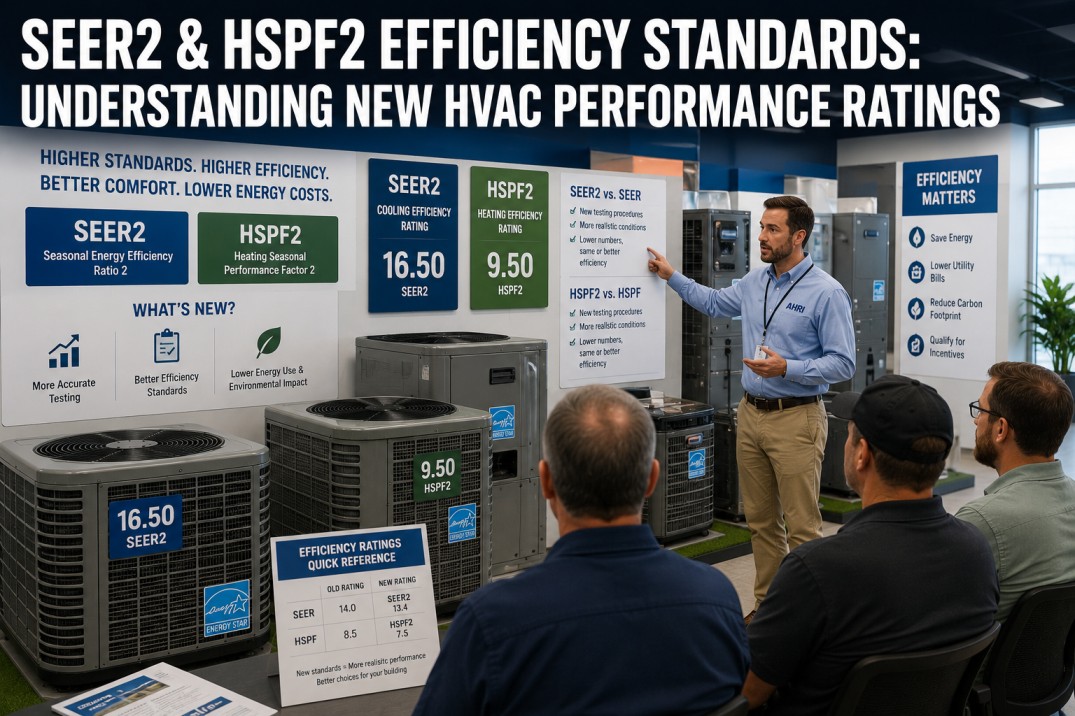
SEER2 and HSPF2 are the updated efficiency ratings that replaced the traditional SEER and HSPF metrics on January 1, 2023, representing the most significant change to HVAC efficiency measurement in decades. These new ratings incorporate external static pressure testing at 0.5 in. w.g. instead of the previous 0.1 in. w.g., reflecting more realistic installation conditions and resulting in ratings that are typically 3% to 6% lower than their predecessors even for identical equipment. Understanding SEER2 and HSPF2 is essential for comparing equipment options, ensuring code compliance, calculating energy savings accurately, and making informed replacement decisions that balance upfront cost with long-term operating expense.
Track Equipment Efficiency Ratings for Compliance
iFactory's Compliance Management module tracks SEER2 ratings, regional minimum standards, and equipment efficiency across your portfolio. Book a demo to see how automated compliance tracking ensures every installation meets code.
SEER2 vs SEER & HSPF2 vs HSPF: How the New Ratings Differ
The new testing methodology produces systematically lower ratings, requiring updated benchmarks for equipment comparison.
| Rating Type | Old Test Method | New Test Method (2023+) | Typical Difference | Impact |
|---|---|---|---|---|
| SEER vs SEER2 | 0.1 in. w.g. external static pressure | 0.5 in. w.g. external static pressure | 3-6% lower | Same equipment rates lower under new test |
| HSPF vs HSPF2 | 0.1 in. w.g. external static pressure | 0.5 in. w.g. external static pressure | 4-8% lower | Heat pump ratings reduced more than AC |
| EER vs EER2 | 95F outdoor, 80F indoor, 0.1 in. w.g. | 95F outdoor, 80F indoor, 0.5 in. w.g. | 5-8% lower | Commercial equipment ratings affected |
| Minimum Standards | 14 SEER (south), 13 SEER (north) | 15 SEER2 (south), 14 SEER2 (north) | Effective minimum increased | Equivalent to ~15.5-16 SEER old rating |
Minimum Efficiency Standards by Region: What Equipment Must Meet
DOE minimum efficiency standards vary by region and equipment type, with different effective dates and requirements.
Southeast & Southwest Regions
Residential AC: minimum 15 SEER2 effective January 2023. Heat pumps: minimum 15 SEER2 / 8.1 HSPF2. These regions have the strictest minimums due to higher cooling loads. Equipment destined for these regions must display SEER2 rating on the EnergyGuide label and meet the minimum at 0.5 in. w.g. test conditions.
Northern Region
Residential AC: minimum 14 SEER2 effective January 2023. Heat pumps: minimum 14 SEER2 / 7.5 HSPF2. Northern minimums are lower reflecting the lower cooling utilization. However, the increase from 13 SEER to 14 SEER2 still represents a meaningful increase in baseline efficiency equivalent to approximately 14.5 old SEER.
Commercial Equipment
Commercial AC units under 240K Btu/hr: minimum 11.0 EER2 / 12.3 IEER effective January 2023. Commercial units over 240K Btu/hr: minimum 10.8 EER2 / 12.1 IEER. VRF systems: minimum 11.0 EER2. Commercial standards are expected to increase further in the next rulemaking cycle targeted for 2027-2029.
Compare Equipment Options With Accurate Efficiency Data
iFactory's platform provides equipment efficiency comparison tools with SEER2, HSPF2, and IEER ratings for informed procurement decisions. Book a demo to see how data-driven equipment selection optimizes lifecycle cost.
How SEER2 and HSPF2 Are Calculated: Understanding the Math
The calculation methodology produces a more accurate measure of real-world efficiency at the cost of lower nominal ratings.
Test Pressure Difference
External static pressure during testing increased from 0.1 to 0.5 inches water gauge. This higher pressure simulates real duct systems with filters, coils, and ductwork. At higher static pressure, the fan consumes more energy, reducing net system efficiency by 3-8%.
SEER2 to SEER Conversion
A unit rated 16 SEER under old test will typically rate 15.2 SEER2. The conversion factor varies by equipment design: higher static pressure fans see less reduction, lower static fans see more. Always compare SEER2 to SEER2, never convert.
HSPF2 to HSPF Conversion
Heat pump ratings are more affected by the new test because heating mode involves higher fan speed and longer operation. An 8.5 HSPF unit typically rates 7.9 HSPF2. The colder the climate, the more the heating test conditions affect the rating.
IEER for Commercial
IEER replaced EER as the primary commercial efficiency metric. IEER measures efficiency at four part-load conditions: 100%, 75%, 50%, and 25% capacity. A unit with good part-load control (VFD, multiple compressors) scores significantly better on IEER than on EER alone.
How SEER2 Affects Equipment Selection and Energy Calculations
Using old SEER values for new equipment comparisons leads to inaccurate efficiency expectations and energy savings projections.
Comparing Equipment
When comparing new equipment quotes: verify all ratings are SEER2 (not SEER). A unit listed as 16 SEER in a dated specification sheet is not equivalent to a 16 SEER2 unit. The 16 SEER unit would rate approximately 15.2 SEER2. Specify "minimum 16 SEER2" in all equipment procurement documents to avoid confusion.
Energy Savings Calculations
Using pre-2023 SEER values for new equipment overestimates savings. Correct approach: calculate energy using SEER2 for new equipment and apply appropriate conversion to existing equipment baseline if rated under old system. A 14 SEER to 16 SEER upgrade (old ratings) appears to save 12.5%, but the SEER2 equivalent is 13.3 to 15.2 (saving 12.5% the same, but the absolute values are lower).
Code Compliance Verification
Verify installations comply with local code. Most states adopted the 2023 DOE standards directly. Some states have additional requirements. Confirm: equipment AHRI certificate shows SEER2 rating, rating meets minimum for the installation region, and the equipment is listed on the DOE compliance database.
Future Efficiency Standards: What to Expect in 2028-2030
DOE is already working on the next round of efficiency increases, continuing the trend toward higher minimums.
| Equipment Type | Current Minimum (2023) | Proposed Next Step | Effective Date | Impact |
|---|---|---|---|---|
| Residential AC (South) | 15 SEER2 | 17-18 SEER2 | 2028-2029 | Significant: requires 2-stage or VSC compressors |
| Residential AC (North) | 14 SEER2 | 15-16 SEER2 | 2028-2029 | Moderate: improved coils and fans |
| Heat Pumps (All) | 15 SEER2 / 8.1 HSPF2 | 16-17 SEER2 / 8.5-9.0 HSPF2 | 2028-2029 | Significant: cold-climate heat pump design needed |
| Commercial AC (<240K) | 11.0 EER2 / 12.3 IEER | 11.5-12.0 EER2 / 13.0-14.0 IEER | 2029-2030 | Substantial: VFD fans, enhanced coils, economizers |
Frequently Asked Questions
What is the difference between SEER and SEER2?
SEER2 is the updated efficiency rating that replaced SEER on January 1, 2023. The key difference is the test conditions: SEER was tested at 0.1 in. w.g. external static pressure (essentially no duct), while SEER2 is tested at 0.5 in. w.g. (simulating real duct systems with filters and coils). This results in SEER2 ratings that are 3-6% lower than SEER for identical equipment. A unit rated 16 SEER under old testing will rate approximately 15.2 SEER2 under the new method.
What are the current minimum SEER2 requirements?
Southeast and Southwest regions: 15 SEER2 minimum for residential AC, 15 SEER2 / 8.1 HSPF2 for heat pumps. Northern region: 14 SEER2 minimum for AC, 14 SEER2 / 7.5 HSPF2 for heat pumps. Commercial equipment under 240K Btu/hr: 11.0 EER2 / 12.3 IEER. All minimums effective January 1, 2023.
How do I convert SEER to SEER2 for comparison?
While exact conversion varies by equipment design, approximate factors are: SEER2 = SEER x 0.95 for AC units, and HSPF2 = HSPF x 0.93 for heat pumps. However, the best practice is to compare SEER2 to SEER2 directly. Never use old SEER values to evaluate new equipment. Specify SEER2 in all equipment specifications and verify AHRI certificates show SEER2 ratings.
How does SEER2 affect energy savings calculations?
The basic percentage savings calculation remains the same: upgrading from 14 SEER to 16 SEER saves approximately 12.5% ((1/14 - 1/16) / (1/14)). However, be consistent: if your existing equipment has a SEER rating, convert it to SEER2 equivalent using the 0.95 factor before calculating savings against SEER2-rated new equipment. This prevents overestimating savings by 3-6%.
Will SEER2 standards increase further?
Yes. DOE is working on the next efficiency rulemaking expected to take effect 2028-2030. Proposed increases: residential AC in southern regions to 17-18 SEER2, heat pumps to 16-17 SEER2 / 8.5-9.0 HSPF2, and commercial equipment IEER to 13.0-14.0. These increases will likely require 2-stage or variable-speed compressors, electronically commutated motors, and enhanced coil designs as standard equipment.
Complete Efficiency Compliance Management With iFactory
iFactory's Compliance Management delivers end-to-end efficiency tracking from equipment specification through installation verification and ongoing performance monitoring. Book a demo to see how structured efficiency compliance protects your investment.