Pulling new conduit and cable through a finished ceiling to add a single vibration sensor on an aging air handler can cost more than the sensor itself, and that cost is exactly why so many retrofit sensing projects get scoped down to almost nothing before they start. Wireless mesh sensor networks remove that constraint by routing data hop to hop across the building instead of running a dedicated cable back to a controller, and reliability engineers can see how a mesh deployment gets architected for an existing HVAC system by choosing to book a demo with our team.
The Sensors You Actually Need Are Rarely Near an Existing Data Drop
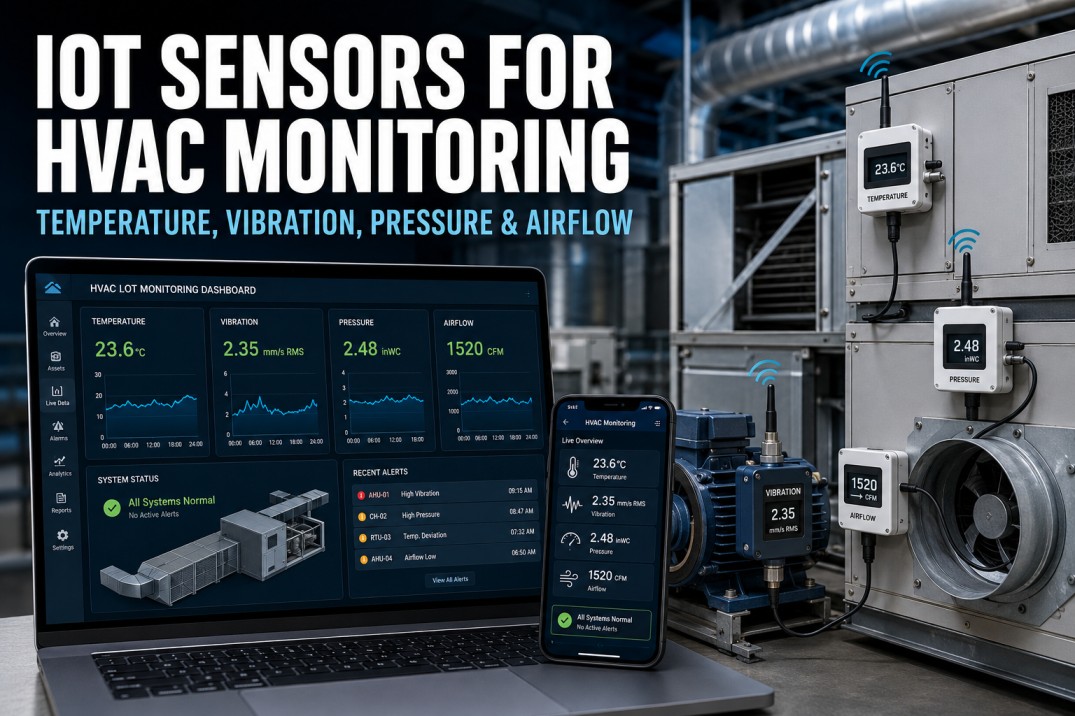
Vibration, temperature, humidity, and airflow sensors deliver the most diagnostic value exactly where wiring is hardest to reach, on rooftop units, in mechanical rooms with finished ceilings, and across distributed VAV boxes. iFactory helps reliability teams design wireless mesh sensor networks that reach those locations without a rewiring project, and turns the resulting data into decisions the existing BAS was never built to make on its own.
Wireless Mesh Is Not Always the Right Answer, but It Usually Is for a Retrofit
Reliability engineers weighing a sensor deployment should not treat wireless mesh as a universal upgrade over wired sensing, the two approaches solve different problems well. A new-construction project running conduit during the original build has little reason to choose wireless, wired connections are more power-reliable and immune to RF interference concerns that mesh networks have to actively manage. The calculation changes entirely once the building already exists and the sensor is going into a location a cable was never planned to reach.
In that retrofit scenario, the labor and disruption cost of running new cable through finished space, sometimes requiring ceiling tile removal, wall penetrations, or fire-rated conduit in mechanical spaces, routinely exceeds the cost of the sensor hardware itself by a wide margin. Wireless mesh sidesteps essentially all of that cost, at the tradeoff of needing thoughtful network architecture to guarantee reliable coverage and battery-life planning that a hardwired sensor never has to account for.
What Each Sensor Type Actually Catches Before It Becomes a Failure
A wireless mesh deployment is only as useful as the sensor types feeding it, and each of the common HVAC sensor categories is diagnosing a distinct failure mode. Deploying only one type, temperature sensing alone is the most common gap, leaves entire failure categories invisible regardless of how good the network architecture underneath them is.
Map Where Wireless Sensing Would Actually Close Your Blind Spots
iFactory reviews your current sensor coverage against known failure modes and identifies where a mesh deployment delivers the fastest diagnostic value.
Why Mesh Topology Matters More Than Individual Sensor Range
The defining advantage of a mesh network over a simple point-to-point wireless sensor is redundancy in the data path. Every node in a properly designed mesh can relay data for its neighbors, so a single obstruction, an equipment relocation, or one dead battery does not take down the entire network, traffic simply reroutes through an alternate path. A star topology, where every sensor talks directly to one central gateway, does not have this property, a single sensor with a weak or blocked signal becomes a dead zone with no fallback.
Reliability engineers planning a deployment should map RF propagation through the specific mechanical spaces involved before finalizing sensor placement, since HVAC mechanical rooms are frequently full of exactly the kind of dense metal equipment that degrades wireless signal strength unpredictably. A mesh design with sufficient node density tolerates this far better than a sparse network, because each additional node is also a potential relay point for its neighbors, strengthening the overall network resilience rather than just adding one more isolated data source.
Gateway placement deserves the same deliberate attention as sensor placement itself, since a single point of aggregation failure defeats much of the resilience the mesh topology was designed to provide. Redundant gateways, positioned so that a loss of connectivity at one still leaves the network with a working aggregation point, are a relatively small additional cost during initial deployment compared to the cost of retrofitting redundancy in after a facility has already experienced a full network outage from a single gateway failure.
| Protocol | Typical Range | Best Fit |
|---|---|---|
| Zigbee Mesh | 10-30 meters per hop, extendable via mesh relay | Dense sensor deployments across multiple mechanical rooms |
| LoRaWAN | Several hundred meters to kilometers, line of sight dependent | Campus-wide or outdoor rooftop unit deployments |
| Wi-Fi Based Sensors | 30-50 meters, dependent on existing building Wi-Fi infrastructure | Buildings with strong existing wireless coverage and available bandwidth |
| Bluetooth Mesh | 10-20 meters per hop, lower power draw | Battery-sensitive deployments needing multi-year sensor life |
Why AI Integration Is the Difference Between More Data and More Insight
A wireless mesh network solves the deployment problem, getting sensor data out of hard-to-reach locations, but it does not by itself solve the interpretation problem. Raw vibration or temperature streams from dozens of new sensor points quickly become their own kind of overload if every reading is presented to a reliability engineer without context, which is exactly the alarm fatigue pattern that plagues poorly designed monitoring systems generally.
AI-driven integration addresses this by establishing a normal operating baseline for each sensor and each piece of equipment individually, since normal vibration signatures differ meaningfully between a rooftop unit fan and a chilled water pump, and flagging deviations from that specific baseline rather than applying one static threshold across dissimilar equipment. This is also where cross-sensor correlation adds real diagnostic value, a rising vibration reading combined with a slowly climbing temperature trend on the same piece of equipment is a stronger failure signal together than either reading would be in isolation.
This correlation approach also helps distinguish a genuine developing fault from an ordinary seasonal or load-driven change that would otherwise trigger a false alarm on a naive threshold system. A rooftop unit running harder on a hot afternoon is expected to show a temperature and vibration profile different from its overnight baseline, and a model that has learned this expected daily and seasonal variation avoids flagging normal operating conditions as anomalies, reserving alerts for deviations that fall outside the pattern the equipment itself has established over time.
The Tradeoff Nobody Mentions Until the Batteries Start Dying
Wireless mesh sensors remove wiring cost but introduce a different, often underestimated maintenance overhead, battery replacement across potentially dozens or hundreds of nodes. A network designed without battery life as a first-class architectural concern can end up requiring almost as much ongoing labor as a wired system would have, just redistributed from installation to maintenance instead of eliminated.
Node density and reporting frequency are the two levers with the biggest impact on battery life. A sensor reporting every few seconds drains far faster than one reporting on a sensible interval matched to how quickly the monitored condition actually changes, vibration data driving bearing failure prediction genuinely needs frequent sampling, while a humidity sensor in a stable mechanical room rarely needs readings more often than every few minutes. Matching reporting frequency to the actual rate of change in each monitored condition, rather than defaulting every sensor to the same aggressive interval, is one of the simplest ways to extend battery life across a large deployment without losing diagnostic value.
Battery chemistry and mounting location matter almost as much as reporting frequency. Nodes mounted in mechanical spaces exposed to temperature extremes, near a boiler or on an uninsulated rooftop unit, see accelerated battery drain compared to a climate-controlled interior mechanical room, and a deployment plan that treats every node's expected battery life identically regardless of its thermal environment tends to be surprised by early failures on exactly the units exposed to the harshest conditions. Building a maintenance calendar around a realistic, location-adjusted battery replacement schedule avoids the scenario where a sensor silently goes dark for weeks before anyone notices its data stream stopped.
Sequencing a Mesh Rollout Across an Occupied, Operating Facility
Unlike a wired sensor project, which typically requires scheduled downtime or after-hours access to run cable through occupied space, a mesh sensor deployment can usually proceed with minimal disruption to ongoing operations, since installation is largely a matter of mounting battery-powered nodes rather than routing infrastructure. This is a meaningful practical advantage for facilities that cannot easily schedule extended equipment downtime, but it does not mean deployment planning can be skipped, it simply shifts the planning effort from scheduling logistics to RF site survey work.
A sensible sequencing approach starts with a gateway placement survey, identifying where a central receiver can reliably reach the mesh backbone across the facility's mechanical spaces, followed by a phased sensor rollout starting with the highest-value, hardest-to-reach equipment identified in the initial criticality assessment. Reliability engineers who front-load the RF survey work before ordering hardware consistently avoid the most common deployment failure mode, discovering after installation that a specific mechanical room has a dead zone the network cannot reliably bridge.
Commissioning a mesh network also benefits from a validation period before it is treated as a trusted data source for maintenance decisions, typically several weeks of parallel operation where sensor readings are compared against manual inspection findings to confirm the baseline the AI model is building actually reflects real equipment condition rather than an artifact of sensor placement or a miscalibrated unit. Skipping this validation step is a common reason early deployments produce a string of false positives that damage trust in the system before it has had a chance to prove its value.
| Deployment Phase | Primary Activity | Typical Duration |
|---|---|---|
| Site Survey and Gateway Placement | Map RF propagation and identify backbone coverage across mechanical spaces | Days to a couple weeks depending on facility size |
| Phased Sensor Installation | Mount nodes starting with highest-criticality, hardest-to-reach equipment | Ongoing, prioritized rollout across equipment tiers |
| Baseline Validation | Compare sensor readings against manual inspection to confirm accuracy | Several weeks of parallel operation before full reliance |
| Full Operational Reliance | AI-flagged deviations drive maintenance scheduling decisions | Ongoing, with accuracy improving over each seasonal cycle |
Questions Reliability Engineers Ask About Mesh Sensor Deployment
Reach the Equipment Your Current Sensors Can't
iFactory designs wireless mesh sensor networks for the mechanical rooms, rooftop units, and distributed equipment a wiring project was never going to reach affordably.