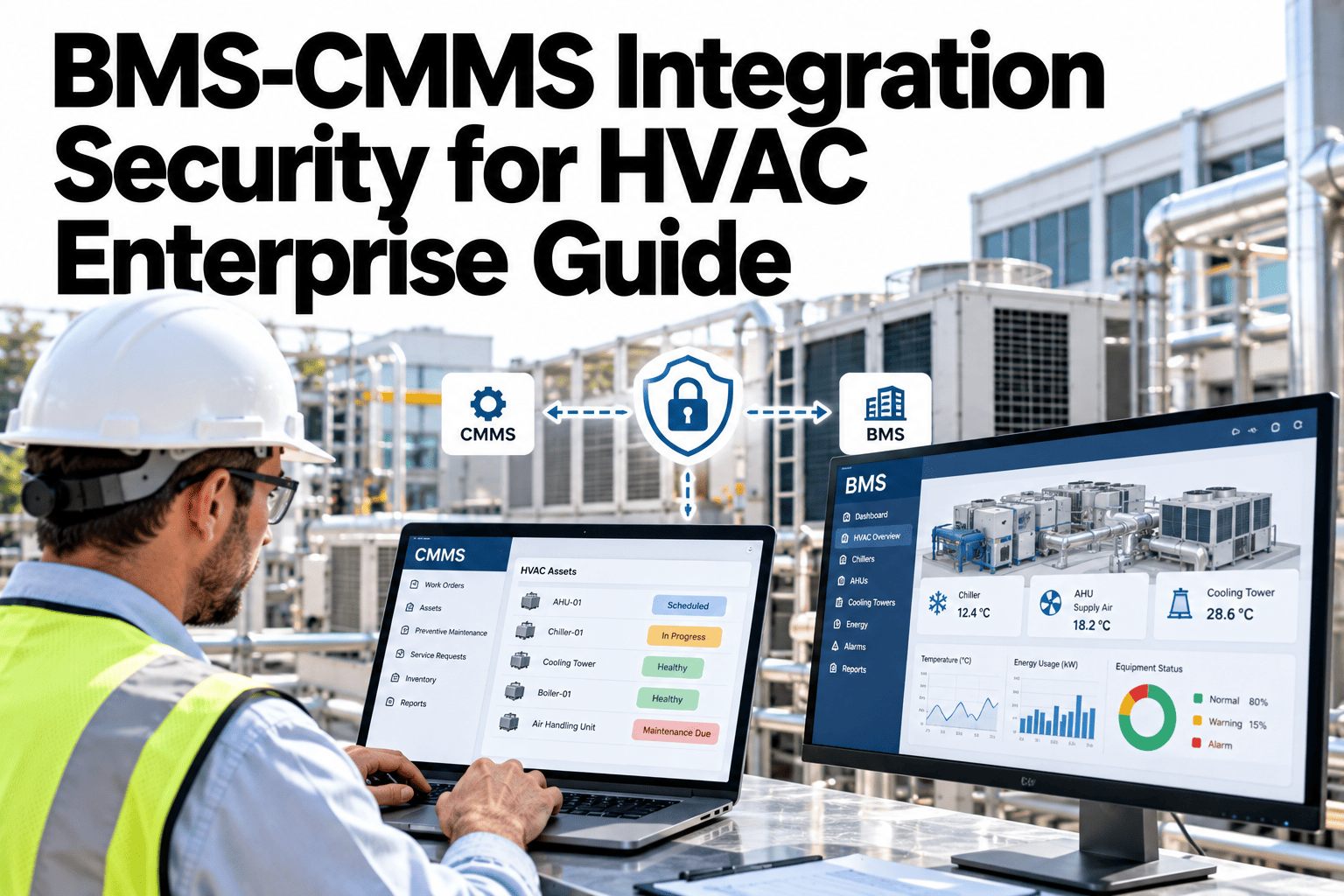
Connecting a building management system to a CMMS means connecting an operational technology network that was never designed with security in mind to an IT-facing system that handles credentials, API tokens and work order data. Treating that bridge as just another integration project, without network segmentation or credential hygiene, turns a maintenance efficiency win into an open door onto the BAS network. Enterprise HVAC portfolios with dozens of buildings and multiple BAS vendors carry this risk at scale, and security teams can review their own integration architecture against these patterns in a short session.
Integrate the Data Without Opening the Network
iFactory connects BMS and CMMS data bidirectionally through a segmented architecture, so maintenance visibility never means exposing the OT network.
Why BMS-CMMS Integration Carries Real Security Risk
A BAS network was typically designed assuming physical access control was the main defense, not internet-facing authentication. Once a CMMS integration opens a path into that network, old assumptions stop holding.
The risk is not integration itself, it is integration done without segmentation, scoped credentials and monitoring built in from the start.
| Risk Area | Common Mistake | Mitigation |
|---|---|---|
| Network path | Direct connection from CMMS to BAS controllers | Route through a segmented DMZ with a dedicated gateway |
| Credentials | Shared, long-lived service accounts | Scoped, rotated credentials per integration |
| API authentication | Static API keys with broad permissions | Token-based auth with least-privilege scopes |
| Monitoring | No visibility into integration traffic | Log and alert on unusual access patterns at the DMZ |
Get Your Integration Path Reviewed for Security Gaps
Book a 30-minute session and iFactory will walk through your current BMS-CMMS data path against this security pattern.
Network Segmentation in Practice
Segmentation is not a single firewall rule, it is a layered design that limits how far an intrusion can travel if one layer is compromised.
Enterprise IT Zone
Where the CMMS, work order system and corporate directory live, protected by standard enterprise IT controls.
Integration DMZ
A dedicated, narrowly scoped zone where the integration gateway runs, with no direct route from IT to OT devices.
BMS/OT Network
Where BAS controllers and field devices live, reachable from the DMZ gateway only, never directly from enterprise IT.
Credential Rotation and API Authentication
A segmented network still fails if the credentials crossing it are shared, static and never rotated. These two practices matter as much as the network design itself.
Signals Your Integration Security Needs a Second Look
These patterns tend to show up in enterprise portfolios well before a formal audit catches them.
Where iFactory Fits
iFactory's BMS/BAS and CMMS integration is built around segmentation and credential hygiene from the start, not added after a security review flags a problem.
Segmented Gateway Architecture
Integration traffic routes through a dedicated DMZ layer, never directly between enterprise IT and BAS controllers.
Scoped, Rotated Credentials
Each integration uses narrowly scoped credentials on a defined rotation schedule, not a shared long-lived account.
Token-Based API Authentication
Authentication uses revocable tokens with least-privilege scopes rather than static, broadly permissioned keys.
Integration Traffic Monitoring
Access patterns at the DMZ are logged and alerted on, giving security teams visibility into the one path that matters.
Reviewed by iFactory's OT Security team for alignment with current BMS/BAS integration security practice. The architecture shown is a general pattern; actual segmentation design should be validated against your own network topology and any applicable regulatory requirements before deployment.
Frequently Asked Questions
Does segmentation slow down the integration?
Not meaningfully for the data volumes involved in maintenance and work order sync. The DMZ gateway adds a hop, but that overhead is negligible compared to the sync intervals most CMMS integrations run on. Support can walk through expected latency for your scale.
Who should own the integration's security long term?
Ideally a joint arrangement between IT security and facilities, since the integration touches both domains. Clear ownership of credential rotation and monitoring review should be assigned explicitly rather than left ambiguous between the two teams.
Can this architecture work across buildings with different BAS vendors?
Yes, the segmentation and credential pattern applies regardless of which BAS platform a given building runs, since the DMZ gateway is the common layer across all of them. See this mapped across your own mixed-vendor portfolio in a short session.
How often should credentials actually be rotated?
This depends on your organization's security policy, but a defined schedule, commonly every 90 days for service accounts, matters more than any specific interval. The key failure mode is having no schedule at all.
Does this satisfy compliance requirements for regulated facilities?
Segmentation and credential hygiene support most common compliance frameworks, but specific regulatory requirements vary by industry and jurisdiction. Ask support how this maps to your specific compliance obligations.
Connect Your BMS and CMMS Without Opening a New Attack Surface
iFactory integrates BMS and CMMS data through a segmented, credential-safe architecture. Book a walkthrough on your own portfolio.