Predictive Scrap AI in Mining Flotation: Supervisors Playbook
By Grace on June 9, 2026
The shift supervisor reviews the 14:00 concentrate assay. Cell 4 grade dropped from 28% Cu to 24.5% Cu. The target is 26% minimum. The froth looked stable. The operator reported normal conditions. But the lab result at 14:00 represents the grade at 13:00, when the sample was taken. The circuit has been running at 24.5% for an hour. That hour of off-grade material will be written off as scrap or diverted to the low-grade stockpile at a fraction of target concentrate value. The supervisor closes the report. The cause is unknown. The timing is unknown. The extent of the scrap — how many tonnes, how many minutes, which cells — is unknown. This is the defining scrap problem in mining flotation: not a single catastrophic failure, but the invisible, cumulative production of off-spec material that is only detected when the lab assay arrives, hours after the condition that caused it developed. Predictive scrap analytics changes this. Machine learning models trained on froth characteristics, reagent dosages, air flow rates, feed mineralogy, and pulp chemistry data forecast scrap risk hours before it materialises — giving the supervisor a window to intervene before the circuit produces off-grade concentrate.
Every Hour You Wait for the Lab Assay Is an Hour of Scrap You Cannot Recover. Predictive Analytics Closes That Gap.
iFactory's predictive scrap analytics platform monitors every flotation cell continuously — forecasting scrap risk, tracking Cpk in real time, and alerting supervisors 1–3 hours before off-grade material is produced — cutting scrap by 30–50% in operating flotation circuits.
Scrap reduction achieved when predictive analytics alerts supervisors to grade deviation risk before off-spec material reaches the thickener
1–3 hrs
Early warning window from predictive scrap models — time between the forecast alert and the predicted scrap event, during which the supervisor can investigate and intervene
0.85–0.96
R² score range for validated predictive models in flotation — demonstrating that grade deviation, recovery loss, and scrap events are forecastable from process data
12–18%
Average Cpk improvement observed in flotation circuits using predictive quality models — shifting processes from marginal capability to fully capable
The Scrap Risk Horizon: What Predictive Analytics Shows the Supervisor Before Scrap Happens
A supervisor's shift runs on a 12-hour cycle. In that cycle, the flotation circuit processes hundreds of tonnes of ore. Without predictive scrap analytics, the supervisor operates on lagging indicators — lab assay results that report the grade from 45 minutes ago, end-of-shift concentrate samples, and shiftly recovery calculations. With predictive analytics, the dashboard shows a different view: a forward-looking risk horizon that forecasts scrap probability across the remaining shift hours, updating every time the model ingests new process data from the cells, reagents, and feed system.
Prediction fires at 09:47 — Scrap risk alert on Cell 3: Grade deviation probability 87% within the 12:00–14:00 window
The model detects froth colour shifting on Cell 3 since 08:30, combined with declining air recovery and a 7% drop in froth stability index. Historical pattern match: 89% similarity to the last three grade deviation events. Supervisor has 2 hours and 13 minutes to investigate before the predicted scrap window opens. Corrective action at 10:12 — reagent adjustment on Cell 3. Scrap avoided: approximately 48 tonnes of off-grade concentrate valued at $4,200.
The Six Scrap Drivers in Flotation — and How Predictive Analytics Forecasts Each One
Scrap in flotation is not a single event type. It originates from six distinct process conditions, each producing a different quality deviation and each forecastable by a different combination of sensor inputs and model features. The predictive scrap analytics model monitors all six drivers simultaneously on every cell, across every shift, and fires a forecast alert when any driver crosses its prediction threshold.
Grade Deviation
Concentrate grade drifts below the target specification due to feed mineralogy shifts, reagent depletion, or froth residence time changes. This is the highest-frequency and highest-cost scrap driver in flotation. The model forecasts grade deviation by correlating froth colour index, froth velocity, and reagent dosage trends against historical grade assay data — typically achieving 2–4 hour prediction horizons.
Prediction model: Random Forest regression on froth colour, velocity, and reagent dosage features
Recovery Loss
Valuable minerals lost to tailings when aeration efficiency drops, froth stability collapses, or bubble surface area decreases below the recovery threshold. Recovery loss scrap is invisible at the cell — it looks like normal tailings but carries higher-than-acceptable payable mineral content. The model forecasts recovery loss by monitoring air flow per cell, froth stability index, bubble size distribution, and mass pull rate.
Prediction model: Gradient boosting on air flow, froth stability, and bubble size distribution features
Reagent Imbalance
Incorrect frother or collector dosage creates unstable froth, poor mineral selectivity, or depressed recovery. Reagent imbalance scrap is particularly insidious because the froth may appear normal while the flotation chemistry is already degraded. The model forecasts reagent-driven scrap by correlating dosage rates, froth characteristics, and pulp chemistry data against historical recovery and grade records.
Prediction model: Neural network on reagent flow rates, froth texture, and pulp pH features
Feed Grade Variability
Incoming ore grade changes faster than the control loop compensates, causing the circuit to produce concentrate outside the target range. Feed variability is the scrap driver the supervisor has least direct control over — making prediction and early warning the most valuable intervention tool. The model forecasts feed-driven scrap by analysing upstream mill data, feed grade trends, and the circuit's demonstrated response time to grade changes.
Prediction model: Time-series LSTM on feed grade, mill throughput, and circuit response lag features
Aeration Disruption
Air flow reduction in a flotation cell reduces bubble surface area, dropping recovery and increasing the payable mineral content lost to tailings. Aeration disruptions can develop gradually — a fouled sparger, a compressor drift, a valve sticking — making them difficult to detect by operator observation alone. The model forecasts aeration-driven scrap by monitoring air flow per cell, bubble size distribution, and froth velocity trends.
Prediction model: Anomaly detection on air flow, bubble size, and froth velocity multivariate signals
Froth Stability Collapse
Froth structure breaks down rapidly, causing mineralised bubbles to collapse before reaching the launder. Stability collapse can recover spontaneously or worsen into a full circuit disturbance. The model forecasts stability-driven scrap by tracking the froth stability index trend, bubble burst rate, and froth depth variation — detecting the precursor patterns of an imminent collapse before the froth surface visibly changes.
Prediction model: XGBoost classifier on stability index, bubble burst frequency, and froth depth features
Cpk Prediction Window: How the Supervisor Sees Capability Trending Before Scrap Occurs
Process capability index is the supervisor's most compressed measure of flotation circuit health. A Cpk of 1.33 or higher means the circuit is producing within specification with acceptable margin. A Cpk below 1.0 means the circuit is producing out-of-spec material — scrap. Between 1.0 and 1.33, the circuit is in the marginal zone where any additional disturbance will push it into scrap territory. Predictive scrap analytics adds a forward-looking dimension to Cpk: the dashboard shows not only the current Cpk value, but a predicted Cpk trajectory for the next 2 to 4 hours — giving the supervisor a clear view of whether the capability is improving, holding, or deteriorating toward the scrap threshold.
Cpk Prediction Window — Current vs Forecast Capability for Cell 3 (Concentrate Grade)
Current State: Marginal
Cpk 1.12 is above the scrap threshold (1.0) but below the capable threshold (1.33). The circuit is producing in-spec material but without sufficient margin. Any additional disturbance will push the Cpk below 1.0, producing scrap.
Predicted Trajectory: Deteriorating
Cpk declining at 0.08 per hour. At current trend, Cpk crosses the scrap threshold (1.0) at approximately 13:00. Predicted Cpk at 14:00: 0.94 — below the scrap boundary. Intervention required within 90 minutes to prevent scrap.
Recommended Intervention
Increase frother dosage on Cell 3 by 8%, reduce air flow by 3%. Expected Cpk recovery to 1.22 within 45 minutes. Predicted scrap avoided: 18–24 tonnes of off-grade concentrate.
Supervisor Dashboard: Predictive Scrap View — Four Panels That Change How You Manage Quality
The supervisor dashboard for predictive scrap analytics is designed around a single operating principle: the supervisor should never discover scrap at the end of a shift. Every alert, every forecast, and every trend line is positioned to give the supervisor information before the scrap event — not after.
Dashboard Panel 01
Scrap Risk Forecast — Per Cell, Per Shift
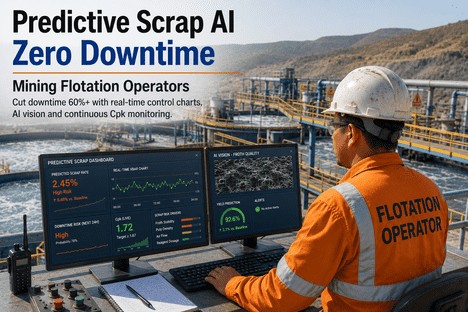
Every flotation cell displays a current scrap risk score (0–100%) and a forecast trend for the next 4 hours. The score is a composite of all six scrap driver predictions for that cell, weighted by each driver's historical contribution to scrap events. Cells with risk scores above 60% appear in amber, above 80% in red — visible immediately on the dashboard without opening individual cell views. The supervisor sees the complete flotation circuit scrap risk profile on a single screen, with the most critical cells sorted to the top of the list by risk score.
Supervisor action: Scan risk scores at shift start and after each process change. Investigate amber cells; intervene on red cells.
Dashboard Panel 02
Cpk Trend with Prediction Window
Live Cpk for each quality characteristic — concentrate grade, recovery, silica in concentrate — displayed as a trend line extending from the past 8 hours into the next 4 hours (predicted). The Cpk prediction window is the dashboard element that shifts the supervisor's quality management from reactive to proactive: instead of seeing Cpk where it was (last hour's value) and deciding whether that is acceptable, the supervisor sees Cpk where it is going and decides whether intervention is needed before it reaches the scrap threshold.
Supervisor action: When predicted Cpk crosses 1.15 (amber) or 1.0 (red), investigate the driver with the highest contribution to the Cpk decline.
Dashboard Panel 03
Scrap Driver Contribution — Root Cause at a Glance
When a scrap risk forecast fires, the dashboard displays a driver contribution breakdown showing which of the six scrap drivers is driving the forecast, and by how much. The breakdown is expressed as a percentage contribution per driver — enabling the supervisor to see at a glance whether the forecast is driven by feed grade variability (upstream issue), reagent imbalance (chemicals adjustment), or froth stability collapse (aeration or frother issue). This eliminates the investigation time spent guessing which process variable caused the scrap condition.
Supervisor action: Review driver contribution — direct corrective action to the dominant driver rather than adjusting parameters by trial and error.
Dashboard Panel 04
Intervention Record and Scrap Avoided Counter
Every predictive alert and every corrective action is logged automatically — timestamp, cell, predicted driver, forecast risk score, actual outcome, and estimated scrap value avoided. The scrap avoided counter aggregates across all interventions in the shift, week, and month, displaying the cumulative value of concentrate that would have been produced off-spec but was held within specification because the supervisor acted on a predictive alert. Over a month, the counter provides the direct ROI evidence for the predictive scrap analytics deployment.
Supervisor action: Review intervention record in shift handover — include scrap avoided metrics as leading indicators of quality performance improvement.
"
I have been a flotation supervisor for 11 years. I can read the froth. I know when the colour is wrong, when the bubbles are too big, when the froth is moving too fast or too slow. But I cannot measure it, and I cannot see what happens when I am not at the cell. The predictive scrap dashboard shows me things I could never see from the catwalk. It told me at 09:47 that Cell 3 would go off-grade at 12:00. I did not believe it at first — the froth looked fine. But I checked the trend data and saw the colour index had shifted 12% since 08:30. I adjusted the reagent at 10:12. By 11:30, the risk score was back to green. The lab assay at 12:00 confirmed the grade held. Without the prediction, I would have found out at 14:00 when the next assay arrived — two hours of off-grade concentrate that I would have written up in the shift report as 'cause unknown.' That prediction changed how I manage quality on every shift since.
— Shift Supervisor, Copper Flotation Circuit, South America
Conclusion
Scrap in flotation is not detected by the lab. It is detected by the customer — when the concentrate shipment is assayed at the smelter and the grade falls short of the specification, triggering a penalty, a rejection, or a renegotiation. The lab assay at the concentrator is the supervisor's best available tool for in-process quality measurement, but it operates on a 45-minute delay. In those 45 minutes, the flotation circuit can produce 30 to 60 tonnes of off-grade material. That material is scrap — whether it is sent to the low-grade stockpile at a fraction of the value or blended into on-spec shipments at a quality discount.
Predictive scrap analytics breaks the cycle by forecasting scrap risk before the scrap occurs — not by replacing the lab assay, but by giving the supervisor a 1-to-3-hour early warning window that makes the lab assay a confirmation tool instead of a detection tool. The machine learning models do not need to be perfect. They need to be right often enough and early enough that the supervisor can investigate, intervene, and prevent a scrap event that would otherwise have been discovered only after it was complete. A prediction accuracy of 85% that provides a 2-hour intervention window prevents more scrap than a 99% accurate lab assay that reports the result 45 minutes after the sample was taken.
iFactory's predictive scrap analytics platform is built for flotation supervisors who are tired of discovering scrap in the end-of-shift report. Book a Demo to see how the scrap risk horizon, Cpk prediction window, and driver contribution models perform on your circuit data, or talk to an expert about configuring predictive scrap analytics for your cell layout, reagent regime, and concentrate specification targets.
Frequently Asked Questions
The model requires a minimum of 60 to 90 days of historical process data with corresponding lab assay results to achieve reliable prediction accuracy. This data window captures the range of operating conditions — different ore types, feed grades, reagent regimes, and seasonal variations — that the model needs to learn the relationship between process variables and scrap events. During the data accumulation phase, the system collects froth characteristic data, reagent dosages, air flow rates, pulp chemistry measurements, and lab assay results from the existing quality control process. The model begins generating predictions after 30 days, but these initial predictions run in shadow mode (compared against actual outcomes without driving alerts). Full prediction activation typically occurs after 90 days, when the model has been validated against at least three full scrap event cycles. Talk to an expert to review your current data availability and estimate the timeline to prediction activation for your circuit.
The system is designed to minimise false alarms through a two-stage alert architecture. The first stage is a risk score (0–100%) that adjusts continuously as new process data arrives. A scrap risk forecast at 65% requiring investigation is different from a forecast at 92% requiring immediate intervention. The second stage is a prediction confidence threshold that the supervisor team sets during deployment calibration — typically at 75–80% for amber alerts and 90%+ for red alerts. Alerts below the confidence threshold are displayed as monitoring recommendations rather than actionable notifications. During the first 30 days of live operation, the system tracks false positive and false negative rates, and the prediction confidence threshold is adjusted to balance sensitivity against specificity. Most deployments achieve a false positive rate below 8% after calibration, with supervisors reporting that the system's specificity — its ability to distinguish real scrap risk from routine process variation — is the feature that sustains their trust in the alerts over time. Book a Demo to see how the confidence calibration process works on your historical data.
The predictive scrap analytics platform is designed as an overlay layer that integrates with existing DCS, SCADA, CMMS, and lab information management systems. It ingests process data from the control system, froth image data from the vision system, and assay results from the lab system — correlating all inputs through the prediction models and outputting forecasts and alerts to a supervisor dashboard that can run as a standalone interface or as an embedded view within the existing HMI. The platform does not write setpoints to the control system (unless the supervisor explicitly configures closed-loop control on validated model outputs). This integration architecture means the existing control system continues to manage regulation and safety-critical functions while the predictive layer adds the forecasting capability that the control system does not natively provide. Talk to an expert about the integration requirements for your specific DCS platform and lab information system.
For a copper concentrator processing 40,000 tonnes per day at 0.7% feed grade with 88% recovery and a concentrate grade target of 26% Cu, the annual payable concentrate production is approximately 296,000 dry metric tonnes. If 4% of that concentrate is produced off-spec and diverted to low-grade stockpile at a 15% price discount, the annual scrap cost is approximately $1.7 million at current copper prices. A 30% reduction in off-grade material saves approximately $510,000 per year in avoided concentrate discount penalties. For larger operations — 80,000+ tonnes per day — the annual scrap cost doubles to $3.4 million and the savings from a 30% reduction exceed $1 million. These figures exclude the additional savings from reduced low-grade stockpile management costs, fewer penalty claims from smelter customers, and improved Cpk that may qualify the operation for premium pricing on consistent-quality concentrate. The financial impact varies by operation size, feed grade, concentrate specification, and current scrap rate — each deployment includes an ROI analysis based on the operation's specific production data and concentrate pricing structure. Book a Demo to receive a scrap reduction ROI estimate calculated against your operation's production parameters.
The Lab Assay Tells You What Happened 45 Minutes Ago. Predictive Analytics Tells You What Will Happen 2 Hours from Now. The Difference Is Scrap Saved vs Scrap Discovered.
iFactory's predictive scrap analytics platform monitors six scrap drivers across every flotation cell — grade deviation, recovery loss, reagent imbalance, feed variability, aeration disruption, and froth stability collapse — forecasting each one with 1-to-3-hour early warning and cutting scrap by 30–50% in operating flotation circuits.