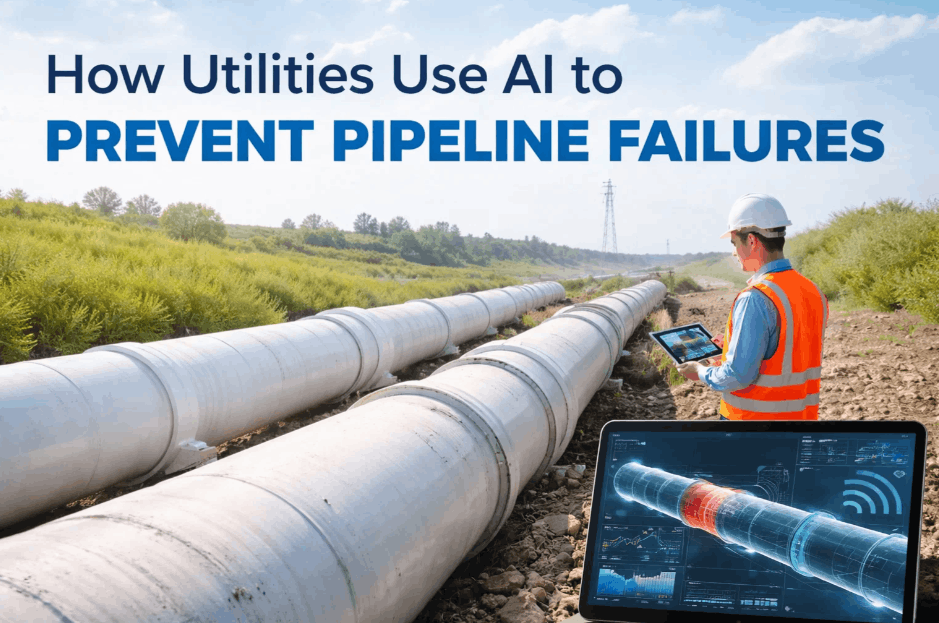
Pipeline integrity management is undergoing a paradigm shift as municipal and private utilities move away from reactive "break-fix" cycles toward AI pipeline failure prevention. By integrating high-fidelity IoT sensors with advanced machine learning models, utility operators can now detect structural anomalies—such as micro-cracks, anaerobic corrosion, and pressure transient spikes—weeks before a catastrophic rupture occurs. An AI copilot for pipeline analytics doesn't just display sensor data; it interprets the "acoustic fingerprint" of the network, identifies the root cause of pressure drops, and auto-generates emergency work orders natively. Book a demo to see how iFactory's infrastructure monitoring software secures these critical utility lifelines.
Prevent Pipeline Ruptures with AI-Driven Predictive Intelligence
iFactory's machine learning maintenance platform delivers real-time acoustic leak detection, pressure surge analysis, and autonomous failure forecasting—purpose-built for utility engineers.
Why Traditional SCADA Falls Short in Modern Pipeline Management
Most utility pipelines are governed by legacy SCADA systems that trigger alerts only after major pressure thresholds are breached. By the time a "Low Pressure" alarm fires on a standard dashboard, thousands of gallons of fluid have often already escaped, and the structural damage is irreversible. The core problem in ai prevent pipeline failures utilities adoption is the "noise" of modern networks. High-demand variables and legitimate flow fluctuations often hide the subtle signals of a developing fault. Predictive analytics infrastructure bridges this gap by applying frequency-domain analysis to sensor streams, separating the normal "hum" of the network from the specific acoustic signature of a pinhole leak. Schedule a mapping session to see how iFactory's AI copilot identifies these anomalies in seconds.
How the AI Copilot Secures Urban Utility Networks
iFactory's infrafstructure maintenance ai platform integrates directly with your existing telemetry and GIS mapping—turning raw pressure and acoustic data into actionable insights accessible from any tablet or dispatch center.
Pipeline Repair Automation
Real-World Integrity Outcomes: Utility AI Scenarios
The success of smart infrastructure management is measured in the ruptures that never happened. These scenarios illustrate how iFactory's predictive engine transforms utility operations from reactive to proactive.
Scenario 1: The Pinhole Leak in the Pavement
Acoustic sensors flagged a minor anomaly in a high-traffic downtown corridor. AI confirmed it was not traffic noise but a 2mm pinhole leak. Repair cost was $4k; avoided estimated sinkhole repair of $250k.
Scenario 2: Pump-Induced Surge Management
AI identified that a specific pump-start sequence was creating "water hammer" events 80% above design limits. Adjusted VFD settings via iFactory infrastructure ai insight, extending line-life by 15 years.
Scenario 3: Corrosive Soil Alert
AI correlated a surge in anaerobic soil moisture with rapid wall-thinning patterns. Targeted these specific 4 blocks for replacement during a low-load period, preventing a major arterial rupture during winter. Book a demo to audit your corrosive risk.
Scenario 4: High-Heat Thermal Anomaly
Integrated drone thermal data flagged a "hot spot" above a subterranean steam line. Predictive analytics infrastructure identified the likely insulation breach and auto-generated the repair plan before dawn.
Next-Gen AI vs. Standard Utility Leak Detection
For city managers evaluating AI prevent pipeline failures utilities investments, this table illustrates the efficiency gap between traditional acoustic loggers and iFactory's self-learning AI copilot platform.
| Capability | Manual Leak Loggers | Static SCADA Thresholds | iFactory AI Copilot |
|---|---|---|---|
| Detection Window | Weeks (Post-leak detection) | Hours (Post-rupture drop) | Days/Weeks (Pre-failure anomaly) |
| Localization Accuracy | Low (+/- 20 meters) | Medium (Between valves) | High (Precision within 1 meter) |
| False Positive Rate | High (Ambient interference) | High (Flow fluctuations) | Near-Zero (Intelligent filtering) |
| Asset Health Context | None | Basic Trend Charts | Full Remaining Useful Life (RUL) |
| Work Order Integration | Manual Paper Entry | Static Email Alerts | Automated, Data-Rich Dispatch |
How iFactory's Utility Integrity Platform Is Architected
Deploying machine learning maintenance for utility pipelines requires an architecture capable of processing "high-frequency" data without overwhelming municipal IT networks. iFactory's system is built for resilience and security.
Edge-to-Cloud Data Ingestion
Connects to pressure, acoustic, and flow sensors via Cellular IoT (LTE-M/NB-IoT), ingesting GIS and CMMS records into a single AI context model without requiring costly network overhauls.
Acoustic Signature Fine-Tuning
The GenAI model is fine-tuned on the "physics of failure" for specific pipe materials, learning your network's unique "normal" flow harmonics over the first 30 days of live deployment.
Retrieval-Augmented Generation (RAG)
Every AI-generated insight is grounded in your actual pipe age data, pressure history, and repair logs—ensuring that work order recommendations are traceable and safe.
GIS-Aware Prediction Engine
The system continuously overlays prediction data onto your municipal map, allowing dispatchers to visualize "integrity heat maps" and prioritize capital replacement for the highest-risk corridors. Book a demo to see your map live.
Deploying Utility Integrity AI: The Phased Path to Autonomy
Transitioning to AI prevent pipeline failures utilities operations is a surgical process designed for zero disruption to active municipal water or utility distribution workflows.
Instrumentation Audit & GIS Sync
iFactory engineers audit existing telemetry nodes and sync GIS coordinate data. We identify "integrity blind spots" where targeted IoT acoustic loggers should be deployed.
Active Data Ingestion & Normalization
Existing SCADA streams and new IoT telemetry are centralized. The AI begins mapping "normal" diurnal pressure cycles and acoustic background levels for the specific district.
Failure Model Calibration & Copilot Training
The AI model starts scoring anomalies. Dispatchers begin using the conversational copilot to query asset history and safety protocols during supervised trial runs.
Fully Integrated Integrity Operations
Auto-generated work orders, surge-reduction protocols, and lifecycle capital planning summaries go live permanently. Continuous machine learning improves accuracy quarter-over-quarter.
Utility Pipeline AI: Frequently Asked Questions
Your Pipeline Infrastructure Deserves Better Than Reactive Repair.
iFactory's generative AI copilot delivers real-time acoustic failure detection, automated SOP lookup, and intelligent GIS-aware work order creation—purpose-built for utility teams running critical 24/7 distribution networks.