Water Valve & Hydrant Maintenance — Exercising Programs & AI Asset Tracking
By Grace on June 19, 2026
Every water distribution network has them: gate valves that have not been turned in seven years, hydrants that pass visual inspection but deliver half the rated flow, isolation points that exist on a GIS map but have been paved over, buried, or seized closed since the last road resurfacing project. For the reliability engineer, these are not maintenance backlog items — they are emergency response liabilities. When a main break occurs at 3 a.m., the difference between isolating 50 customers and isolating 500 depends on whether the valves in the isolation path actually operate. The American Water Works Association estimates that more than 15% of distribution valves in aging networks are in an unknown or inoperable condition at any given time. In documented municipal programmes, fewer than 38% of valves were operable before a structured exercising programme was implemented. The gap between the asset register and the operational reality is where reliability risk compounds — and where AI-powered asset tracking and adaptive maintenance scheduling close it.
15%
Estimated proportion of distribution valves in aging water networks that are inoperable at any given time — seized, buried, or partially closed, per AWWA distribution system studies
62%
Percentage of valves found inoperable at the start of documented municipal exercising programmes — rising to over 80% operable within two years of structured intervention
60%
Reduction in valve inspection costs documented when AI-driven risk-based prioritisation replaces fixed-interval inspection cycles across the entire distribution network
85-99%
Leak detection accuracy range documented in peer-reviewed Water Research studies using ML-based acoustic and pressure analytics across diverse pipe materials and soil conditions
The Reliability Engineer's Core Problem: You Cannot Operate What You Cannot Find, and You Cannot Trust What You Have Not Turned
Water distribution valves and hydrants are the most maintenance-critical and most systematically neglected assets in any municipal network. Unlike pumps or treatment equipment that fail with observable symptoms — vibration, temperature rise, pressure drop — valves and hydrants fail in silence. A gate valve seized by corrosion does not generate an alarm. A hydrant with a failed drain valve that freezes in winter does not report its condition. A butterfly valve left partially closed after a repair restricts flow for years before someone investigates a low-pressure complaint. The reliability engineer inherits a network where thousands of appurtenances exist on the asset register but their true condition is unknown until an emergency tests them. The core problem is not the absence of maintenance — it is the absence of visibility into which assets are operational, which are deteriorating, and which will fail when called upon.
Four Root Causes of Valve and Hydrant Unreliability — and How AI Asset Tracking Eliminates Each One
01
Valve Exercising Gaps Compound Over Time
A valve that is not exercised for one year may still turn freely. A valve not exercised for five years has a statistically significant probability of being inoperable. Most utilities operate on a 5-7 year exercising cycle per AWWA M44 guidelines, but without digital tracking, the actual interval is determined by staff availability and memory rather than schedule compliance. Valves in low-visibility locations — dead-end mains, rural zones, behind commercial developments — accumulate exercising debt until the next emergency reveals their condition at the worst possible moment.
AI fix: GPS-tagged valve register with auto-generated exercising work orders on configurable cycles. Overdue status visible at network level.
02
Hydrant Condition Is Inferred, Not Measured
Most hydrant maintenance programmes rely on visual inspection — the hydrant is upright, the paint is intact, the caps are in place. Visual inspection does not measure flow rate, does not test drain valve function, does not verify that the hydrant delivers NFPA-rated fire flow under demand conditions. Hydrants that pass visual inspection routinely fail flow tests, and the first indication of a failed hydrant is often the fire department report after a structure fire. The gap between visual condition and operational capability is where reliability risk is systematically underestimated.
AI fix: Flow test results trended by hydrant and pressure zone. Predictive model flags hydrants below NFPA threshold before annual test cycle.
03
SCADA Alarms Generate Noise, Not Actionable Prioritisation
SCADA systems generate thousands of data points per minute — pressure readings, flow rates, valve positions, hydrant flow data. In most utilities, these data streams are monitored for threshold exceedances but not analysed for patterns that indicate developing asset failure. A PRV drifting 3 PSI above setpoint, a hydrant zone showing a 10% flow decline over six months, a DMA night flow minimum rising gradually — each is individually below the alarm threshold, but collectively they describe a distribution system that is degrading. The reliability engineer needs pattern recognition, not threshold alerts.
AI fix: ML models analyse SCADA/AMI data for trend deviation. Work orders generated from pattern-based risk scoring, not single-threshold violations.
04
Asset Records and Field Reality Are Out of Sync
The GIS asset register shows 15,000 valves. Field crews know that at least 1,000 of those are buried under asphalt, have been removed without record, or are documented at the wrong GPS coordinates. When emergency crews arrive at the mapped location of a critical isolation valve and find an intersection that was reconfigured five years ago, the gap between the record and reality becomes an operational crisis. Reliability engineers spend disproportionate time reconciling asset records instead of analysing condition data — because the register cannot be trusted for emergency response.
AI fix: Field-verified GPS corrections update asset register in real time. Reconciliation reports flag discrepancies between GIS and field data.
When 15% of Your Isolation Valves Are Inoperable, the Asset Register Is Not a Source of Truth — It Is a Source of Risk. AI Asset Tracking Makes Every Valve Count.
iFactory transforms water distribution asset tracking from a static register into a dynamic reliability system — with GPS-verified field data, ML-driven condition scoring, and automated work order generation that closes the gap between what the map shows and what the crew finds.
The iFactory AI Asset Tracking Architecture for Distribution System Reliability
iFactory's platform for water valve and hydrant maintenance operates as a three-layer reliability system — digital asset intelligence at the register level, condition-based maintenance scheduling at the operational level, and predictive failure analytics at the strategic level. Each layer solves a specific failure mode in distribution system reliability, and all three run continuously without requiring the reliability engineer to maintain separate data pipelines.
Layer 01
Digital Asset Intelligence
GPS-verified register that stays current with field reality
Every valve, hydrant, air-release valve, blow-off, and PRV in the distribution network is registered as an individual digital asset record with GPS coordinates, installation date, size, type, manufacturer, and last-service history. The iFactory platform imports existing GIS data and overlays it with field-verified corrections captured through mobile inspection workflows. When a field crew identifies a valve at a different location than the GIS record, the correction updates the register in real time. When a hydrant is found to be abandoned or removed, the record is flagged for reconciliation. The reliability engineer sees not a static snapshot of what the network should contain, but a live register of what the network actually contains — with discrepancy reports that highlight the gap between planned assets and verified assets.
GIS import with field verification
Real-time asset record correction
GIS discrepancy reporting
Layer 02
Condition-Based Maintenance Scheduling
Auto-generated work orders from condition data, not calendar intervals
The maintenance scheduling layer ingests data from SCADA pressure monitoring, AMI meter infrastructure, acoustic leak sensors, and field inspection records to determine when each asset actually needs attention — not when the calendar says it does. Valves are prioritised for exercising based on criticality score, years since last exercise, and known deterioration rate in their pressure zone. Hydrants are scheduled for flow testing based on NFPA 25 intervals modified by condition trend data — a hydrant in a corrosive soil zone with a declining flow trend is tested more frequently than a hydrant with stable performance in a low-risk area. Work orders are generated automatically with GPS navigation links, digital inspection checklists, and pre-loaded asset history. The reliability engineer moves from schedule management to exception management.
Criticality-based prioritisation
SCADA/AMI data integration
Auto-generated work order dispatch
Layer 03
Predictive Failure Analytics
ML models that forecast asset failure before it disrupts service
The predictive layer uses machine learning models trained on historical work order data, asset characteristics, and operational history to assign a dynamic failure risk score to every valve, hydrant, and pipe segment in the distribution network. Risk combines failure probability — derived from age, material, soil corrosivity, leak history, and pressure zone — with consequence score based on customer impact, critical facility dependence, and isolation zone size. Instead of inspecting all 15,000 valves on a five-year cycle, reliability engineers inspect the highest-risk 10% every quarter and extend inspection intervals for low-risk assets. In documented deployments, this approach reduced inspection costs by 60% while increasing the number of critical defects found per inspection hour. Peer-reviewed 2024-2025 research in Water Science and Technology confirms predictive maintenance scheduling as the highest-ROI water utility AI application, with documented payback periods under 18 months for systems serving 50,000 connections or more.
The Highest-ROI Water Utility AI Application Has a Documented Payback Under 18 Months. iFactory's Three-Layer Architecture Makes It Deployable on Your Existing SCADA and GIS Infrastructure.
iFactory connects to your existing SCADA, AMI, and GIS systems — no rip-and-replace required — and begins generating prioritised, condition-based maintenance work orders from the data your network already produces. The reliability engineer moves from monitoring raw data to managing exceptions.
The reliability engineer's dashboard is designed around the questions that matter most for distribution system reliability: Which assets are overdue for maintenance? Which zones carry the highest failure risk? Which valves must be operational to isolate critical customers? And what is the current compliance status against AWWA M44, AWWA M17, and NFPA 25 standards? Every view is designed to turn data into action without requiring manual analysis.
Reliability View 01
Network Asset Health Map — Live Condition by Zone
A GIS-integrated map view that colour-codes every valve, hydrant, and PRV by current condition score — green for operational, amber for deteriorating, red for critical or inoperable. Each asset marker is clickable for full history including last exercise date, flow test results, work order history, and manufacturer data. Reliability engineers see the entire distribution network condition in one view and can filter by asset type, pressure zone, criticality tier, or overdue status without navigating separate screens.
Engineer action: Identify red-zone clusters for targeted inspection campaign — not random selection, but data-driven.
Reliability View 02
Exercising Compliance Tracker — By Valve, Cycle, and Due Date
Every valve registered in the system is tracked against its exercising cycle — annually for critical valves, every 1-5 years for distribution valves per AWWA M44 guidelines. The compliance view shows the percentage of valves exercised within their cycle, the count currently overdue, and the next 30 days of due exercises grouped by zone for route optimisation. Overdue valves are flagged with escalation rules configurable by criticality class — a critical isolation valve overdue by 30 days generates a notification to the distribution superintendent. Historical compliance trend shows whether the programme is improving or degrading.
Engineer action: Route-optimised work order bundles reduce crew travel time between exercises by as much as 40%.
Reliability View 03
Hydrant Flow Test Trending — Per Hydrant and by Pressure Zone
Flow test results are plotted as trend lines for each hydrant, with the NFPA-rated flow threshold marked as a reference line. A hydrant whose flow rate has declined 15% over three consecutive tests is flagged for investigation before it falls below the fire flow requirement. Zone-level aggregation shows which pressure areas have systematically declining hydrant performance, indicating potential distribution main issues — tuberculation, closed valves, or PRV drift — that affect multiple hydrants simultaneously.
Engineer action: Zone-level flow decline triggers main condition assessment before individual hydrant failures escalate.
Reliability View 04
Risk-Scored Asset Priority List — Dynamic Ranking
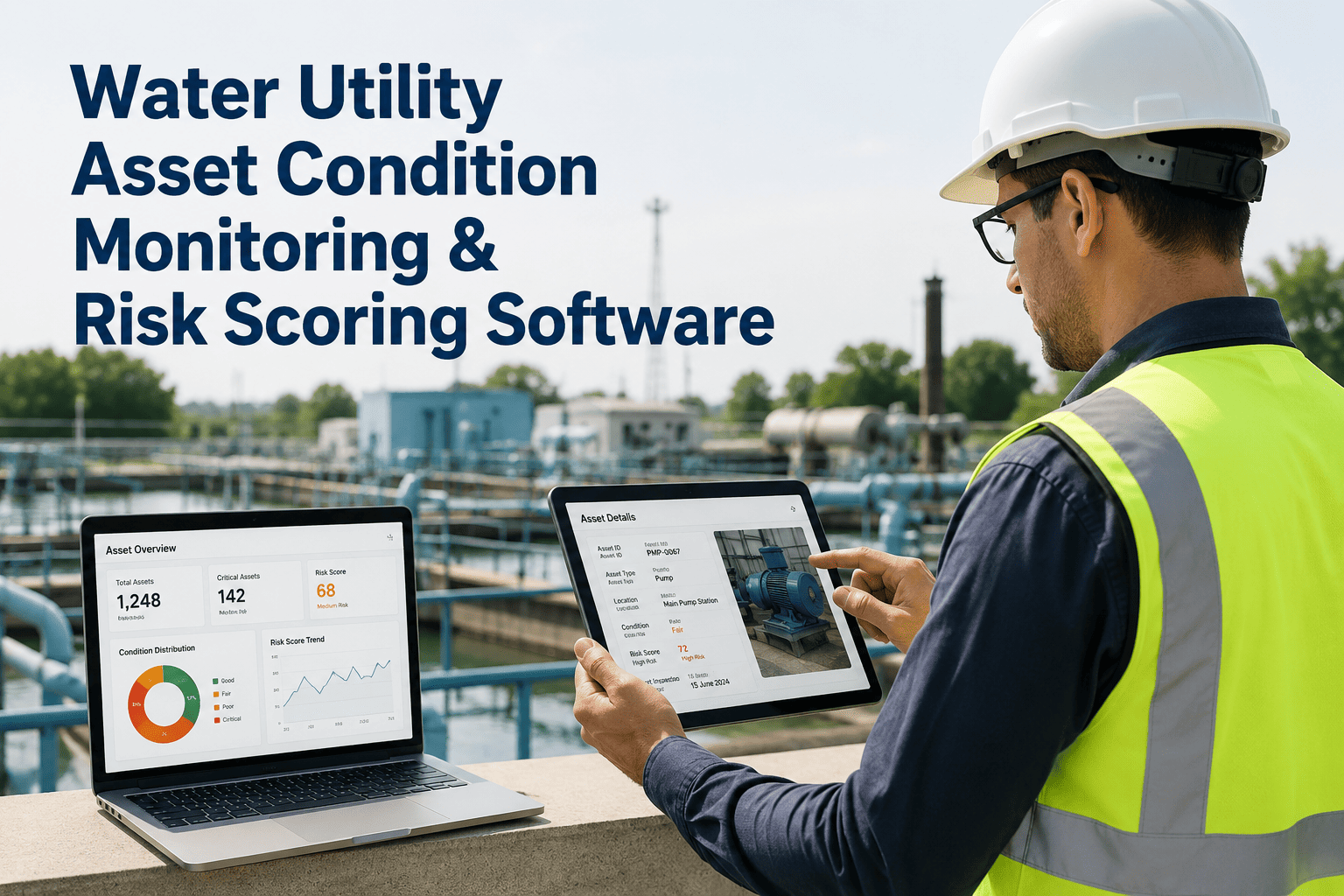
Every asset in the distribution network receives a dynamic risk score that combines failure probability and consequence. The ranking updates automatically as new condition data arrives — a valve that was low-risk last quarter becomes medium-risk after a stiff operation is noted during exercising. The priority list is the single source of truth for inspection scheduling, capital replacement planning, and budget justification. When the engineer needs to defend a maintenance budget before council or regulators, the risk-scored list provides defensible, data-backed prioritisation.
Engineer action: Risk-scored list replaces subjective priority judgements with auditable, data-driven rankings.
Pressure and flow data from SCADA, AMI, and acoustic sensors are analysed by ML models that detect developing anomalies — a DMA night flow minimum rising over 14 days, a PRV outlet pressure trending upward while inlet pressure holds steady, a pressure transient pattern matching historical main break precursors. Each anomaly is scored by severity and routed as a condition-based work order to the appropriate crew. The reliability engineer does not monitor raw data; the system monitors the data and surfaces only the signals that indicate developing failure risk.
Audit Export — AWWA, NFPA, and ISO 55001 Records in One Click
Every valve exercise record, hydrant flow test, PRV inspection, and corrective action is timestamped, technician-attributed, and linked to the asset record with photo evidence and GPS confirmation. Audit packages for AWWA M44 valve programme compliance, NFPA 25 hydrant inspection records, and ISO 55001 asset management documentation are generated automatically for any date range, asset class, or pressure zone. The adaptive limit change log — which shows every schedule adjustment, the condition data that triggered it, and the rationale — demonstrates that the maintenance programme is actively managed, not statically documented.
Engineer action: Export full compliance package on demand. No manual data compilation required.
Our valve exercising programme was running on paper route sheets and institutional knowledge — and the knowledge was retiring faster than we could replace it. When we imported our GIS data into iFactory, the first field verification pass showed that 22% of our critical isolation valves were either at the wrong GPS coordinates or completely inaccessible. The digital register gave us a baseline we had never had. Within the first year, we increased valve operability from 62% to 89%, reduced route time by coordinating exercises by zone, and generated the compliance documentation that our state regulator had been requesting for three consecutive audit cycles. The predictive risk scoring identified 12 hydrants with declining flow trends that would have gone undetected until the next annual test cycle. We scheduled repairs before they became fire flow deficiencies.
— Reliability Engineer, Municipal Water Utility — 85,000 Service Connections, 12,500 Valves, 4,200 Hydrants
Conclusion
Valve and hydrant reliability is not a field crew scheduling problem — it is a visibility architecture problem. When the asset register does not match field reality, when exercising schedules are determined by memory rather than data, when hydrant condition is inferred from visual inspection rather than measured flow performance, and when SCADA data generates raw numbers instead of prioritised actions, the distribution network accumulates reliability debt that compounds until the next emergency reveals the gap.
AI-powered asset tracking addresses all four dimensions simultaneously: GIS-verified digital registers that stay current with field corrections, condition-based maintenance scheduling that replaces fixed intervals with risk-prioritised work orders, ML-driven failure prediction that assigns dynamic risk scores to every asset, and SCADA-linked pattern alerting that detects developing failure modes before they become service disruptions. The documented outcomes across utilities of all sizes — 60% reduction in inspection costs, 80-90% valve operability within two years of structured programmes, leak detection accuracy above 85%, and payback periods under 18 months — are not projections. They are the documented result of moving from static, calendar-based appurtenance management to dynamic, condition-based reliability engineering.
iFactory's AI asset tracking platform is built for reliability engineers who need to know which valves will operate, which hydrants will deliver flow, and which zones carry the highest failure risk — before the emergency tests the answer. Book a Demo to see the platform configured for your distribution network asset register and pressure zone map, or talk to an expert about a free distribution system reliability assessment for your utility.
Frequently Asked Questions
The system initialises from your existing GIS asset registry — valve locations, sizes, types, and installation dates — and any existing maintenance records or work order history you can export from your current CMMS or spreadsheet tracking. For a typical municipal utility with GIS data available, the initial asset register is populated and the first exercising schedules generated within 2-4 weeks of project start. Field crews are deployed with mobile devices loaded with the asset register and inspection checklists from day one, and every field visit simultaneously verifies asset data and completes maintenance. Full network coverage — where every valve and hydrant has been field-verified at least once — typically takes 3-6 months depending on network size and crew availability. Talk to an expert about deployment timelines for your network size and asset count.
iFactory connects to SCADA systems via OPC-UA or Modbus in read-only mode — no write-back to control systems is ever configured. AMI meter data is ingested via API or batch export at configurable intervals. GIS asset registries are imported as shapefiles, geodatabases, or via REST API where available. All data sources are mapped to distribution asset categories — valves, PRVs, hydrants, and mains — with asset IDs cross-referenced across systems. The integration is typically completed in 1-2 weeks per data source, and no existing infrastructure is modified. The platform operates as an analytics and work order generation layer on top of existing systems, not a replacement for them. Book a Demo to see live integrations with major SCADA and GIS platforms.
Yes. The iFactory mobile application operates fully offline — inspection checklists, asset records, GPS maps, and work orders are synced to the device before the crew leaves the depot. Completed inspections, photos, exercise data, and field-verified GPS corrections are stored locally on the device and synced automatically when the device reconnects to a cellular or WiFi network. There is no data loss and no manual upload step required by the technician. Sync is bidirectional: field-verified asset corrections update the central register automatically, and schedule changes made in the office are pushed to field devices on the next sync. The reliability engineer can configure the asset download scope per crew — full network for depot devices, zone-specific for route-optimised field devices. Talk to an expert about configuring offline sync for your field crew devices and network coverage areas.
Every valve exercise, hydrant flow test, and inspection generates a timestamped, technician-attributed digital record that is permanently linked to the asset record in the system. The record includes GPS coordinates, before-and-after photos, measurements (turns, flow rate, pressure), condition observations, and any corrective actions taken. AWWA M44 valve programme records include exercise date, turns count, valve condition, and operability status. NFPA 25 hydrant records include flow test data, drain valve function, and maintenance findings. For state regulatory audits that require evidence of a structured valve exercising programme, the system generates a compliance report covering any date range — showing the total valve count, the number exercised within the reporting period, the percentage overdue, and the trend compared to prior periods. All exports are in structured formats suitable for direct submission to regulators or inclusion in audit documentation. Book a Demo to review sample compliance exports configured for your state's regulatory framework.
Fifteen Percent of Your Valves May Be Inoperable Right Now. AI Asset Tracking Tells You Which Ones Before the Next Main Break Does. Get a Free Distribution System Reliability Assessment.
iFactory's AI asset tracking platform for water distribution reliability engineers — GPS-verified digital registers, condition-based maintenance scheduling, ML-driven failure prediction, and AWWA/NFPA compliance documentation generated automatically from the asset data your network already contains.