A single pharmaceutical batch represents months of scheduling, formulation development, and raw material investment before a single dose ever reaches a patient. When that batch drifts outside its critical process parameters, the financial exposure does not stop at the cost of the discarded material. It extends into lost production time, extended quarantine, regulatory scrutiny, and in the worst cases a full product recall that can run into the tens of millions of dollars. Manufacturing teams that still rely on end-of-batch testing to catch these problems only find out about the deviation once the batch is already finished, when almost nothing can be done except reject, rework, or escalate. Facilities that pair real-time process data with AI-driven monitoring catch the same drift while the batch is still running, while there is still time to intervene, which is why more manufacturing leads are choosing to Book a Demo and see how continuous process monitoring changes the economics of batch release.
One Deviation Can Cost Fifty Million Dollars. Most of Them Are Preventable.
iFactory brings AI-driven process monitoring to every critical process parameter on your regulated line, catching drift in real time instead of finding it in an end-of-batch report three weeks later.
Why Batch Consistency Is Non-Negotiable in Regulated Manufacturing
Batch failure is not a rare event in pharmaceutical manufacturing, it is a recurring cost of doing business that most facilities have learned to budget for rather than eliminate. Industry surveys of biopharmaceutical manufacturers report total batch failure rates hovering around seven percent, with large-scale biologics facilities experiencing a full batch failure roughly every forty weeks. Each of those failures carries raw material, labor, and investigation costs that commonly exceed one to two million dollars once cleaning, requalification, and lost capacity are factored in, and severe contamination events routinely push total exposure above two million dollars when the market value of undelivered doses is included.
The pressure compounds because pharmaceutical manufacturing operates inside one of the most heavily audited regulatory frameworks in industry. Good manufacturing practice regulations, the FDA's quality by design paradigm from ICH Q8 through Q10, and the more recent ICH Q13 guidance on continuous manufacturing, harmonized across the FDA, EMA, and Japan's PMDA through 2023 and 2024, all push toward the same conclusion: quality has to be built into the process itself rather than tested into the finished product. A facility that discovers its deviations at final release testing is, by definition, running a manufacturing process that regulators consider structurally behind where the industry is now expected to be.
Unplanned downtime adds another layer to the calculation. Analysts estimate that a stopped production line in pharmaceutical manufacturing costs between fifteen and thirty thousand dollars per hour once lost production, investigation labor, and regulatory documentation are included. A facility running two shifts across three major lines that cuts unplanned downtime in half through earlier detection is not chasing a marginal efficiency gain, it is protecting several million dollars a year in avoided losses on top of whatever it saves in scrapped batches.
The training and staffing side of the equation matters just as much as the technology. Industry practitioners consistently point to operator error and inconsistent training as leading contributors to batch failure, particularly at larger manufacturing scale where more people, more shifts, and more handoffs create more opportunities for a small deviation to go unnoticed. AI-based monitoring does not remove the need for well-trained operators, but it does give them a consistent, always-on second set of eyes on the process, one that does not get fatigued at the end of a twelve-hour shift and does not miss a slow drift because attention was elsewhere on the line at the critical moment.
The Cost of a Batch Failure Escalates With Every Stage It Travels
The single most important number in any batch quality program is not the average cost of a deviation, it is how steeply that cost climbs the further the defect travels before someone catches it. A raw material problem caught at incoming inspection is a rejection slip. The same defect discovered after it has been built into a finished, released product is a recall. The staircase below shows how the financial exposure compounds at each successive stage of the manufacturing and distribution process.
Where Traditional Batch Records Miss the Signal
Paper and PDF-based batch records are excellent at proving that a procedure was followed. They are far weaker at revealing that a process parameter drifted gradually over hours in a way that no single reading would have flagged, which is exactly the pattern behind most consistency problems. A batch record confirms that an operator signed off on a step within its allowed time window, but it rarely captures whether that step was performed near the edge of its acceptable range for the entire duration or only briefly, and that distinction is often the difference between a batch that passes comfortably and one that barely scrapes by. The six sources below account for a large share of the batch variability investigations that manufacturing teams open every quarter.
Blend Uniformity Drift
Powder segregation or inconsistent mixing time produces content uniformity failures that only surface at final assay, long after the blend has already been compressed into tablets.
Granulation Moisture Variability
Small swings in drying time or inlet air humidity change granule friability and downstream tablet hardness in ways that operators cannot see without continuous moisture sensing.
Tablet Hardness and Dissolution Drift
Compression force creep across a long run gradually shifts hardness and dissolution profiles outside the validated range well before any single tablet fails a spot check.
Bioreactor Temperature and pH Excursions
Short-duration excursions in temperature, dissolved oxygen, or pH during a multi-day cell culture run can suppress titer and product quality without triggering a single alarm threshold.
Fill-Finish Weight Variability
Pump wear and viscosity changes across a fill campaign cause slow fill-weight drift that standard in-process checks sample too infrequently to catch in real time.
Cleaning Validation Carryover
Incomplete cleaning cycles between product changeovers introduce trace carryover that is rarely detected until a swab result comes back from the lab days later.
Building the Data Foundation Consistency Monitoring Depends On
None of the variability sources above can be caught by AI models that never see the underlying data. The practical starting point for most facilities is an honest inventory of what is already being collected: historian tags from the DCS or SCADA layer, batch records from the MES, lab results from the LIMS, and environmental monitoring data from the building management system. In many plants this data already exists but sits in four or five disconnected systems that were never designed to talk to each other, which means the correlation between a bioreactor temperature excursion at hour six and a titer shortfall at hour eighty never gets made by anyone, human or algorithm.
Connecting those systems into a single time-aligned data layer is usually the highest-leverage step a facility can take before a single AI model is trained. Once process, quality, and environmental data share a common timeline, even simple statistical process control catches problems that were previously invisible, and the more advanced multivariate and predictive models described below become dramatically more accurate because they are learning from a complete picture of the batch rather than fragments of it. Facilities that try to skip straight to predictive AI without this integration step tend to get disappointing results and lose confidence in the technology for reasons that have nothing to do with the modeling itself.
How AI-Enabled Process Control Keeps Batches Inside Spec
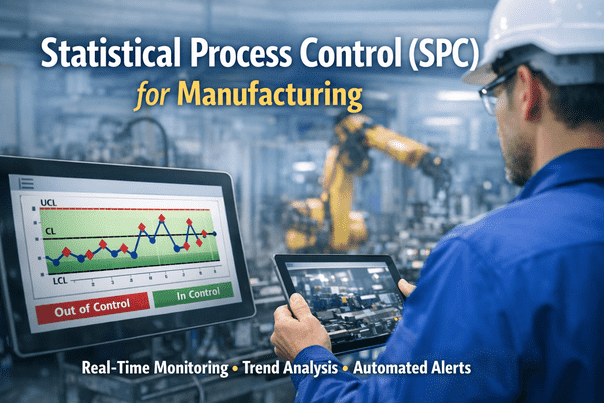
The FDA's process analytical technology framework, first published in 2004, established the principle that critical quality attributes should be measured and controlled during manufacturing rather than confirmed after the fact. AI extends that framework rather than replacing it. Soft sensors built on historical process data infer quality attributes that would otherwise require a lab test, multivariate models track the interaction between dozens of parameters simultaneously, and anomaly detection flags a drifting pattern days before it would cross a hard alarm limit. The band chart below illustrates the core mechanism: a critical process parameter trending inside its specification limits, with an AI-detected drift signal appearing well before the value would have breached the boundary a traditional single-point alarm relies on.
A traditional single-point alarm fires only once the parameter crosses the spec limit. AI-based multivariate monitoring flags the same drift roughly a full processing stage earlier, while corrective action is still possible.
Real-Time Release Testing vs Traditional End-of-Batch Testing
Real-time release testing, built on validated PAT and AI models, allows a batch disposition decision to be made from in-process data rather than waiting on a full battery of end-product lab tests. The comparison below shows how the two approaches differ across the dimensions that matter most to a quality and manufacturing team.
| Dimension | Traditional End-of-Batch Testing | AI-Enabled Real-Time Release |
|---|---|---|
| Detection Point | After batch completion, at final lab assay | Continuously, during active processing |
| Cycle Time to Disposition | Days to weeks, pending lab turnaround | Minutes to hours after process completion |
| Sampling Basis | Discrete samples at fixed checkpoints | Continuous multivariate process data |
| Deviation Response | Batch already finished, quarantine required | Mid-batch correction still possible |
| Regulatory Basis | End-product specification testing | FDA PAT framework, ICH Q8-Q10, Q13 |
The gap between these two columns is not theoretical. It is the difference between a quality team that spends its week reviewing what already happened and a quality team that spends its week preventing what would have happened. Facilities that have made this transition consistently report that the conversation with regulators changes too, since an auditable, continuously monitored process is easier to defend during an inspection than a paper trail assembled after the fact, and inspectors increasingly expect to see this level of process understanding from any site claiming a mature quality system.
Stop Waiting for the Lab to Tell You What Already Happened.
See how iFactory turns your existing sensor data into a real-time consistency signal your quality team can act on immediately.
Three Levels of AI Maturity in Batch Manufacturing
Facilities rarely move from paper batch records to fully autonomous process control in a single step. Most progress through three distinct levels of AI maturity, each building on the data infrastructure and trust established at the previous level. It is worth setting expectations honestly here: the jump from Level 1 to Level 2 typically takes a few quarters of clean historical data before the predictive models are accurate enough to trust, and the jump to Level 3 requires the kind of validation rigor that most regulated facilities will only extend to a handful of well-understood unit operations first. Trying to skip a level rarely works, since the trust an operations team places in an alert or a recommendation is built cumulatively, one accurate prediction at a time.
Monitoring and Alerting
Sensor and historian data streams into a unified dashboard with AI-generated alerts when a parameter approaches its control limit. Human operators retain full decision authority.
Predictive Deviation Detection
Multivariate models trained on historical batch outcomes predict the probability of an out-of-spec result hours ahead of time, giving operators a window to adjust setpoints proactively.
Closed-Loop Adaptive Control
Validated control algorithms adjust process setpoints automatically within a pre-approved design space, with full audit trail and human oversight preserved for every adjustment made.
AI and Pharmaceutical Batch Consistency — Common Questions
How much does a pharmaceutical batch failure typically cost?
The cost depends entirely on when the defect is caught. Industry reporting places in-process rework in the thousands of dollars, full batch investigations and rejections near fifty thousand dollars, contamination events above two million dollars once lost doses and equipment disposal are counted, and post-release recalls routinely into the tens of millions once retrieval logistics and regulatory action are included. Teams can Book a Demo to model this exposure against their own product mix.
What is real-time release testing and how does it differ from traditional QC?
Real-time release testing uses validated in-process measurements and models, built on the FDA's process analytical technology framework, to make a batch disposition decision without waiting for a full slate of end-product lab tests. Traditional QC samples the finished batch at fixed checkpoints and can take days to return a result, while real-time release compresses that decision window to minutes or hours after processing completes.
Can AI process monitoring work with the equipment we already have?
Yes. Most deployments connect to existing historians, PLCs, and MES systems rather than requiring new instrumentation on day one. Soft sensor models can infer several quality attributes from data already being collected, which lets a facility start generating value from AI monitoring well before any capital equipment upgrade is needed. The iFactory Support team can assess your current data infrastructure during onboarding.
Does using AI for process control conflict with GMP or FDA expectations?
No, provided the models are validated and documented within the existing quality system. Regulators have signaled openness to AI-enabled manufacturing while expecting transparency, robustness, and a controlled process for managing model updates over time, consistent with the risk-based principles already established in ICH Q9 and the quality system elements described in ICH Q10. AI is treated as an extension of validated process control, not a replacement for the quality unit's authority.
How long does it take to see ROI from AI-driven batch monitoring?
Facilities running multiple shifts across several major lines typically recover the cost of implementation within the first year through a combination of reduced unplanned downtime, valued at fifteen to thirty thousand dollars per hour of avoided stoppage, and fewer full batch investigations. Sites with higher-value biologic products or a history of contamination-related losses often see the business case close faster given the higher cost per incident avoided, since a single prevented recall alone can outweigh several years of platform investment.
Every Batch Deserves a Chance to Be Caught in Time.
Talk to iFactory about connecting your existing process data to AI-driven monitoring built for regulated pharmaceutical manufacturing lines.