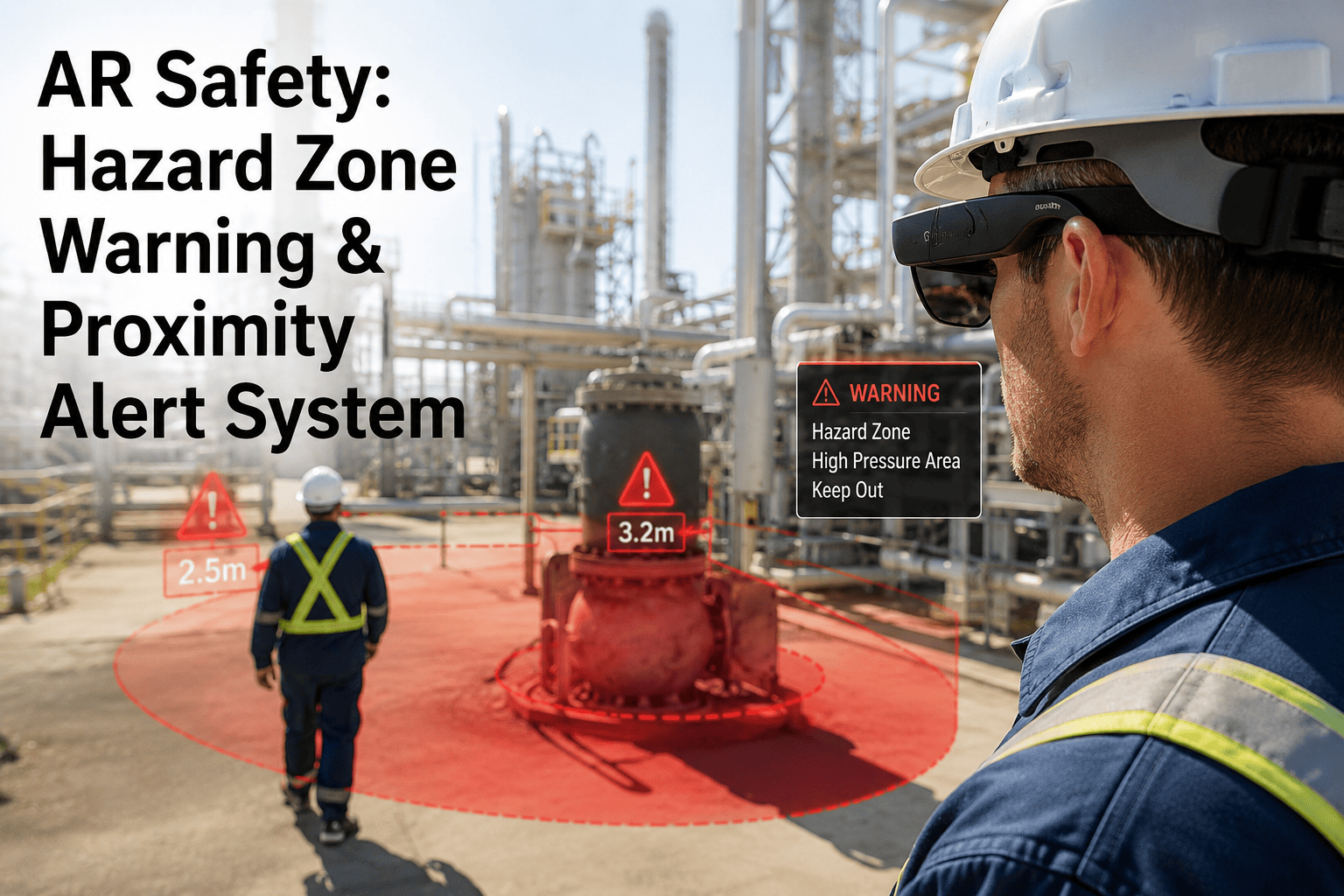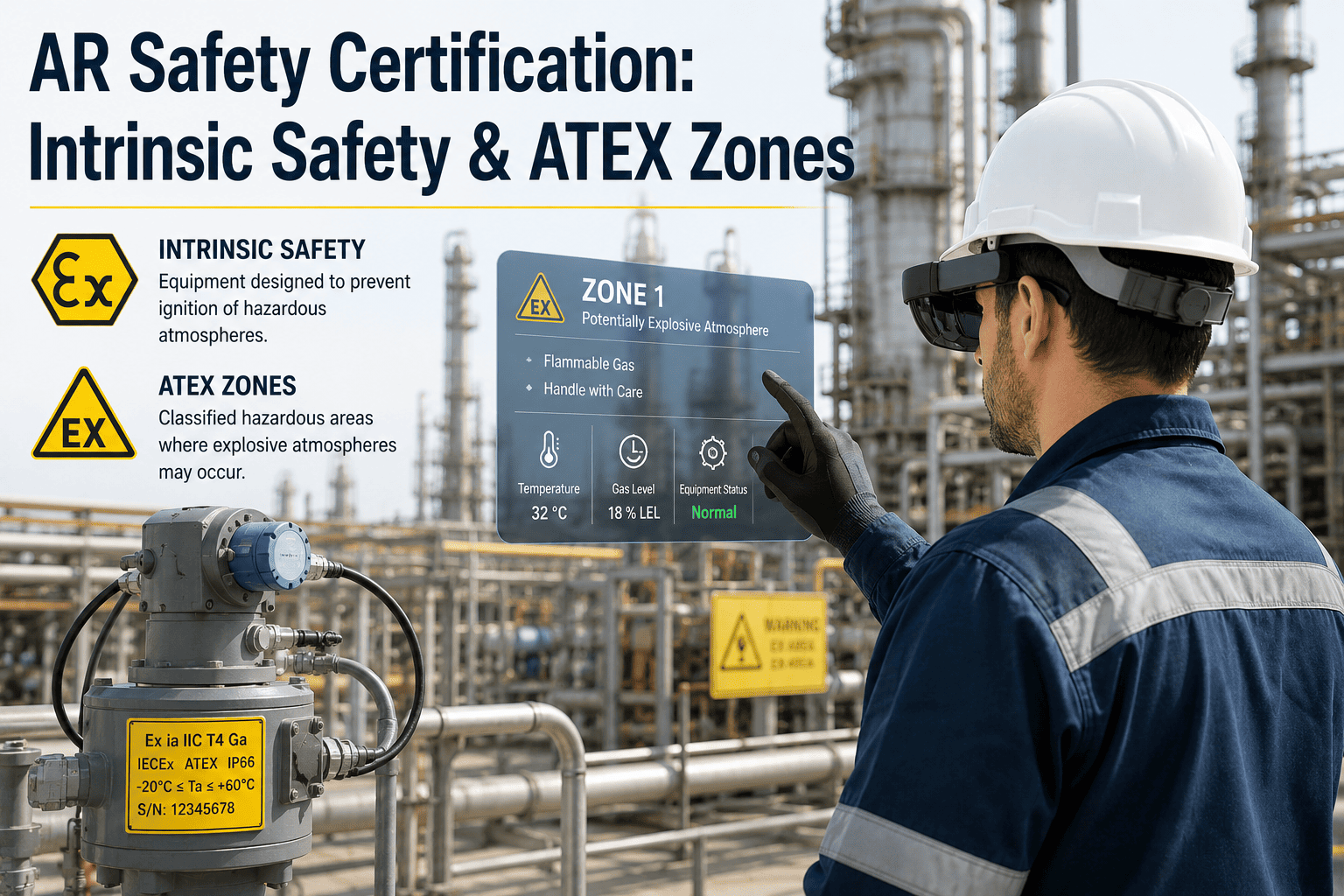
A maintenance technician walks toward a distillation column wearing a consumer AR headset that worked perfectly during the pilot in the training room down the hall. Nobody flags it until a safety officer stops him at the boundary line of a Zone 1 area, because that headset was never built to be near flammable vapor in the first place. This is the moment most AR rollouts in oil and gas, chemical, and pharmaceutical plants quietly stall: the technology works, the use case is proven, but the hardware itself becomes the hazard the moment it crosses into a classified area. Getting this right starts with understanding what certified AR hardware actually needs to prove before it belongs on that floor.
Choosing AR Glasses That Are Actually Legal to Wear in a Hazardous Zone
Intrinsic safety ratings, ATEX zone classifications, and IP protection classes are not paperwork you file after the fact. They determine whether a device is allowed within a specific distance of flammable gas, vapor, or combustible dust at all. This page breaks down what each rating actually means and how to match hardware to the zones your plant already has documented.
Why Certification Gets Discovered Too Late
Most AR programs start in a conference room, a training lab, or an office pilot where nobody is thinking about explosive atmospheres. The headset is evaluated on display clarity, battery life, and how well it integrates with the work instruction library. By the time the program is ready to move onto an actual production floor, someone on the EHS team asks a question the pilot never had to answer: is this device rated for the areas where our technicians actually work? For a plant running any classified hazardous area, the answer determines whether the entire rollout continues on schedule or gets sent back to procurement for a device that should have been specified from day one.
This gap tends to appear at the worst possible moment, right after a program has already earned budget approval and a champion inside operations. Procurement teams that specify consumer AR hardware are usually optimizing for the metrics that show up on a spec sheet: resolution, weight, field of view, and price. None of those numbers say anything about whether the battery pack, the wireless radio, or the display driver can release enough stored energy to ignite a flammable vapor if a fault occurs. That information lives on a separate certification document that most procurement checklists never ask to see, which is exactly why the gap survives all the way to the plant floor before anyone notices it.
Intrinsic Safety, Explained Without the Jargon
Intrinsic safety is a design principle, not a sticker. An intrinsically safe device is engineered so that it cannot release enough electrical or thermal energy to ignite a surrounding explosive atmosphere, even if a fault occurs inside the circuit. That means the battery, the display driver, and every internal component are limited by design, not just wrapped in a protective case. This is the single biggest difference between a rugged industrial tablet and a device that is actually cleared to enter a classified zone. A device can be dustproof and drop-tested to survive a two-meter fall and still be completely unsafe to power on next to a flammable vapor cloud, because ruggedness and intrinsic safety are solving two entirely different problems.
Matching Certification to the Environment
Once a plant knows which zones its technicians actually operate in, matching a device becomes a straightforward lookup rather than a guessing game. The table below lines up the zone, the protection level a device needs, and the kind of area where that zone is typically found on an industrial site.
| Zone | Required Protection | Equipment Category | Typical Location |
|---|---|---|---|
| Zone 0 / 20 | Ex ia | Category 1 | Inside tanks, vessels, silos |
| Zone 1 / 21 | Ex ib | Category 2 | General process areas, near open handling points |
| Zone 2 / 22 | Ex ic | Category 3 | Perimeter areas, ventilated enclosures |
| Unclassified | Not required | Standard industrial rating | Control rooms, offices, warehouses |
The Second Number That Matters: IP Rating
Intrinsic safety and IP protection classes answer two different questions, and a device needs both answered correctly. Intrinsic safety asks whether the device can ignite the atmosphere around it. The IP rating asks whether dust and liquid can get inside the device at all. A pair of AR glasses can carry a valid Ex certification and still fail on a cement or flour handling line if its enclosure lets fine dust past the seals during a normal shift.
What Actually Breaks When Certification Gets Skipped
Skipping this step rarely shows up as a dramatic incident. It shows up as friction that quietly stalls the entire AR program, and the pattern tends to repeat across plants that treat certification as a formality instead of a hard requirement.
Bring Your Zone Classification Drawings to the Conversation
Before comparing a single AR headset spec sheet, the plant's existing hazardous area classification study should already answer which zones a technician actually walks through during a normal shift. We can walk through it with you.
A Practical Path to Selecting Certified AR Hardware
Getting from an unclassified pilot to a fully compliant deployment does not require re-engineering the entire program at once. It follows a sequence that most plants with existing hazardous area documentation can move through in a matter of weeks rather than months.
What Plants Running Certified AR Are Reporting
Once hardware selection is handled correctly the first time, the operational gains tend to show up quickly because the AR use case was already proven in the pilot. The remaining work is deployment, not redesign.
Where Plants Commonly Get This Wrong
The most frequent mistake is treating "rugged" and "certified" as interchangeable terms. A device can survive a fall onto concrete and still lack any intrinsic safety rating whatsoever, because ruggedness testing and explosion protection testing follow completely different standards. A second common mistake is over-specifying every device on site for the worst-case zone across the entire plant, which drives up cost unnecessarily when most technicians only ever pass through Zone 2 or 21 areas during a normal task. A third mistake is accepting a vendor's claim of certification without requesting the actual ATEX or IECEx certificate number, which can be independently verified against the issuing body's public registry before a single unit is purchased.
A fourth mistake shows up after the hardware is already in service: treating certification as a one-time checkbox rather than something tied to how the device is actually used in the field. A modified battery pack, an aftermarket case, or a third-party accessory attached to an intrinsically safe device can invalidate the original certificate entirely, because the certification covers the device exactly as tested, not the device plus whatever accessory a technician later clips onto it. Plants that maintain a clear policy on approved accessories and firmware versions avoid quietly voiding a certificate they paid to obtain in the first place.
Who Should Be in the Room Before You Buy
Selecting certified AR hardware is rarely a single-department decision, and plants that treat it that way tend to circle back to the same conversation twice. Process or safety engineering typically owns the zone classification study and can confirm exactly which zones a given task actually passes through. Procurement owns the vendor relationship and needs the certificate number in hand before a purchase order goes out, not after the hardware arrives on site. Operations and the frontline technicians who will actually wear the device need a say in weight, field of view, and comfort, because a certified headset nobody wants to wear for a full shift will not deliver the productivity gains the program was funded to achieve. Bringing all three perspectives together before the request for quote goes out tends to shorten the overall timeline rather than slow it down, since it removes the back-and-forth that otherwise happens after a device fails to clear one of these three checks late in the process.
Frequently Asked Questions
Match Your AR Fleet to Your Actual Hazardous Areas
Bring your zone classification drawings and your current AR shortlist to the call. We will help you confirm which Ex rating and IP class each area actually requires before you commit budget to hardware.