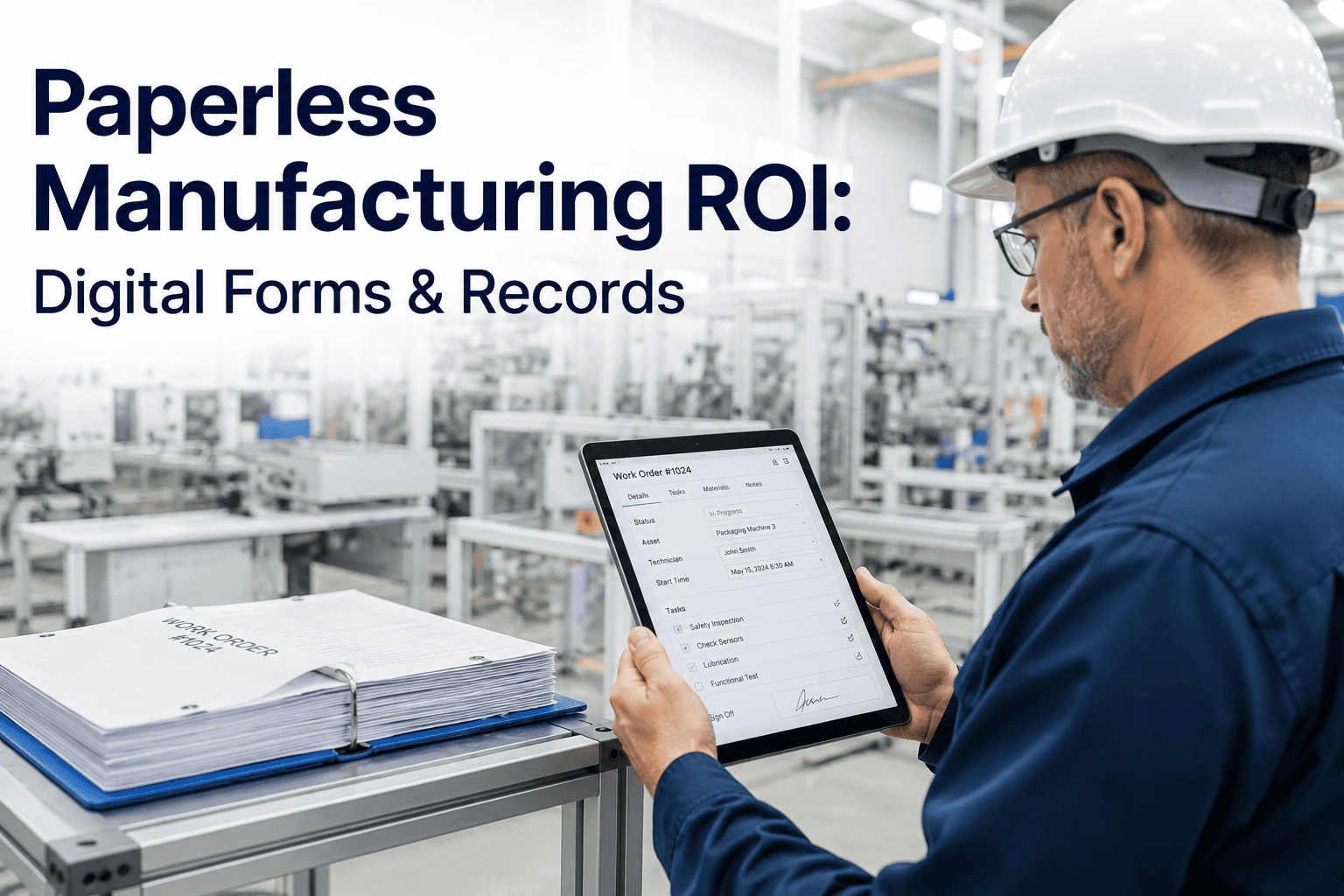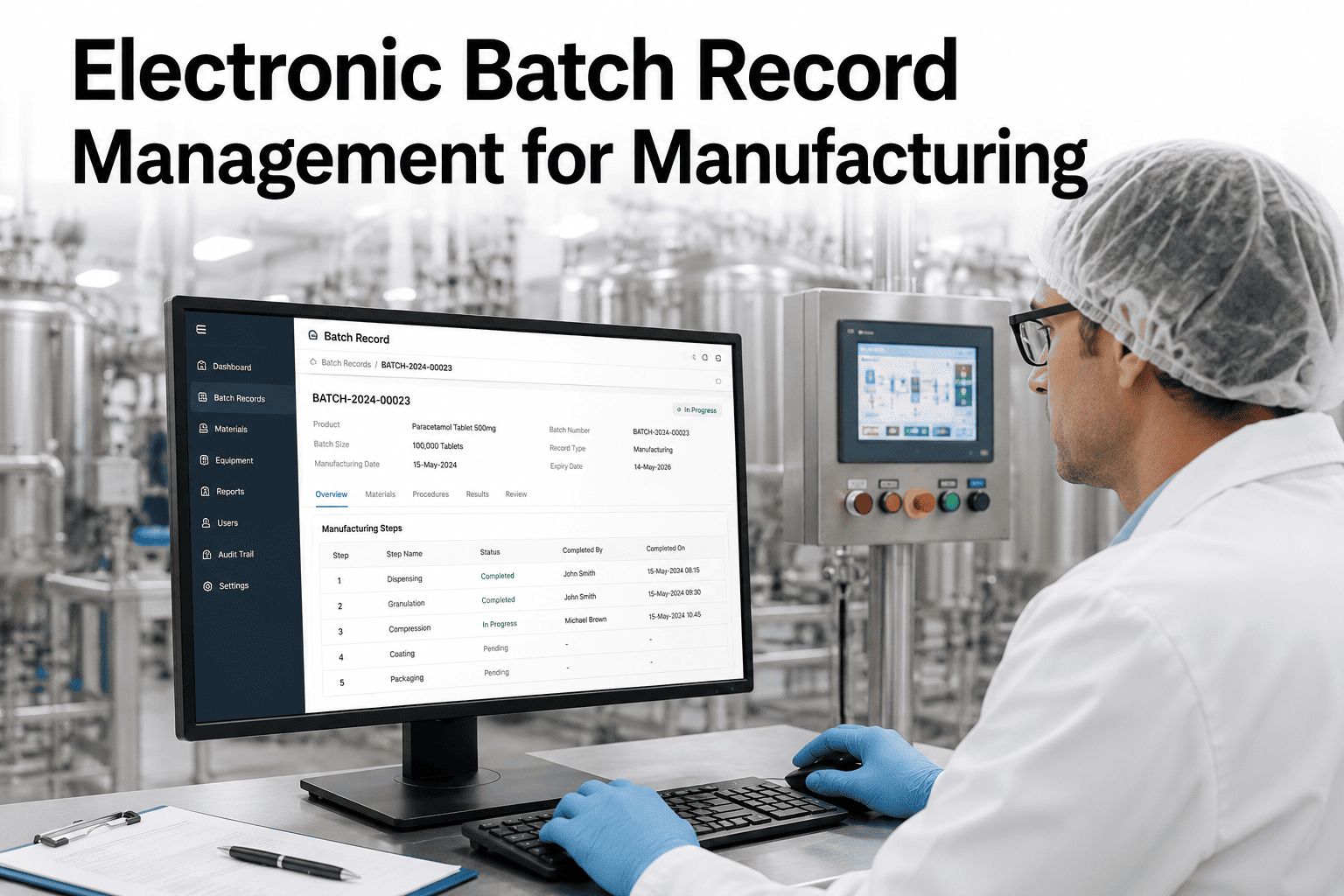
A paper batch record for a single production run can pass through fifteen or twenty hands before it's archived — operators initialing each step, a supervisor countersigning, quality reviewing every page line by line before release. Somewhere in that chain, a transcription error, a missed initial, or an out-of-range value that got copied forward without anyone catching it can sit undetected until an audit finds it months later. Electronic batch records replace that sequential, page-by-page review with structured data capture at the point of execution and review-by-exception at release, so quality reviews the handful of deviations that actually happened instead of re-reading pages that went exactly to plan. Book a demo with iFactory's batch record team to see electronic batch execution and review-by-exception working against your own recipe structure.
Operations Management · Electronic Batch Records
Electronic Batch Record Management: From Paper Trail to Structured, Reviewable Data
Recipe management, in-process parameter capture, automatic deviation flagging, and a full audit trail — built so quality review focuses on what actually deviated, not on re-checking pages that were filled out correctly.
Why Paper Batch Records Slow You Down
Sequential Page Review vs. Review by Exception
Paper Batch Records
Every page reviewed line by line, in sequence
Transcription errors possible at every manual entry
Batch release often waits days for full record review
Deviations found only if the reviewer happens to catch them
Archival, retrieval, and audit prep consume significant staff time
Electronic Batch Records
Only flagged deviations require reviewer attention
Parameters captured directly from equipment where possible
Release decisions often made within hours of batch completion
Out-of-range values flagged automatically at the point of entry
Full record instantly retrievable with a searchable audit trail
Recipe and Parameter Management
Building the Master Recipe That Every Batch Executes Against
An electronic batch record system is only as reliable as the master recipe behind it — the structured definition of every step, parameter, tolerance, and required sign-off that a batch must pass through before release. Getting this structure right up front is what makes review-by-exception possible later, because the system can only flag a deviation if the acceptable range was defined precisely in the first place.
Step Sequencing
Each process step is defined with required order, dependencies, and any steps that must be electronically signed before the next can begin.
Parameter Tolerances
Every recorded value — temperature, weight, pressure, time — carries a defined acceptable range, so entries outside tolerance are flagged the moment they're captured.
Material Traceability Links
Each material addition is tied to a specific lot number, automatically building the genealogy needed for a rapid, precise recall if one is ever required.
Sign-Off Requirements
Critical steps require electronic signature from a specific role before the batch can proceed, enforcing the same control paper records relied on manual initials for.
Data Integrity Foundation
ALCOA+ — The Principles Every Electronic Record Has to Satisfy
Electronic batch records aren't just a digital copy of a paper form — they need to satisfy the same data integrity standard regulators apply to any GMP record, commonly summarized as ALCOA+. A system built around these principles produces records that hold up under audit, not just records that look organized.
AAttributable
LLegible
CContemporaneous
OOriginal
AAccurate
+Complete, Consistent, Enduring, Available
In practice, this translates to specific system requirements: every entry tied to a unique authenticated user, timestamped at the moment of capture rather than backfilled, and stored in a way that preserves the original entry alongside any correction — never overwriting it.
Build a Recipe Structure That Actually Catches Deviations
iFactory Configures Electronic Batch Records Around Your Real Process
No generic template forced onto your recipes. iFactory maps your existing paper batch record structure into a configured electronic system with the tolerances, sign-offs, and traceability links your process actually requires.
Deviation Documentation
What Happens the Moment a Parameter Falls Out of Tolerance
The value of electronic batch records shows up most clearly the moment something goes wrong, not when everything goes right. A defined deviation workflow determines whether a single out-of-range reading becomes a documented, investigated event or slips through unnoticed until the next audit.
1
Real-Time Flag
The system flags the entry immediately against the defined tolerance, before the batch moves to the next step.
2
Reason Capture
The operator or supervisor records the immediate cause and any corrective action taken, directly against the flagged entry.
3
Investigation Routing
Deviations above a defined severity automatically route to quality for a formal investigation before the batch can proceed to release.
4
Disposition Decision
Quality records a disposition — release, rework, or reject — with the full deviation history attached permanently to the batch record.
Audit Trail
What a Complete Audit Trail Actually Needs to Capture
An audit trail that only logs "record modified" without capturing who, when, what the value was before, and why it changed does not meet the standard regulators expect, and it leaves your quality team unable to reconstruct what actually happened during an investigation.
User Identity
Every entry and change tied to an authenticated individual, never a shared login.
Timestamp
Captured automatically by the system at the moment of entry, not manually entered by the user.
Before and After Value
Original entry preserved alongside any correction, with the reason for the change recorded.
Reason for Change
A documented justification required for any modification to a previously entered value.
The plants that get the most out of an electronic batch record system aren't the ones with the most sophisticated software — they're the ones that did the unglamorous work of getting the master recipe right before go-live. I've seen implementations stall for months because a team tried to digitize a paper form exactly as it existed, tolerances and all, without asking whether those tolerances were ever actually correct. A tolerance copied from a twenty-year-old paper form, now enforced automatically by a system that flags every borderline entry, generates a flood of nuisance deviations that trains the review team to click through flags without reading them — which defeats the entire purpose of review-by-exception. Getting the tolerances right, even if it means a genuine engineering review before digitization, is worth more than any feature the software itself provides.
Adaeze Kowalczyk-Bright
Quality Systems Consultant · Former Head of Batch Record Compliance · 16 years implementing electronic batch record systems across pharmaceutical and food manufacturing
Quality and Production Team Questions
Electronic Batch Record Management — Frequently Asked
How long does it typically take to move from paper to electronic batch records?
Timeline depends heavily on how many distinct product recipes need to be digitized and how much engineering review the existing tolerances require before they can be trusted in an automated flagging system. A single product line with a well-documented, already-validated paper process can move to electronic records in a matter of weeks. A facility with dozens of product families and tolerances that haven't been revisited in years should expect the recipe-building and validation phase to take considerably longer, since that upfront work is what determines whether the system produces useful flags or constant nuisance alerts. Contact our support team for a realistic timeline estimate based on your specific recipe count.
Does review by exception actually reduce batch release time, or just shift the work around?
Review by exception genuinely reduces release time in most implementations, because the majority of any batch record's content — steps executed within tolerance, signatures captured correctly, materials verified against the recipe — requires no manual re-checking once the system has already validated it against defined rules at the point of entry. The reviewer's attention goes specifically to flagged deviations, which in a well-tuned system represent a small fraction of total batch content. The time saving is real, but it depends entirely on tolerances being set correctly; a system that flags too aggressively due to overly tight tolerances can end up generating nearly as much review work as the paper process it replaced.
Can electronic batch records integrate with our existing MES or ERP system?
Yes, and integration is one of the most valuable aspects of moving to electronic records, since it allows parameter values to be captured directly from equipment or an MES layer rather than manually keyed in by an operator, eliminating transcription error at the source. ERP integration additionally allows material lot consumption to update inventory automatically as the batch record executes, keeping traceability data synchronized without a separate manual reconciliation step. The specific integration approach depends on your existing systems and their data exchange capabilities, which is typically assessed during the initial system scoping.
What happens if the electronic system goes down mid-batch?
A properly designed electronic batch record system includes a documented contingency procedure for exactly this scenario, typically a defined fallback to a controlled paper record for the remainder of the batch, with a formal reconciliation process to enter that data into the electronic system once it's restored. The contingency procedure itself needs to be validated and part of operator training, since an undocumented improvised fallback during a system outage is itself a data integrity risk. Redundancy and backup infrastructure reduce how often this scenario occurs, but the procedure needs to exist regardless of how reliable the underlying system is.
How do we decide which parameters need tight tolerances versus which can be broader?
Tolerance width should be driven by the actual criticality of the parameter to product quality and safety, not copied uniformly across every recorded value out of caution. A parameter directly tied to a critical quality attribute — one that, if out of range, genuinely risks product safety or efficacy — warrants a tight, carefully justified tolerance and a mandatory investigation on any deviation. A parameter that is recorded for traceability but has wide latitude before it affects product quality can carry a broader tolerance without compromising safety, and setting it too tight only generates nuisance flags that erode reviewer attention over time. Book a demo to walk through tolerance-setting methodology with our team.
Replace the Page-by-Page Review With Exception-Based Release
Get an Electronic Batch Record System Configured Around Your Real Recipes
iFactory maps your existing batch record structure into a configured electronic system with correctly engineered tolerances, automatic deviation flagging, and a complete ALCOA+ audit trail — so release decisions happen in hours, not days.