A mid-market contract manufacturer serving the food, beverage, and consumer packaged goods (CPG) sectors executed a strategic expansion from 2 to 8 production facilities in just 24 months — a growth trajectory that demanded a unified operations backbone to maintain quality, consistency, and control. Facing quality inconsistencies across sites, fragmented analytics platforms, and the mounting administrative complexity of managing eight separate facility-level systems, the company deployed iFactory as its enterprise operations platform. The result: standardized quality management across every facility, real-time operational visibility from the plant floor to the executive suite and the ability to activate new production sites in weeks rather than quarters.
SCALE YOUR MANUFACTURING OPERATIONS WITHOUT SCALING COMPLEXITY
From 2 to 8 Facilities — A Unified Operations Backbone Made It Possible
iFactory gives contract manufacturers a single platform for quality management, real-time analytics, and operational control across every site — from two facilities to two hundred.
2 to 8
Facilities in 24 Months
−74%
Quality Non-Conformances
8 Weeks
Average Facility Onboarding
Single
Unified Operations Platform
01 / The Manufacturer
A Growing Contract Manufacturer, A Widening Operations Gap
Facility TypeContract manufacturer serving food, beverage, and consumer packaged goods markets. Eight production facilities across three U.S. regions supporting 40+ client brands across retail, foodservice, and direct-to-consumer channels.
Scale8 facilities totaling 1.2 million square feet of production space. 60+ packaging lines. 2,400+ active SKUs managed across the network. Three-shift operations at primary facilities with two-shift schedules at secondary sites.
Growth TrajectoryExpanded from 2 to 8 facilities in 24 months through a combination of acquisition and greenfield construction. Each new facility added between 4 and 8 production lines and introduced new client relationships with distinct quality requirements and compliance frameworks.
Pre-iFactory SystemsDisparate facility-level ERP and quality systems. No enterprise-wide operations platform. Paper-based quality checks at 6 of 8 sites. Cross-facility reporting compiled manually through spreadsheet consolidation averaging 40 hours of centralized coordination per week.
Quality PerformanceAverage 14 quality non-conformances per month across all sites. Resolution cycle time averaging 9 days. No cross-facility root cause analysis capability. Quality trends identified at one site remained undetected at others for weeks or months.
Annual Operations CostPre-deployment operations overhead of approximately $2.8 million annually — including multi-site quality administration, cross-facility reporting headcount, compliance documentation labor, and the cost of quality failures across 40+ client programs.
02 / The Challenge
Rapid Expansion Without a Unified Platform: The Compounding Cost of Fragmented Operations
Contract manufacturing is fundamentally a quality business. Each client contract carries specific quality specifications, compliance requirements, and service-level agreements. When those specifications are met, the operation runs smoothly. When they are not, the consequences include chargebacks, rejected shipments, and lost contracts. As this manufacturer grew from 2 to 8 facilities, the absence of a unified operations platform created structural vulnerabilities that compounded with every new site acquisition.
14
Quality Non-Conformances Per Month
Each facility operated under locally defined quality processes with no centralized visibility or standardized corrective action workflows. A defect trend identified at one facility could remain active at others for weeks before detection, generating recurring non-conformances that eroded client confidence and triggered contractual penalties.
No
Unified Operational Visibility
Executive leadership had no real-time view into production performance, quality metrics, or equipment utilization across the facility network. Decision-making relied on weekly spreadsheet reports that arrived 3–5 days after the data was collected — too late for proactive intervention on developing issues.
6+
Months to Onboard New Facilities
Each new facility required 6 or more months of manual process standardization, system configuration, and quality protocol alignment before reaching full operational integration. This extended timeline delayed the revenue contribution of each acquisition and stretched corporate operations resources across too many active integration projects.
40
Hours Per Week of Admin Overhead
Cross-facility reporting, compliance documentation, and quality administration consumed 40+ hours per week of centralized coordination. This overhead scaled linearly with each new facility, threatening to require additional corporate headcount with every acquisition and eroding the margin benefit of scale.
"We were operating eight independent quality systems with no way to compare performance, track trends, or understand which facilities were executing effectively and which needed support. Every new acquisition made the problem worse instead of better. We needed a platform that could function as the centralized nervous system for the entire operation."
03 / The Solution
iFactory as the Operations Backbone: Unified Quality, Visibility, and Analytics Across Every Site
Following evaluation of four enterprise operations platforms, the manufacturer selected iFactory for its demonstrated capability in multi-site food and beverage manufacturing environments, configurable quality management architecture, and AI-driven analytics that could transform fragmented facility-level data into enterprise-wide operational intelligence. The platform was deployed as the unified operations backbone across all 8 facilities. To explore how iFactory structures multi-facility deployments for contract manufacturers, Book a Demo with iFactory's enterprise operations team.
QUALITY
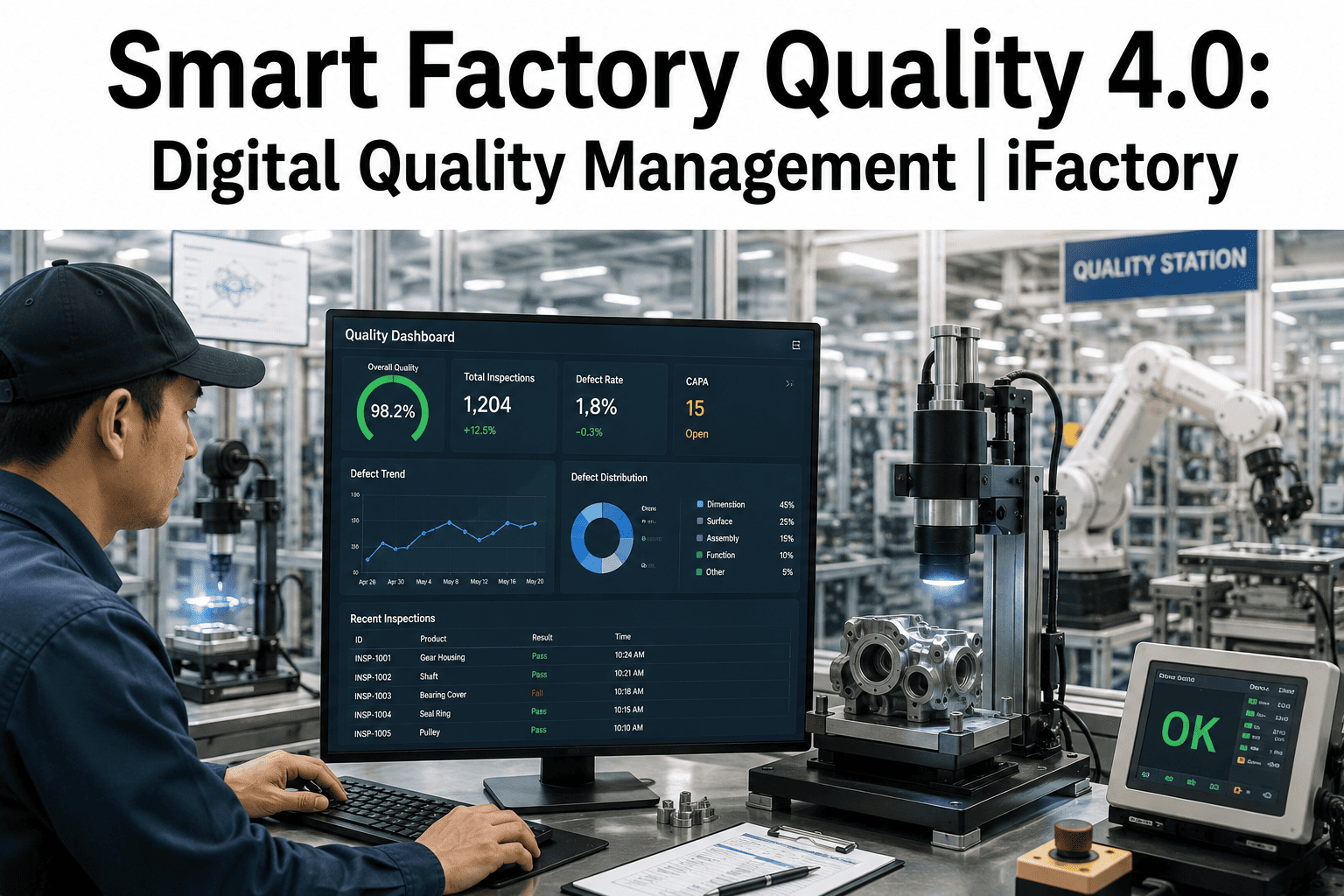
Standardized quality management platform deployed across all 8 facilities, providing unified non-conformance tracking, root cause analysis workflows, and corrective action management. Every site now operates from the same quality framework with role-based access for facility-level and corporate stakeholders. Quality event data flows into a centralized analytics engine that identifies cross-site trends and emerging risk patterns in real time.
VISIBILITY
Unified operations dashboard delivering real-time visibility into production throughput, quality metrics, OEE, and equipment utilization across every facility — with drill-down capability to individual lines, work centers, and SKU-level performance. Custom role-based views serve plant managers, quality directors, and executive leadership with the specific operational intelligence each role requires to make informed decisions.
ANALYTICS
AI-driven cross-facility analytics identifying quality trends, predicting potential non-conformances before they occur, and recommending process adjustments based on data patterns across the entire facility network. Machine learning models continuously compare facility-level performance to detect deviations from enterprise baselines — enabling corporate quality leadership to intervene proactively rather than reactively.
ONBOARDING
Standardized facility deployment template enabling new site activation in 8 weeks rather than 6+ months. Pre-configured quality workflows, operational dashboards, reporting structures, and compliance frameworks are deployed as a repeatable package — reducing integration labor by approximately 70% per facility and allowing the corporate team to scale without proportional headcount increases.
04 / Implementation
Full Enterprise Platform Live Across 8 Facilities in 60 Days
Days 1–14
Enterprise Assessment and Platform Architecture Design
All 8 facilities assessed for operational maturity, system integration requirements, and quality workflow standardization needs. Platform architecture designed to support multi-site deployment with centralized data aggregation and facility-level autonomy. Corporate quality workflows mapped and standardized as the foundation for the unified platform configuration. Integration points identified with existing ERP systems at each facility.
Days 15–35
Phase 1 Deployment — Pilot at Two Established Facilities
iFactory platform deployed at the two original facilities that represented the highest production volume and most complex client quality requirements. Quality management modules, operational dashboards, and analytics engines configured and tested with live production data. Corporate and facility-level user training conducted during active deployment. Initial AI baseline models established from the first 14 days of enterprise-wide data integration.
Days 36–52
Phase 2 — Rollout Across Remaining Six Facilities
Platform deployment completed across all remaining facilities using the standardized template developed during Phase 1. Each facility was configured with its specific quality workflows, client compliance requirements, and production monitoring parameters while maintaining enterprise-wide data standardization. Full 8-facility network live on iFactory by Day 49 with all dashboards operational and cross-facility analytics active.
Days 53–60
Enterprise-Wide Activation and Operations Team Handoff
Corporate operations dashboard configured for executive leadership with cross-facility KPIs, quality trend analysis, and risk indicators. Quality management workflows fully integrated with existing corrective action processes. Operations team trained on analytics interpretation and alert response protocols. First cross-facility quality trend detected on Day 56 — a packaging specification deviation pattern appearing at three facilities simultaneously that was identified and corrected before any client detected the variance.
05 / Results
12 Months of Measured Performance Improvement Across the Enterprise
The transition from fragmented, facility-level operations management to an enterprise-wide unified platform produced measurable improvements across every tracked performance dimension within the first two quarters. Quality non-conformances declined by 74%. New facility onboarding time compressed from 6 months to 8 weeks. And the annual operations cost reduction of $1.2 million delivered a platform ROI that the operations director confirmed within the first six months of full deployment.
| Metric |
Before iFactory |
After iFactory |
Change |
| Quality non-conformances per month |
14 avg |
3.6 avg |
−74% reduction |
| New facility onboarding time |
6+ months |
8 weeks |
−67% faster |
| Quality issue resolution time |
9 days avg |
2 days avg |
−78% faster |
| Operations reporting overhead |
40 hrs/week |
8 hrs/week |
−80% reduction |
| Cross-facility quality visibility |
None |
Real-time, all sites |
Centralized visibility |
| Mean time to detect quality trend |
Weeks post-event |
Real-time detection |
Proactive detection |
| Facilities on unified platform |
2 |
8 |
4x expansion |
| Annual operations expenditure |
~$2,800,000 |
~$1,600,000 |
−43% cost reduction |
| Annual operations savings |
— |
$1,200,000 |
Net annual saving |
| Deployment timeline |
N/A |
60 days (8 facilities) |
Live in 60 days |
−74%
Quality Non-Conformances
8 Weeks
New Facility Activation
Zero
Missed Client Deliveries
$1.2M
Annual Operations Savings
See How iFactory Unifies Operations Across Your Manufacturing Network
Get a live walkthrough of multi-facility quality management, real-time operational dashboards, and AI-driven analytics built for contract manufacturing environments.
"The first time iFactory flagged a quality deviation pattern appearing simultaneously at three of our facilities, I realized how blind we had been operating. Under the old system, that trend would have taken weeks to detect — and by then, three client programs would have been affected. The platform identified it in real time, and we corrected the process before a single client noticed."
06 / Expert Analysis
Why the Performance Improvement Was This Comprehensive
01
Enterprise-wide quality standardization eliminated the fragmentation that generated recurring non-conformances. When each facility operates its own quality system with locally defined processes, non-conformance patterns at one site provide no learning value to others. iFactory's unified quality platform ensured that a corrective action implemented at any facility was immediately reflected across all sites — eliminating the repeat-issue cycle that had driven 40% of recurring non-conformances under the prior model.
02
Real-time operational visibility transformed executive decision-making from reactive to proactive. Under the previous weekly-report model, leadership discovered problems 3–5 days after they developed — too late for preventive intervention. iFactory's unified dashboard provided real-time visibility into quality metrics, production performance, and equipment utilization across all 8 facilities, enabling leadership to identify developing issues and allocate resources before problems escalated.
03
Standardized deployment templates converted facility onboarding from a 6-month project into an 8-week process. Before iFactory, each new facility required months of manual configuration, process mapping, and quality system setup. The iFactory deployment template with pre-configured quality workflows, operational dashboards, and compliance frameworks reduced integration labor by 70% per facility — enabling the company to execute its expansion strategy without proportional growth in corporate operations headcount.
04
Cross-facility AI analytics enabled predictive quality management at enterprise scale. iFactory's machine learning models continuously compared facility-level performance against enterprise baselines, detecting deviations before they produced non-conformances. This predictive capability transformed quality management from a reactive investigation function into a proactive risk prevention system — the primary driver of the 74% reduction in quality non-conformances across the network.
07 / Business Impact
Operational, Financial, and Strategic Outcomes Beyond Platform Implementation
Quality Management Transformation
Standardized quality management across all 8 facilities eliminated the fragmentation that had generated 14 non-conformances per month. Real-time cross-facility visibility and unified corrective action workflows reduced quality events by 74% while improving resolution speed by 78% — strengthening client retention metrics across the 40+ brand portfolio.
Operations Cost Restructuring
Annual operations expenditure reduced from $2.8 million to $1.6 million — a $1.2 million structural cost reduction driven by elimination of redundant cross-facility reporting labor, reduced quality failure costs, and the efficiency gains from standardized processes. The platform enabled the corporate operations team to manage 8 facilities with the same headcount previously required for 2 sites.
Strategic Scalability
Reducing facility onboarding from 6+ months to 8 weeks transformed the company's acquisition integration capability. The standardized iFactory deployment template enabled the corporate team to absorb new facilities without disproportionate headcount increases — directly supporting the strategic goal of continued geographic and capacity expansion across food and beverage markets.
Client Relationship Strength
Achieving unified quality management and real-time operational visibility strengthened client confidence across the portfolio. Fewer quality deviations and faster issue resolution improved the manufacturer's audit performance with existing clients while the standardized compliance framework reduced new client onboarding friction — supporting an estimated $3.4 million in retained and incremental contract value.
$2.8M
Annual operations spend before
$1.6M
Annual operations spend after
8
Facilities on unified platform
$1.2M
Annual savings achieved
08 / Conclusion
Operations at Scale: The Compounding Value of a Unified Manufacturing Platform
This contract manufacturer's transformation from fragmented, facility-level operations to an enterprise-wide unified platform eliminated the structural inefficiencies that had made each new acquisition a source of compounding complexity rather than compounding value. iFactory's operations backbone gave the company continuous, standardized visibility across all 8 facilities — and the platform's AI-driven analytics converted that visibility into actionable quality insights, accelerated facility onboarding, and operational decisions that improved quality, cost, and scalability simultaneously.
The $1.2 million in annual operations savings is a direct financial outcome. The 74% reduction in quality non-conformances is a quality reliability outcome. The compression of facility onboarding from 6 months to 8 weeks is a strategic scalability outcome — enabling the manufacturer to execute a growth strategy that would have been impossible under the prior operating model. To assess what iFactory's unified operations platform would deliver for your contract manufacturing or multi-facility operation, Book a Demo with iFactory's enterprise operations team.
Enterprise Operations Platform. Live Across All Facilities in 60 Days.
See how iFactory's unified platform delivers standardized quality management, real-time operational visibility, and AI-driven analytics for contract manufacturers scaling across multiple facilities.
09 / FAQ
Frequently Asked Questions
How does iFactory standardize quality management across multiple manufacturing facilities?
iFactory deploys a unified quality management platform across all facilities with standardized non-conformance tracking, root cause analysis workflows, and corrective action management. Each facility operates within the same quality framework with role-based access for site-level and corporate stakeholders, while quality data flows into a centralized analytics engine that identifies cross-site trends and emerging risk patterns in real time.
How long does it take to deploy iFactory across an existing multi-facility manufacturing network?
This manufacturer achieved full platform coverage across 8 facilities within 60 days — with the first two sites live and generating operational intelligence within 35 days. The standardized deployment template enables new facility activation in approximately 8 weeks, with no production interruptions during installation.
Can iFactory integrate with existing ERP, MES, and quality systems already deployed at each facility?
Yes. iFactory is designed as an operations backbone layer that connects to existing facility-level systems — including major ERP platforms, MES solutions, and quality management tools. Integration is completed during the deployment window with no disruption to ongoing production operations.
What operational visibility does iFactory provide for multi-site executive leadership?
iFactory's unified operations dashboard delivers real-time visibility into production throughput, quality metrics, OEE, and equipment utilization across every facility — with drill-down capability to individual lines, work centers, and SKU-level performance. Custom role-based views serve plant managers, quality directors, and executives with the specific intelligence each role requires.
What ROI should contract manufacturers expect from deploying iFactory as their operations backbone?
Manufacturers with multi-facility quality inconsistencies, slow onboarding cycles, or high operations administration overhead typically recover platform investment within the first operating year. This manufacturer achieved a $1.2 million annual operations cost reduction and confirmed ROI within six months of full deployment, driven by quality event reduction, faster facility onboarding, and administrative efficiency gains.