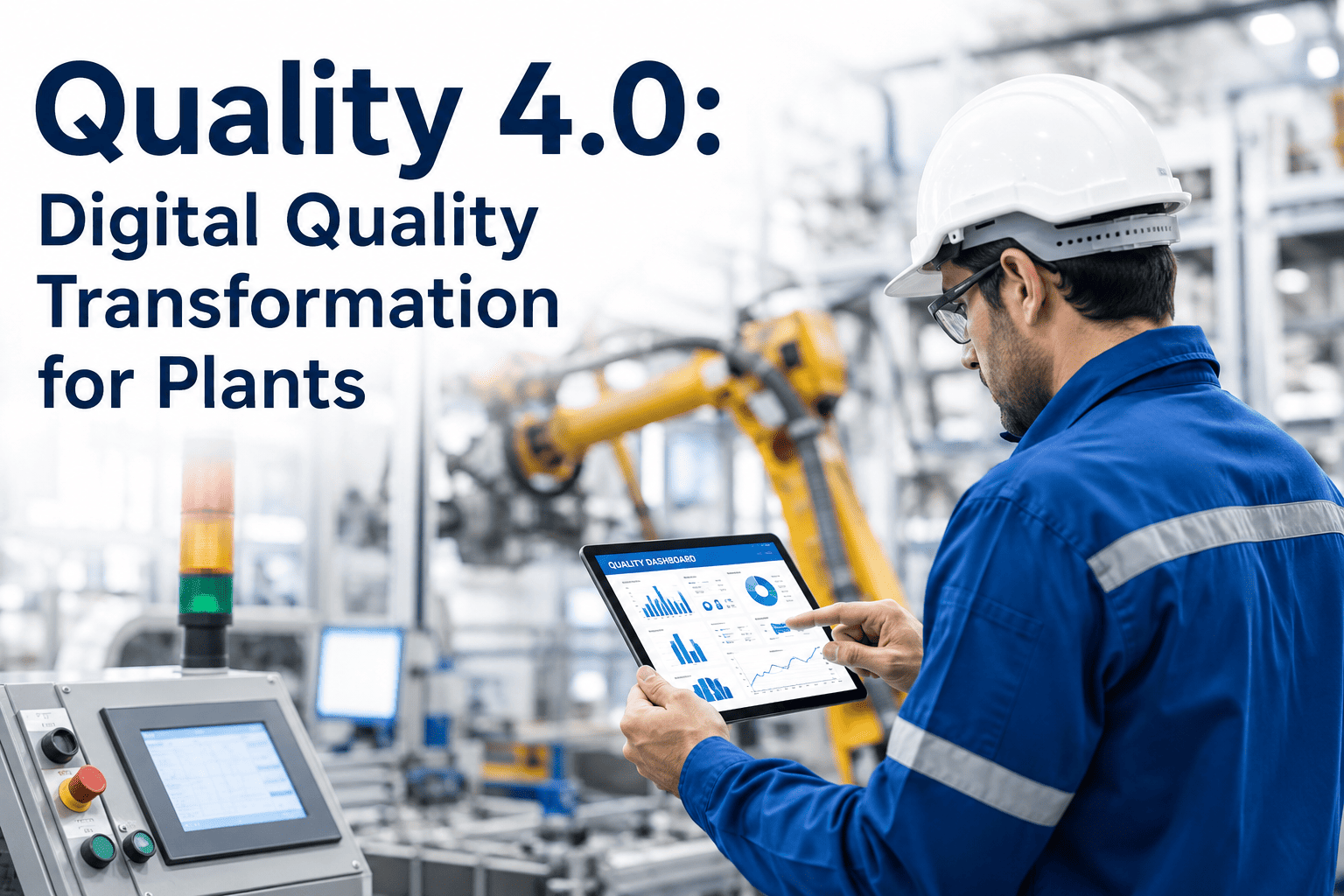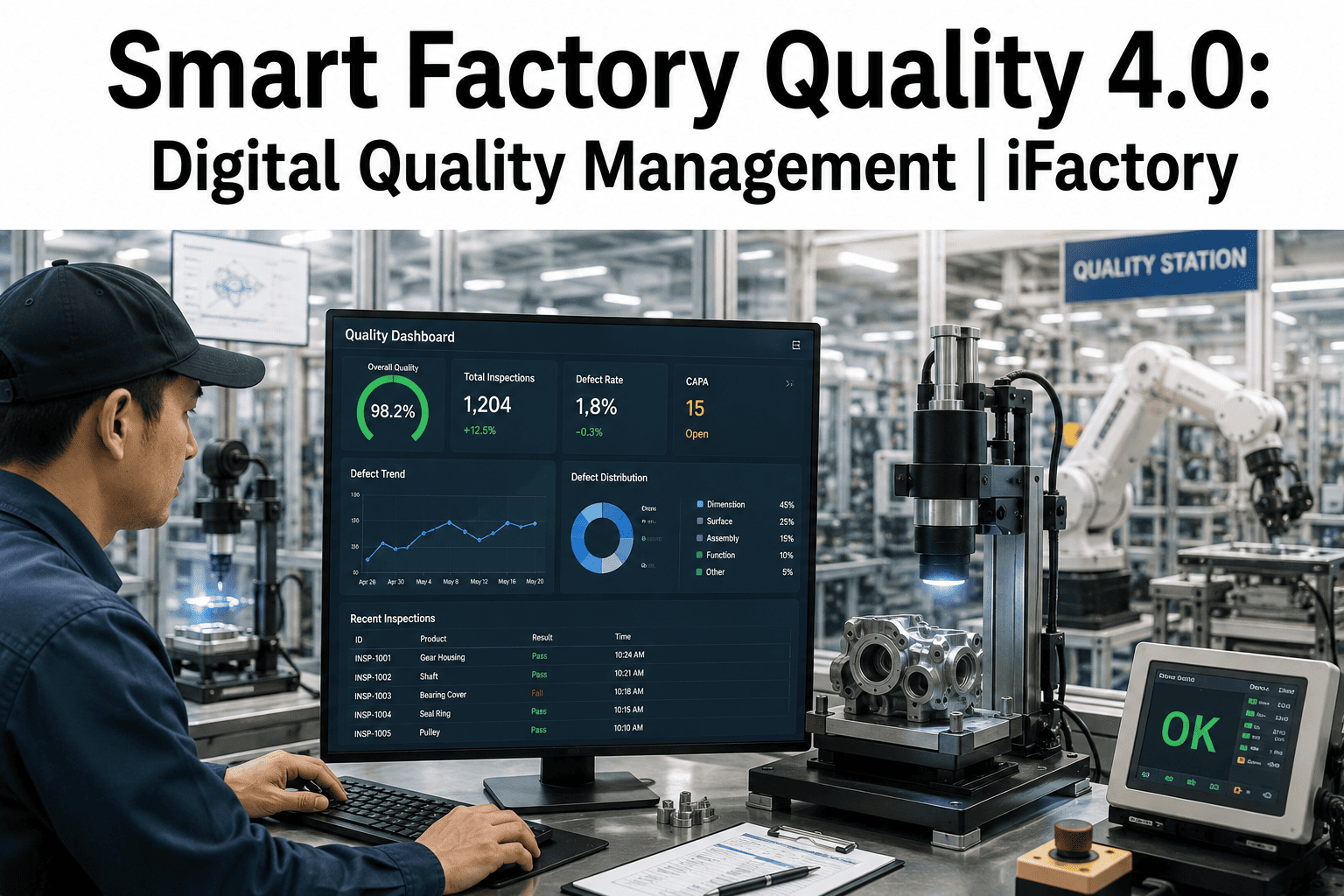
Quality teams have spent decades getting good at catching defects after they happen: pull a sample, run the gauge, log the deviation, file the CAPA. That model built the reliability standards modern manufacturing runs on, but it was designed for a slower, less connected factory than the one most plants operate today. Production speeds have climbed, defect tolerances have tightened, and a single missed non-conformance can now ripple through a multi-site supply chain before the next scheduled audit even catches it. Quality 4.0 is the response: a shift from sampling and reacting to continuously monitoring and predicting, and you can book a demo to see what that shift looks like running against your own production line.
Your Quality Team Is Still Finding Out About Defects After the Batch Is Already Built
iFactory's Quality 4.0 platform connects SPC, machine vision inspection, and predictive analytics into one system, so deviations are flagged the moment they start rather than discovered at the next scheduled audit.
The Gap Between Traditional Inspection and What Modern Production Actually Needs
Traditional quality management relies heavily on end-of-line inspection and periodic statistical sampling, an approach built for structured audits and control plans that created decades of reliable manufacturing output. The discipline behind that model has not failed, but the environment around it has changed faster than the model itself. Production lines now run faster, product mixes change more often, and customers expect zero-defect delivery with full traceability on demand, which is a difficult combination to satisfy when quality data still arrives as yesterday's news. The gap does not usually show up as a single catastrophic failure; it shows up as a slow accumulation of small escapes, warranty claims, and rework hours that never get traced back to a common root cause because the underlying data was never connected in the first place.
Five Capabilities That Separate Quality 4.0 From a Traditional QMS
A digital quality management system is not simply a paperless version of the same inspection binder. Quality 4.0 introduces genuinely new capabilities that a document-based or spreadsheet-based QMS cannot replicate, no matter how well organized it is. Expand each capability below to see what changes when quality data becomes continuous, connected, and predictive instead of periodic and siloed, and notice how each capability builds directly on the one before it rather than functioning as an isolated feature.
Traditional SPC pulls a sample every so many units and plots it after the fact, which means a process can drift out of control for an entire shift before anyone notices the trend on a chart. Real-time SPC streams every measurement as it is generated, applying control limits continuously so an operator sees a shift the moment it starts, not after the next scheduled sample.
Deep learning vision systems inspect every unit rather than a statistical sample, catching defects measured in microns that are simply invisible to a human inspector working at line speed. Because the models continuously learn from new production data, they adapt to new defect types without needing to be manually reprogrammed for every product variant.
Rather than waiting for a defect to occur and then investigating its cause, predictive quality models analyze process parameters, machine condition, and material variation together to forecast which upcoming batches carry elevated risk. That forecast gives quality engineers a window to intervene before the non-conformance is ever produced, instead of after it is already in the finished goods bin.
Most quality data still lives in a system separate from production and enterprise data, which forces engineers to manually stitch together a batch record from three or four different logins during any serious investigation. A connected Quality 4.0 platform unifies inspection results, defect records, and process parameters with ERP, MES, and SCADA data so root cause analysis starts from a single, already-correlated dataset.
Corrective and preventive action processes frequently stall because nobody circles back to confirm the fix actually worked once it has been implemented on the floor. A connected platform automatically tracks whether the defect rate associated with a CAPA actually drops after implementation, closing the loop with data instead of a manager's sign-off on a form.
Connect, Detect, Predict, Prevent — The Architecture of a Quality 4.0 System
A mature Quality 4.0 deployment is built on four pillars that work together continuously rather than four separate tools bolted onto an existing QMS. Each pillar depends on the one before it, which is why plants that try to jump straight to predictive analytics without first connecting their data sources usually see disappointing results and end up blaming the algorithm for a data problem the algorithm was never given the chance to solve.
Connect
Inspection stations, sensors, ERP, MES, and SCADA systems are unified into a single quality data model, eliminating the manual data-stitching that slows down every investigation.
Detect
Real-time SPC and AI vision inspection monitor every unit and every process parameter continuously, replacing statistical sampling with full coverage.
Predict
Machine learning models trained on connected process and quality data forecast which batches, shifts, or machines carry elevated defect risk before it materializes.
Prevent
Predicted risk automatically triggers a preventive action or process adjustment, closing the loop before a non-conforming unit is ever produced.
Quality Performance Benchmarks Across the Maturity Curve
Plants moving from reactive inspection toward a fully predictive Quality 4.0 program tend to see improvement concentrated in a consistent set of metrics. The figures below reflect typical performance levels achieved by facilities operating at a mature Quality 4.0 stage, benchmarked against the same metric at a traditional, sampling-based quality program, and they are the numbers most quality directors are asked to defend when a board or a major customer requests a maturity assessment.
Every Defect Your Team Finds After the Fact Already Cost You the Full Price of Building It
iFactory's Quality 4.0 platform connects your inspection, SPC, and process data into one predictive system, so quality engineers see risk before it becomes a non-conformance instead of after. Book a demo and see the platform analyzing your own production data live.
Traditional QMS vs a Connected Quality 4.0 Platform
Quality leaders evaluating a move from a document-based or legacy QMS to a connected Quality 4.0 platform need to see the operational difference in concrete terms, not just a maturity model diagram. The table below compares the two approaches across the capabilities that most directly affect defect escape rate, investigation time, and audit readiness, since these are the areas where a legacy system typically falls furthest behind once production volume and product complexity increase.
| Capability | Traditional / Legacy QMS | iFactory Quality 4.0 Platform |
|---|---|---|
| Inspection Coverage | Statistical sampling, periodic checks | 100% inspection at full line speed |
| SPC Data Latency | Plotted after batch sampling intervals | Streamed and evaluated continuously |
| Root Cause Investigation | Manual correlation across separate systems | Pre-correlated ERP, MES, and SCADA data |
| Defect Risk Visibility | Known only after the defect occurs | Forecasted before production of the batch |
| CAPA Effectiveness Verification | Manual sign-off, rarely re-checked | Automatically tracked against defect data |
| Audit and Compliance Reporting | Weeks of manual document compilation | Continuously updated, audit-ready records |
Quantified Results From Quality 4.0 Deployments Across Manufacturing Facilities
The figures below reflect measured outcomes reported from Quality 4.0 deployments across discrete manufacturing sites, each tracked over a minimum six-month period following implementation and validated against production and inspection records rather than self-reported estimates, which is the level of evidence most procurement teams now expect before approving a platform switch of this size.
Why Customers, Auditors, and Boards Are Now Asking for Quality 4.0 Specifically
The push toward Quality 4.0 rarely originates entirely from inside the quality department. Increasingly it arrives as a requirement from a customer's supplier scorecard, an auditor's request for continuous process data instead of a periodic sampling report, or a board asking why warranty costs keep climbing despite a quality team that has never been better staffed. Automotive and aerospace supply chains in particular have started specifying real-time process monitoring and full traceability as a condition of a new sourcing award, which means a plant without connected quality data risks losing new business before a single defect is ever produced.
Inside the plant, the pressure looks different but points the same direction. Engineering teams are tired of investigations that take days because the relevant machine parameters, material lot data, and inspection results live in three separate systems that were never designed to talk to each other. Operations leaders are under pressure to reduce cost of quality without adding headcount, which is only realistic if the system itself is doing more of the detection and correlation work automatically. Both pressures point toward the same architecture: a connected, predictive quality platform rather than a faster version of the same manual process.
There is also a workforce dimension that is easy to overlook. Experienced quality engineers who built deep tribal knowledge of a plant's specific failure modes are retiring at a faster rate than replacements can be trained, and a document-based QMS does very little to preserve that expertise once the person who held it leaves. A predictive quality system, by contrast, encodes patterns learned from years of production data directly into its models, which means the plant retains institutional knowledge about its own failure modes even as the people who originally observed those patterns move on.
What to Look For Before You Commit to a Quality 4.0 Platform
Not every vendor claiming Quality 4.0 capability actually delivers the connected, predictive architecture the term implies. Some platforms only digitize existing paper forms without adding real-time monitoring or predictive analytics, which leaves the underlying reactive workflow unchanged behind a nicer interface. Before committing budget to a platform, quality leaders should confirm it can genuinely stream SPC data continuously rather than in periodic batches, since this single capability determines whether the system can catch a drift while it is still developing instead of after a shift's worth of product has already been affected.
It is equally important to confirm that the vision inspection component uses models that continuously retrain on new defect types rather than a fixed rule set configured once at installation. Manufacturing environments change constantly, whether through new suppliers, new product variants, or seasonal material variation, and a static inspection model degrades in accuracy as the process it was trained on drifts away from its original baseline. Ask any vendor how their model handles a genuinely new defect type it has never seen before, and be skeptical of an answer that involves a lengthy manual reconfiguration process.
Finally, verify that the platform actually connects to your existing ERP, MES, and SCADA systems rather than requiring a parallel data entry workflow that duplicates effort for your team. A Quality 4.0 platform that cannot pull machine parameters, work order data, and material lot information automatically is not meaningfully more connected than the spreadsheet-based system it is replacing, no matter how sophisticated its dashboards look during a sales demonstration. It is also worth asking how the vendor handles the pilot-to-scale transition, since a platform that performs well on a single pilot line but requires a full re-implementation to extend across additional lines or sites will end up costing far more in integration time than the initial contract price suggests.
Where Quality 4.0 Initiatives Stall Before They Deliver Any Return
The single most common reason a Quality 4.0 initiative underdelivers is starting with predictive analytics before the underlying data is actually connected. A model trained on incomplete or poorly correlated data will produce unreliable predictions, and a few months of false alerts is usually enough to convince a skeptical production team to ignore the system entirely, which then makes it much harder to get buy-in for a second attempt later. This is why a properly sequenced rollout treats data connection as the mandatory first stage rather than an optional nice-to-have.
A second common pitfall is treating the pilot line as a permanent home for the technology rather than a proving ground meant to generate the evidence needed for a facility-wide business case. Pilots that never graduate to a documented ROI case tend to lose executive sponsorship once the original champion moves to a different role, leaving the plant with an isolated pocket of Quality 4.0 capability surrounded by lines still running the old reactive process. Building the case for expansion into the pilot plan from day one avoids this stall entirely.
Your Path From Reactive Inspection to Predictive Quality 4.0
Reaching a fully predictive quality program does not require replacing your entire QMS on day one. iFactory's deployment model is structured in five stages so the first measurable improvement in defect detection typically appears within the first pilot cycle, well before the full facility-wide rollout is complete, which keeps stakeholder confidence high through the later, more involved stages of connecting every line and site.
Quality Data Audit and System Connection
Existing inspection stations, SPC data, and ERP, MES, or SCADA feeds are catalogued and connected into a single data model.
Pilot on Your Highest-Value Inspection Point
Real-time SPC and AI vision inspection are deployed on the line or station with the greatest defect escape risk to prove measurable ROI quickly.
Predictive Model Calibration
Machine learning models are trained against your specific process parameters, material variation, and defect history to minimize false alerts.
Closed-Loop CAPA Activation
Corrective actions are linked directly to defect data, so effectiveness is verified automatically instead of relying on a manual sign-off.
Facility-Wide Rollout and Continuous Reporting
Predictive quality monitoring extends across every line and site, with unified dashboards and audit-ready compliance reporting throughout.
Common Questions About Quality 4.0 and Digital Quality Management
Stop Discovering Quality Problems After the Batch Is Already Built
iFactory's Quality 4.0 platform connects your inspection, SPC, and process data into one predictive system so your team catches risk before it becomes a defect. Book a demo and see the platform running against your own production line.