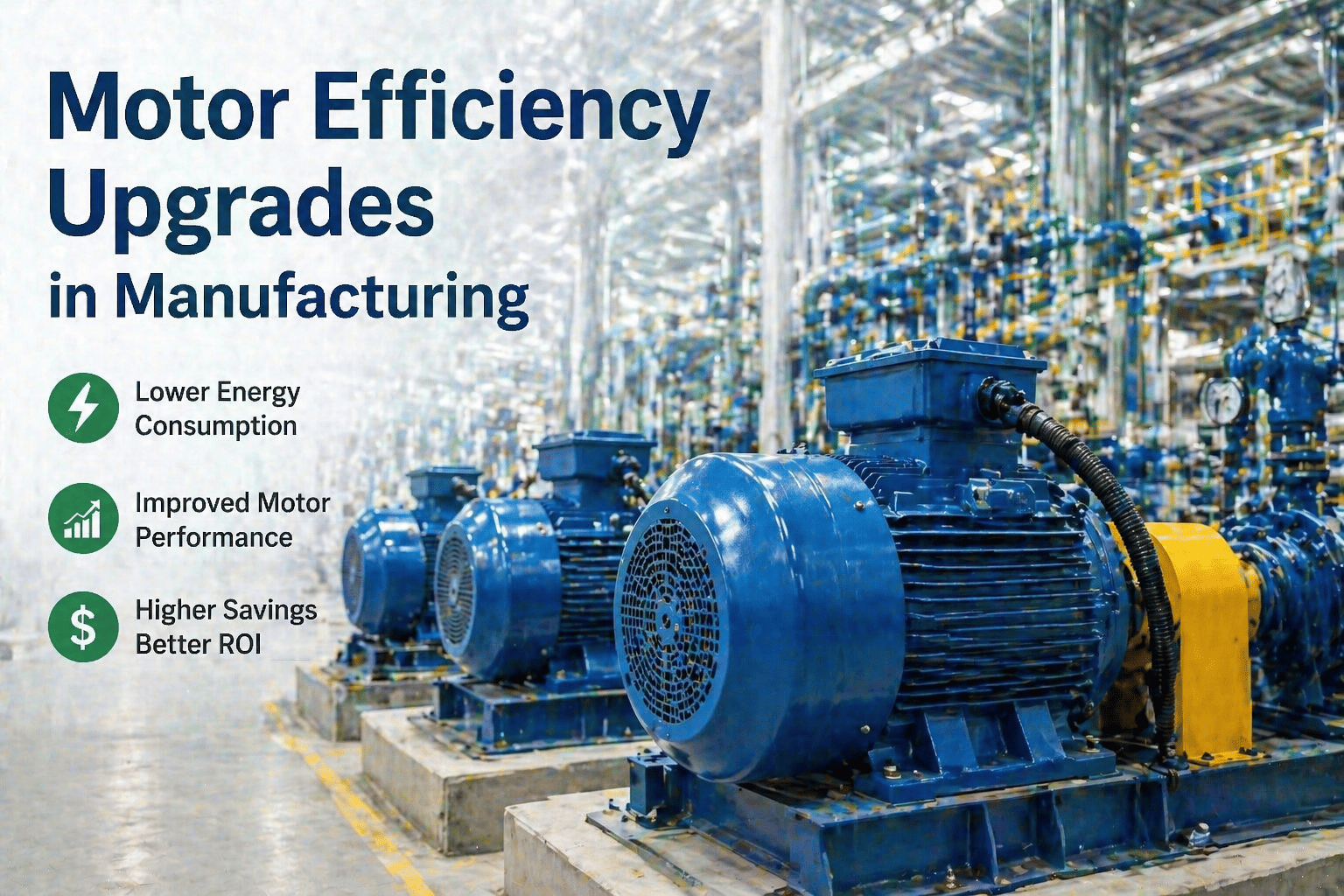
Electric motors account for roughly 70 percent of total industrial electricity consumption, which makes them the single largest energy line item in most manufacturing facilities, larger than lighting, HVAC, and process heating combined in many plants. Most of that motor fleet is still running on aging IE1 or IE2 designs at fixed speed regardless of actual load, and a large share of it is oversized for the job it does today, not the job it was specified for years ago. Upgrading to IE3 or IE4 motors paired with variable frequency drives is one of the highest-return investments available to an operations team, with typical payback of 6 to 18 months. Book a demo to see how iFactory identifies which motors in your fleet are worth upgrading first.
The Motor That Has Run Fine for Ten Years Might Still Be Costing You Thousands Every Year
Efficiency class, load factor, and speed control together determine how much of every kilowatt-hour a motor actually turns into useful work. iFactory tracks motor loading across your fleet continuously, flagging oversized and inefficient units with a calculated payback before you spend a dollar on replacement.
The Four IE Efficiency Classes, and What Each One Actually Buys You
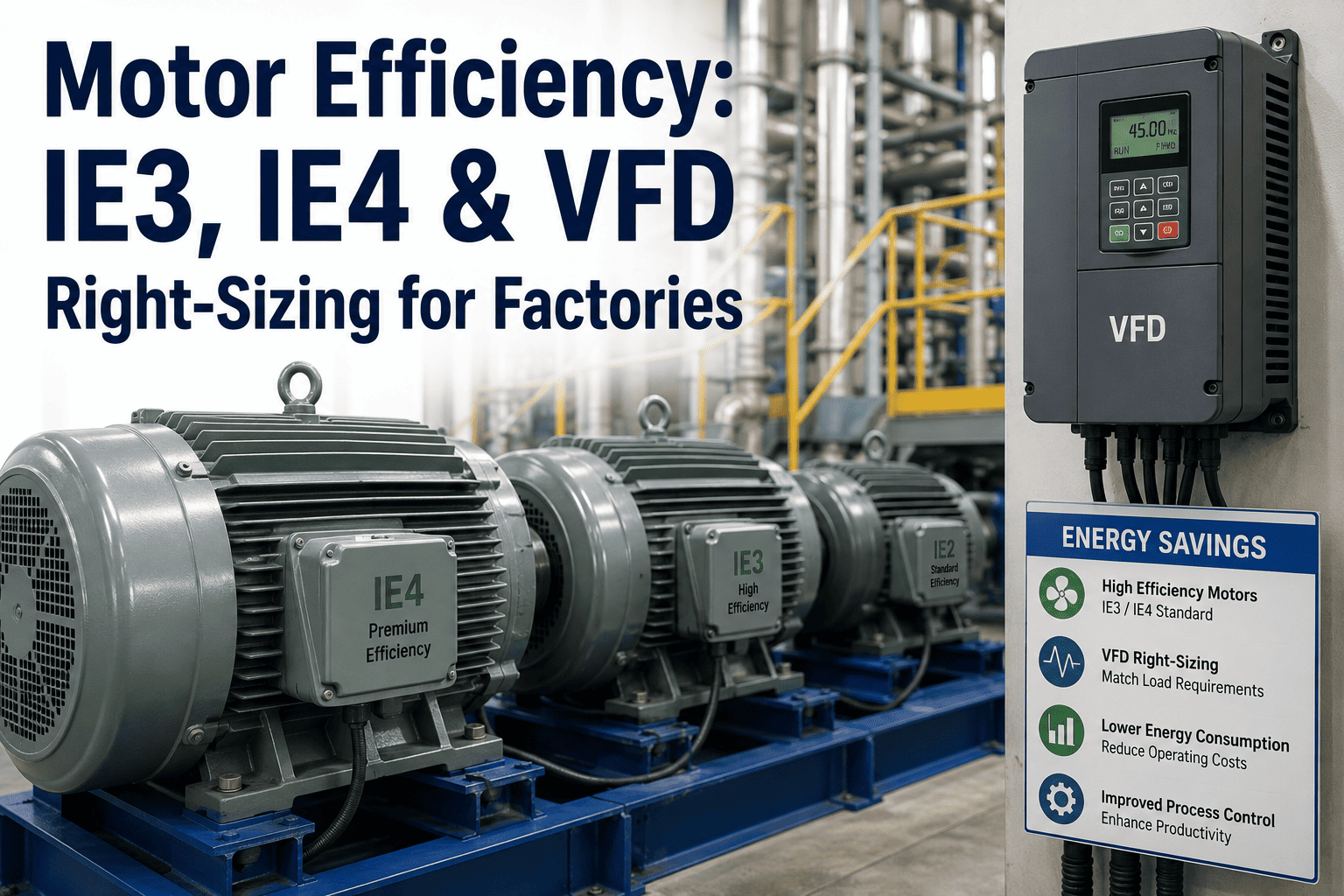
IEC 60034-30-1 defines four internationally recognized efficiency classes for induction motors. Each step up reduces electrical losses through better materials, tighter air gaps, and refined winding and lamination design, and each step also comes with a different regulatory status depending on where the motor operates. The reference figures below are for a mid-size 15 kW four-pole motor and illustrate the relative gap between classes rather than an exact figure for every frame size.
| Efficiency Class | Typical Efficiency | Regulatory Status | Best Fit |
|---|---|---|---|
| IE1 Standard Efficiency | ~85-87% | Being phased out globally, no longer sold new in most markets | Legacy fleet only, replace at failure |
| IE2 High Efficiency | ~88-89% | Permitted in the EU only when paired with a VFD | Small motors run continuously with variable speed control |
| IE3 Premium Efficiency | ~90-91% | Mandatory minimum in the EU, US, India, and China for 0.75-1000 kW | Standard choice for most new industrial motor purchases |
| IE4 Super Premium Efficiency | ~92-93% | Mandatory in the EU for 75-200 kW since July 2023, US DOE aligning by 2027 | High-runtime, continuous-duty applications with long payback horizons |
A one or two percentage point efficiency gap looks small until it is multiplied across thousands of running hours a year for fifteen to twenty years, which is the typical service life of an industrial motor. On a continuously running application, the difference between IE1 and IE4 compounds into a meaningful multi-year cost gap that dwarfs the price premium of the higher-efficiency motor.
Motor Load Is the Number That Actually Decides Whether an Upgrade Pays Off
Efficiency class matters, but it is secondary to a simpler question: how much of the motor's rated capacity is actually being used. A premium-efficiency motor running at 30 percent load is still a poor investment, while a standard-efficiency motor running near its rated capacity may be performing reasonably well. Motors specified years ago for peak loads that have since declined, or oversized as a safety margin during original design, commonly end up running well below their efficient operating range.
The marker above reflects a commonly observed load factor for oversized industrial motors once they are actually metered, well inside the range where efficiency and power factor both degrade. Metering load factor directly is the only reliable way to know where a specific motor sits, since nameplate horsepower reflects the original design assumption, not current operating reality.
Nameplate Horsepower Tells You Nothing About Actual Load Today
iFactory meters motor loading continuously and ranks every oversized or inefficient motor in your fleet by dollar opportunity, so upgrade budget goes to the motors that will actually pay it back.
Affinity Laws: Why a 20% Speed Cut Delivers Roughly a 50% Energy Cut
For variable-torque loads, pumps, fans, and compressors, the relationship between speed and power consumption is not linear, it is cubic. A modest reduction in motor speed produces a disproportionately large reduction in power draw, which is the physics that makes VFDs one of the highest-ROI retrofits available for these specific application types. Constant-torque applications like conveyors follow a different relationship and see meaningfully smaller savings from the same speed reduction.
The savings shown are theoretical values from the cube relationship and will differ from measured results once VFD conversion losses and real-world system curves are accounted for, but the direction and rough magnitude hold consistently across pump and fan applications with genuinely variable demand.
Before and After: What a Right-Sizing Project Actually Looks Like
The clearest way to understand the combined value of efficiency class and load matching is to compare a typical unaddressed motor against the same application after a right-sizing and VFD retrofit project.
Repair or Replace: A Practical Decision Framework for Failed Motors
The moment a motor fails is the highest-leverage decision point in a motor management program, because replacement cost is already being spent whether the facility rebuilds the old unit or buys new. The criteria below reflect the factors that most reliably separate a good repair candidate from a good replacement candidate.
Common Questions About Motor Efficiency and VFD Upgrades
Is it worth upgrading a motor that is still running fine, or should we wait until it fails?
It depends primarily on operating hours and load factor rather than whether the motor currently runs without issue. A continuously running, significantly oversized motor on an IE1 or IE2 platform can justify early replacement because the annual energy waste alone may cover a meaningful share of the upgrade cost within a few years, independent of any mechanical concern. Motors running fewer than 1,500 to 2,000 hours per year rarely justify early replacement purely on energy savings, and the repair-at-failure approach remains the more sensible default for those units. Book a demo to get a fleet-wide priority ranking based on actual operating hours and measured load.
Can any existing motor accept a VFD retrofit, or does it require a specific motor design?
Most standard induction motors from IE2 and above can accept a VFD, but a few compatibility checks matter before installation. The motor should have inverter-duty rated insulation to withstand the voltage spikes a VFD introduces, bearing compatibility should be verified to avoid electrical erosion from shaft currents on larger frames, and the application needs to be genuinely variable-torque, such as a pump or fan, to realize meaningful savings, since constant-torque applications like conveyors see a much smaller benefit from the same retrofit. Contact support to check VFD compatibility across your motor fleet.
How much more does an IE4 motor cost compared to IE3, and is the extra efficiency worth the premium?
IE4 motors typically carry a meaningful price premium over IE3, but for continuous-duty, high-runtime applications the payback difference between the two classes is often only a matter of months, and IE4 delivers materially more savings across the remaining 15 to 20 year service life once that gap is closed. For applications running fewer hours per year or with intermittent duty cycles, IE3 usually remains the more economically sensible choice, since the extra efficiency has less runtime to earn back the premium. Regulatory requirements are also tightening, with IE4 already mandatory in parts of the EU for 75-200 kW motors, which is worth factoring into a purchasing decision even where it is not yet legally required. Book a demo to model IE3 versus IE4 payback for a specific application.
How can we tell which motors in our facility are actually oversized without a full engineering study?
The most direct method is metering actual current or power draw against the motor's rated nameplate capacity over a representative operating period, since a motor consistently running well below 75 percent of rated load is a strong oversizing candidate regardless of what the original specification assumed. A quick screening approach without full metering is to check motor amperage against the nameplate full-load amps using a clamp meter during normal operation, which gives a rough load factor estimate in minutes per motor. Continuous monitoring goes further by capturing load variation across shifts and seasons rather than a single point-in-time snapshot. Contact support to set up continuous load monitoring across your fleet.
Does upgrading motor efficiency and adding VFDs have any benefit beyond the energy bill?
Efficiency and load matching improvements typically reduce operating temperature, since a more efficient motor generates less waste heat and a properly loaded motor runs closer to its designed thermal envelope rather than fighting excess heat from oversizing or inefficiency. Lower operating temperature translates into reduced bearing and insulation stress, which extends service life and lowers unplanned failure rates, an operational benefit that compounds with the direct energy savings over the motor's lifetime. VFDs add a further benefit through soft-start capability, which reduces mechanical stress on couplings, belts, and driven equipment compared to across-the-line starting. Book a demo to discuss reliability benefits alongside energy savings.
Find Out Which Motors in Your Fleet Are Actually Worth Upgrading
iFactory meters motor load continuously, ranks every candidate by measured operating data instead of nameplate assumptions, and calculates payback before a single dollar is committed to replacement or VFD installation.