AI in Midstream Oil & Gas: Smarter Transportation and Storage
By Ethan Walker on May 20, 2026
Midstream oil and gas operations — the pipelines, compression stations, storage terminals, and LNG logistics networks that move energy from wellhead to end-user — have historically been the least digitized segment of the oil and gas value chain. That is changing fast. AI midstream oil gas transportation storage technologies are now delivering measurable improvements in throughput efficiency, leak detection accuracy and demand forecasting precision. This guide walks U.S. energy professionals through the real-world architecture, deployment considerations and ROI frameworks for AI adoption across midstream operations.
Midstream & Supply Chain Intelligence 2026
AI in Midstream Oil & Gas: Smarter Transportation and Storage
How AI is reshaping pipeline flow, terminal management, and LNG logistics across the U.S. energy supply chain
$4.2B
Annual Pipeline Incident Losses (U.S.)
89%
AI Leak Detection Accuracy Rate
31%
Reduction in Unplanned Downtime
$620K
Avg. Savings Per Avoided Rupture Event
Ready to see how AI transforms your midstream operations from pipeline to terminal? Book a technical demo with our oil & gas specialists.
Why Midstream Operations Are Now AI's Highest-Value Frontier
Upstream AI investment — drilling optimization, reservoir modeling, seismic analysis — has dominated industry headlines for a decade. Downstream has seen refinery optimization tools mature significantly. Midstream sat in the middle: operationally complex, geographically dispersed and often running on SCADA systems designed in the 1990s. The result is a segment where margin leakage is enormous and visibility is genuinely poor.
Three structural shifts are now making AI adoption in midstream both urgent and economically justified. First, PHMSA pipeline safety regulations have tightened enforcement timelines, creating compliance pressure that manual inspection cannot satisfy at scale. Second, LNG export volumes have tripled since 2020, making logistics optimization a nine-figure opportunity. Third, real-time sensor density across pipeline networks has reached the point where human operators cannot process the data stream — AI is the only scalable interpretation layer.
Pipeline Complexity
U.S. interstate pipelines span 2.7 million miles. Manual monitoring leaves critical blind spots between inspection intervals.
Demand Volatility
LNG spot prices move 40–60% intraday. Static scheduling models leave significant margin on the table.
Aging Infrastructure
44% of U.S. pipeline infrastructure is over 50 years old. Corrosion and fatigue failure risk is not captured by calendar-based inspection.
Regulatory Exposure
PHMSA violations carry fines up to $257,664 per day per violation. Documentation gaps are the most common audit trigger.
AI Applications Across the Midstream Value Chain
AI in midstream is not a single technology — it is a stack of capabilities applied to distinct operational domains. The most mature and highest-ROI applications span five core areas. Understanding which application fits which operational problem prevents the most common deployment mistake: buying a platform and expecting it to solve every problem without scoping the use cases first.
AI Application
Operational Problem Solved
Primary Data Source
Typical ROI Window
Pipeline Flow Optimization
Maximizes throughput by adjusting compressor speeds and valve positions in real time based on pressure-flow models
SCADA, flow meters, pressure sensors
6–12 months
Leak & Anomaly Detection
Identifies pressure drop signatures, flow imbalances, and acoustic anomalies indicating leaks before they become reportable incidents
Forecasts compressor, pump, and valve failure timelines to shift from reactive repair to planned maintenance windows
Vibration sensors, temperature, run-hour logs
9–18 months
LNG Demand Forecasting
Integrates weather, shipping schedules, spot pricing, and industrial demand signals to optimize cargo scheduling and terminal throughput
Market feeds, weather APIs, booking systems
12–20 months
Inventory & Storage Optimization
Dynamically allocates crude, NGL, and refined product storage across terminal tanks to minimize demurrage and maximize margin capture
Tank level sensors, market pricing, nomination data
6–14 months
Pipeline Flow Optimization
Maximizes throughput by adjusting compressor speeds and valve positions in real time based on pressure-flow models
Leak & Anomaly Detection
Identifies pressure drop signatures, flow imbalances, and acoustic anomalies before they become reportable incidents
Predictive Asset Maintenance
Forecasts compressor, pump, and valve failure timelines to shift from reactive to planned maintenance windows
LNG Demand Forecasting
Integrates weather, shipping schedules, spot pricing, and industrial demand signals to optimize cargo scheduling
Inventory & Storage Optimization
Dynamically allocates crude, NGL, and refined product storage to minimize demurrage and maximize margin capture
iFactory's AI platform covers the full midstream stack — from pipeline SCADA integration to terminal inventory optimization. Book a walkthrough matched to your specific operational challenges.
Pipeline Flow AI: How Real-Time Optimization Works
Pipeline flow optimization is the highest-frequency AI application in midstream — decisions are made continuously, not daily. The architecture runs in three concurrent loops, each operating at a different time horizon. Understanding the loops explains why some operators see results in weeks while others struggle after months of deployment.
Three-Loop AI Architecture for Pipeline Flow Control
01
Real-Time Control Loop
Frequency: Every 1–5 seconds
Reads live pressure and flow sensor data from SCADA
Adjusts compressor speed setpoints within safe operating bands
Outcome: +8–14% throughput efficiency vs. static setpoints
02
Short-Term Planning Loop
Frequency: Every 15–60 minutes
Models line pack and storage buffer requirements 4–8 hours ahead
Incorporates demand nominations from downstream shippers
Recommends valve sequencing for planned nominations
Outcome: −22% fuel gas consumption in compression stations
03
Strategic Scheduling Loop
Frequency: Daily / weekly
Optimizes batch scheduling across interconnected pipeline segments
Integrates weather forecasts for demand and operational planning
Generates maintenance window recommendations by segment
Outcome: +17% on-time delivery rate for committed nominations
AI for LNG Transportation and Storage: The Demand Forecasting Advantage
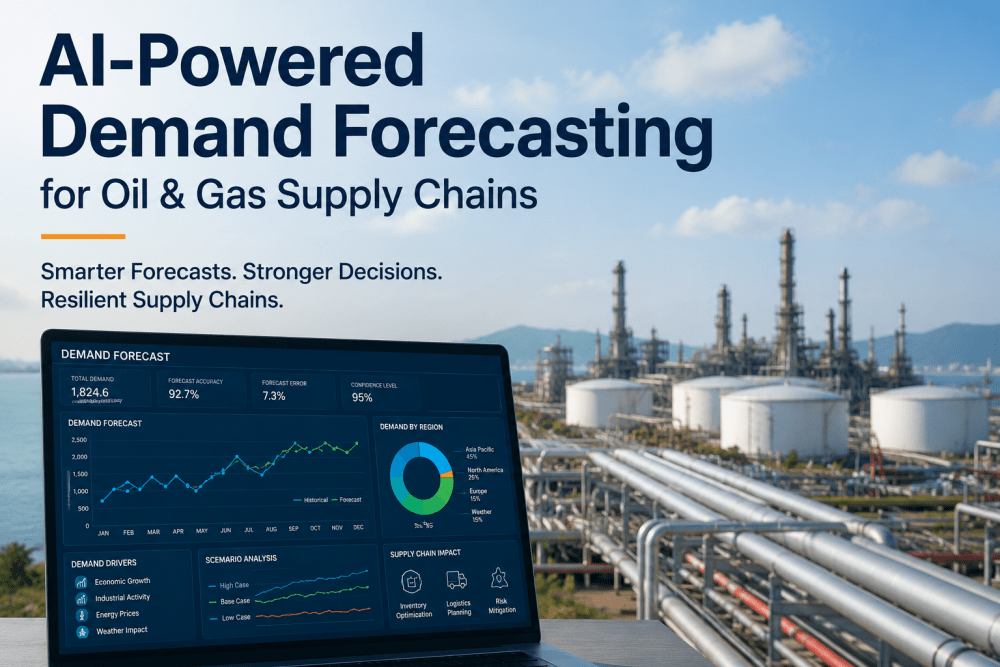
LNG logistics present a forecasting problem that humans cannot solve manually at scale. A single LNG cargo represents $40–80 million in commodity value. Slot availability at export terminals is priced on 72-hour windows. Weather-driven demand swings in Asia and Europe propagate back to U.S. Gulf Coast loading schedules within hours. The operators who consistently capture premium pricing are those with AI systems that synthesize these signals simultaneously.
Managing LNG Logistics or Terminal Throughput?
iFactory's AI demand forecasting engine integrates market feeds, shipping schedules, weather data, and SCADA signals to give your team a 72-hour operational edge — updated every 15 minutes.
AI models consume weather forecasts, industrial production indices, shipping AIS data, and Henry Hub futures simultaneously. Forecast horizon: 30 days with 6-hour granularity.
94%72-hour demand forecast accuracy
Cargo Slot Optimization
Algorithms allocate terminal loading slots across shipper nominations to maximize throughput while respecting boil-off rate constraints and maintenance windows.
+19%Improvement in terminal utilization rate
Inventory Buffer Management
AI determines optimal LNG heel levels in each storage tank based on upcoming scheduled and unscheduled demand, minimizing boil-off losses while maintaining sendout capacity.
−28%Reduction in boil-off gas losses
Shipping Route Intelligence
Integrates live vessel AIS positions, port congestion data, and spot market pricing to recommend cargo rerouting decisions within 4-hour execution windows.
$2.1MAvg. annual margin capture per terminal
iFactory's LNG optimization module integrates with your existing terminal management systems in under 6 weeks. Request a technical assessment specific to your terminal configuration.
Predictive Maintenance for Midstream Assets: A Practical Checklist
Midstream predictive maintenance differs from plant-floor PM in one critical way: assets are geographically dispersed and often in unmanned locations. A compressor station failure at mile 340 of a 600-mile pipeline triggers a cascade — line pack depletion, downstream pressure drops, shipper notification obligations, and potential PHMSA reporting — before a technician can reach the site. AI maintenance systems that operate on edge devices and transmit alerts to mobile teams are the only architecture that works at this operational distance.
Midstream AI Predictive Maintenance Readiness Checklist
Data Infrastructure
Asset Coverage
Operational Readiness
Compliance Integration
Use iFactory's readiness assessment to score your midstream operation against 40 deployment criteria before committing to a platform. Schedule your free assessment with our midstream AI team.
ROI Framework: Quantifying AI Returns in Midstream Operations
ROI calculations for midstream AI split into three categories: avoided event costs, operational efficiency gains, and regulatory cost avoidance. The most common measurement mistake is counting only the first category. Efficiency gains — fuel cost reduction in compression, demurrage elimination at terminals, labor reallocation from reactive to planned work — often exceed avoided event ROI in the first 18 months because they accrue continuously rather than episodically.
Avg. cost of undetected pipeline rupture
$620K–$4.8M
Compressor failure cost (unplanned vs. planned)
8× higher
Reduction in unplanned downtime events/year
−31%
AI early leak detection accuracy rate
89%
Based on iFactory deployments across U.S. midstream operators, 2023–2025.
Fuel gas savings in AI-optimized compression
−22%
Terminal throughput improvement
+19%
Demurrage cost reduction per terminal annually
$1.4M–$3.2M
Reduction in reactive maintenance labor hours
−44%
Efficiency gains typically begin accruing within 90 days of full deployment.
PHMSA max penalty per day per violation
$257,664
Reduction in audit documentation gaps
−87%
Inspection report generation time (manual vs. AI)
6 hrs → 11 min
Continuous compliance log gaps eliminated
100%
Continuous AI logging eliminates the data gaps that trigger regulatory audit escalation.
Expert Review
Robert D., VP of Pipeline Operations
1,200-Mile Natural Gas Transmission System, Mid-Continent Region
"We were running our compression optimization on manual setpoints established in 2014. Our fuel gas consumption was 11.4% of throughput — industry average is closer to 8.2%. When we deployed iFactory's flow AI, we brought that number to 8.9% in the first quarter, which translated to approximately $3.1 million in annual fuel cost reduction on our system alone. The leak detection module caught two anomalous pressure patterns in the first six months that our SCADA operators had written off as normal line pack variation. Both turned out to be early-stage micro-leak events at weld seams — we resolved them during scheduled maintenance windows rather than emergency responses. The PHMSA reporting on both was clean because the AI had maintained a continuous timestamped log of the anomaly detection sequence. That documentation alone is worth the platform cost."
$3.1M
Annual Fuel Cost Reduction
2
Leak Events Caught Early
Q1
Payback Quarter
Frequently Asked Questions
AI platforms like iFactory integrate with SCADA and DCS systems via OPC-UA, Modbus TCP, or REST API connections — no replacement of existing control infrastructure is required. The AI layer reads historian data and real-time tags, runs inference and optimization models externally, and writes recommended setpoints back to operators via a separate recommendation interface. Control authority remains with the human operator; the AI is a decision-support layer, not an autonomous control system. Integration timelines typically run 4–8 weeks for standard SCADA platforms (Wonderware, OSIsoft PI, GE iFIX, Honeywell Experion).
For pipeline leak detection, the baseline requirement is flow meter and pressure sensor data at 5-minute or better resolution, retained for a minimum of 12 months. Shorter histories produce higher false-positive rates because the AI cannot distinguish seasonal flow patterns from anomalies. Acoustic sensor data — captured via fiber optic distributed acoustic sensing (DAS) or discrete hydrophone arrays — dramatically improves detection specificity and can reduce the minimum data history requirement to 6 months. Sites without acoustic sensing can still achieve 78–82% detection accuracy on pressure-based models alone; adding DAS typically pushes accuracy to 89%+.
LNG demand forecasting models use ensemble architectures — combining LSTM neural networks for pattern recognition in time-series price data with regression models for structural demand drivers (industrial output indices, weather degree-days, shipping slot availability). The ensemble is retrained on a rolling 30-day window so that recent market regime shifts are captured quickly. The 72-hour forecast horizon, which covers most cargo nomination and rescheduling decisions, typically achieves 90–94% accuracy under normal market conditions. During high-volatility events (geopolitical disruptions, severe weather), the model flags elevated uncertainty and widens confidence intervals rather than producing false precision.
AI analytics platforms that operate as decision-support tools — reading operational data and providing recommendations without autonomous control authority — do not trigger new PHMSA operational control obligations under 49 CFR Parts 192 and 195. However, connecting an AI platform to pipeline control networks does create new attack surface under TSA's Pipeline Cybersecurity Directives (SD-02D and SD-02E for critical pipelines). Operators must ensure the AI platform vendor is compliant with TSA's access segmentation, multi-factor authentication, and incident reporting requirements. iFactory's architecture maintains a read-only connection to SCADA historians, with recommendation output delivered via separate network segment to operator workstations — a design that satisfies TSA SD-02D network segmentation requirements.
For midstream operators with clean historian data and standard SCADA platforms, the timeline from contract to first measurable ROI runs 14–22 weeks: 4–6 weeks for data integration and model baseline, 4–6 weeks for pilot asset deployment and validation, 6–10 weeks for full fleet rollout and operator adoption. The first ROI events to materialize are typically efficiency gains — fuel gas savings from compression optimization and scheduling improvements — which begin accruing within 30–60 days of going live on the first compressor station. Avoided failure ROI events are inherently episodic, but operators consistently report the first AI-prevented unplanned event within 6 months of full deployment.
Conclusion: The Midstream Intelligence Gap Is Now a Competitive Liability
The midstream operators who have adopted AI are not running experiments — they are compounding operational advantages that widen with every month of deployment. Their compressors run more efficiently. Their leak detection catches events that SCADA operators miss. Their LNG scheduling captures margin that manual nominators leave in spot market volatility. Their compliance documentation is continuous, timestamped, and audit-ready without a preparation sprint before every inspection.
The operators still running on 2010-era SCADA monitoring and static compression setpoints are not just missing efficiency gains — they are accumulating risk exposure that is becoming quantifiable in regulatory fines, insurance premiums, and lender covenant requirements. AI midstream oil gas transportation storage intelligence is no longer a technology decision. It is an operational risk decision with a measurable price tag for inaction.
Ready to Quantify Your Midstream AI Opportunity?
Get a site-specific assessment of your pipeline, compression, and terminal operations — including an ROI model built on your actual asset mix, data history, and throughput profile.
.png)