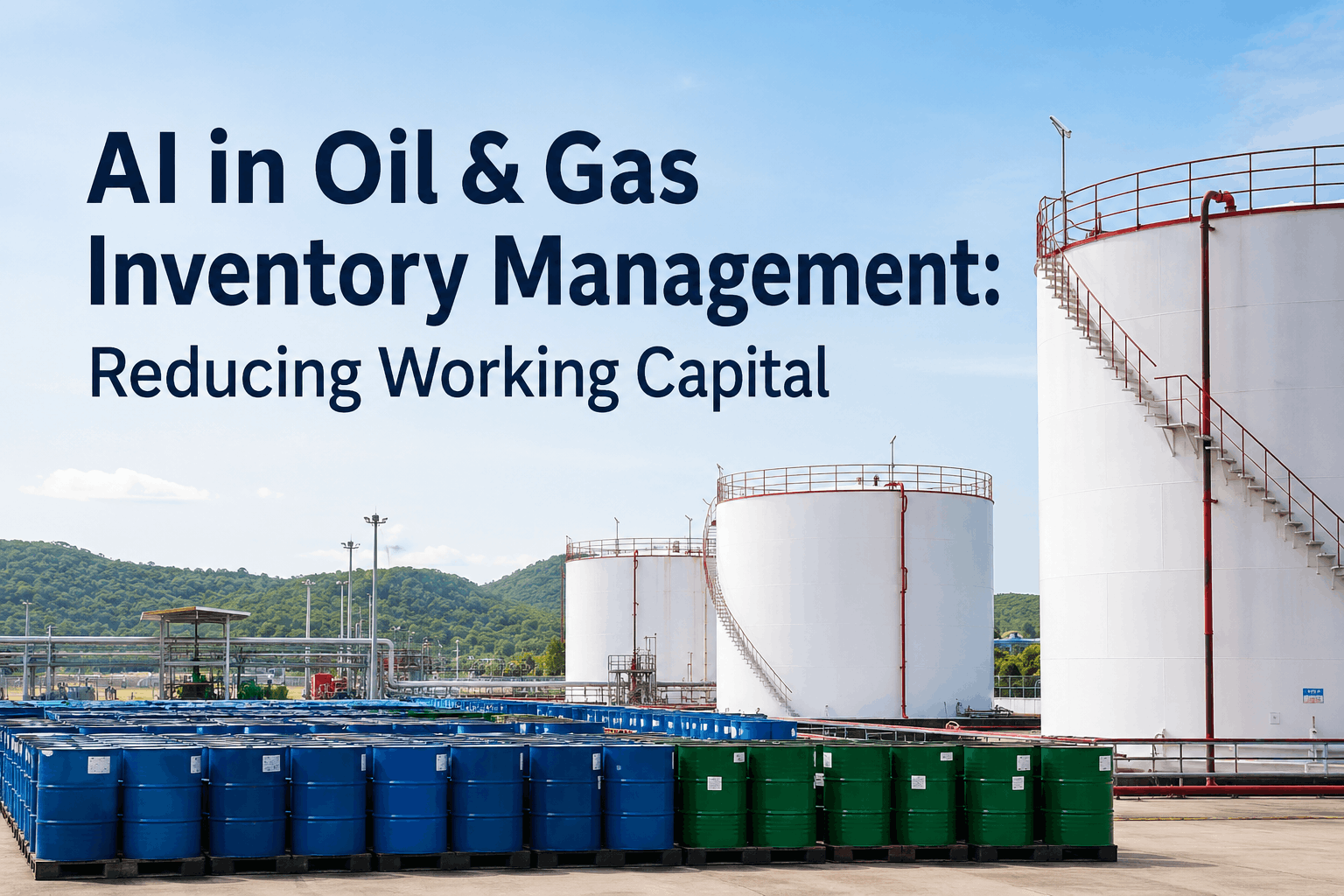
Oil and gas companies collectively hold hundreds of billions of dollars in trapped working capital — locked inside overstocked spare parts warehouses, misaligned procurement cycles, and inventory buffers sized for worst-case scenarios that rarely materialize. Across upstream, midstream, and downstream segments, excess inventory silently consumes cash flow while stockouts of critical components trigger unplanned shutdowns costing tens of thousands of dollars per hour. Book a Demo to see how AI inventory management breaks this cycle by replacing calendar-based purchasing with continuous, data-driven forecasting tied directly to asset health, production schedules, and supply chain conditions — generating precise, just-in-time replenishment signals that release working capital without increasing operational risk.
AI inventory management in oil and gas uses machine learning models trained on equipment sensor data, failure histories, procurement records, and production schedules to forecast spare parts demand at the component level — eliminating the overstocking and stockout cycles that trap working capital. iFactory's AI platform integrates directly with SCADA, DCS, historian, and ERP systems to connect real-time asset health data to inventory replenishment logic. Predictive maintenance forecasts generate forward-looking parts demand signals weeks in advance. Procurement workflows automate purchase orders based on AI-calculated stock requirements. The platform covers upstream drilling, midstream pipelines and compressor stations, and downstream refining — delivering a single source of truth for inventory, asset condition, and supply chain performance across the entire oil and gas portfolio.
What Is AI Inventory Management in Oil & Gas?
Traditional inventory management relies on static min/max rules and reactive emergency procurement — both guarantee either excess inventory tying up cash or stockouts delaying critical maintenance. AI inventory management replaces these with dynamic, continuously-updated forecasting models that ingest SCADA pressure and temperature readings, vibration and acoustic sensor data, work order histories, vendor lead-time records, and pipeline throughput schedules to generate precise demand predictions at the individual component level for each asset at each facility. iFactory's AI and digital twin platform — which you can explore with a Book a Demo session — connects these forecasts directly to live equipment health, production plans, and maintenance schedules, turning procurement from a reactive back-office function into an anticipatory, working-capital-optimizing operation.
Why Working Capital Is Trapped in Oil & Gas Inventory
Working capital inefficiency in oil and gas inventory is not a failure of intent — it is a structural consequence of operating in high-stakes environments with fragmented data and slow feedback loops. Understanding the root causes explains why AI is the right solution.
Operators experiencing costly stockouts respond by increasing safety stock levels — a rational response to an isolated event that becomes systematically irrational when applied across thousands of SKUs and dozens of locations. The result is warehouse inventory that covers failure scenarios with a 0.1% probability occupying shelf space for years at significant carrying cost.
SCADA and DCS systems hold real-time equipment condition data. ERP and CMMS systems hold procurement and inventory data. In most operations, these systems never communicate. A pump showing early bearing degradation signals in SCADA data triggers no inventory action until a work order is manually raised — often too late to source parts within lead time.
Min/max rules set when a facility was commissioned rarely reflect current production throughput, equipment age, or maintenance strategy changes. A pipeline segment running at 140% of design capacity depletes spare parts at rates that three-year-old reorder points were never designed to anticipate, creating predictable stockout patterns.
Emergency procurement for offshore platforms or remote pipeline compressor stations carries 3× to 5× normal procurement costs due to expedited freight, helicopter mobilization, and after-hours labor. Operators absorb these premiums repeatedly rather than investing in the forecasting capability that eliminates the emergency in the first place.
Turbine rotors, large-bore compressor valves, and custom-engineered pump casings with 16- to 24-week lead times are typically stocked in quantities driven by conservative risk assumptions rather than actual failure probability models. AI calculates the statistically correct quantity based on predicted failure rates, eliminating millions in unnecessary capital tied to low-probability events.
When equipment fails unexpectedly, it consumes parts at rates far above normal, drawing down inventory buffers that were sized for planned maintenance consumption patterns. Without predictive visibility into upcoming failures, inventory planning cannot pre-position stock before demand spikes materialize.
Connect Asset Health to Inventory Intelligence With iFactory AI
iFactory unifies predictive maintenance, demand forecasting, and procurement automation across upstream, midstream, and downstream operations — reducing working capital while eliminating stockout risk. ROI in 6 weeks.
How AI Solves Oil & Gas Inventory Management: The iFactory Approach
iFactory's AI inventory management capability — available to explore via a Book a Demo session with the platform team — works through five interconnected layers, from raw sensor ingestion through automated procurement action, where each layer adds intelligence that the next layer depends upon.
iFactory connects via OPC-UA, REST API, and MQTT to existing SCADA systems (GE DigitalWorks, Wonderware, Ignition, Siemens), DCS platforms, and historian databases (OSIsoft PI, InfluxDB, Grafana). Every pressure reading, vibration signature, temperature anomaly, and flow rate measurement feeds into the AI inventory model in real time. OT data remains inside your security perimeter. Asset-level condition scores update continuously — not quarterly during manual inspections.
Machine learning models trained on thousands of historical failure events analyze incoming sensor streams to generate failure probability scores and remaining useful life estimates for every monitored asset. A compressor bearing scoring 78% probability of failure within 30 days creates a demand signal for the associated seal kit, bearing set, and gasket inventory — 30 days before the work order is raised. This forward-looking demand signal is the foundation that separates AI inventory management from reactive procurement.
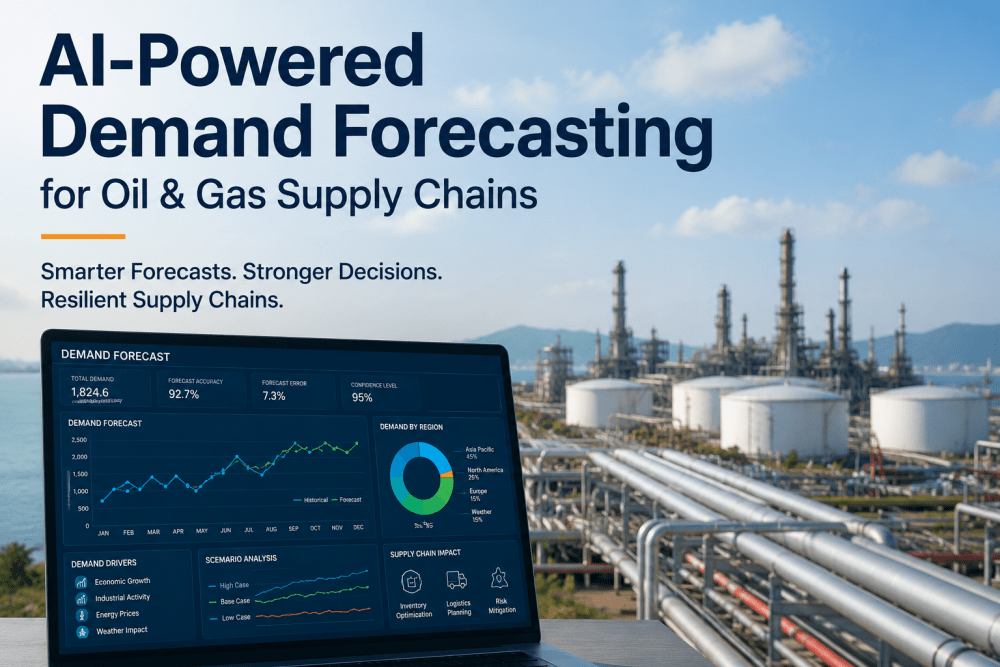
Time-series forecasting models combine predictive maintenance signals with historical consumption data, production throughput schedules, seasonal patterns, vendor lead-time distributions, and external supply chain risk factors. Forecasts are generated at the individual component level for each asset at each facility — not at aggregate category levels that mask local stockout risk. Rolling 90-day demand forecasts update daily as new sensor and operational data flows in, reflecting current equipment condition rather than historical averages.
iFactory continuously recalculates optimal safety stock levels and reorder points using actual failure probability distributions, current lead-time performance by vendor, and cost-of-stockout estimates for each asset class. High-criticality assets on offshore platforms or remote pipeline segments receive higher safety stock buffers justified by logistics cost analysis. Low-risk, fast-moving consumables on well-serviced facilities carry tighter stock buffers. This differentiated approach frees working capital from low-risk positions while protecting against the stockouts that matter most.
When AI demand forecasts indicate replenishment requirements, iFactory automatically generates draft purchase orders pre-populated with part numbers, quantities, preferred vendors, and required delivery dates calculated from predicted maintenance windows. Procurement teams review and approve rather than initiate — compressing procurement cycle times and eliminating the manual effort of translating maintenance plans into purchasing actions. Emergency procurement events decrease by over 60% within the first 12 weeks of deployment.
AI Inventory Management Across the Oil & Gas Value Chain
Working capital inefficiency manifests differently across upstream, midstream, and downstream operations, and iFactory — Book a Demo to see a live segment walkthrough — addresses each segment's specific inventory dynamics with purpose-built AI models and integration pathways.
Upstream drilling operations consume high volumes of consumable components — drill bits, mud pump liners, valve seats, and rotating assembly seals — at rates that vary significantly with formation hardness, drilling depth, and fluid chemistry. AI models trained on real-time drilling parameter data (WOB, RPM, torque, ECD) forecast consumption rates for critical consumables by well and formation type. Wellhead pump and separator component inventory at production facilities is optimized based on AI-generated failure probability scores from continuous sensor monitoring. Stock positioning across multi-well pad facilities is rebalanced automatically as production profiles evolve, reducing total upstream parts inventory by 28–35% without increasing operational risk.
Midstream compressor stations, metering facilities, and liquid terminals represent the most critical inventory challenge in the value chain — a single compressor trip can interrupt throughput for an entire pipeline network, triggering shipper penalties and contractual liabilities. iFactory monitors compressor train health through vibration, temperature, and pressure sensor analysis, generating failure probability scores that feed forward demand signals for cylinder valves, packing rings, piston rod seals, and bearing assemblies. Pipeline pig launchers, pressure regulators, and SCADA-connected control valve components receive AI-calculated reorder recommendations based on actuation cycle counts and sensor-detected wear patterns. Terminal tank farm inventory for equipment maintenance is aligned to throughput schedules and planned outage windows, eliminating both emergency procurement and shelf-obsolescence of slow-moving specialty parts.
Downstream refinery inventory management is defined by two competing pressures: the massive planned demand spike of turnarounds requiring precise pre-positioning of thousands of components, and the steady-state MRO inventory that must remain lean between shutdowns. AI turnaround planning in iFactory ingests equipment condition data from continuous monitoring to refine scope predictions — identifying which exchangers, reactors, and columns require more or fewer components than the maintenance plan originally estimated. This reduces both turnaround over-procurement and emergency mid-outage sourcing. Between turnarounds, AI demand forecasting for rotating equipment, heat exchanger bundles, fired heater components, and instrumentation consumables right-sizes the MRO warehouse by asset criticality and actual condition data — releasing working capital without compromising refinery reliability.
AI Implementation Roadmap: From Integration to Working Capital Release
iFactory delivers measurable inventory cost reduction within 6 weeks of deployment through a structured 8-week implementation that requires zero production interruption and no replacement of existing SCADA or ERP systems.
SCADA connection, historian integration, ERP/CMMS data mapping, and asset registry population. Complete equipment registry established. Sensor data quality validated. Historical maintenance and procurement records ingested for model training. Zero production impact.
Failure prediction models trained on historical data. Current inventory levels audited against AI-calculated optimal positions. Surplus and under-stocked SKUs identified. First demand forecasts generated. Digital twin activated with live sensor feeds.
AI demand forecasts go live. Automated purchase order drafting activated. Reorder points recalculated dynamically. First working capital savings measurable as surplus stock identified. Emergency procurement incidents begin declining. Maintenance crews receive predictive alerts with pre-populated parts requirements.
Inventory optimization extended across all connected facilities. Cross-site stock balancing activated. Working capital dashboard live with real-time surplus identification and reorder signals. ESG and operational compliance reporting integrated. Continuous model improvement begins as completed work orders feed training data.
Start Releasing Working Capital From Your Oil & Gas Inventory in 6 Weeks
iFactory connects predictive asset health intelligence to inventory and procurement automation — cutting spare parts carrying costs by 35% and eliminating emergency procurement premiums across upstream, midstream, and downstream operations.
Real-World Results: AI Inventory Management in Oil & Gas Operations
These outcomes — each achieved within 12 weeks of Book a Demo and subsequent iFactory AI deployment — reflect real results across operating oil and gas facilities spanning upstream, midstream, and downstream segments.
A gas transmission operator managing 14 compressor stations across a 1,800-mile pipeline deployed iFactory AI to connect compressor health monitoring directly to spare parts demand forecasting. AI models analyzing vibration and pressure data identified 22 impending component failures over 8 weeks with an average of 19 days advance notice. Pre-staged parts eliminated all emergency freight premiums in that period. Simultaneous audit of existing inventory identified $4.7M in surplus stock eligible for redeployment or return. Total working capital reduction of 34% achieved within 12 weeks without a single maintenance-related production interruption.
A multi-well pad operator with 12 production sites integrated iFactory with existing OSIsoft PI historian and SAP ERP systems to create AI-driven demand forecasts for pump, separator, and wellhead equipment components. Within 6 weeks, predictive alerts with embedded parts lists enabled maintenance teams to order components before work orders were issued. Emergency procurement spend declined 41% quarter-over-quarter. Consolidated purchasing triggered by AI batch signals — rather than ad-hoc emergency orders — reduced average unit procurement costs by 18% through volume leverage with preferred vendors.
A refinery planning a major turnaround deployed iFactory AI to refine component quantity forecasts using continuous equipment condition monitoring from 600+ sensors across heat exchangers, rotating equipment, and fired heaters. AI-refined scope predictions reduced turnaround material procurement by 22% versus the original estimate — eliminating $3.2M in components that condition data indicated were not required. Post-turnaround surplus parts returned to stock were cut by 67%, freeing warehouse space and reducing write-off exposure for perishable or time-limited components.
Before and After: AI Inventory Management Transformation
Frequently Asked Questions: AI Inventory Management in Oil & Gas
Transform Oil & Gas Inventory Management With AI-Driven Asset Intelligence
iFactory delivers predictive demand forecasting, automated procurement signals, and dynamic safety stock optimization across upstream drilling, midstream pipelines, and downstream refining — releasing working capital trapped in your warehouses while protecting operational reliability. One platform, every segment.