As aging infrastructure, volatile commodity cycles, and increasingly stringent regulatory requirements converge, oil and gas operators face a fundamental question: can legacy inspection and maintenance routines keep pace with the scale and complexity of modern asset portfolios? AI asset integrity management in oil and gas is answering that question — not with incremental improvements to manual workflows, but with a structural shift toward predictive, data-driven asset oversight that reduces unplanned downtime, extends equipment life, and closes the gap between inspection cycles and actual asset risk. This guide delivers a technical and strategic framework for oil and gas professionals evaluating AI-powered asset integrity platforms in 2025 and beyond. Book a Demo to see how iFactory AI closes your asset risk gap.
AI-Powered Asset Integrity Management in Oil & Gas
A strategic deployment guide for U.S. oil and gas operators integrating AI-driven inspection, risk-based assessment, and predictive maintenance to achieve continuous asset health visibility across upstream, midstream, and downstream facilities.
Transform Your Asset Integrity Program with AI
iFactory AI integrates directly with your inspection data, sensor networks, and CMMS to deliver a unified, predictive asset integrity layer — across every facility and asset class.
From risk-based inspection scheduling to fitness-for-service assessments and lifecycle cost modeling, our platform gives your integrity engineers the decision intelligence they need — automatically, every shift. Book a Demo to see the platform in action.
Why Traditional Asset Integrity Programs Are Failing in 2025
Static inspection schedules and calendar-based maintenance routines were designed for a world with far fewer assets, less process variability, and lower regulatory scrutiny. AI asset integrity management in oil and gas rewrites this model from reactive to predictive. Book a Demo to see the difference.
Inspection Interval Rigidity
Fixed inspection cycles ignore actual operating conditions, leading to both over-inspection of low-risk assets and dangerous under-inspection of high-stress equipment operating outside design parameters.
Corrosion Rate Miscalculation
Corrosion modeling based on periodic point measurements misses localized attack patterns. AI-driven wall thickness monitoring delivers continuous degradation rate updates across hundreds of monitoring points simultaneously.
Data Fragmentation Across Systems
Inspection records, CMMS work orders, process historian data, and NDT results live in isolated systems. AI integration consolidates these into a single asset health picture that no individual engineer can maintain manually.
Reactive Failure Mode Response
Most integrity programs identify degradation after threshold breach. Predictive AI models project remaining useful life weeks in advance, shifting maintenance from emergency response to planned intervention.
Regulatory Documentation Burden
API 510, API 570, and ASME PCC-3 compliance documentation requires significant engineer hours each audit cycle. AI platforms automate inspection record traceability and generate audit-ready reports on demand.
Knowledge Loss at Workforce Turnover
Decades of equipment-specific knowledge held by retiring integrity engineers cannot be transferred through documentation alone. AI models capture and encode institutional knowledge into persistent predictive logic.
Four Core Failure Modes That AI Risk-Based Inspection Prevents
Understanding the mechanisms through which AI-driven asset integrity platforms eliminate the most costly failure patterns in oil and gas operations.
Corrosion Under Insulation (CUI)
CUI is among the most financially damaging and difficult-to-detect degradation mechanisms in piping and pressure vessels. iFactory AI correlates process temperature cycling, insulation condition records, and historical inspection data to rank CUI probability across all insulated assets, prioritizing physical inspection resources where risk is genuinely concentrated rather than distributing them uniformly.
High-Temperature Hydrogen Attack (HTHA)
HTHA risk is a function of operating temperature, hydrogen partial pressure, and material specification — parameters that shift continuously in refinery and upstream processing units. AI models tracking operating condition excursions against Nelson Curves provide real-time HTHA risk scoring for susceptible assets, enabling targeted NDT scheduling and fitness-for-service review before damage initiation.
Fatigue and Vibration-Induced Cracking
Reciprocating compressors, piping connected to rotating equipment, and offshore structural members accumulate fatigue damage invisibly over operational cycles. iFactory's vibration signature analysis detects harmonic anomalies indicative of developing fatigue sites, issuing alerts before visible cracking initiates and enabling precision weld repair or support modification during planned outage windows.
Pressure Safety Valve Degradation
PSV reliability is a critical safety layer in oil and gas facilities, but testing intervals are often calendar-based rather than risk-informed. AI monitoring of process pressure fluctuations, valve actuation history, and service fluid characteristics generates a reliability score for each PSV, enabling condition-based test scheduling that improves safety assurance without increasing test-induced maintenance burden.
The AI Asset Integrity Data Pipeline: From Sensor to Risk Decision
How iFactory AI transforms raw condition monitoring data into actionable integrity risk intelligence across your entire asset base in near real-time.
Multi-Source Data Ingestion
iFactory AI ingests continuous streams from corrosion monitoring probes, ultrasonic thickness sensors, vibration transmitters, process historians (PI, OSIsoft), CMMS work order records, and inspection management systems via OPC-UA, REST API, or direct database connectors. All data is unified into a single asset-tagged digital record updated at configurable intervals from 1 second to 30 minutes.
Degradation Rate Modeling
Machine learning models calculate current and projected degradation rates for each monitored asset — accounting for process fluid composition changes, temperature and pressure excursions, and historical failure patterns at analogous equipment. Remaining Useful Life estimates are updated continuously as new condition data arrives, not just at inspection intervals.
Risk-Based Inspection Matrix Generation
The platform calculates Probability of Failure and Consequence of Failure scores for each asset using API RBI 581 methodology enhanced by real-time condition inputs. Dynamic risk rankings replace static inspection intervals, directing field inspection resources toward the assets that genuinely carry the highest current risk — not those that have simply reached a calendar milestone.
Fitness-for-Service Assessment Automation
When degradation rate models project a breach of minimum allowable wall thickness or structural integrity limit, iFactory automatically triggers an API 579 Fitness-for-Service assessment workflow. Required inspection data, historical thickness readings, and operating condition envelopes are pre-populated from the digital asset record, reducing FFS assessment preparation time from days to hours.
Work Order Generation and Closure Verification
Approved maintenance recommendations are transmitted directly to your CMMS as structured work orders with asset tag, failure mechanism, recommended inspection method, and risk justification pre-populated. Completed inspection results are ingested back into the integrity model as a continuous learning signal, improving degradation rate accuracy over time.
iFactory AI Integrity Platform: Four Deployment Tiers for Oil & Gas Operations
AI asset integrity management in oil and gas can be deployed across four maturity tiers — from advisory dashboards that support existing inspection teams to fully autonomous risk-ranked work order generation integrated with your CMMS and ERP systems.
Tier 1: Asset Health Advisory Dashboard
iFactory ingests condition monitoring data and presents real-time asset health scores, degradation trend charts, and recommended inspection priorities to integrity engineers via a structured dashboard. Decision authority stays with the engineer, but the risk calculation is continuous and multi-variable — replacing spreadsheet-based RBI tracking with a live, dynamic risk register.
Tier 2: Predictive Failure Alert System
Beyond real-time monitoring, this tier adds a failure prediction engine trained on your historical inspection records, NDT datasets, and process operating data. The model generates condition-specific early warning alerts 14–45 days before projected threshold breach, providing a meaningful planning window for inspection scheduling and material procurement — long before a forced outage.
Tier 3: Risk-Based Inspection Optimization
iFactory's RBI engine generates dynamic inspection schedules aligned with API RBI 581 methodology, continuously updating inspection intervals based on real-time risk scores rather than fixed calendar cycles. Inspection plans are optimized across the full asset portfolio to maximize risk reduction per inspection dollar — directing NDT resources to the highest-risk assets across every outage window and turnaround scope.
Tier 4: Autonomous Asset Performance Management
Full CMMS and ERP integration enables iFactory to generate, prioritize, and close work orders autonomously within defined risk and cost authorization limits. The platform manages inspection scheduling, FFS assessment triggers, spare parts requisitioning, and regulatory documentation — coordinating the full integrity management cycle without manual orchestration. Exception alerts notify integrity engineers only when model confidence boundaries are exceeded or risk thresholds approach critical levels. Book a Demo to see Tier 4 in action.
Regulatory and Industry Standards Supported
iFactory AI's asset integrity module is aligned with the inspection, documentation, and risk assessment requirements of all major U.S. and international oil and gas integrity standards.
Measurable Outcomes from AI Asset Integrity Management
Oil and gas facilities deploying iFactory AI's integrity management platform consistently achieve documented performance improvements within the first year of commissioning.
Expert Review: What Integrity Engineers Say About AI-Driven APM
Independent reliability and integrity engineering professionals with experience across U.S. refining and upstream operations have reviewed iFactory AI's asset integrity architecture.
The fundamental problem with calendar-based inspection programs is that they're averaging across the entire asset population. A vessel that's operating in a service that's changed — different process fluid, different temperature cycling, different corrosion inhibitor — carries completely different risk than its nameplate inspection interval implies. AI integrity platforms that continuously recalculate RBI scores from live process data are the only way to close that gap without adding inspector headcount you don't have.
What I see most often in integrity program assessments is not a lack of inspection data — it's a failure to connect that data across systems in a way that actually drives decisions. Inspection records in one system, process data in another, CMMS in a third, and an integrity engineer trying to synthesize it all manually before the next turnaround. AI asset integrity management platforms that unify these sources and surface risk signals automatically represent a genuine step change in what a small integrity team can realistically manage across a large asset base.
How iFactory AI Delivers Continuous Asset Integrity Intelligence
iFactory AI's integrity management module is not an inspection scheduling tool — it is a plant-wide asset health intelligence layer that integrates condition monitoring sensors, inspection management systems, CMMS platforms, and process historians into a unified predictive model. Book a Demo to see the full integration architecture.
The platform's continuous learning engine adapts to your specific asset population, process chemistry, and operational patterns — building a facility-specific degradation model that no generic inspection interval table can replicate. From corrosion rate trending to PSV reliability scoring, every integrity KPI is tracked, risk-ranked, and acted upon without waiting for the next scheduled audit.
For multi-facility operators, iFactory supports centralized integrity intelligence with site-level autonomy — corporate reliability teams can monitor asset risk profiles across all facilities while individual sites maintain their inspection management workflows within a unified data architecture.
Ready to Move from Reactive Inspection to Predictive Asset Integrity?
Speak with an iFactory AI integrity specialist today about deploying AI-powered RBI and predictive maintenance across your facility's asset network.
Whether you are starting with an advisory dashboard for your integrity team or deploying fully autonomous CMMS-integrated APM, iFactory provides the integration architecture, process engineering expertise, and continuous learning model your asset program needs. Reduce unplanned downtime, optimize inspection spend, and generate complete API and PSM compliance documentation — automatically, every shift. Book a Demo to get started.
Conclusion: From Inspection Schedules to Predictive Asset Intelligence
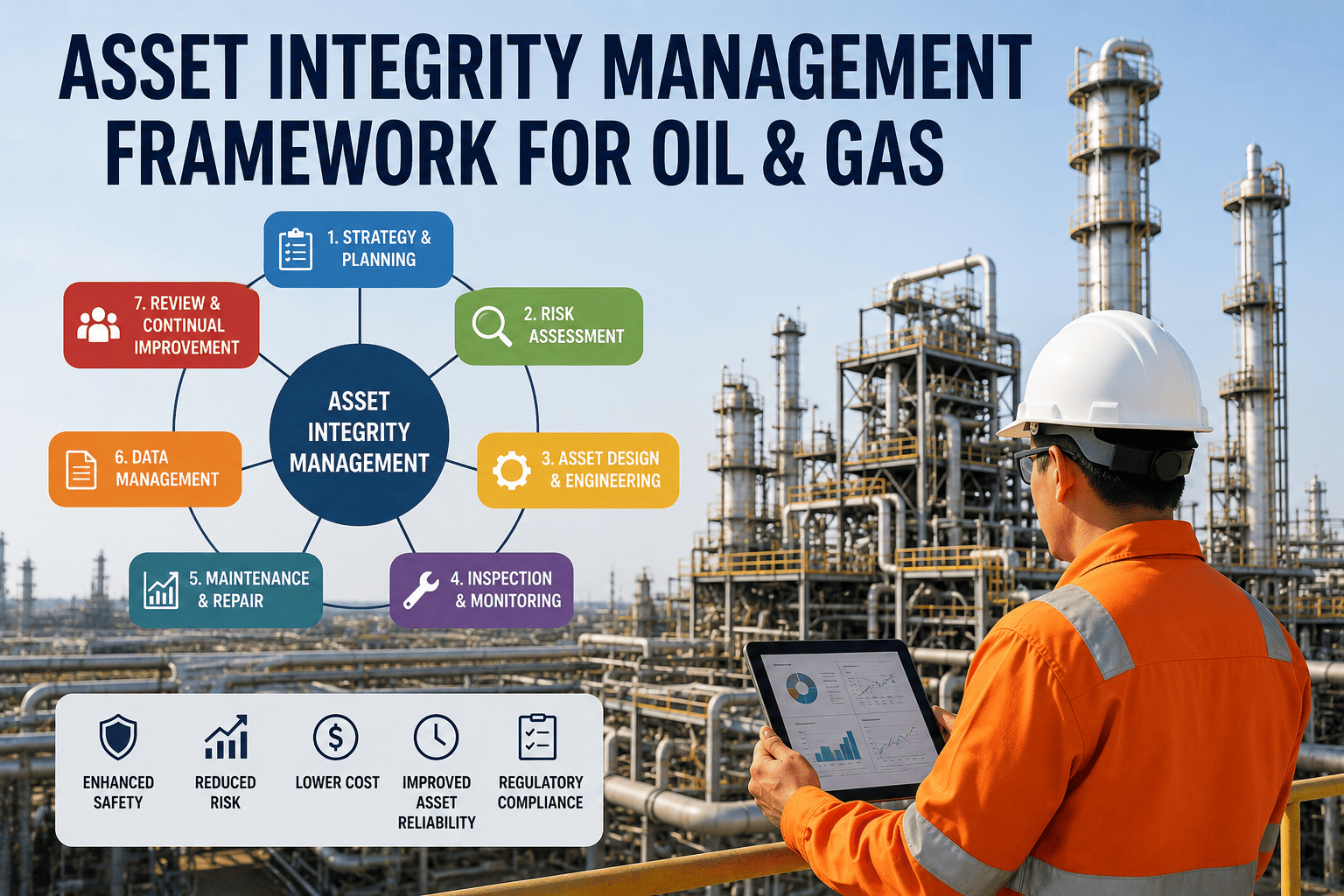
Asset integrity management in oil and gas has historically been a discipline of structured documentation, periodic inspection, and conservative interval scheduling. AI does not simply accelerate this model — it replaces its fundamental logic. Dynamic risk ranking from real-time condition data, continuous degradation rate modeling, and automated FFS workflow generation represent a structural shift from evidence-after-failure to evidence-before-failure.
For U.S. oil and gas operators managing aging infrastructure under increasing regulatory scrutiny and workforce constraints, iFactory AI's integrity management platform provides a measurable, deployable path to continuous asset health visibility. The facilities achieving best-in-class unplanned downtime performance are not doing so with more inspectors — they are doing so with better data loops that surface risk before it becomes a production event. Building that loop is the integrity program decision that separates leading operators from those still reacting to yesterday's failures.
AI Asset Integrity Management: Frequently Asked Questions
Yes. iFactory AI integrates with SAP PM, IBM Maximo, Infor EAM, and other major CMMS platforms via REST API or direct database connectors, enabling bidirectional work order generation and inspection result ingestion without replacing your existing maintenance management system.
For assets with limited inspection history, iFactory initializes degradation models using API RBI 581 generic damage factor tables calibrated to your process conditions, then transitions progressively to plant-specific learned rates as inspection data accumulates — typically reaching facility-specific accuracy within 90 days of live operation.
Yes. iFactory automatically generates time-stamped inspection records, equipment deficiency logs, corrective action closure documentation, and inspection interval justification reports formatted for OSHA PSM 1910.119 mechanical integrity program audits, exportable in PDF and structured XML formats.
iFactory supports ultrasonic thickness sensors, corrosion monitoring probes (ER and LPR), vibration transmitters, acoustic emission sensors, process temperature and pressure transmitters, and any OPC-UA or Modbus-compatible field device — no proprietary hardware required.
A Tier 1 or Tier 2 advisory deployment is typically operational within 6–8 weeks from data integration kickoff; full Tier 4 autonomous APM deployment with CMMS integration is generally complete within 16–20 weeks depending on data system complexity and asset population size.
-rollout.png)