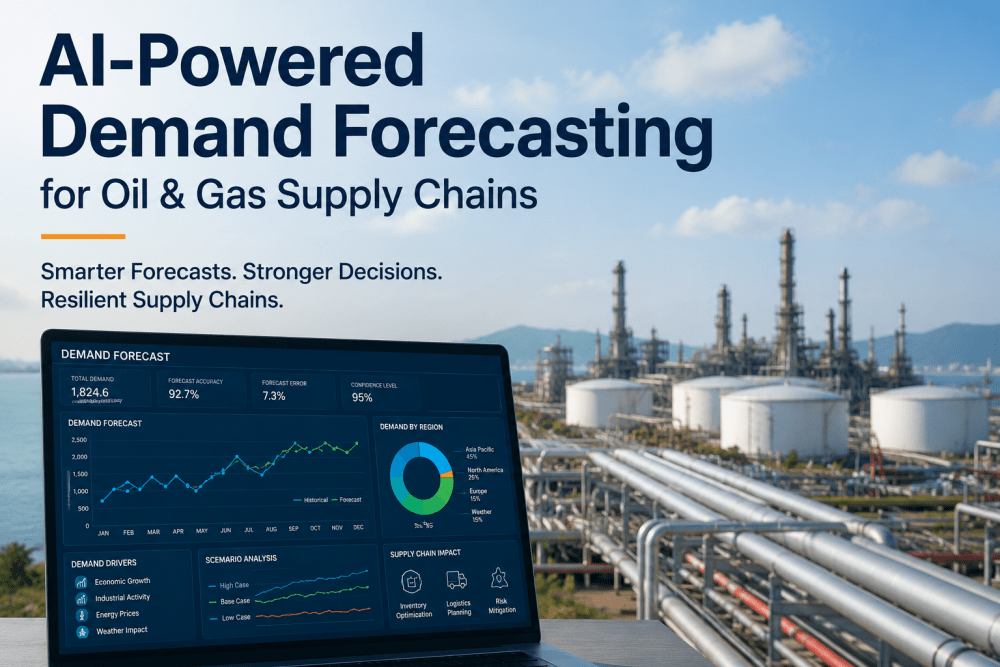
AI demand forecasting is transforming how oil and gas companies plan, procure, and move product across complex, high-stakes supply chains. Crude producers, midstream operators, LNG terminal managers, and refined product distributors all face the same structural challenge: supply and demand signals are volatile, lead times are long, and the cost of getting it wrong — whether in inventory surplus, pipeline underutilization, or missed delivery windows — runs into the tens of millions annually. Traditional forecasting methods built on historical averages and analyst intuition are structurally incapable of processing the volume and variety of signals that now drive hydrocarbon demand. Book a Demo to see how iFactory's AI forecasting platform helps oil and gas operators achieve supply chain accuracy they've never had before.
AI-Powered Demand Forecasting for Oil & Gas Supply Chains
iFactory's AI forecasting platform gives oil & gas operators real-time demand signals, inventory optimization, and pipeline flow intelligence — purpose-built for midstream and downstream complexity.
Why Traditional Oil & Gas Demand Forecasting Fails at Scale
The Core Structural Failures of Legacy Forecasting in Oil & Gas
The Architecture of AI Demand Forecasting in Oil & Gas Supply Chains
Modern AI demand forecasting platforms for oil and gas supply chains are not simple statistical tools — they are multi-layer machine learning architectures that ingest, normalize, and continuously model data from dozens of simultaneous input streams. Understanding the architecture helps operators evaluate vendor claims and set realistic deployment expectations.
Multi-Source Data Ingestion Layer
The foundation of effective AI demand forecasting is a unified data ingestion layer that consolidates SCADA real-time flow data, ERP inventory positions, market pricing feeds (NYMEX, Brent, Henry Hub), weather forecast APIs, vessel AIS tracking data, and geopolitical risk indices into a single normalized data model. iFactory's integration layer connects to existing SCADA and SAP/Oracle ERP environments without requiring rearchitecture of operational systems.
Demand Signal Processing & Anomaly Detection
Raw sensor and market data is processed through real-time anomaly detection models that identify demand signal outliers — distinguishing genuine demand shifts from instrument noise, reporting errors, and one-time disruptions. This processing step is critical in oil and gas environments where a single faulty flow meter can corrupt downstream forecasting models if not identified and isolated immediately.
Ensemble Forecasting Model Execution
The AI platform runs an ensemble of complementary forecasting models simultaneously — LSTM neural networks for time-series pattern recognition, gradient boosting models for feature-importance scoring, and probabilistic models for confidence interval generation. Ensemble outputs are blended by a meta-model weighted to the accuracy history of each constituent model, producing forecasts that outperform any single model type across the full range of market conditions oil and gas operators encounter.
Inventory & Logistics Optimization Output
Forecast outputs are automatically translated into actionable inventory recommendations — reorder point adjustments for terminal tank farms, pipeline nomination scheduling, LNG cargo allocation recommendations, and trucking dispatch optimization. Operators receive not just a forecast number but a complete recommended action set with confidence scores and risk-adjusted alternatives. See how iFactory's action layer works — book a demo with our supply chain engineers.
Continuous Model Retraining & Feedback Loop
Every completed forecast cycle generates new ground-truth data that is fed back into the model training pipeline. As the platform accumulates operational history specific to each operator's asset footprint, forecast accuracy compounds — typically improving from an initial 12–15% MAPE to under 6% MAPE within 6–9 months of continuous operation on a mature oil and gas supply chain deployment.
AI Demand Forecasting Applications Across the Oil & Gas Value Chain
Effective AI demand forecasting delivers distinct value at each segment of the oil and gas value chain. The following breakdown identifies the primary use cases, operational pain points addressed, and measurable outcomes achievable at each segment level.
Upstream: Production Scheduling & Crude Allocation
Upstream operators use AI demand forecasting to optimize production scheduling against real-time downstream demand signals — avoiding the costly scenario of producing crude that cannot be absorbed by refineries within economical transport windows. AI models integrate refinery run rate data, crude quality preference signals, and tanker nomination schedules to generate production optimization recommendations that reduce crude storage buildup by 18–24% compared to monthly planning cycles.
Midstream: Pipeline Nomination & Terminal Throughput
Midstream operators managing pipeline systems face the unique challenge of balancing shipper nominations, system capacity, and downstream demand in real time. AI forecasting models trained on historical nomination patterns, refinery turnaround schedules, and regional demand indices enable pipeline dispatchers to proactively manage capacity allocation — reducing nomination imbalances by up to 34% and improving terminal throughput utilization from typical 71% to above 88%.
LNG: Cargo Scheduling & Regasification Demand
LNG supply chains involve some of the longest lead times and highest per-unit logistics costs in the entire energy sector. AI demand forecasting enables LNG traders and terminal operators to align cargo scheduling with 30–90 day regasification demand forecasts that account for temperature-driven consumption patterns, power sector dispatch signals, and competing energy source pricing. Operators using AI forecasting report reduction in demurrage costs of 28–41% through improved berth scheduling accuracy.
Downstream: Refined Product Distribution & Inventory
Refined product distributors — managing gasoline, diesel, jet fuel, and heating oil logistics across terminal networks — face high-frequency demand volatility driven by seasonal patterns, weather events, and economic activity. AI forecasting models updated in near real time enable distributors to optimize rack inventory levels, reduce safety stock requirements by 15–22%, and eliminate the costly emergency logistics runs that plague distributors operating on static weekly planning cycles.
AI vs. Traditional Forecasting: Head-to-Head Performance Across Key Oil & Gas Metrics
The performance gap between AI-powered and traditional demand forecasting in oil and gas supply chains is measurable across every operational dimension. The following comparison reflects current industry benchmarks from operators that have transitioned from statistical or spreadsheet-based forecasting to AI platform-driven approaches.
| Forecasting Dimension | Traditional / Statistical | AI-Powered (iFactory) | Performance Delta |
|---|---|---|---|
| Forecast Accuracy (MAPE) | 23–38% error rate | Under 8% with trained models | -61% forecast error |
| Demand Signal Latency | Weekly / monthly update cycles | Real-time continuous updating | 72-hour advance warning |
| Pipeline Nomination Imbalances | High frequency, reactive correction | 34% reduction in imbalances | -34% nomination errors |
| Terminal Inventory Accuracy | Manual reconciliation, 3–5 day lag | Automated real-time inventory model | $2.1M/yr per terminal |
| LNG Demurrage Costs | Static berth scheduling, high variance | AI-optimized cargo scheduling | -28 to -41% demurrage |
| Emergency Logistics Runs | 8–14 per month per distribution hub | Under 2 per month average | -76% emergency logistics |
| Safety Stock Capital Tied Up | Excess 15–22% above optimal | Optimized to demand confidence bands | $800K–$1.4M freed capital |
| Black Swan Scenario Coverage | No scenario modeling capability | AI scenario planning with pre-positioning | Disruption buffer deployment |
The business case is not incremental — operators transitioning to AI demand forecasting consistently report ROI realization within 8–11 months, driven primarily by inventory capital release and emergency logistics elimination. Book a demo to see the full ROI model for your specific supply chain configuration.
Deploying AI Demand Forecasting in Oil & Gas: The 120-Day Implementation Timeline
Oil and gas supply chains involve some of the most complex data environments in industry — multiple SCADA systems, legacy ERP platforms, third-party logistics data, and trading system feeds that have been built up over decades. iFactory's deployment methodology is designed specifically for this complexity, with a phased approach that delivers measurable forecasting value by Day 60 while the full AI model matures.
Data Source Mapping & Integration Architecture
Complete inventory of all data sources — SCADA, ERP, market data feeds, logistics APIs — with quality assessment and normalization requirements identified. Integration connectors deployed for primary data streams. Data governance framework established for AI model inputs.
Historical Data Processing & Initial Model Training
2–3 years of historical demand, inventory, and logistics data processed through the AI training pipeline. Ensemble model architecture configured for operator's specific supply chain topology. Baseline MAPE benchmarks established against existing forecasting approach for performance comparison.
Shadow Forecasting & Accuracy Validation
AI forecasts run in parallel with existing forecasting processes. Daily comparison of AI predictions vs. actual demand allows model calibration and rapid accuracy improvement. Operators typically observe 40–55% accuracy improvement over legacy forecasts during this phase. Book a demo to discuss shadow forecasting methodology with iFactory engineers.
Operational Integration & Action Layer Activation
AI forecasts integrated into inventory management, pipeline nomination, and logistics scheduling workflows. Automated reorder recommendations and pipeline dispatch suggestions activated. Planning teams transition from static spreadsheet cycles to AI-directed daily planning sessions.
Full Deployment, KPI Dashboard & Continuous Improvement
Executive and operations dashboards activated with real-time forecast accuracy KPIs, inventory efficiency metrics, and supply chain cost tracking. Continuous retraining pipeline operational. Scenario planning module activated for disruption pre-positioning. Full ROI measurement framework live.
Ready to Replace Spreadsheet Forecasting with AI-Driven Supply Chain Intelligence?
iFactory's oil and gas supply chain AI platform is already deployed across upstream, midstream, and downstream operations. Get a live walkthrough of the forecasting dashboard configured for your segment — upstream, midstream, LNG, or refined products distribution.
Industry Expert Review: What Supply Chain Leaders Say About AI Forecasting in Oil & Gas
iFactory's supply chain engineering team has worked with operators across the U.S. Gulf Coast, Permian Basin, and LNG export terminal networks. The following reflects distilled expert perspective from operational deployments across the oil and gas value chain.
"The fundamental shift with AI demand forecasting in oil and gas is not just accuracy improvement — it is the elimination of the planning latency that costs operators millions every quarter. When a Gulf Coast refinery announces a turnaround two weeks out, a traditional planning system doesn't know about it until the nomination changes hit the pipeline. An AI system connected to the right data feeds knows in real time, and the supply chain reposition happens automatically. That's the operational advantage that changes how these businesses are run."
Three Non-Obvious Insights from Oil & Gas AI Forecasting Deployments
The Financial Impact: Building the Business Case for AI Demand Forecasting
For oil and gas operators evaluating AI demand forecasting investment, the business case is built across four primary value streams. The following framework reflects realistic value realization estimates based on current deployments across U.S. midstream and downstream operations.
| Value Stream | Current State Cost | With AI Forecasting | Annual Value |
|---|---|---|---|
| Excess Safety Stock Capital | 15–22% above optimal | Confidence-band optimized levels | $800K–$1.4M per terminal |
| Emergency Logistics Costs | $2.8M–$4.2M/yr (mid-size network) | Under $700K/yr with AI signals | $2.1M–$3.5M savings |
| LNG Demurrage Charges | $180K–$420K/cargo average | 28–41% reduction per cargo | $4.2M+/yr (10-cargo operator) |
| Pipeline Nomination Imbalances | High penalty exposure, reactive | 34% reduction in imbalance events | $1.1M–$2.3M/yr |
| Planning Labor & Reconciliation | 3–5 FTE manual planning load | Automated AI-directed planning | $380K–$620K FTE reallocation |
For a mid-size midstream operator with 3–5 terminals and 1,200+ miles of pipeline, total annual value realization from AI demand forecasting consistently exceeds $6 million, with full deployment cost typically recovered within the first 9–13 months of operation. Book a demo to build a custom ROI model for your specific asset portfolio.
Conclusion: Why AI Demand Forecasting Is Now a Strategic Necessity in Oil & Gas
The structural complexity of modern oil and gas supply chains — spanning upstream production variability, midstream capacity constraints, LNG shipping logistics, and refined product demand volatility — has permanently exceeded what statistical forecasting methods can reliably manage. The operators that recognized this transition early and invested in AI demand forecasting infrastructure are now running supply chains with measurably lower costs, higher asset utilization, and dramatically reduced disruption exposure compared to competitors still dependent on weekly planning cycles.
AI demand forecasting is not a future technology investment for the oil and gas sector — it is a present-state operational advantage being captured by leading operators right now. The question for supply chain leaders is no longer whether to deploy AI forecasting, but how quickly their organizations can execute the transition before the competitive gap becomes structurally difficult to close.
iFactory's AI demand forecasting platform has been purpose-built for the data complexity, integration requirements, and operational decision-making workflows of the oil and gas supply chain — from wellhead to burner tip. Book a demo with our oil and gas supply chain specialists to see a live walkthrough of the platform configured for your segment.
Frequently Asked Questions: AI Demand Forecasting for Oil & Gas Supply Chains
How does AI demand forecasting integrate with existing SCADA and ERP systems in oil and gas operations?
iFactory's platform uses pre-built integration connectors for the major SCADA platforms (OSIsoft PI, Ignition, Wonderware) and ERP systems (SAP, Oracle, Microsoft Dynamics) commonly deployed in oil and gas operations. Integration is achieved through secure API connections and historian data feeds without requiring modification to existing operational systems. Most integrations are completed within the first 21 days of deployment and do not require dedicated downtime of operational systems.
What forecast horizon does AI demand forecasting provide for oil and gas supply chains?
iFactory's ensemble forecasting architecture generates forecasts across three horizon bands simultaneously: 24–72 hour operational forecasts for dispatch and nomination decisions, 7–30 day tactical forecasts for inventory positioning and cargo scheduling, and 60–90 day strategic forecasts for capital allocation and turnaround planning. Accuracy is naturally highest in the near-term horizon and diminishes appropriately at longer ranges, with confidence intervals clearly communicated at each horizon level.
Can the AI forecasting platform handle the volatility introduced by OPEC production decisions and geopolitical events?
Yes. iFactory's scenario modeling module allows operators to define geopolitical and supply disruption scenarios — OPEC production cuts, pipeline outage events, refinery force majeures — and model their downstream demand and inventory impact in real time. When monitored geopolitical risk indices breach defined thresholds, the platform automatically activates the relevant scenario model and adjusts inventory and logistics recommendations accordingly, allowing operators to pre-position supply chain buffers before disruptions materialize in physical product flows.
How long does it take for the AI models to reach production-grade accuracy on a new oil and gas deployment?
Initial AI model training on 2–3 years of historical data typically delivers forecast accuracy improvement of 35–45% over legacy approaches within the first 45 days. Production-grade accuracy — typically under 8% MAPE on primary demand streams — is usually achieved between months 4 and 7 of continuous operation, as the model accumulates live operational data specific to each operator's asset topology and customer demand patterns. Safety stock and inventory optimization benefits typically materialize before full forecast accuracy is achieved.
Is AI demand forecasting applicable to smaller regional distributors, or only to large integrated oil and gas operators?
iFactory's platform scales from single-terminal regional distributors managing 3–5 product types up to integrated operators with complex multi-segment supply chains. The core AI forecasting architecture — data ingestion, ensemble modeling, and actionable output generation — is the same at all scale levels; the configuration and number of data integration points differ. Regional distributors typically achieve faster time-to-value than large integrated operators because their supply chain topology is simpler to model and the inventory optimization benefits are proportionally larger relative to their total logistics cost base.
Stop Forecasting Yesterday's Market. Start Anticipating Tomorrow's Demand.
iFactory's AI demand forecasting platform is already deployed across upstream, midstream, and downstream oil and gas operations. See a live walkthrough configured for your segment — no obligation, no generic demos.
-optimization.png)