A valve left in the wrong position rarely announces itself. It sits quietly among thousands of others across a refinery until a process upset, a pressure spike, or a full shutdown reveals that someone closed what should have stayed open, or vice versa. Manual operator rounds catch some of these errors, but only if a person happens to walk past the right valve at the right time, and most refineries can only afford to check critical valve banks once or twice a shift. Computer vision changes that math entirely by giving every valve a camera that never blinks and never skips a round, and teams curious what that kind of continuous coverage looks like on their own unit can book a demo to see it running on real valve imagery.
AI Vision · Process Safety
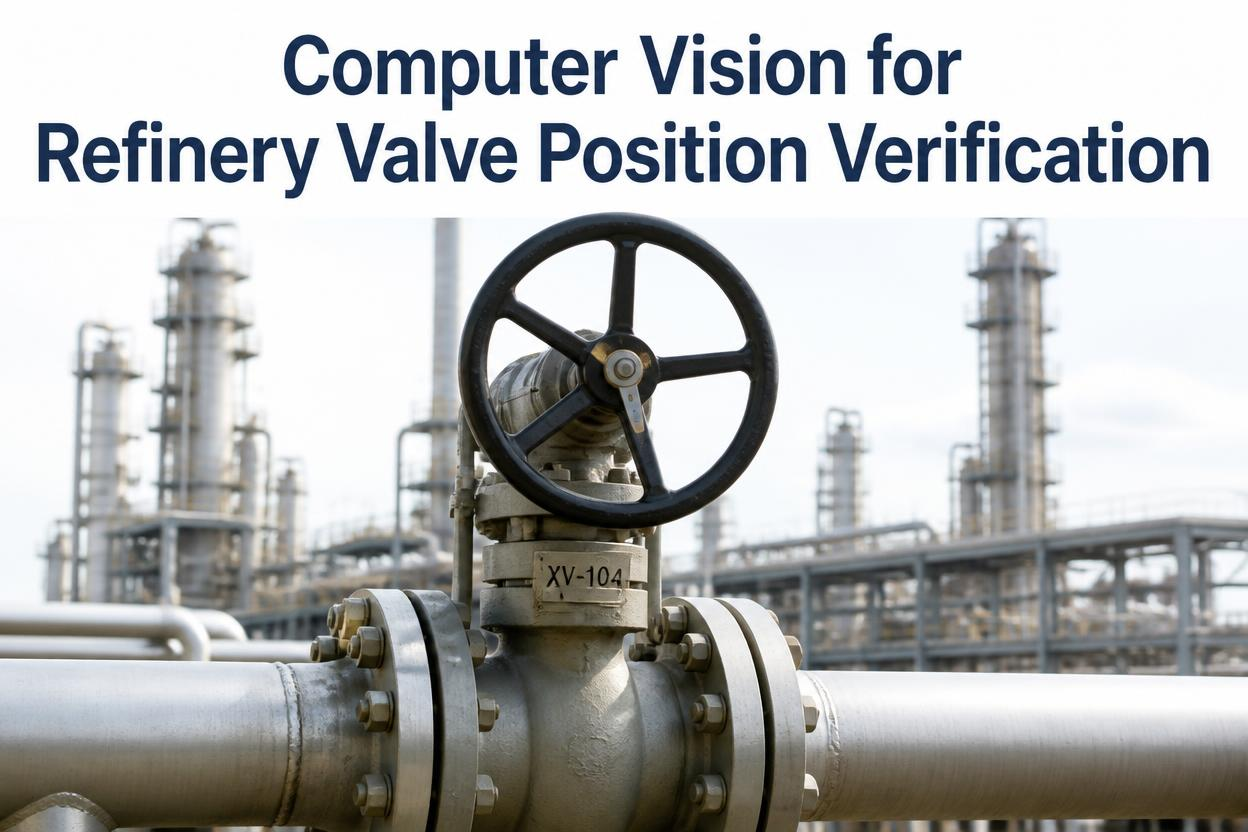
Computer Vision for Refinery Valve Position Verification
Cameras that watch every valve continuously, flag mismatches against work orders, and catch what a quarterly manual round was never designed to see.
Why a Misread Valve Is a Bigger Risk Than It Looks
Valves control cut-off, regulation, and diversion across nearly every process unit, which means a single valve left in the wrong position can trigger fluctuations that cascade into a full incident. History has already shown how severe that can get: a 1997 fire at a chemical plant caused by workers misreading valve positions during a light diesel unloading operation resulted in multiple fatalities and significant economic loss. Most facilities still rely on manual inspection rounds to catch these errors, and manual rounds carry a well-documented weakness known as attention error, where a single missed needle or handle position slips past even an experienced operator.
1-2x
Typical manual valve checks per shift on critical valve banks
24/7
Continuous coverage a camera-based system provides instead
1
Missed valve position is all it takes to trigger a process upset
How Computer Vision Actually Reads a Valve Position
The technology behind this is more precise than pointing a camera at a valve and hoping for the best. Modern approaches use trained detection models, often built on YOLO-based architectures, paired with attention modules that account for a valve's fixed position and rotation angle in the frame.
1
Camera Captures the Valve Continuously
A fixed-angle camera already installed for general area monitoring is trained to also recognize the valve handle or indicator within its field of view.
2
Detection Model Locates the Valve
A trained vision model isolates the valve's bounding box and center point in the image, distinguishing it from surrounding pipework and equipment.
3
Rotation Angle Is Calculated
Using the valve's center point and orientation, a rotation algorithm calculates whether the handle sits in the open, closed, or partial position.
4
Position Is Checked Against the Work Order
The detected position is cross-referenced against what the current work order or process state expects, not just a static rule.
5
Mismatches Trigger an Instant Alert
Any valve that exceeds its expected threshold or contradicts its work order state sends an alert to the control room before the mismatch becomes a process issue.
Where This Catches Problems a Manual Round Would Miss
These are the scenarios where continuous visual monitoring most consistently outperforms a person walking a fixed route on a fixed schedule.
Bypass Valve Left Open
A bypass that should be closed but is venting steam or process fluid is caught the moment it deviates, not hours later during the next round.
Post-Maintenance Verification
After a valve is serviced, the camera confirms it was returned to the correct position before the unit is brought back online.
Low-Light and Night Shift Coverage
Detection models trained across varying lighting conditions maintain accuracy during nighttime and low-visibility hours when manual rounds are hardest to complete.
Hard-to-Reach Valve Banks
Elevated, confined, or hazardous-area valve clusters get the same monitoring frequency as ground-level equipment without sending a person into the area.
Manual Operator Rounds vs. Continuous AI Vision Monitoring
| Factor |
Manual Operator Rounds |
AI Vision Monitoring |
| Check frequency |
Once or twice per shift on critical valves |
Continuous, every frame of every valve in view |
| Attention error risk |
A single missed reading can go unnoticed for hours |
Every position is logged and checked automatically |
| Low-light accuracy |
Depends on operator visibility and fatigue |
Trained across varying lighting conditions |
| Hazardous area access |
Requires a person to physically enter the area |
Monitored remotely with no additional exposure |
| Work order cross-check |
Relies on the operator remembering current state |
Automatically compared against the active work order |
The Technology That Makes This Reliable Enough for Process Safety
Pointing a generic camera at a valve and running basic object detection isn't accurate enough for a process safety application. The detail that makes this dependable is in how the model handles a valve's fixed position and small size within a much larger frame.
Purpose-Built Detection Architecture
Detection models built on modern YOLO-based architectures are specifically trained and validated for the small, fixed-position targets that valve handles and indicators represent in a wide-angle industrial camera frame.
Coordinate Attention for Rotation Accuracy
A coordinate attention module embeds positional information directly into the model's feature channels, sharpening how accurately the system extracts a valve's exact rotation angle rather than just its rough location.
Validated Across Real Industrial Scenarios
Published research on this exact approach has been tested across multiple valve types and two distinct industrial scenarios, confirming the accuracy and robustness standards required for real-time monitoring.
Every valve bank you can't check every hour is a blind spot. If your process safety program still depends on a person catching a misaligned valve during a scheduled round, the gap between checks is exactly where incidents start.
Process Safety Perspective
The uncomfortable truth about manual valve checks is that they work exactly as well as human attention allows, and human attention is not built for repetitive, low-stimulation tasks performed at 2 a.m. on the fortieth valve of a round. A camera doesn't get tired on the fortieth valve. It reads the same way every time, logs every position, and only speaks up when something actually deviates from what the work order says it should be. That consistency is the entire value proposition.
Process Safety Engineer — Refining Operations, AI Vision Deployment
Frequently Asked Questions
Do we need new cameras installed, or can this use existing ones?
In most refineries, existing area cameras already have valve banks somewhere in their field of view, and the detection model can often be trained on that existing footage without new hardware. Where a valve isn't currently covered, a fixed-angle camera is added to that specific location. Either way, the model needs a clear, consistent view of the valve's handle or indicator to calculate rotation accurately.
Book a demo to check whether your current camera coverage is sufficient.
How accurate is valve position detection in low light or at night?
Detection models are trained across a range of lighting conditions, including low-light and nighttime scenarios, specifically because manual rounds are hardest to complete accurately during those hours. Preprocessing steps adjust for brightness variation before the position calculation runs, which keeps accuracy consistent whether it's midday or the middle of a night shift. This is one of the strongest arguments for camera-based monitoring over relying on a person's eyes in poor lighting.
Contact support for details on lighting requirements for your specific valve locations.
What happens when the system detects a mismatched valve position?
An alert is sent to the control room the moment a valve's detected position contradicts what the active work order or process state expects, giving operators the chance to respond before the mismatch escalates into a process upset. The alert includes the valve identifier, detected position, and expected position so the response team knows exactly what to check first. This cross-check against work orders is what separates simple position logging from genuine process safety monitoring.
Book a demo to see a live mismatch alert end to end.
Can this replace manual operator rounds entirely?
Most facilities use it to extend and strengthen operator rounds rather than eliminate them outright, since rounds also cover leak checks, unusual sounds, and other conditions a camera trained specifically on valve position isn't built to catch. What it does remove is the long gap between scheduled checks on the valves that matter most, giving operators continuous coverage on critical positions between their walking rounds. The two approaches work best layered together.
Contact support to discuss how this fits alongside your existing rounds program.
How long does it take to deploy on a typical valve bank?
Initial deployment on a pilot valve bank typically involves a preprocessing and calibration period where the model learns the specific valves, lighting, and camera angles at that location. Once the model is validated against known positions, coverage can expand to additional valve banks more quickly since much of the underlying detection approach transfers across similar valve types. Exact timelines depend on how many distinct valve types and lighting conditions are involved.
Book a demo to get a deployment timeline for your specific unit.
Give Every Critical Valve a Camera That Never Misses a Round
See how continuous AI vision monitoring catches valve mismatches your scheduled rounds were never designed to see.