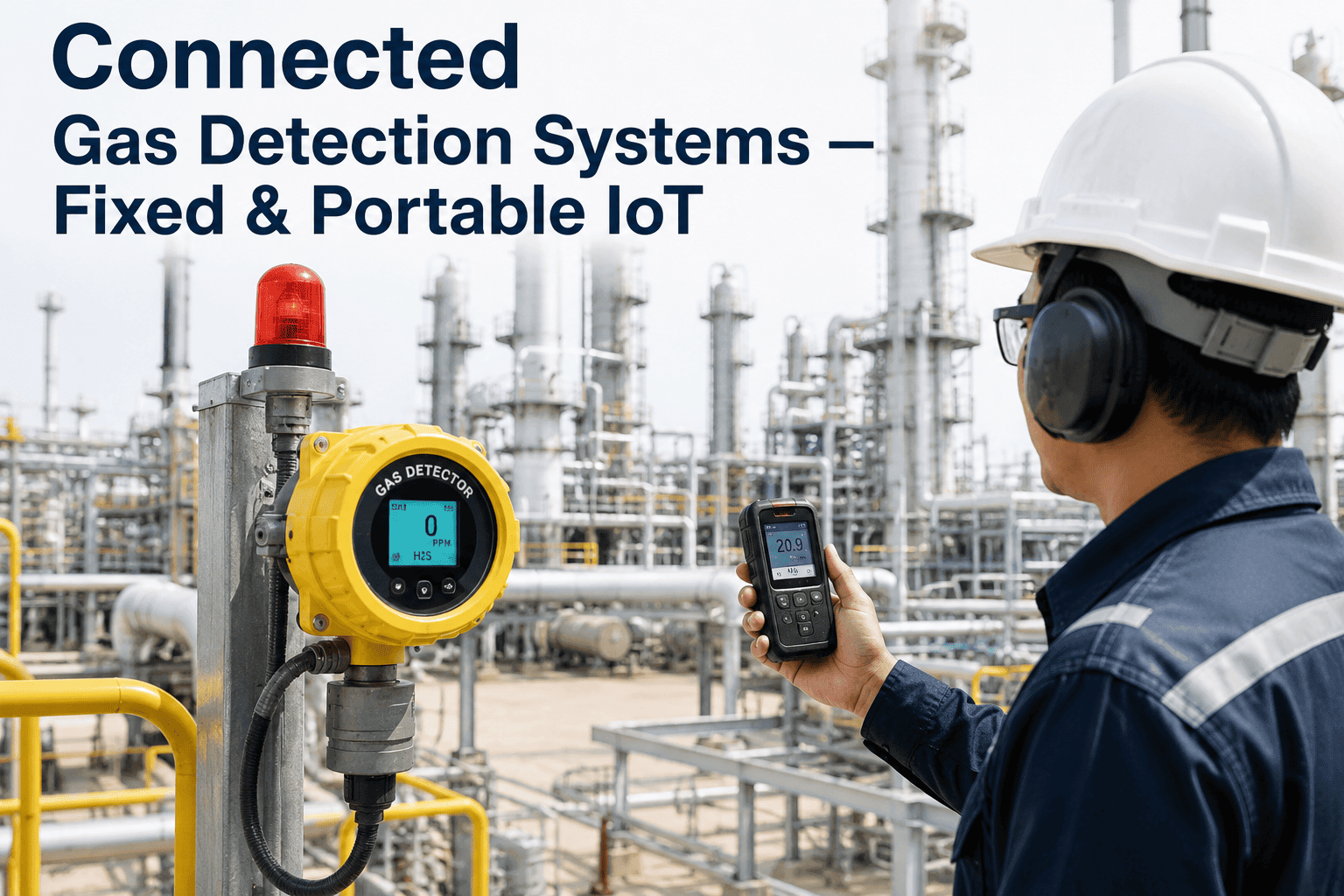
Gas detection in oil and gas operations has historically operated in isolation — fixed point detectors wired to standalone panels, portable monitors logging data locally with no real-time visibility for supervisors, and paper-based calibration records that provide no trend analysis. This fragmented approach leaves significant coverage gaps, delays emergency response when workers are incapacitated, and makes it nearly impossible to demonstrate continuous compliance during regulatory audits. IoT-connected gas detection systems eliminate these blind spots by transmitting real-time readings from both fixed and portable detectors to a centralized platform. If your facility still relies on disconnected gas detection infrastructure, Book a Demo to see how iFactory unifies all gas monitoring into a single connected view.
Unify Fixed, Portable, and Area Gas Detection Into One Real-Time Platform
iFactory connects every gas detector in your facility — fixed point, open-path, personal portable — into a centralized monitoring dashboard with automated alerts, exposure tracking, and compliance-ready documentation.
The Gas Threat Landscape in Oil and Gas Operations
Oil and gas facilities face a uniquely dangerous combination of toxic and combustible gases that vary by process area, production phase, and geographic basin. Understanding which gases present the greatest risk in each zone of your facility is the foundation of any effective detection strategy. The threat profile below covers the six gas categories that drive detection system design decisions across upstream, midstream, and downstream operations — each with distinct exposure limits, detection challenges, and regulatory requirements that a connected monitoring system must address simultaneously.
The most lethal gas in oil and gas production. Present in sour gas wells, refinery sulfur units, and produced water handling. Rapidly fatal at concentrations above 500 ppm, with olfactory fatigue eliminating the warning smell within seconds of exposure.
Methane, propane, butane, and natural gas mixtures present explosion risk when concentration reaches the lower explosive limit. Fixed point and open-path detectors must cover process areas, wellheads, compressor stations, and all confined space entry points.
Colorless, odorless byproduct of incomplete combustion in engines, heaters, and flares. Particularly dangerous in enclosed compressor buildings and turbine halls where ventilation may be insufficient during equipment malfunction.
Oxygen displacement by heavier gases in confined spaces, vaults, and below-grade installations causes disorientation and unconsciousness without warning. Required monitoring for every confined space entry and all below-ground utility areas.
Benzene, toluene, xylene, and hexane present both acute toxicity and chronic exposure risk at storage terminals, loading racks, and refinery process units. PID-equipped detectors provide real-time total VOC concentration monitoring.
Produced during sulfur recovery unit operations, flaring of sour gas, and combustion of high-sulfur fuels. Causes severe respiratory irritation at low concentrations and pulmonary edema at higher exposure levels near SRU facilities.
Detection Evolution: From Standalone to Fully Connected
Gas detection technology in oil and gas has progressed through three distinct generations, each adding a layer of capability that the previous generation could not provide. Understanding where your current systems fall on this evolution curve is essential for making the right investment decision — because deploying IoT connectivity on top of legacy standalone detectors delivers only a fraction of the value that purpose-built connected systems provide natively.
The IoT Connectivity Advantage: Before and After
The operational difference between traditional disconnected gas detection and IoT-connected monitoring is measurable across every critical safety and compliance metric. The comparison below shows representative performance data from oil and gas facilities that have transitioned from Generation 1 or Generation 2 systems to fully connected IoT gas detection platforms — providing a realistic benchmark for organizations evaluating the business case.
Four-Zone Gas Detection Architecture
Effective gas detection coverage in oil and gas requires a layered approach where each zone of detection addresses a different scale of risk and a different monitoring objective. The four-zone architecture below represents the comprehensive detection model that IoT-connected systems enable — integrating personal, process, area, and perimeter monitoring into a single coordinated framework that eliminates the coverage gaps inherent in single-technology approaches.
Real-Time Alert Workflow: From Detection to Response
The value of IoT-connected gas detection is not in the detection itself — any functional detector can identify gas. The value is in what happens in the seconds and minutes after detection, when the speed and structure of the response determines whether a gas event becomes a near-miss or a casualty. The workflow below represents the automated response chain that iFactory enforces when any connected detector — fixed or portable — registers a reading above the defined alarm threshold.
Any fixed or portable detector registers a gas concentration exceeding the configured alarm threshold. Reading, location, detector ID, and timestamp are transmitted immediately via IoT gateway.
Platform classifies the alarm by gas type, concentration level, rate of rise, and zone context. Low-level warnings are logged; high-level and critical alarms trigger immediate escalation workflow.
Push notifications are sent to area supervisors, control room operators, and safety personnel via mobile app, dashboard alert, and SMS. Critical alarms trigger simultaneous multi-channel notification.
System displays affected zone on facility map, identifies all personnel in the area using portable detector positions, and initiates automated muster count for emergency response coordination.
Complete event timeline is auto-generated: detection data, notification log, response actions, muster results, and gas concentration trend. Record is stored for regulatory compliance and incident investigation.
See Every Gas Reading From Every Detector on One Screen
Fixed point, open-path, and personal portable detectors unified in a real-time dashboard with automated alerts, exposure tracking, and one-click compliance reporting for oil and gas.
Regulatory Compliance Requirements for Gas Detection Systems
Oil and gas gas detection systems must satisfy multiple overlapping regulatory frameworks that specify not only where detectors are required but how data is managed, how alarms are handled, and what records must be maintained for audit. The table below consolidates the key compliance requirements across the primary regulatory standards that govern gas detection in oil and gas operations — providing a single reference for safety managers and compliance teams.
| Standard | Detection Requirement | Alarm Response | Data and Records | IoT Advantage |
|---|---|---|---|---|
| API RP 14C | Fixed H2S and LEL detection at all production facilities with surface safety systems | Automatic shutdown at high-level alarm; audible and visual notification | Detection system test records maintained per facility audit cycle | Automated test scheduling with digital records replaces paper-based compliance tracking |
| OSHA 29 CFR 1910.146 | Atmospheric monitoring before and during confined space entry for H2S, LEL, CO, O2 | Immediate evacuation if any parameter exceeds limit; continuous monitoring required | Entry permits with pre-entry atmospheric readings documented | Real-time portable detector data auto-populates entry permits with timestamped readings |
| API RP 756 | Personal H2S monitors for all personnel in areas with H2S exposure potential above 10 ppm | Low-level and high-level alarms with defined response actions per facility plan | Monitor function verification records; exposure documentation | IoT portables provide continuous verification that monitors are functional and on-person |
| IEC 60079-29-1 | Performance requirements for fixed and portable gas detectors in explosive atmospheres | Defined alarm setpoints, response time requirements, and failure mode behavior | Type test certificates, periodic verification records, and calibration documentation | Digital calibration management with automated scheduling and deviation alerting |
| EPA 40 CFR 63 | Fenceline monitoring for benzene and specific HAPs at refineries under Subpart CC | Exceedance reporting within defined timeframe; corrective action required | Continuous monitoring data retention; annual compliance reports with averaged data | Cloud-based fenceline data with automated exceedance flagging and report generation |
Measurable Outcomes After IoT Gas Detection Deployment
Oil and gas operators who have deployed IoT-connected gas detection systems report consistent improvements across safety response, compliance efficiency, and operational cost metrics. The figures below represent aggregated performance data from connected gas detection deployments across upstream production facilities, midstream compressor stations, and downstream refinery environments.
Frequently Asked Questions
Connect Every Detector. See Every Reading. Protect Every Worker.
Fixed, portable, and area gas detection unified on a real-time IoT platform with automated alerts, exposure tracking, and audit-ready compliance documentation.