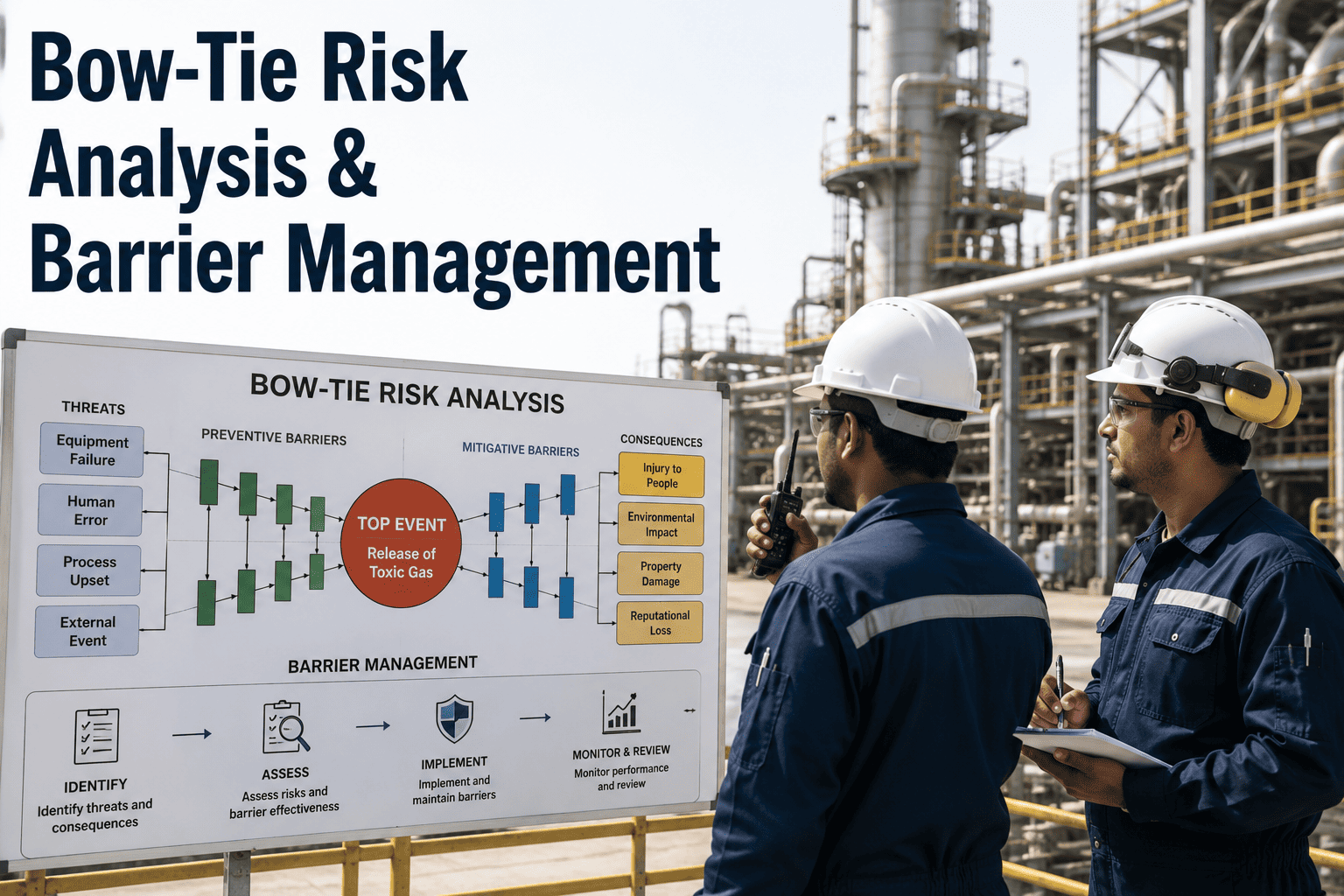
A HAZOP study that misses one high-consequence deviation rarely announces itself at the workshop table. It resurfaces months or years later as a compressor surge nobody modeled, a relief system sized for the wrong scenario, or a revalidation that quietly inherits the same blind spot the last team left behind. The method itself, a guideword-based walk through every process node, is simple to describe and genuinely difficult to facilitate well, which is exactly why so many studies produce a thick report that reads impressively and protects far less than it appears to. Teams looking to tighten their own node selection and revalidation cycle can book a demo to see how a connected system keeps HAZOP actions from disappearing after the workshop ends.
HAZOP STUDY · FACILITATION · REVALIDATION
A Study Is Only as Good as Its Weakest Node
HAZOP protects a process by systematically breaking it into nodes and asking what could go wrong at each one. Here is how strong facilitation, node discipline, and revalidation cycles keep that protection real.
How a Process Becomes a Set of Nodes
Before any deviation is discussed, the facilitator splits the process into nodes, sections of the plant small enough to analyze rigorously but large enough that the study does not take months. A node can be a single vessel, a transfer line, or a defined operational event like loading LNG from a truck into a bunkering tank. Getting node boundaries right shapes everything that follows.
Node 1
Feed Line to Reactor
2-3 hrs
Typical time to properly analyze a single well-scoped node
IEC 61882
International standard governing HAZOP methodology
5 yrs
Common revalidation cycle for a plant's hazard register
4 words
No, More, Less, and Reverse remain the most-used guidewords
Guidewords Are the Question, Not the Starting Point
A common facilitation mistake treats deviations as the starting point of a study, working through a checklist of guidewords for each node without first defining what the node was designed to do. Strong facilitation reverses this. The team first defines the design intent for each parameter at a node, flow, temperature, pressure, level, or a specific action, and only then applies guidewords to generate deviations from that intent. This keeps the study anchored in what the process is actually supposed to do rather than a generic checklist.
No
Complete absence of the design intent, such as no flow through a transfer line
More
A quantitative increase, such as more pressure than the vessel was rated for
Less
A quantitative decrease, such as reduced coolant flow to a reactor
Reverse
The logical opposite of intent, such as reverse flow into a feed line
Facilitation Habits That Separate a Strong Study From a Weak One
The facilitator's neutrality matters as much as the guideword sequence itself. Operations should speak first on consequences, since engineering should not simultaneously define the problem and judge whether the risk is acceptable. Reserving the first twenty to thirty minutes for clarifying drawings and node boundaries, using a short structured silence before asking each participant for causes, and parking out-of-scope items rather than letting them derail the session are what keep a multi-day study productive instead of exhausting.
HAZOP ACTION TRACKING
Stop Losing Recommendations After the Workshop Ends
See how a connected system keeps every HAZOP recommendation tracked to closure instead of buried in a static report.
The Revalidation Cycle
1
Trigger Check
Confirm whether the scheduled interval or a significant process change has been reached.
2
Action Closure Review
Verify every recommendation from the prior study was actually closed, not just marked complete.
3
Node Re-Walk
Re-examine nodes affected by any modification since the last study, not the entire process by default.
4
Register Update
Publish a revalidated hazard register that stands up to third-party audit review.
What Facilitators Are Saying
We used to lose half our HAZOP recommendations somewhere between the workshop report and the next turnaround. Now every action ties back to its node and owner, and revalidation starts from a register we actually trust instead of rebuilding it from scratch.
Process Safety Lead, Gas Processing Facility
What a Revalidation Should Never Simply Repeat
A revalidation that re-runs the entire original study from scratch wastes the team's time and often reintroduces inconsistencies with the closed-out actions from the prior cycle. A well-run revalidation instead starts from the existing hazard register, confirms every prior recommendation was genuinely closed rather than administratively marked complete, and focuses fresh analysis on nodes affected by process changes, new equipment, or incidents since the last study. Nodes with no relevant changes and no open findings can typically be confirmed rather than fully re-analyzed, freeing the team's time for the areas that actually need it.
HAZOP, What-If, and FMEA: Choosing the Right Tool
HAZOP is not the only process hazard analysis method recognized under PSM, and knowing when a different method fits better can save significant workshop time without weakening the analysis. What-If analysis works well for less complex processes or for teams experienced enough with a unit to generate credible scenarios without the structure of guidewords, though it relies more heavily on the team's collective experience and can miss deviations a systematic guideword pass would catch. Failure Mode and Effects Analysis is better suited to equipment and procedural failures where the priority is understanding detection methods and maintenance strategy rather than system-level process deviations.
Many mature programs use these methods together rather than choosing one exclusively. FMEA might drive the mechanical integrity inspection strategy for a specific piece of rotating equipment, while HAZOP covers the broader process deviations across the unit that equipment sits within. Selecting the right method for the right scope, rather than defaulting to HAZOP for every analysis regardless of fit, is itself a facilitation skill that experienced process safety teams develop over multiple studies.
Frequently Asked Questions
How is a node different from a P&ID section?
A node is a study boundary chosen specifically for HAZOP analysis, while a P&ID section is simply a drawn portion of the piping and instrumentation diagram. A single node might span several P&ID sections if they share one continuous design intent, or a single P&ID section might be split into multiple nodes if it contains distinct pieces of equipment like a pump, a vaporizer, and a compressor that each deserve separate analysis.
What triggers a HAZOP revalidation outside the standard cycle?
Any significant management of change affecting process conditions, equipment, or operating philosophy should trigger a revalidation of the relevant nodes, regardless of where the facility sits in its standard cycle. Incident investigations that reveal a hazard scenario not captured in the existing study are another common trigger. Facilities can review how MOC and revalidation triggers connect through
support.
Should HAZOP recommendations always lead to LOPA?
Not every recommendation needs a Layer of Protection Analysis, but any scenario where the team is uncertain whether existing safeguards provide sufficient independent protection is a strong candidate for escalation. LOPA adds a semi-quantitative layer on top of HAZOP's qualitative findings, helping determine whether an additional independent protection layer is actually justified rather than relying on team judgment alone.
How long should a HAZOP study take for a mid-size unit?
With each node typically requiring two to three hours of focused analysis, a unit with fifteen to twenty nodes often spans several full workshop days. Compressing this timeline by combining nodes to save time is a common shortcut that reduces the rigor of the study, so facilitators should resist the temptation even when a project schedule is tight. Teams can
book a demo to see how digital node tracking speeds up documentation without cutting analysis time.
What is the biggest documentation gap in most HAZOP reports?
The most common gap is a recommendation that was discussed and recorded but never linked to an owner, a due date, or a closure record, leaving it effectively invisible after the workshop ends. This is exactly the kind of gap an OSHA compliance officer or third-party auditor looks for when sampling records, since an open recommendation with no tracked action suggests the hazard it addresses may still be unmanaged.
HAZOP STUDY MANAGEMENT
Make Every Node, Deviation, and Action Traceable
Walk through how a connected HAZOP and revalidation system fits your facility's next scheduled study.