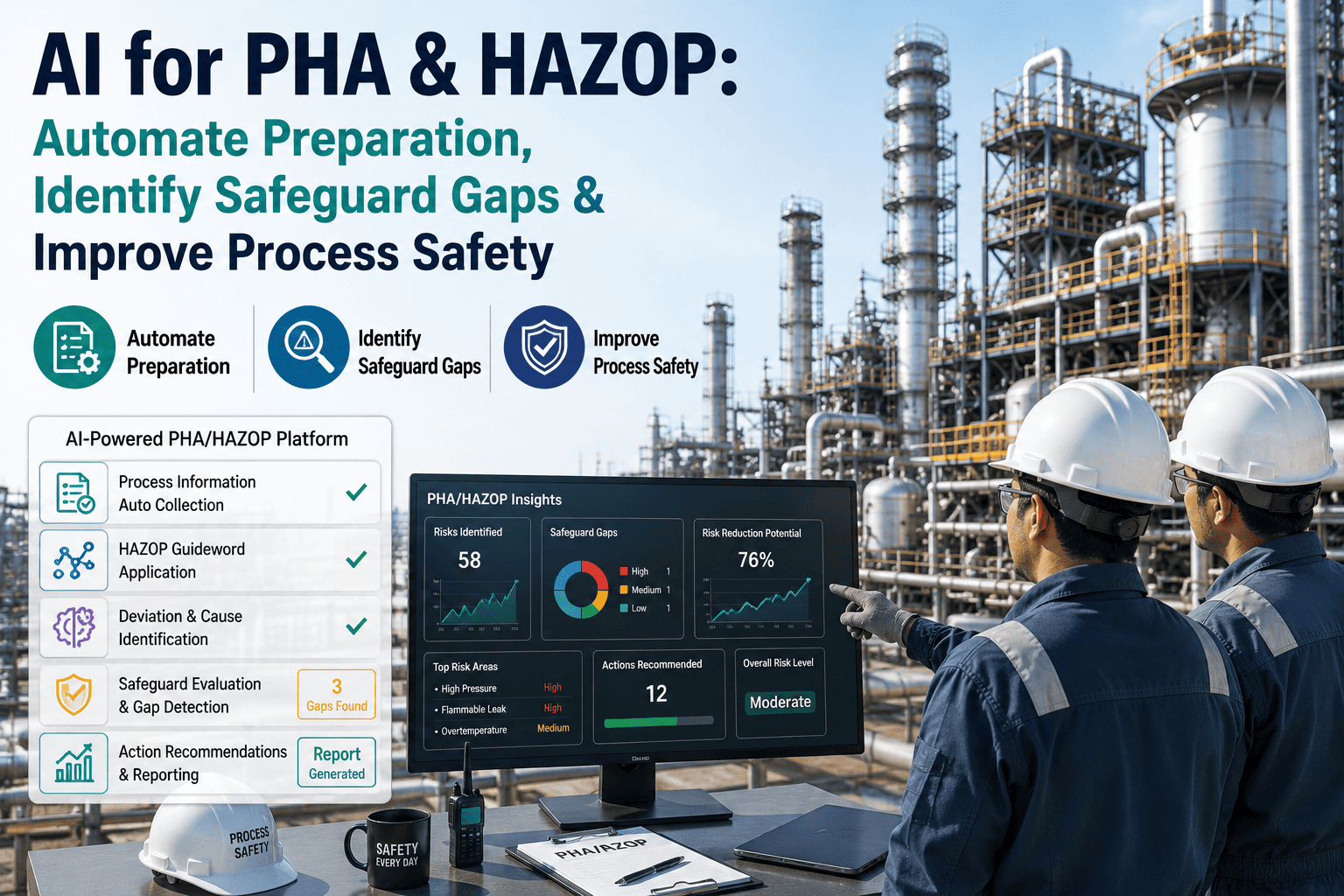
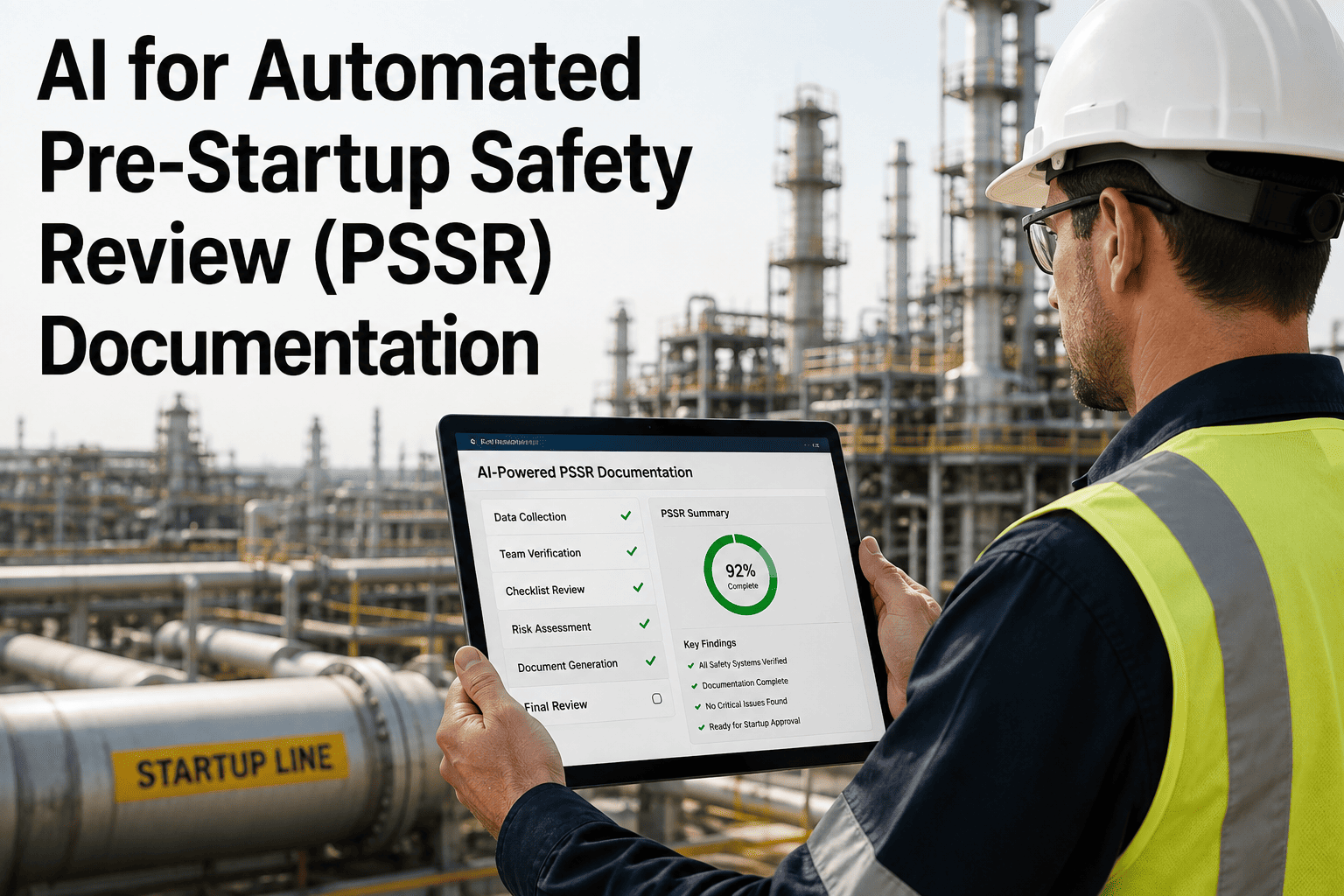
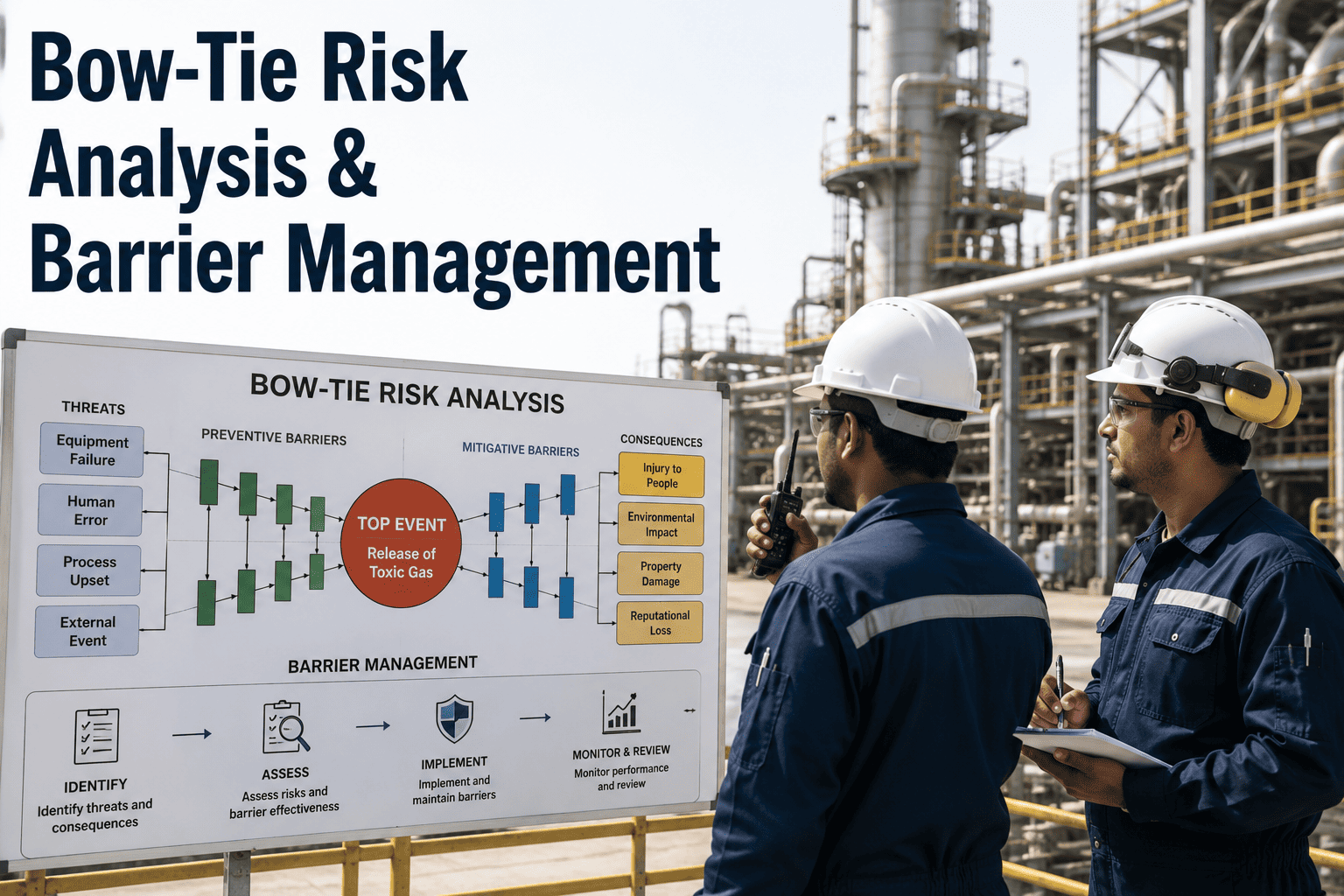
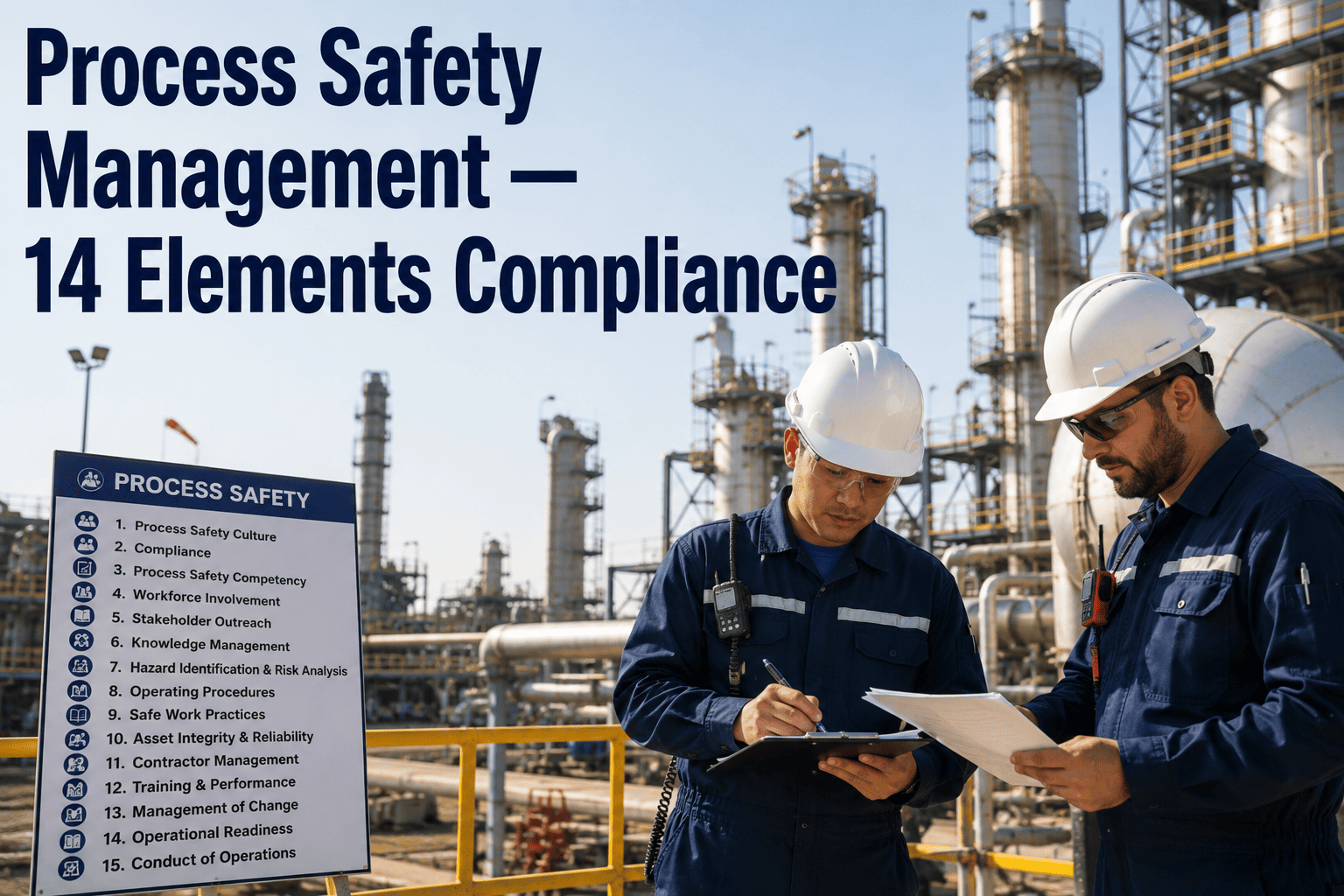
Before a HAZOP team ever sits down in the room, someone has spent weeks tracing P&IDs, defining nodes, locating safeguards, and reconstructing process context from documents that were never designed to work together. That preparation burden, not the facilitated session itself, is where most of a PHA's calendar time actually goes. AI can compress that preparation dramatically, generating draft deviation scenarios, flagging safeguard gaps, and surfacing relevant incident history before the team ever opens a P&ID. What it cannot do is replace the qualified team making the actual judgment calls. Book a demo to see AI-assisted PHA preparation on your own P&ID data.
PROCESS SAFETY AI · PHA & HAZOP PREPARATION
The Bottleneck Was Never the Session. It Was Everything Before It.
Weeks of manual P&ID tracing and context reconstruction happen before a HAZOP team examines a single node. AI accelerates that preparation without touching the part of the standard that requires a qualified human team.
Weeks
Typical manual prep time before a HAZOP session even begins
5 yrs
OSHA-mandated PHA revalidation cycle under 29 CFR 1910.119(e)(6)
Life of Process
Required retention period for every PHA and its revalidations
WHERE THE TIME ACTUALLY GOES
Preparation Isn't Administrative Overhead, It's the Basis of the Review
Before a facilitated session can test a single credible scenario, a team spends weeks tracing P&IDs, defining node boundaries, locating existing safeguards, checking operating procedures, and reviewing prior studies. This work is often treated as administrative overhead ahead of the "real" analysis, but current process safety information, procedures, safeguard data, and incident history are not supporting details, they're the actual basis the review depends on. A HAZOP doesn't become outdated simply because time has passed, it becomes outdated when the underlying process information does, and rebuilding that context manually every cycle is where most of the calendar time disappears.
Node Definition
Tracing P&IDs to define node boundaries around major equipment and pipe runs, a task that depends heavily on the reviewing team's own judgment.
Safeguard Location
Cross-referencing operating procedures, alarm databases, and interlock logic to confirm what protection actually exists at each node today.
Incident History Review
Searching prior incident records and near-miss reports for relevant learning that should inform this cycle's deviation scenarios.
WHAT AI ACTUALLY DOES IN PREPARATION
Three Places AI Genuinely Compresses the Timeline
The realistic, evidence-backed value of AI in HAZOP preparation sits specifically in the node preparation, deviation scenario generation, and consequence screening phases, the three most time-intensive steps before the facilitated session even starts. This is what that looks like in practice.
01
P&ID-Based Node Generation
AI ingests P&ID data and process safety information to propose candidate node boundaries, giving the team a starting structure to review and adjust rather than building it from a blank page.
02
Draft Deviation Scenarios
Applying standard IEC 61882 guide words, MORE OF, LESS OF, NONE, REVERSE, OTHER THAN, AI drafts candidate deviations, causes, and consequences at each node for the team to validate, edit, and challenge.
03
Safeguard Gap Identification
Cross-referencing drafted scenarios against documented existing safeguards, surfacing nodes where protection appears thin before the team spends session time discovering it live.
THE HONEST LIMITATION
What Published Research Actually Shows About AI-Only HAZOP
Any credible answer to "can AI run a HAZOP" needs to start with what the evidence actually shows, not the vendor pitch. A 2026 study tested several leading AI models generating full HAZOP worksheets from the same P&ID and had experts check the technical accuracy of the output. The results are the reason human-led review isn't optional, and why any tool claiming otherwise should be treated with real skepticism.
19-37%
Of AI-generated scenarios were judged technically valid by expert reviewers checking against the reference worksheet.
Procedural Bias
Many AI-suggested safeguards leaned toward procedural measures rather than more robust engineering controls.
Run-to-Run Volatility
A separate benchmarking study found analytical quality varied noticeably between repeated runs on the same input.
WHAT THE STANDARD ACTUALLY REQUIRES
IEC 61882 Puts the Facilitation Role on a Qualified Human, Full Stop
IEC 61882, the governing HAZOP methodology standard, defines the team leader as a person with specific methodology knowledge and sufficient process knowledge to guide the team through node examination. This is a live facilitation role requiring real-time judgment about when a deviation scenario has been examined to sufficient depth, not a documentation role a tool can fill. No current AI tool holds a position in this role, and that isn't a temporary technology gap, it's what the standard itself requires. AI's legitimate place is compressing the preparation burden before the session and reducing documentation friction after it, not standing in for the qualified team during it.
MANUAL PREP VS AI-ASSISTED PREP
What Changes and What Doesn't
The comparison isn't AI versus the facilitated team, that comparison doesn't make sense given what the standard requires. It's manual preparation versus AI-assisted preparation feeding the same team-led session.
| Preparation Task | Manual Process | AI-Assisted |
| Node boundary definition |
Manually traced across P&IDs |
Draft boundaries proposed for team review |
| Deviation scenario drafting |
Written from scratch per node |
Guide-word scenarios drafted, team validates |
| Safeguard cross-referencing |
Manual search across procedures and logs |
Automatically matched to drafted scenarios |
| Incident history retrieval |
Manual search through past records |
Relevant history surfaced automatically |
| Session facilitation and judgment |
Qualified human team, per IEC 61882 |
Still qualified human team, unchanged |
| Final sign-off and ownership |
Qualified team, documented |
Still qualified team, documented |
FROM DOCUMENTS TO DRAFT WORKSHEET
How AI-Assisted Preparation Actually Works
This is the path from raw process documentation to a draft worksheet a team can walk into session with, already reviewed and ready to challenge rather than built from nothing.
1
P&IDs and process safety information ingested. Current P&IDs, operating procedures, safeguard documentation, and prior PHA reports are pulled into the system as the working basis.
2
Candidate nodes proposed. AI proposes node boundaries around major equipment and pipe runs, giving the team a structured starting point to adjust.
3
Draft deviations and safeguards generated. Guide-word deviations, candidate causes and consequences, and cross-referenced existing safeguards are drafted per node.
4
Team reviews before the session. Process safety engineers and facilitators review the draft ahead of time, editing and flagging anything that needs deeper live discussion.
5
Session runs on a validated starting point. The facilitated team spends session time testing and challenging scenarios rather than reconstructing process context from scratch.
Cut Preparation Time Before Your Next Revalidation Cycle
We'll show you what AI-assisted node generation and deviation drafting looks like against your actual process safety information.
WHERE THIS FEEDS THE COMPLIANCE PICTURE
HAZOP Output Drives Four Downstream Requirements
A HAZOP worksheet isn't the end of the process, its output feeds directly into several other OSHA-mandated activities, and faster, more complete preparation improves the quality of all four.
Action Register
Recommendations for engineering changes, procedural updates, and additional safeguards feed the project action register and must be closed before startup.
LOPA Candidates
Deviations where existing safeguards may be insufficient are carried forward for independent protection layer quantification.
SIL Candidates
Deviations requiring a Safety Instrumented Function trigger a dedicated SIL verification study under IEC 61511.
Five-Year Revalidation
A well-documented current cycle makes the next revalidation faster, since the team is updating an accurate baseline rather than rebuilding one.
MISTAKES THAT UNDERMINE THE STUDY
Six Ways AI-Assisted PHA Preparation Goes Wrong
None of these are exotic failures, they're the predictable ways a genuinely useful preparation tool gets misapplied in a process safety context where the standard is unambiguous about who's accountable.
Treating AI output as final, not draft
With only 19-37% of AI-generated scenarios validated as technically sound in published testing, unreviewed output is not a defensible study.
Not documenting AI's role in the PSM program
Using AI-generated scenario lists to shorten session time without formally documenting the tool creates a real compliance inconsistency.
Weak P&ID extraction feeding downstream errors
If the system misreads symbols or misses equipment during extraction, every downstream draft scenario inherits that error silently.
Over-relying on procedural safeguards
AI models have shown a documented bias toward suggesting procedural safeguards over more robust engineering controls.
Skipping the facilitation role entirely
IEC 61882 requires a qualified team leader making real-time depth judgments, a role no tool is positioned to fill.
Letting the baseline data go stale
AI preparation is only as good as the P&IDs and process safety information it's fed, and stale source documents produce confidently wrong drafts.
BEFORE YOU START
Readiness Checklist for AI-Assisted PHA Preparation
These basics should be in place before AI preparation tools are introduced into your PHA workflow.
Current, accurate P&IDs available for the process under review, kept synchronized with any recent changes
Process safety information, operating procedures, and safeguard documentation centralized and current
Qualified team leader and team identified per IEC 61882 competency requirements before session scheduling
PSM program documentation updated to formally reflect AI tool usage in the preparation workflow
TURNKEY AI DEPLOYMENT
iFactory Supports PHA Preparation, Not Session Replacement
iFactory's process safety AI is built around the honest scope the evidence supports: accelerating node generation, deviation drafting, and safeguard cross-referencing before your team's facilitated session, never replacing the qualified human judgment IEC 61882 requires. The platform ingests your P&IDs and process safety information and produces reviewable draft content your team validates, edits, and owns.
P&ID ingestion and candidate node boundary generation for team review
Draft deviation, cause, and consequence generation using standard IEC 61882 guide words
Safeguard cross-referencing against your documented process safety information
Prior incident history retrieval relevant to each drafted scenario
Documentation formatted for formal inclusion in your PSM program records
Twenty-four seven remote support from day one of use
DEPLOYMENT TIMELINE
Live in 6 to 12 Weeks Before Your Next Revalidation Cycle
Deployment is structured to have draft preparation content ready well ahead of your next scheduled PHA or five-year revalidation, not scrambling at the deadline.
Weeks 1-4
Ingest and Configure
P&IDs and process safety information ingested. System configured to your process safety information structure and prior PHA formatting.
Weeks 5-8
Draft Generation and Team Validation
Candidate nodes and deviation scenarios drafted for a pilot process unit, validated by your process safety engineers against known ground truth.
Weeks 9-12
Full Rollout and Documentation Handoff
Preparation workflow extended across covered processes, with documentation formatted for formal PSM program inclusion.
FREQUENTLY ASKED QUESTIONS
Questions Process Safety Teams Ask Before Adopting AI
Can AI actually replace our HAZOP facilitator or team?
No, and any tool claiming it can should be treated with real caution given what published testing actually shows. IEC 61882 requires a qualified team leader with specific methodology and process knowledge making live, real-time judgment calls about scenario depth, a role the standard assigns to a human, not a documentation function a tool can perform. AI's legitimate value is compressing the weeks of manual preparation before the session and reducing documentation friction after it, while the facilitated session itself stays exactly where the standard puts it.
Book a demo to see where AI fits into your existing PHA workflow without touching the facilitation role.
How accurate is AI-generated HAZOP content really?
Published 2026 testing found only 19 to 37 percent of AI-generated deviation scenarios were judged technically valid by expert reviewers, which is exactly why every piece of AI-drafted content is a starting point for team review, not a finished worksheet. The value isn't in trusting the output blindly, it's in giving your team a structured draft to challenge and correct rather than a blank page to fill from scratch, which still meaningfully compresses preparation time even accounting for the review effort.
Does using AI in our PHA process create a compliance problem?
It can, specifically if the tool's role isn't formally documented in your PSM program. Some operators have used AI-generated scenario lists to shorten facilitated session time without documenting the AI tool as part of their PHA methodology, which creates a real inconsistency an OSHA inspection could flag. Formally recording how AI is used in preparation, and confirming the final study remains reviewed, edited, and owned by your qualified team, keeps the practice defensible.
Contact our support team to discuss documenting AI tool usage within your PSM program.
How much preparation time does this actually save?
Some operators report facilitated session time shortened by 30 to 40 percent when working from AI-generated draft scenario lists, though the exact savings depend heavily on process complexity and how current your underlying P&IDs and process safety information already are. The larger time savings tend to come from the preparation phase itself, node tracing, safeguard location, and incident history review, rather than the session time reduction alone.
Does this help with our five-year revalidation requirement under 29 CFR 1910.119(e)(6)?
Yes, revalidation specifically involves reviewing the previous PHA against current process conditions, incorporating changes made since the last cycle, and evaluating new incident data, all tasks AI-assisted preparation directly accelerates by surfacing what's actually changed rather than requiring a full manual re-trace. The qualified team still performs the revalidation and owns the outcome per the standard, but they're starting from a current, structured draft instead of reconstructing context from a five-year-old binder.
Book a demo to see revalidation preparation against your actual PHA history.
Give Your Team a Head Start Before the Next Session
iFactory drafts node boundaries, deviation scenarios, and safeguard gaps from your P&IDs, ready for your qualified team to review and own. Book a demo and see it on your own process data.