Every PSM-covered facility eventually reaches the same moment: construction is finished, instruments are calibrated, and the only thing standing between an empty line and live hydrocarbons is a signature. That signature is supposed to mean every open item was actually closed, not just marked as in progress because the startup date was already set. A pre-startup safety review built from a stack of separate spreadsheets, punch lists, and training rosters asks one person to hold all of that in their head at once, during the exact week when schedule pressure is highest and every open item has a natural pull toward being called good enough. Book a demo to see how AI assembles and verifies your PSSR package before that signature gets requested.
Oil & Gas · Process Safety AI
Don't Let a Startup Date Decide Whether the Checklist Is Actually Complete
iFactory builds your PSSR checklist directly from the MOC package, verifies every item against current P&IDs and construction drawings, and flags what's genuinely incomplete before anyone is asked to sign off on startup.
4Core areas every PSSR must confirm under OSHA 1910.119(i)
2Separate PSM elements a PSSR has to reconcile — MOC closure and training
1Signature that's supposed to represent every open item actually closed
The Four Things a PSSR Has to Prove
A PSSR Isn't a Punch List. It's a Confirmation That Four Different Things Line Up.
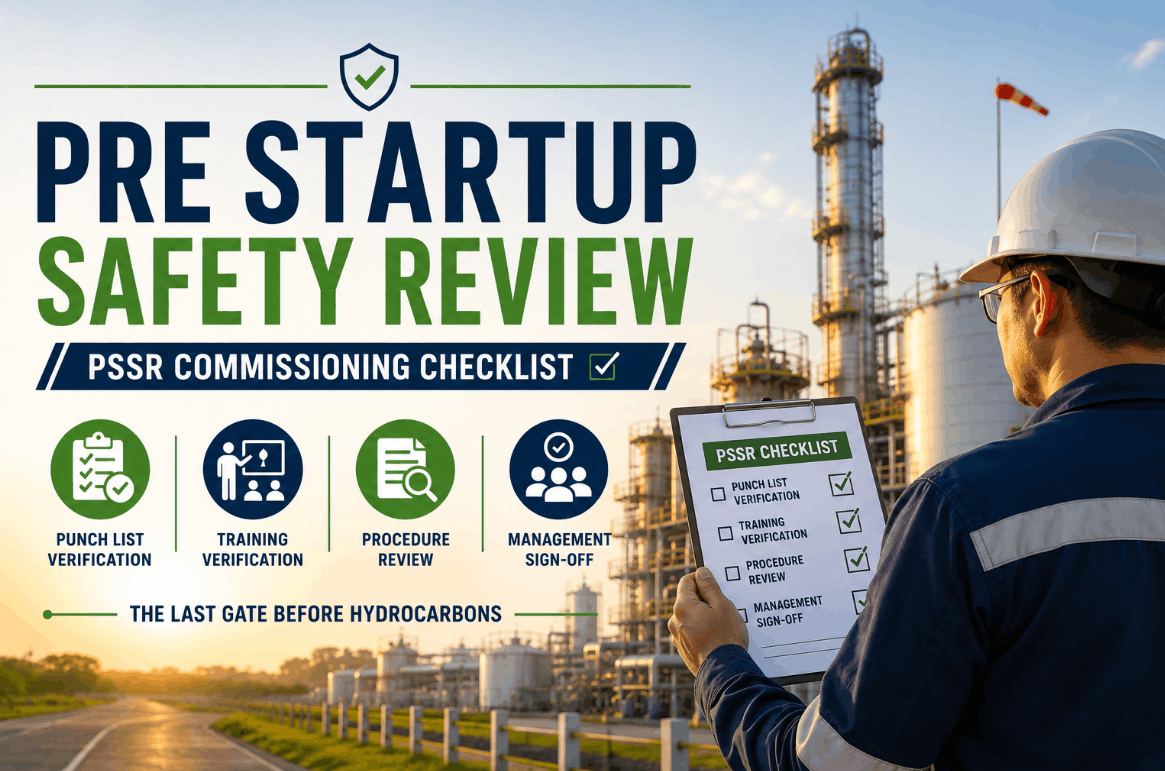
A PSSR is not a design review and not a repeat of the hazard analysis. It confirms that what was approved on paper has actually been built, documented, and staffed correctly, across four areas that rarely get checked by the same person. A HAZOP looks for hazards during design, before anything has been built; a PSSR looks at what's actually standing in front of the reviewer and asks whether the controls that design assumed are genuinely in place and functioning.
Equipment and Construction
Equipment is installed per design drawings, piping connections match the P&ID, and instrumentation is calibrated and tested against the values the design assumed.
Safety and Relief Systems
Relief devices, interlocks, and emergency shutdown systems are installed, set, and functionally tested for the process conditions the unit will actually run under.
Operating Procedures
Operating, maintenance, and emergency procedures have been updated to reflect the change, not left pointing at a version of the process that no longer exists.
Personnel Training
Every employee who will operate or maintain the modified process has completed training on what actually changed, not just a general refresher scheduled around the startup date.
Where PSSR Breaks Down
The Same Four Failure Patterns Show Up on Almost Every Rushed Startup
Punch-List Items Waved Through
An open item gets reclassified as "minor" or "post-startup acceptable" not because a risk assessment supports that call, but because the schedule doesn't have room for it to stay open.
Training Marked "In Progress" and Signed Off Anyway
Operator training on the specific change is scheduled to finish the week after startup, and the PSSR is signed on the assumption that it will happen, not on evidence that it did.
Documentation Lag Behind the Field
The P&ID, operating procedure, and MOC record are each updated by a different person on a different timeline, so the PSSR reviewer is comparing the field to three documents that don't fully agree with each other.
Commissioning Gets Treated as a Substitute
Systems being commissioned and tested is not the same as a completed PSSR. A unit can pass commissioning and still fail PSSR if procedures are incomplete or training is unfinished, because commissioning verifies that equipment functions, not that the surrounding documentation and workforce are actually ready for it.
When a PSSR Is Actually Required
It's Not Just New Facilities. Most Sites Under-Trigger This Review.
OSHA requires a PSSR for any new covered process before its first startup, and for any modification significant enough to require a management of change review before that modified process is restarted. In practice, a surprising number of sites apply that second trigger too narrowly, treating PSSR as something reserved for major projects while smaller changes go straight to startup on the strength of a commissioning sign-off alone. That narrower interpretation is usually where the gap between what's documented and what's built starts to grow, since each individually small change is judged not to need the same rigor a major project would get.
New Process Facilities
Any new process using highly hazardous chemicals above OSHA threshold quantities requires a PSSR before hazardous materials are introduced for the first time.
Any Change That Triggered an MOC
If a modification was significant enough to require a management of change review, restarting that process requires a PSSR, not just a completed commissioning checklist.
Restarts After Extended Shutdowns or Turnarounds
Best practice extends PSSR to restarts following extended shutdowns, major turnarounds, and equipment replacements that are not strictly in-kind, even when no single change looks large enough on its own to trigger one.
How It Works
From MOC Package to a PSSR Ready for Sign-Off
Instead of a startup lead assembling the checklist by hand from whatever documents happen to be on hand, the checklist is generated directly from the record of what actually changed, then checked against what was actually installed. The review team still makes every judgment call about what's acceptable to leave open; the difference is that they're working from a checklist that has already been reconciled against the documents, rather than one that assumes those documents agree with each other.
1
Checklist Generated From the MOC
The approved MOC package defines the scope of what changed, and the PSSR checklist is built directly from that scope instead of a generic template.
2
Construction Verified Against Drawings
Installed equipment, piping, and instrumentation are checked against the current P&ID and construction drawings to confirm the field matches the design.
3
Procedure and Document Cross-Check
Operating, maintenance, and emergency procedures are checked for whether they were actually revised to reflect the change, not just scheduled for revision.
4
Training Completion Verified
Training records for every employee in scope are checked for actual completion, so "in progress" can no longer be recorded as "complete" on the sign-off sheet.
5
Open Items Ranked for the Reviewer
Every unresolved item is ranked by whether it is truly safety-critical or genuinely acceptable to close post-startup, with the reasoning attached for the sign-off record.
See What a Real PSSR Package Would Flag Before You Ask Someone to Sign It
iFactory checks your next PSSR against the MOC scope, current P&IDs, and training records, and shows you exactly what's still open.
Manual vs. AI-Verified
What Changes When the Checklist Checks Itself Against the Record
| Verification Step |
Manual PSSR |
AI-Verified PSSR |
| Checklist Scope |
Built from a generic template adapted by memory |
Generated directly from the approved MOC scope |
| Construction Match |
Confirmed by a walk-through against a printed drawing |
Checked directly against the current P&ID and drawings |
| Training Status |
Self-reported as complete or scheduled by supervisors |
Verified against actual completion records per employee |
| Open-Item Classification |
Judgment call made under startup schedule pressure |
Ranked with documented reasoning attached to each item |
| Sign-Off Record |
A signature with limited backup if questioned later |
A timestamped record of what was checked and against what |
What Actually Gets Caught
The Kind of Finding a Verified Checklist Surfaces Before Startup
None of these require a reviewer to have missed something obvious. They are the kind of mismatch that only shows up when the checklist is actually checked against the underlying documents instead of taken on the word of whoever filled it out.
An Instrument Range That Doesn't Match the Revised P&ID
A transmitter calibrated to the original process range is still installed after a change altered the operating envelope, and nobody re-checked the calibration sheet against the updated drawing.
A Procedure Still Referencing the Old Configuration
The operating procedure describes a valve lineup or setpoint that was changed months earlier, and it was never routed back through revision after the MOC closed.
Training Completed for the Wrong Shift Roster
Training records show completion for the crew on shift during commissioning, but not for the rotation scheduled to be on shift the week after startup.
A Relief Device Sized for a Condition That No Longer Applies
A relief valve installed before the change is still in service after the process conditions shifted, and its original sizing basis was never re-verified against the new operating case.
A Punch-List Item Closed Without Its Supporting Evidence
An item is marked resolved in the tracker, but the inspection report, test result, or sign-off that was supposed to justify that closure was never actually attached to the record.
An MOC Item That Was Never Formally Closed
The management of change record shows an action item still open even though the associated construction work was completed weeks earlier, a gap that a document-by-document check catches immediately.
A Realistic Scenario
How This Plays Out on an Actual Startup Week
A refinery unit is scheduled to restart Monday morning after a modification to add a secondary feed line. By Friday afternoon, the punch list still has four open items and two operators haven't finished training on the new lineup. Under schedule pressure, the punch-list items get reclassified as post-startup acceptable and the training is marked as scheduled for Monday. An AI-verified PSSR check run against the MOC scope shows one of those four punch-list items involves a relief valve whose sizing basis was never re-confirmed for the new feed composition, information that was sitting in the process safety information the whole time but never made it into anyone's Friday afternoon judgment call. The item gets escalated and resolved before the weekend is over, instead of becoming the subject of an incident report the following month. The operators still finish training Monday morning as planned, but this time the sign-off reflects that fact accurately, rather than assuming it, and the relief valve question never has to be answered after the fact by an investigation team instead of a startup team.
Illustrative scenario based on common PSSR failure patterns during startup schedule pressure
Before You Sign
Five Questions Worth Asking Before Your Next PSSR Sign-Off
A startup lead who can answer all five of these with evidence, not assurances, is signing a PSSR that will actually hold up if it's ever questioned.
01
Is every item on this checklist tied back to the actual scope of the approved MOC, or copied from a generic template?
02
Has every open punch-list item been classified as post-startup acceptable based on a real risk review, or on the calendar?
03
Do the training records show completed sessions for the specific crew rotation working the week after startup?
04
Have the P&IDs and operating procedures been checked against the field, or only against each other?
05
If this sign-off were reviewed by an auditor next month, what evidence exists beyond the signature itself?
Frequently Asked Questions
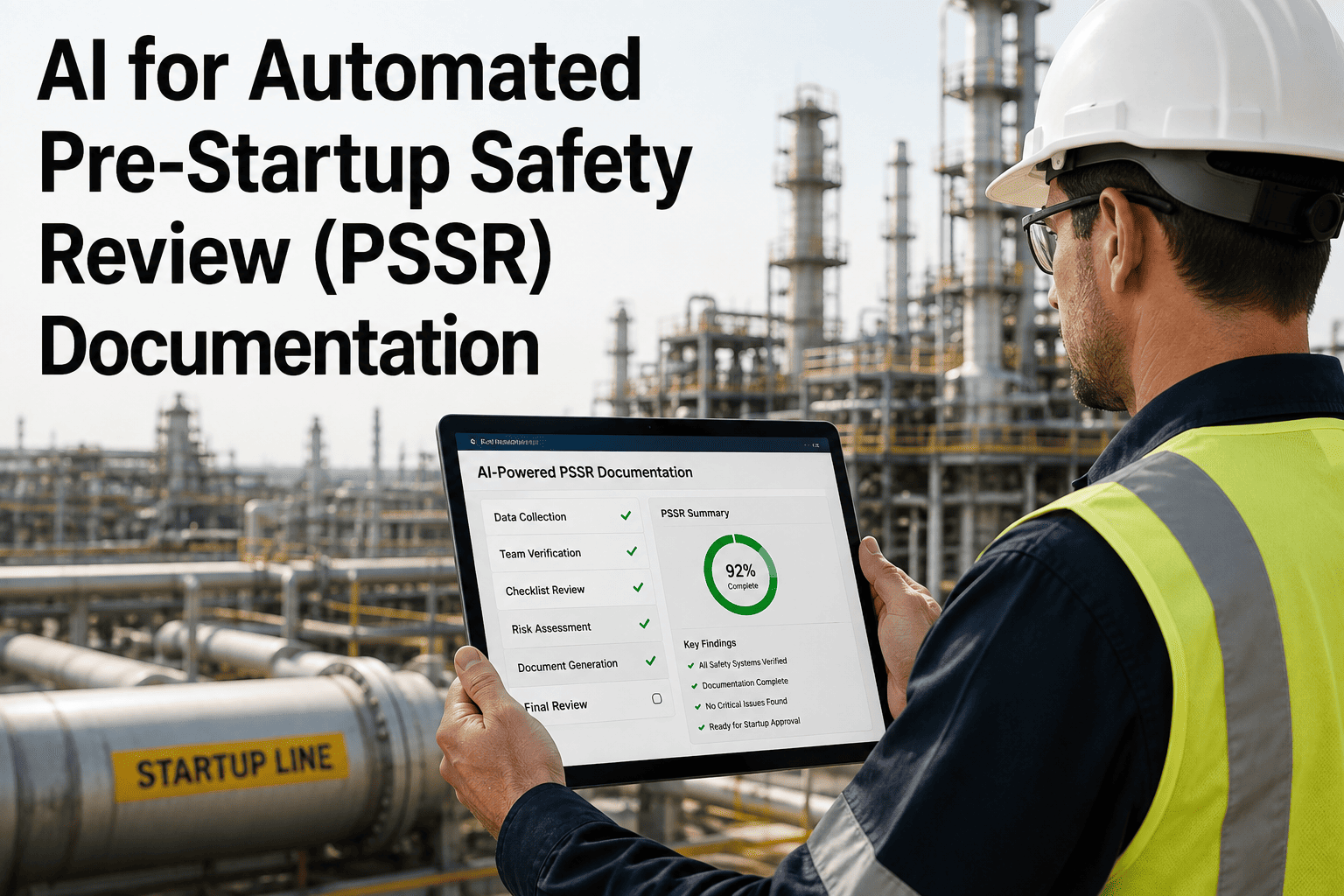
AI for Automated PSSR Documentation — Common Questions
How is this different from a digital PSSR checklist tool?
A digital checklist tool replaces the paper form with a form on a screen, which helps with tracking but doesn't verify that what's written on the form is actually true. This approach generates the checklist from the approved MOC scope and then checks each item against the current P&ID, construction drawings, and training records, so a box can't be marked complete unless the underlying document actually supports it.
Contact support to see the difference on a real checklist from your last startup.
Does this replace the multi-disciplinary PSSR review team?
No. OSHA requires a PSSR to be conducted by a team that includes engineering, operations, maintenance, and safety representatives, and that requirement doesn't change. What changes is what that team is reviewing when they sit down. Instead of spending the meeting trying to confirm whether documents agree with each other, they start with a checklist where the document cross-checking has already been done, and can focus their time on the items that genuinely need a judgment call. That shift matters most on the days when schedule pressure is highest, since it's exactly then that a reviewer is most likely to accept an unverified assurance rather than ask for the underlying evidence.
What happens when the system finds an incomplete item close to the planned startup date?
The finding is surfaced to the review team with the specific document or record that triggered it, so the team can make an informed decision about whether the item is truly safety-critical or genuinely acceptable to resolve after startup, with that reasoning captured as part of the record rather than lost in a hallway conversation.
Does this work for restarts after a turnaround, not just new modifications?
Yes. Best practice extends PSSR beyond brand-new facilities to restarts following extended shutdowns, major turnarounds, and equipment replacements that aren't strictly in-kind, and the same document-verification approach applies in each of those cases, checking what was actually done during the outage against what the process safety information and procedures say should be true before startup. This matters because turnaround work often involves dozens of small in-kind and near-in-kind replacements happening in parallel, and it's the accumulation of those small items, not any single one, that most often gets missed under a manual review.
Can this help demonstrate PSSR compliance during an OSHA inspection?
Yes. Because every checklist item is linked to the specific MOC scope, drawing, or training record that verified it, the resulting package is a documented trail showing what was checked and how, rather than a signature that has to be explained after the fact. That distinction tends to matter most in the exact moment it's needed, when an inspector or investigator is asking not whether a review happened, but what it actually verified.
Book a demo to see what that record looks like for a real startup package.
The Signature Should Mean the Checklist Was Actually Verified
See how AI builds your PSSR checklist from the MOC scope and checks every item against your P&IDs, drawings, and training records before startup authorization.