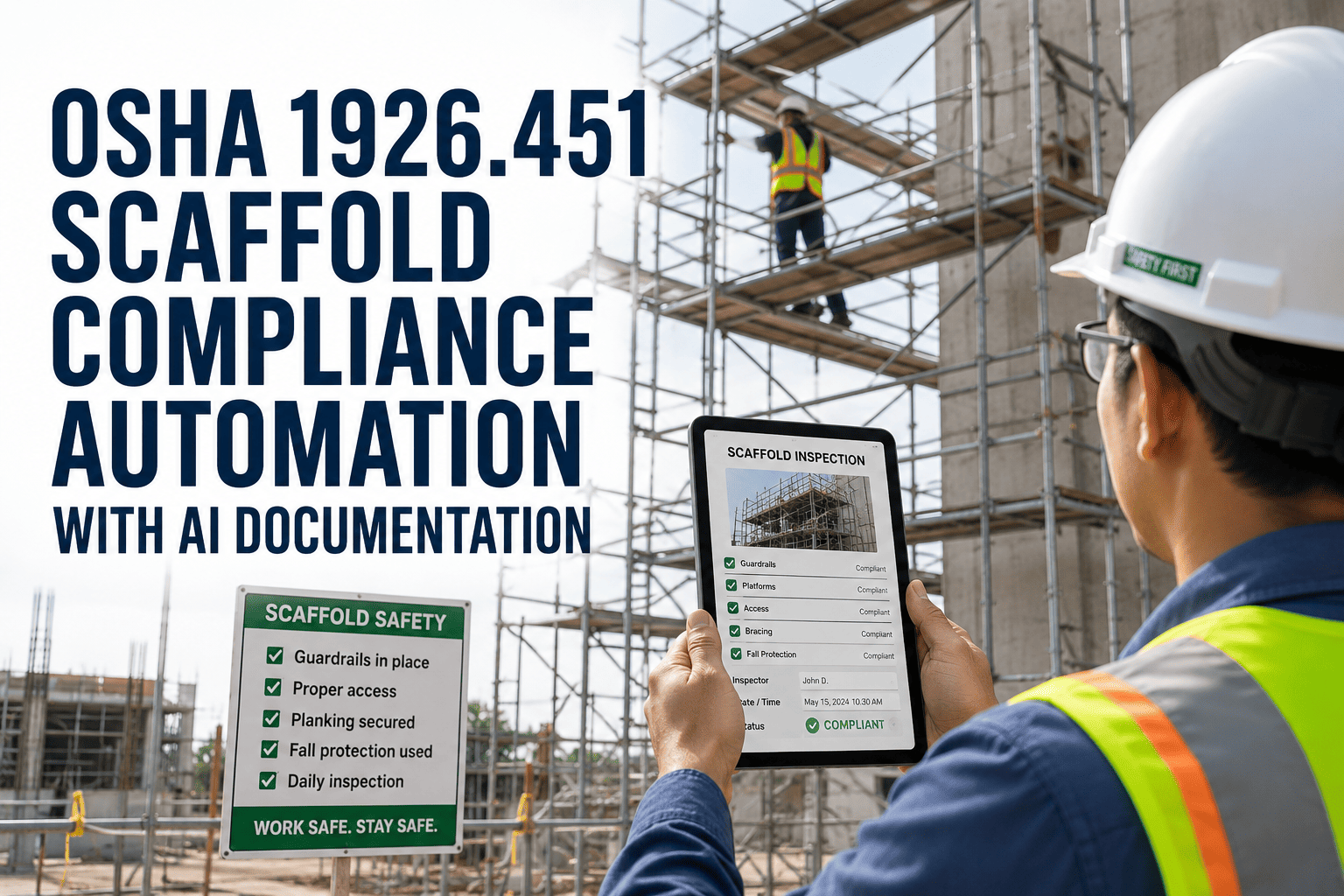
Every scaffold on an active jobsite is supposed to be inspected by a competent person before each shift and after anything that could affect its structural integrity, and that inspection is supposed to leave a record someone can produce on demand. In practice, most of those records live on a clipboard, a phone photo nobody labeled, or in someone's memory of "yeah, I checked it this morning." Scaffolding citations under 29 CFR 1926.451 climbed again in the most recent OSHA reporting year and remain one of the ten most frequently cited standards across all industries, and the gap between what the standard requires and what a paper log can actually prove is where most of those citations come from. AI-generated documentation closes that gap by turning every inspection into a timestamped, photo-backed, audit-ready record the moment it happens, and you can book a demo to see how it works on a live jobsite feed.
Your Scaffold Log Says It Was Inspected. Can You Prove It Without Asking Someone to Remember?
iFactory's AI documentation layer watches scaffold inspections happen and builds the compliance record automatically, timestamped photos, competent person identification, per-item compliance status, and deficiency tracking, so the paperwork is already done before the inspector walks off the platform.
Scaffold Documentation Failures Are Not a Paperwork Problem, They Are a Citation Problem
OSHA estimates that roughly 65 percent of the construction workforce works on scaffolds at some point, which is why the agency treats scaffold compliance as a standing enforcement priority rather than a niche concern. Scaffold-related incidents are tied to an estimated 60 fatalities and 4,500 injuries every year, and the vast majority of the citations issued after those incidents trace back to the same root cause: a missing, incomplete, or unverifiable inspection record rather than a scaffold that was actually unsafe when it was built. The standard does not just require the inspection to happen, it requires the employer to be able to demonstrate that a qualified competent person did it, on this shift, on this specific scaffold, and found it fit for use.
Four Things 1926.451(f)(3) Expects From Every Single Inspection
Most safety teams know the general shape of the scaffold inspection requirement, but the standard is more specific than "check it once in a while." Paragraph (f)(3) requires that scaffolds and scaffold components be inspected for visible defects by a competent person before each work shift and after any occurrence that could affect structural integrity, and paragraph (f)(7) requires that a competent person with training specific to that scaffold type direct and supervise erection, alteration, and dismantling. The four requirements below are the ones that generate the most citations when the documentation cannot support them.
Clipboard Inspections vs. What OSHA Actually Wants to See
A paper tag or a shared spreadsheet feels like documentation until an inspector or an incident investigator starts asking specific questions about a specific shift on a specific scaffold. The comparison below is not about competent people doing a bad job on the platform, it is about the fact that a checkmark on a clipboard cannot answer the follow-up questions that determine whether a citation gets issued.
Stop Reconstructing Inspection History After the Fact
iFactory builds the compliance record while the inspection happens instead of asking your team to recreate it from memory when an auditor or investigator asks. See what a fully documented shift looks like on your own scaffold layout.
From Walkthrough to Audit-Ready Record in Five Steps
The goal of AI documentation is not to replace the competent person's judgment, it is to remove the manual burden of writing everything down while the inspection is happening. The competent person still walks the scaffold and makes the call, the system just makes sure that call is captured completely and correctly the first time.
Every Record Contains the Five Things Investigators Actually Ask For
When OSHA or an internal safety audit reviews a scaffold incident, the questions are almost always the same: who inspected it, when, what did they find, what was done about it, and can you prove any of that. AI documentation is built to answer all five without anyone digging through a trailer full of binders.
Manual Log vs. AI-Generated Record: What Each One Can Actually Prove
The table below lays out the same six compliance questions asked against both approaches. It is not that manual logs never contain the right information, it is that they cannot reliably prove it was captured at the right time, by the right person, in a way that survives a follow-up question.
| Compliance Question | Manual Log | AI-Generated Record |
|---|---|---|
| Was every shift inspected | Relies on someone remembering to sign the sheet | Missed shifts are flagged automatically before work starts |
| Who performed the inspection | Handwritten name, hard to verify after the fact | Identity captured and cross-checked against training records |
| What was the actual condition | A checkmark with no visual evidence attached | Timestamped photo evidence for every checklist item |
| Was a defect corrected | Noted once, rarely tracked to resolution | Deficiency stays open in the system until closed out |
| Was there a post-event check | Often skipped when no one flags the trigger event | Trigger event logged and re-inspection requirement enforced |
| Can you produce it on request | Search through binders, trailers, and phones | Pulled instantly by scaffold, date, or competent person |
What This Looks Like When an Auditor Actually Shows Up
A general contractor running a mid-size commercial build has four active scaffold zones across the site, each requiring a before-shift inspection and any post-event re-inspection triggered by weather, impact, or modification. With a manual process, the safety manager spends the first hour of every day chasing down paper tags from four different foremen, several of which are incomplete or missing entirely. When a state inspector arrives unannounced to review a near-miss on an adjacent structure, the team cannot immediately produce a complete inspection history for the scaffold zone closest to the incident, and the resulting citation is issued for a documentation gap rather than an actual structural failure.
With AI documentation running the same four zones, each competent person completes their guided walkthrough on a device, the system compiles the record in real time, and the safety manager has a live dashboard showing every zone's inspection status before the first crew even arrives on site. When the same unannounced inspection happens, the team pulls the complete history for the affected scaffold, including every before-shift check and the specific re-inspection triggered by the prior week's high-wind event, directly from the platform in under a minute. The scaffold itself was compliant the entire time in both scenarios, the only difference is whether the team could prove it fast enough to matter.
Common Questions About Scaffold Compliance Automation
Does AI documentation replace the competent person's inspection judgment?
No, and it is not meant to. The competent person still walks the scaffold, applies their training, and makes every judgment call about what passes and what does not, exactly as 29 CFR 1926.451 requires. What the system changes is what happens to that judgment once it is made, capturing the checklist responses, the photo evidence, and the identity of the inspector automatically instead of relying on a handwritten note that may or may not survive to the next audit. The authority to stop work and flag a hazard always stays with the competent person. Book a demo to see the guided walkthrough a competent person actually follows.
How does the system know when a post-event re-inspection is required?
The platform is configured to prompt a re-inspection whenever a trigger event is logged against a scaffold zone, whether that is a reported impact, a high-wind advisory, a modification to the structure, or any other occurrence that could affect structural integrity under paragraph (f)(3). Once that trigger is logged, the affected scaffold is flagged as requiring re-inspection before it can be marked available for use again, and the system will not let that status get skipped silently. This closes one of the most common gaps in manual logs, where a trigger event happens but nobody circles back to document the follow-up check.
Can the system verify that the competent person is actually qualified for that scaffold type?
Yes. Each inspector identifies themselves at the start of a walkthrough, and the system cross-checks that identity against the training and authorization records your organization has on file for that scaffold type, whether it is a supported scaffold, a suspended system, or a mobile tower. If someone attempts to complete an inspection without the corresponding authorization on record, the system flags it rather than allowing the record to be generated as if the requirement had been met. Contact support to discuss how your existing training records integrate with the verification step.
What happens to a deficiency once it is flagged during an inspection?
A flagged deficiency stays open in the system with the specific component, the responsible party, and the required corrective action attached to it, and it does not disappear from the record until someone confirms the fix and closes it out. This directly addresses the standard's requirement that damaged or weakened components be immediately repaired, braced, or removed from service, because the platform keeps the item visible on every subsequent shift log until resolution is documented rather than letting it quietly vanish from the next day's paperwork.
How quickly can we produce a complete inspection history if an OSHA inspector shows up unannounced?
Because every inspection compiles into a centralized, searchable record as it happens, your team can pull the complete history for any scaffold zone, filtered by date, competent person, or trigger event, in well under a minute instead of sending someone to search through trailers and binders. That speed matters because inspectors are evaluating not just whether the scaffold was safe, but whether your program can demonstrate ongoing compliance on demand, and a fast, complete answer changes the tone of the entire inspection. Book a demo to see how fast a real record actually pulls up.
Your Competent Person Already Does the Inspection. Make Sure the Record Can Actually Prove It.
iFactory turns every scaffold walkthrough into a timestamped, photo-backed, deficiency-tracked compliance record automatically, so your team spends time keeping scaffolds safe instead of reconstructing paperwork after the fact.