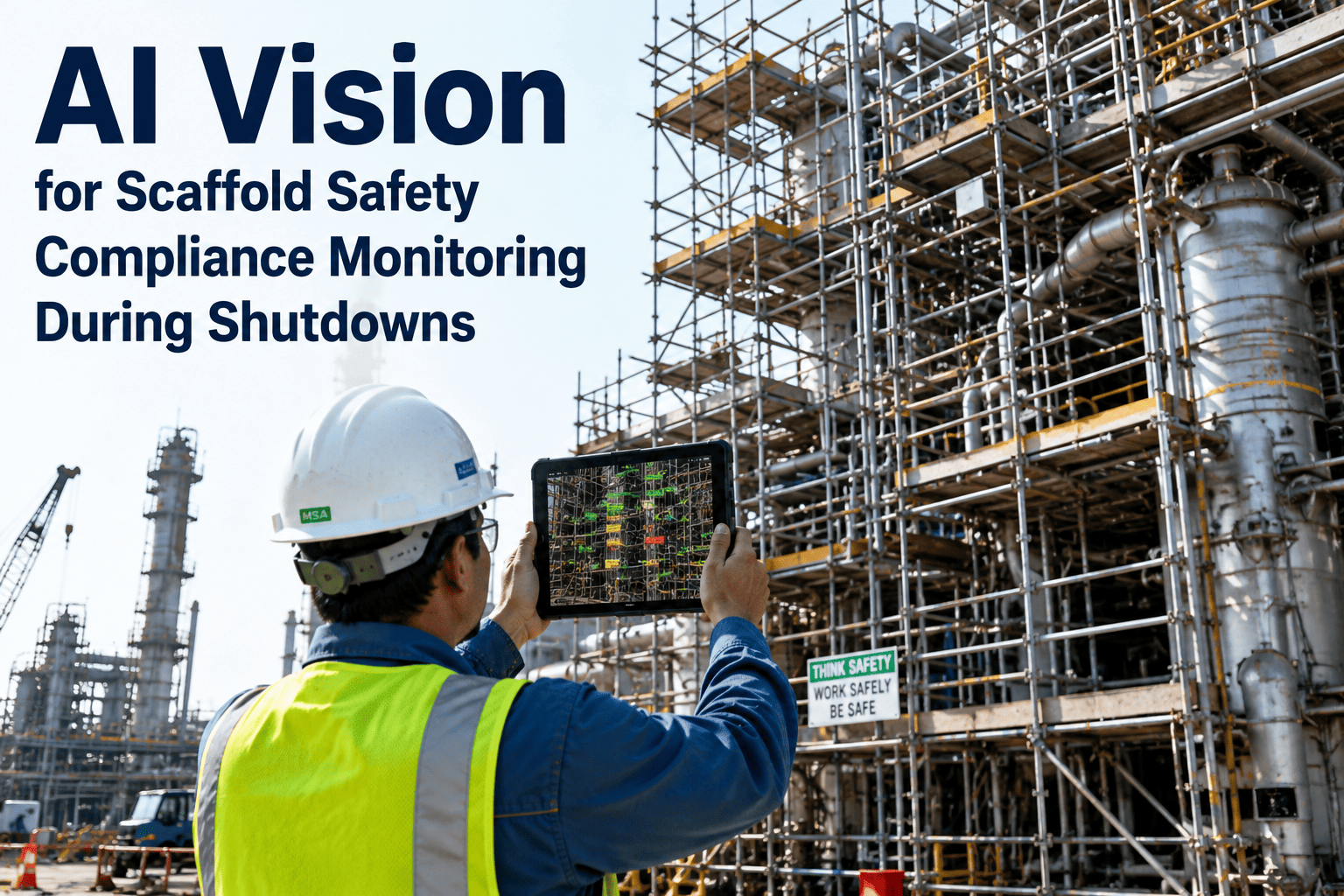
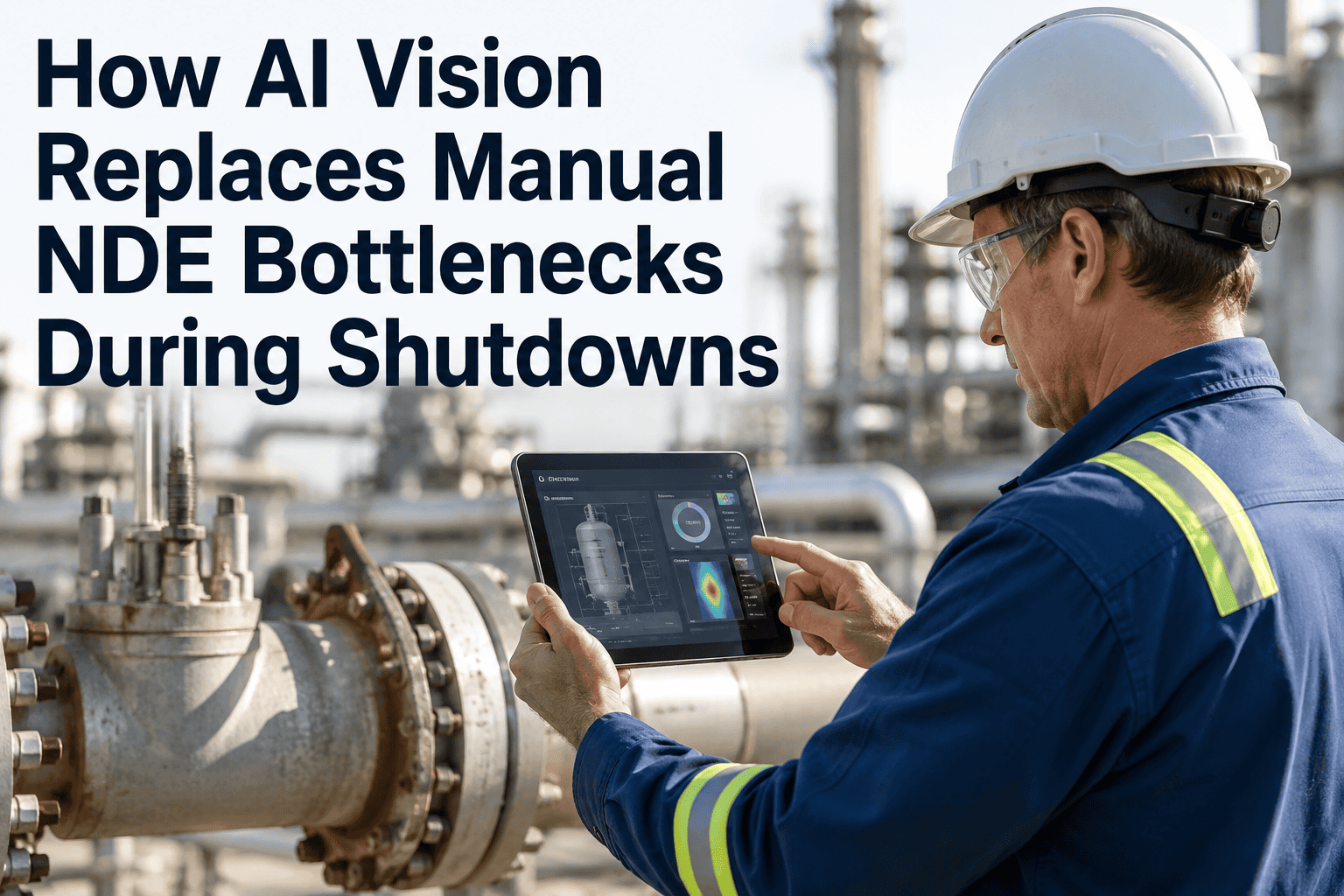
A turnaround at a chemical plant or a refinery is where scaffold density peaks and human oversight thins simultaneously. The site erects hundreds of scaffolds across a two-week window, each one built by a rotating crew, each one supposed to carry a green tag before workers step onto it, and each one theoretically inspected daily under 29 CFR 1926.451. The reality on any large shutdown is that a competent-person inspector cannot physically walk every scaffold every shift, and the gap between the paper inspection log and the actual condition of the platform is where scaffold-related falls keep happening. AI vision closes that gap by continuously scanning scaffolds on site — verifying guardrail installation, toe board presence, base plate condition, and platform planking against the OSHA requirements the tag says it meets — and flagging any non-compliant scaffold before a worker touches it. Sites building this capability into shutdown safety programs work with iFactory's scaffold vision engineering team to map camera coverage, defect libraries, and tag-status integration to each specific site's scaffold density and access pattern.
Scaffold Safety · Compliance Monitoring
AI Vision for Scaffold Safety Compliance Monitoring During Shutdowns
Verify every scaffold on site against 29 CFR 1926.451 in real time — guardrails, mid-rails, toe boards, base plates, planking, access. Flag non-compliant structures before workers access them, replace paper daily inspection with continuous AI verification, and turn scaffold tag status into a live compliance record instead of a hopeful assertion.
Live Scaffold Status Board
GREEN
Fully Compliant
All checks pass · Safe to access
YELLOW
Restricted Use
Minor deficiency · Fall arrest required
RED
Do Not Use
Non-compliant · Access blocked
Continuously reconciled against AI vision checks
Why Scaffold Compliance Is A Shutdown-Scale Problem
The Structural Reason Scaffold Falls Keep Ranking In OSHA's Top Violations
OSHA's scaffolding standard sits consistently in the agency's most-cited construction violations year after year. That's not because scaffold rules are obscure — they're spelled out in 29 CFR 1926.451 with specific numeric requirements for guardrail height, toe board dimensions, planking, base plates, and access. The rules are clear. What breaks down is the inspection cadence: the standard requires a competent person to inspect each scaffold before every work shift and after any occurrence that might affect structural integrity, and on a large shutdown that inspection burden simply exceeds what any human team can deliver at the same quality across every structure on site.
The result is a compliance gap that grows with site scale. A refinery turnaround might have four hundred scaffolds active simultaneously, spread across process units, tank farms, cooling towers, and elevated flare structures. A green tag on a scaffold is a competent person's assertion that at the moment of inspection, every requirement was met — but between one inspection and the next shift, workers move planks, remove mid-rails to pass equipment through, add loads that shift base plates, or leave a toe board off after a repair. By the time the next inspector arrives, the scaffold may no longer match its tag, and a worker climbing it is trusting a piece of paper that no longer reflects reality.
AI vision doesn't replace the competent person — it extends the inspector's eyes across every scaffold on site continuously. Cameras positioned to see the scaffold structures capture the physical state of each one, deep learning models classify guardrails, mid-rails, toe boards, base plates, planking, and access, and any deviation from the tag's asserted status raises a live alert. The scaffold that had all its guardrails at 9 AM but lost a section during a lift at 2 PM shows up on the alert screen at 2:01 PM — not at the next shift inspection. That's the difference between paper compliance and live compliance, and it's why AI vision is moving from pilot to standard on large shutdown programs where the stakes concentrate.
The 29 CFR 1926.451 Check Set
Every OSHA-Required Attribute AI Vision Verifies On Each Scaffold
The scaffold standard lists specific numeric requirements across guardrails, toe boards, planking, access, and structural elements. Modern scaffold vision platforms are trained to check every one of them against the exact language of 1926.451 on every scaffold in camera view. The eight checks below are the standard OSHA-derived attribute set that runs continuously on live footage.
C1
Top Rail Presence & Height
Guardrail top rail present on all open sides at 38–45 inches. AI classifies presence, height range, and continuity across the platform edge — flags any gap or missing segment.
C2
Mid-Rail Installation
Mid-rail installed between top rail and platform, or equivalent intermediate structural member. Verified continuously along the full platform edge on scaffolds over 10 feet.
C3
Toe Board Presence & Height
Toe board minimum 3.5 inches installed on all edges of platforms over 10 feet where workers pass below. AI segments the toe board along the platform perimeter and flags missing runs.
C4
Platform Planking & Gaps
Full planking or decking across the working platform, with plank gaps within tolerance. Missing planks, unsecured planks, and excessive gaps between planks all flagged as compliance failures.
C5
Base Plate & Mudsill Condition
Base plates present under every leg, mudsills present on soft ground, and no evidence of settlement or displacement at the scaffold foundation. The structural integrity check for the base of the scaffold.
C6
Access Ladder & Attachment
Proper attached ladder, stair tower, or approved access method present. Cross-brace climbing detection flags workers attempting to access via cross braces — a prohibited but common shortcut.
C7
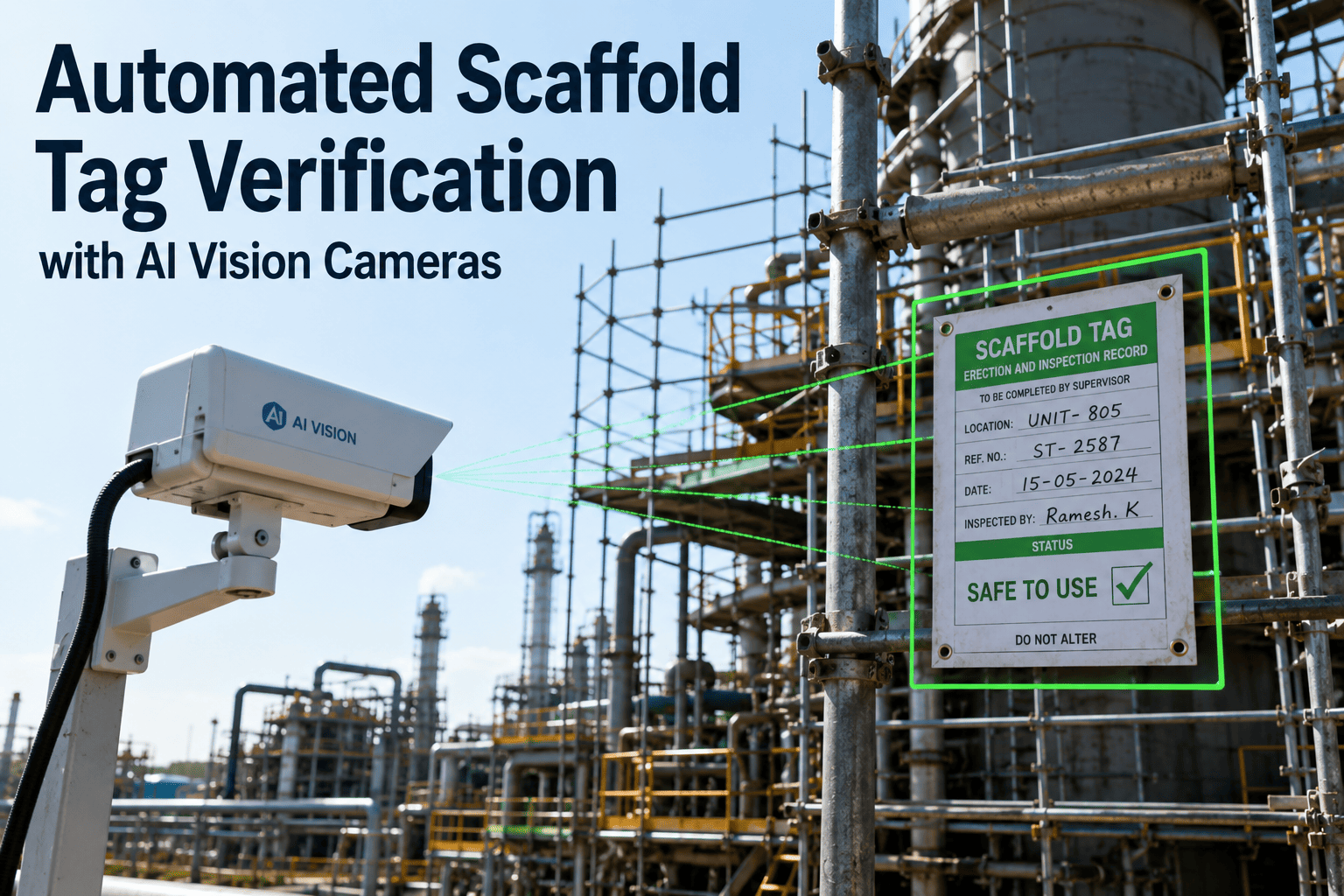
Tag Presence & Status Match
Green, yellow, or red tag present and visible at scaffold access point. AI reads the tag and cross-checks the asserted status against the live compliance state of the structure it labels.
C8
Load, Debris & Housekeeping
Material stacking below toe board height, no unsecured tools at platform edge, no debris on planking. Housekeeping compliance that turns into falling-object hazards to workers below when it fails.
The Inspection-To-Alert Pipeline
From Live Camera Feed To Blocked Access — What Actually Happens
The value of AI scaffold vision isn't the camera — it's the pipeline that turns raw imagery into an actionable compliance decision fast enough to prevent access to a non-compliant structure. The five-stage flow below is what runs on site once the system is deployed on a shutdown.
01
Camera Placement & Scaffold Registration
Fixed cameras or mobile pole-mounted units positioned to cover scaffold zones on the shutdown map. Each scaffold registered with a unique ID and geometry model at erection time, tying the physical structure to its tag status and inspection record.
02
Continuous Attribute Classification
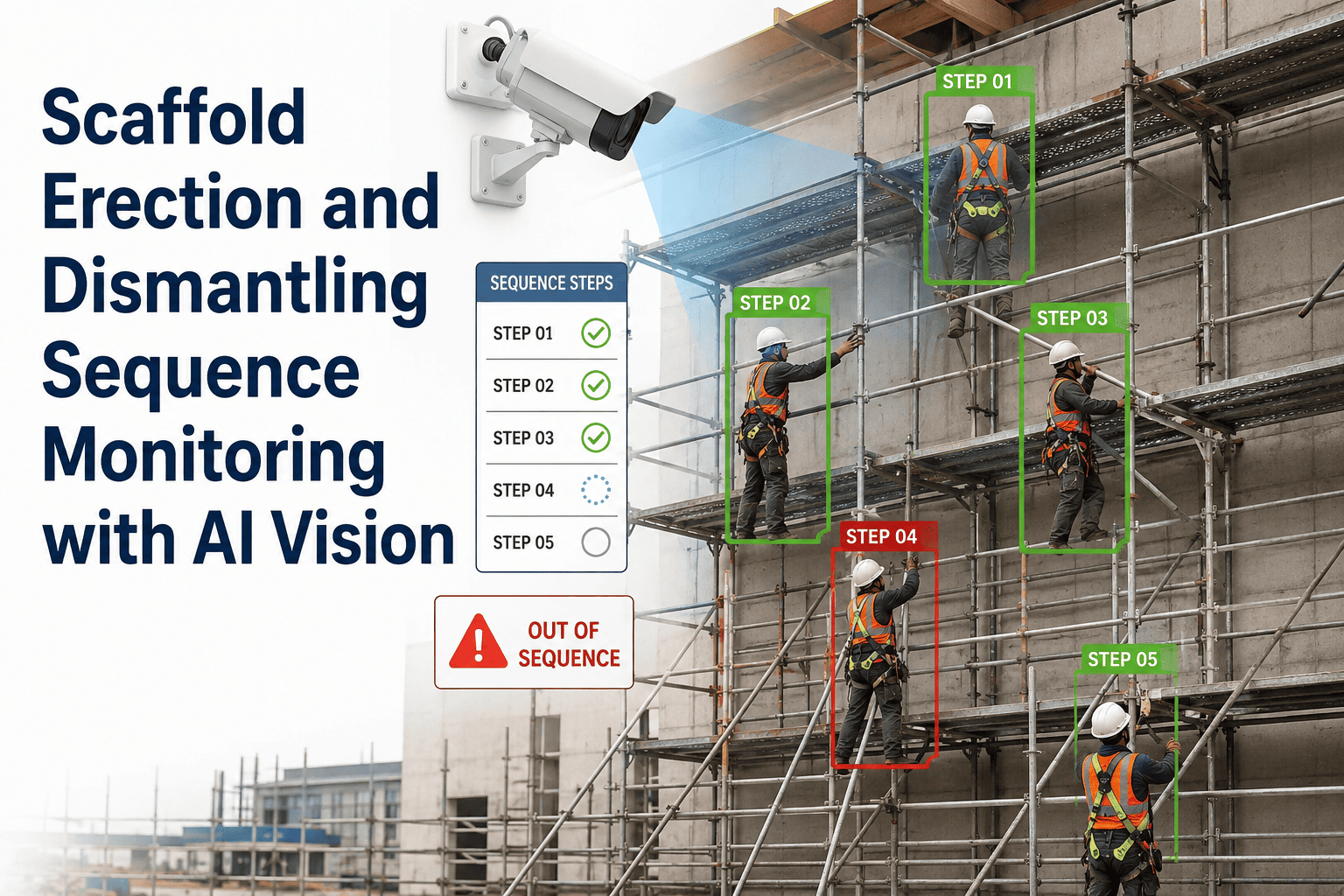
Deep learning models run on live camera feed. Every scaffold in view gets classified against the eight-attribute check set continuously — guardrails, mid-rails, toe boards, planking, base plates, access, tag status, and housekeeping.
03
Tag-Status Reconciliation
Every classification result compared against the tag's asserted status. A scaffold tagged green that fails a check becomes a live discrepancy — the AI flags the mismatch immediately rather than waiting for the next shift inspection to discover it.
04
Alert Escalation & Access Block
Discrepancy triggers alert to the competent person and site safety supervisor. Tag automatically flipped to red on the digital scaffold register, physical access blocked pending re-inspection. Worker approaching the structure receives the current status before they climb.
05
Correction, Re-Inspection & Audit Log
Scaffold crew corrects the deficiency, competent person re-inspects and re-tags, AI confirms the corrected state and re-authorizes the tag. Every state change archived with camera imagery and timestamps for OSHA audit and shutdown after-action review.
See Live Scaffold Compliance On A Real Shutdown
Watch AI Vision Detect A Missing Toe Board And Auto-Block Access Within Seconds
Book a walkthrough with iFactory's scaffold vision engineering team and see live 1926.451 attribute classification on real shutdown footage — guardrail gap detection, toe board segmentation, cross-brace climbing detection, and automatic tag-status flip with CMMS incident routing.
Paper Daily Inspection vs Continuous AI Verification
The Structural Gap Between A Green Tag And A Compliant Scaffold
Every safety leader running a large shutdown has felt the same disconnect: the daily scaffold inspection log says every scaffold on site is green, and yet the incident review after a fall consistently finds that the scaffold in question had drifted out of compliance since the last inspection walk. The table below is the structural comparison that explains why — every row is a place where paper inspection cannot deliver what continuous verification can.
| Dimension |
Competent Person Paper Inspection |
AI Vision Continuous Verification |
| Inspection Frequency Per Scaffold |
1–2 times per shift, when reached |
Continuous, whenever in camera view |
| Coverage On Large Shutdowns |
Selective — inspector prioritizes by risk |
Every registered scaffold, no prioritization gaps |
| Time From Deviation To Detection |
Hours until next inspection walk |
Seconds after the deviation appears |
| Tag-Reality Reconciliation |
Trust the tag until re-inspection |
Continuous reconciliation, auto-flip on mismatch |
| Detection Consistency |
Inspector-dependent, fatigues over shift |
Constant sensitivity, 24/7 |
| Evidence Chain |
Signed paper log, occasional photo |
Timestamped imagery per attribute per scaffold |
| Root-Cause Data On Incidents |
Post-incident reconstruction from notes |
Recorded scaffold state timeline before, during, after |
| Scalability Across Shutdown Size |
Linear labor scaling, harder as site grows |
Camera coverage scales, marginal cost drops |
The layering matters most in the biggest exposure window. On a small maintenance job, competent-person inspection can plausibly cover the scaffold population at the required cadence. On a full turnaround with hundreds of concurrent scaffolds and a rotating erection crew, the inspection burden physically exceeds what any human team can deliver, and the safety exposure concentrates in the gap between what the paper says and what the platforms actually look like at 3 AM on shift changeover. That's precisely where continuous AI verification pays back.
Where Continuous Scaffold Verification Actually Pays Back
Six Categories Where AI Scaffold Vision Moves The Numbers
Continuous scaffold compliance verification delivers value across specific, quantifiable categories on a shutdown P&L and safety scorecard. The six categories below are the pattern iFactory's engineering team consistently sees on large turnaround deployments, sorted by the categories with the most visible direct impact.
01
Fall Incident & Recordable Reduction
The primary safety return. Every scaffold-related fall prevented is a recordable injury avoided, an incident investigation avoided, and a workers' compensation claim avoided. On large turnarounds, catching a single non-compliant scaffold before a worker accesses it is often the whole business case.
02
OSHA Citation & Regulatory Exposure
Scaffolding sits in OSHA's top-cited construction standards year after year. Every compliance gap the AI catches before an OSHA inspector does is a citation, a fine, and a compliance record blemish avoided. The evidence chain the vision system produces is also the defense record if an inspection does occur.
03
Turnaround Schedule Protection
A scaffold-related incident during a shutdown stops work, triggers investigation, and puts the whole turnaround schedule at risk. Preventing the incident preserves the critical-path progress that every day of overrun costs the plant in lost production.
04
Competent Person Capacity Multiplier
The competent person's attention is the scarcest resource on a large shutdown. AI vision multiplies their reach by pre-filtering scaffolds — the inspector focuses on flagged structures rather than walking every scaffold on site, and coverage per inspector effectively multiplies without adding headcount.
05
Contractor Accountability & Documentation
Scaffold contractors carry contractual quality obligations. Continuous vision data produces the objective record that supports contractor performance conversations, backcharge disputes, and future scope decisions — a workflow that used to depend on inspector recollection.
06
Insurance & Client Assurance
Owner-operators, EPCs, and insurers increasingly ask for evidence-based scaffold safety programs during shutdown planning. Continuous AI verification is exactly the evidence layer they're asking for, and it strengthens the site's position at insurance renewal and pre-shutdown client audit.
Where This Concentrates On Shutdowns
The Four Scaffold Scenarios AI Vision Was Built To Cover
Not every scaffold on a shutdown carries the same compliance risk. Some are erected and left in place for weeks; others get modified daily as work progresses; some are in high-traffic zones where deviations are inevitable. The four scenarios below concentrate the highest-value AI vision coverage on the structures where deviations happen most often.
Scenario 1
Elevated Process Unit Scaffolds
Scaffolds erected around vessels, reactors, and columns on multi-level process structures. Workers pass through, planks get moved to fit equipment, and mid-rails are commonly removed for equipment access. High deviation frequency, high fall exposure.
Scenario 2
Tank Farm & External Vessel Access
Tall scaffolds against storage tanks and external vessels. Wind loading, ground movement, and multi-day dwell time all shift base plate condition and structural integrity over the shutdown window. Continuous verification catches base plate settlement before it compounds.
Scenario 3
Confined Space & Interior Scaffolds
Scaffolds erected inside vessels, columns, and confined spaces for internal inspection and repair. Access is restricted, competent-person inspection windows are limited, and every deviation carries higher consequence because emergency egress is constrained.
Scenario 4
Suspended & Swing Stage Scaffolds
Suspended scaffolds on cooling towers, stacks, and flare structures. Rope condition, tie-back integrity, and daily lift adjustments create continuous exposure to deviation. Vision monitoring on suspended structures is the scenario where the continuous-verification value is most visible.
Field Perspective
"
The framing I bring to shutdown safety leadership is that the scaffold tag was never designed for the scale that modern turnarounds operate at. The tag system works beautifully on a maintenance job with a dozen scaffolds and a full-time competent person on site. It breaks down on a turnaround with four hundred scaffolds, three shifts, rotating crews, and the physical impossibility of walking every structure every shift at the quality the standard requires. That's not a critique of the inspectors — it's arithmetic. What AI vision does is give the competent person a set of eyes on every registered scaffold continuously, so their inspection walks concentrate on the scaffolds the vision system has flagged rather than trying to cover the whole site by brute force. The other point I make with clients is that the vision data changes the safety conversation with contractors. When a scaffold crew knows every mid-rail removal, every plank movement, every toe board omission is going to show up on the flag screen within seconds, the erection quality changes. Contractors don't want to be the crew whose scaffolds keep flipping red. Once you've seen a shutdown run with continuous verification against one run without, the argument for it stops being about technology and starts being about the arithmetic of what any human team can physically cover.
Callum Adeyemi-Rasmussen
Shutdown Safety Systems Lead · 22 years in refinery and chemical turnaround safety, scaffold program governance, and AI safety monitoring deployment across mega-projects
Common Questions
Frequently Asked Questions
Does AI scaffold vision replace the OSHA-required competent person inspection?
No, and any vendor claiming it does is overselling and creating regulatory exposure for the customer. 29 CFR 1926.451 explicitly requires a competent person to inspect scaffolds before each work shift and after any occurrence that could affect structural integrity — that requirement is not delegable to an automated system. What AI vision does is extend the competent person's reach across every registered scaffold continuously between their inspection walks, and pre-filter the population so the inspector's attention concentrates on flagged structures. The competent person still signs the tag; the AI ensures the tag stays honest between signings.
Talk to scaffold vision engineering about how the two layers integrate on your specific site.
How accurate is the AI at detecting missing guardrails or toe boards on real shutdown footage?
Well-trained scaffold vision models achieve high classification accuracy on the standard attribute set — guardrails, mid-rails, toe boards, planking, and access — when trained on representative site imagery covering the specific scaffold systems and lighting conditions in use. The model learns the visual signature of a compliant scaffold against the specific site's steel color, plank material, and background clutter, so accuracy improves as site-specific training data accumulates. Early false positives typically resolve within the first weeks of deployment as edge cases get labeled back into the training set, and mature deployments run at low single-digit false positive rates. The system is tuned to err toward flagging ambiguous cases for competent-person review rather than passing them silently.
Can the vision system integrate with our existing digital scaffold register and permit-to-work system?
Yes, and this integration is where the operational value concentrates. The AI vision platform is designed to read from and write to the digital scaffold register — each registered scaffold's ID, geometry, tag status, and inspection history are all cross-referenced when the vision system evaluates its state. When a deviation is detected, the platform can automatically flip the register tag to red, notify the competent person, alert the permit-to-work system to block access authorizations for that scaffold, and generate a CMMS work order for correction. Integration uses standard REST APIs and industrial protocols and completes during deployment engineering without requiring changes to the existing register or permit system.
What camera coverage does a typical shutdown site need for full scaffold vision monitoring?
Camera density depends on scaffold zone density and geometry rather than a generic square-footage rule. High-density zones like process unit skids and elevated pipe racks typically use fixed cameras with overlapping fields of view to see multiple scaffolds simultaneously. Lower-density zones like tank farms use pole-mounted or mast-mounted cameras with wider fields covering fewer structures each. Mobile pole units cover temporary scaffolds erected in areas not served by fixed cameras. The deployment engineering phase maps camera positions against the shutdown scaffold plan so coverage is designed against the specific site, not a generic template — and coverage expands or contracts as the shutdown scope shifts across the work window.
Book a demo to walk through coverage planning for your specific site.
How does the system handle privacy concerns around continuous camera monitoring of workers?
Modern scaffold vision platforms are designed for structural attribute classification rather than worker identification, and the deployment engineering explicitly addresses privacy from the start. The AI models focus on the scaffold structure — guardrails, planks, toe boards, base plates — rather than on tracking or identifying individual workers. Where workers appear incidentally in frames, they are treated as anonymous entities for purposes like cross-brace climbing detection, without retaining identifiable imagery beyond the operational retention window. Sites operating under works councils or worker representation agreements typically have vision deployment scope agreed with representatives during pre-shutdown planning, and the compliance-focused framing generally addresses privacy concerns because the safety benefit is directly to the workers themselves.
Turn Scaffold Tags Into A Live Compliance Record
Extend Every Competent Person Across Every Scaffold On Site, Continuously
iFactory's AI scaffold vision platform is built for the specific realities of large industrial shutdowns — hundreds of concurrent structures, rotating erection crews, three-shift operations, and 29 CFR 1926.451 compliance obligations that scale with site size. Continuous attribute verification, tag-status reconciliation, competent-person escalation, and CMMS-integrated correction routing come together into a single scaffold intelligence layer that turns compliance from a paper assertion into a live record.