Scaffold collapses and falls rarely happen because a crew ignored safety altogether — they happen because one lift went up before its base was tied, or a guardrail came down before the level beneath it was cleared. On a fast-moving erection or strike-out crew, sequence is the actual safety control, and it is also the one thing nobody can watch continuously. An estimated 2.3 million construction workers work on scaffolds regularly, and scaffold-related hazards still account for roughly a quarter of all fatal falls recorded across the industry every year. iFactory's AI vision layer watches every lift, tie-in, and decking stage as it happens and flags the exact moment a step goes out of order, catching sequence violations while there is still time to correct them — see how the detection works by booking a demo with our team.
The Fall Doesn't Happen at Height. It Happens in the Sequence.
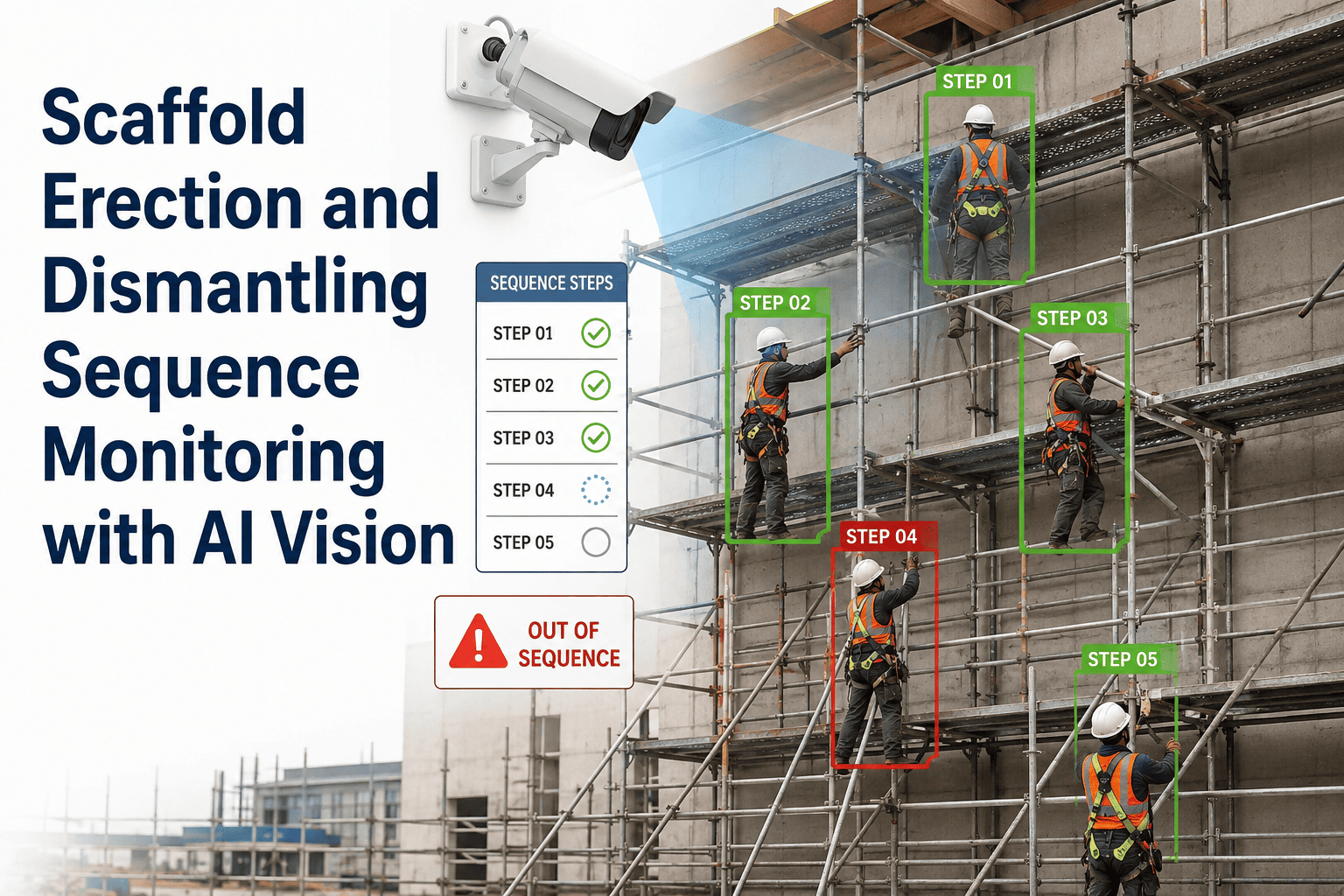
Scaffold erection and dismantling are the two phases where fall protection is hardest to guarantee — because the structure protecting workers is, by definition, incomplete. iFactory's AI vision nodes verify that every build and strike-out step follows the approved sequence, in real time, on every lift, and flag the exact bay and stage the moment something is missing.
Why Sequence Is the Hazard Nobody Is Watching
Scaffold collapses and falls rarely happen because a crew ignored safety altogether — they happen because one lift went up before its base was tied, or a guardrail came down before the level beneath it was cleared. On a fast-moving erection or strike-out crew, sequence is the actual safety control, and it is also the one thing nobody can watch continuously. A base plate placed without a mudsill, a diagonal brace skipped to save a trip up the frame, a platform decked before the level below has its rails up — each is a sequence failure, and each is invisible to a spec sheet that only checks the final state. By the time a walk-around inspection reaches that bay, the crew has often already moved two levels higher, and the gap that existed for those twenty minutes never makes it into any report unless something went wrong while it was open.
Fall protection rules for erectors and dismantlers are written differently from the rules for everyone else on a finished scaffold, precisely because the structure is being built or removed underneath them in stages. Falls to a lower level remain the single largest cause of construction fatalities nationally, and scaffold erection and dismantling sit at the center of that category because they are the only phases where the fall protection system itself is under construction. That is exactly the window AI vision sequence monitoring is built to close.
What a Skipped Step Actually Costs
The financial case for sequence monitoring rarely comes up in safety meetings, but it shapes every decision a site makes about where to spend on prevention. A single lost-time construction injury averages roughly $35,000 in direct cost, and indirect costs — schedule delay, retraining, investigation time, and insurance impact — typically run two to four times that figure under OSHA's own Safety Pays framework. A work-related fatality carries an estimated cost above $1.2 million once medical, administrative, and wage-loss impacts are included, before accounting for the schedule impact of a stop-work order on the rest of the site. Against that backdrop, a camera system that catches a missing guardrail before the next lift begins is one of the least expensive interventions a scaffold-heavy project can make.
Five Out-of-Sequence Patterns That Precede Most Scaffold Incidents
These are not exotic failure modes. They are the shortcuts crews take under schedule pressure, and every one of them removes a layer of protection before the next layer is in place. iFactory's vision model was trained specifically to recognise these patterns as they happen, not after a walk-around finds the finished structure incomplete, and each pattern below carries its own trigger and escalation threshold inside the platform.
Decking Ahead of Guardrails
A platform level gets planked and workers step onto it before the guardrail system for that level is installed, leaving an open edge on a surface crews assume is already protected.
Bracing Skipped to Save a Climb
Diagonal or horizontal braces get left off a bay to avoid an extra trip up the frame, with the plan to "add it after," which frequently never happens once the next level is underway.
Base Removed Before Upper Ties
During dismantling, base-level components come out before the corresponding wall ties or outriggers above have been released in the correct order, shifting load onto a structure no longer rated to carry it.
Access Ladder Missing at Handover
A level is declared ready for occupancy before a compliant access point is in place, so workers climb the frame itself or use bracing as a ladder to reach the platform.
No Competent-Person Sign-Off Recorded
Erection continues to the next lift without the shift's required competent-person check on the level just completed, so a defect introduced early goes uncaught for the rest of the build.
Overlapping Erection and Dismantling
On tight schedules, one crew starts striking out a section while another is still erecting an adjacent bay, creating a shared work zone where neither crew's sequence assumptions hold anymore.
Individually, each of these shortcuts looks minor, and most of the time nothing goes wrong because the missing component gets added a few minutes later. The risk is the window in between — the interval where a worker steps onto a level that looks finished but is one step short of what the method statement requires, and nobody on the ground has any way of knowing that from the outside.
How AI Vision Verifies a Build Sequence in Real Time
A human safety officer can review a scaffold once it is finished, or sample a few minutes of a build at a time. Neither approach catches a step that happened out of order and was already covered up by the next step, because by the time the officer arrives, the missing brace is behind a plank and the crew has moved on. iFactory's vision layer instead treats erection and dismantling as a sequence to be verified continuously, stage by stage, against the approved method statement, so the check happens at the moment the work happens rather than sometime after.
Method Statement Loaded as a Reference Sequence
Before erection starts, the approved scaffold design and erection method statement are loaded into the platform as a stage-by-stage reference: base preparation, standard placement, ledger and brace installation, decking, guardrail fitting, and tie-in, in the order the competent person has specified for that structure. Dismantling gets its own reverse sequence, since removing components in the wrong order is just as dangerous as building them out of order.
Camera Nodes Track Component State by Level
Fixed and repositionable AI vision nodes around the build zone continuously classify what is present at each level of the structure — standards, ledgers, braces, boards, guardrails, toe boards, and ties — and timestamp when each component appears or is removed. Coverage moves with the crew, so a node network sized for a three-level lift can be repositioned as the structure grows taller.
Sequence Comparison Against the Approved Plan
Every detected state change is compared against the loaded reference sequence. If a platform is decked before its guardrails are detected, or a tie is released before the level above is confirmed clear, the system flags the specific step and the specific bay where the mismatch occurred, rather than issuing a generic site-wide warning that a crew has to spend time tracking down.
Instant Alert to the Site Safety Dashboard
A sequence violation pushes an alert to the site supervisor's dashboard within seconds, tagged with the bay location, the missing or out-of-order component, and a short clip of the exact moment it happened, so the crew can be redirected before the next lift begins rather than after the shift ends.
Digital Sign-Off Log for Every Level
Once a level's full sequence is confirmed complete and compliant, the platform logs a timestamped record that supports the manual competent-person check, building an audit trail for the entire structure without adding paperwork to the crew's day or slowing down the next lift.
Put Sequence Verification on Your Next Build or Strike-Out
Every scaffold incident report reads the same way after the fact — a step that got skipped, and nobody around to see it happen. A 30-minute walkthrough will show you exactly how the sequence model is configured for your scaffold type, site layout, and existing method statements.
Manual Walk-Around Versus Continuous AI Sequence Verification
The gap between a periodic scaffold inspection and continuous sequence monitoring is not about diligence — even the most careful safety officer can only be in one place at a time, and a multi-level structure with several crews working simultaneously can outrun a single set of eyes within the first hour of a shift. The table below lays out where the two approaches diverge across a typical erection shift, from how often each catches a problem to what record survives once the work is finished.
| Coverage Factor | Manual Walk-Around Inspection | Continuous AI Sequence Monitoring |
|---|---|---|
| Frequency of observation | A few passes per shift, minutes at a time | Continuous, every lift and every level |
| Detects components already covered up | No — only sees the current finished state | Yes — flags the moment a step is skipped |
| Overlapping erection and dismantling crews | Hard to track across multiple zones at once | Every zone tracked in parallel, continuously |
| Record of who verified which level, and when | Paper or verbal handoff, easy to miss | Automatic timestamped digital log per level |
| Time to flag a missed guardrail or brace | Next scheduled walk-around, if at all | Within seconds of the state change |
| Coverage during shift changes and breaks | Gaps when the competent person is off-site | Uninterrupted, independent of crew presence |
Neither approach replaces the other entirely — the competent person's judgment on complex or non-standard situations is still irreplaceable. What changes is how much of the build that judgment has to be stretched across, and how much of it is backed by a continuous record instead of a memory of what the site looked like a few hours earlier.
Getting Sequence Monitoring Running on a Live Site
Scaffold work moves fast and changes shape daily, so the rollout is built around a site's existing erection and dismantling process rather than asking crews to change how they work. Nothing about the crew's method changes — the cameras learn the site, not the other way around. The steps below are the typical path from first site visit to a live sequence dashboard running against a real build.
Site Survey and Method Statement Mapping
iFactory's team reviews the scaffold design, erection method statement, and site layout to map the approved sequence into the reference model, including any structure-specific variations for bridges, tie patterns, or access points, and confirms which levels or zones carry the highest consequence if a step is skipped.
Camera Placement Around the Build Zone
Nodes are positioned to cover the full elevation of the structure being erected or dismantled, with overlapping fields of view so no bay or level goes unmonitored as the crew moves along the run, and mounting is chosen to avoid interfering with material hoists or access ladders.
Calibration Against a Supervised Build
The model runs alongside a normal competent-person inspection for an initial period, comparing its flags against what the safety officer independently catches, and tuning thresholds to the site's specific scaffold system, lighting, and weather conditions before it is trusted to run unsupervised.
Live Dashboard and Alert Handoff
Once calibrated, alerts route directly to the site safety team's existing communication channel, and the digital sign-off log becomes part of the site's permanent scaffold inspection record, available for the next audit, insurance review, or incident investigation without anyone needing to reconstruct what happened from memory.
Once a structure is fully commissioned, the same nodes can be repositioned to the next erection or dismantling job on site, so the coverage moves with the schedule instead of staying tied to a single scaffold.
What Reliability and Safety Teams Take Away From This
None of these lessons require a different scaffold system or a slower crew. They require watching the build the way it actually happens, in the order it actually happens, rather than judging it against the finished structure once the crew has already moved to the next level.
The Sequence Is the Safety System, Not Just the Checklist
Component specs describe the finished structure, but almost every serious scaffold incident happens while the structure is incomplete. Monitoring order of operations catches the hazard while it is still correctable, not after the fact, which is the entire difference between a near miss and an incident report.
Erection and Dismantling Need Their Own Coverage Model
Standard fall protection rules assume a finished platform. Build and strike-out phases need monitoring that understands what should exist at each stage, not just what should exist when the work is done, because that is the entire period during which the structure cannot yet protect the people building it.
A Digital Log Turns Inspection Into Evidence
A timestamped, level-by-level sign-off record does more than catch violations in the moment — it gives safety teams and insurers a verifiable history of exactly how a structure was built, which a verbal handoff never provides, and it is the kind of documented, continuously logged evidence that underwriters and clients increasingly ask to see at renewal or project close-out.
Frequently Asked Questions
Can AI vision really tell the difference between a step that is skipped and one that just hasn't happened yet?
Yes, because the model works against the loaded reference sequence rather than a static checklist. It knows which components are expected at each level and in what order, so it can distinguish between a guardrail that simply hasn't been installed yet because the crew is still decking, and a guardrail that was skipped entirely while work moved on to the next level. The system only raises a sequence violation when a later-stage action is detected without its required earlier-stage component in place, and it holds that flag open until the missing component is confirmed installed. If you want to see this distinction demonstrated against a real method statement, our team can walk through it on a demo call.
Does this work for every scaffold type, or only specific systems?
The detection model is trained across the common supported scaffold systems used on industrial and commercial sites, including tube-and-coupler, frame, and system scaffolds, and it is calibrated to the specific structure being monitored during setup. Because the reference sequence is built from the site's own method statement rather than a generic template, it adapts to structure-specific variations such as bridging, cantilevers, suspended sections, and non-standard tie patterns without requiring a separate model for each project. Our support team can confirm compatibility with your scaffold system and site conditions before deployment — reach out to support here.
Does sequence monitoring replace the required competent-person inspections?
No — it is designed to strengthen that process, not substitute for it. The competent person remains responsible for judgment calls, site-specific decisions, and formal sign-off, but the platform gives them continuous visibility into every level of the structure instead of relying on periodic walk-arounds, and it produces the timestamped record that supports their inspection findings. Most sites use it to catch issues between visits, prioritize which levels need a physical look first, and build a defensible audit trail alongside the required manual checks rather than relying on memory or verbal handoffs between shifts.
How long does it take to get sequence monitoring running on an active erection schedule?
A typical single-structure deployment moves from site survey to a calibrated, live dashboard within two to four weeks, depending on scaffold complexity and the number of camera nodes required to cover the build zone. Larger or multi-structure sites with overlapping erection and dismantling crews take longer to map, since each zone's sequence needs to be modeled independently and calibrated against its own method statement before it can run unsupervised. Our team can scope a realistic timeline once we understand your site layout and schedule — contact support for a scoping call.
What happens when the system flags a false alert during a live build?
Every flag includes a short clip and the specific bay and stage involved, so the safety officer can confirm or dismiss it in seconds rather than stopping work to investigate blind. Dismissed alerts feed back into the model as labeled corrections, and the system continues learning the site's specific lighting, materials, weather conditions, and crew habits over the first several weeks of use, the same way it does on any other iFactory vision deployment, which steadily reduces false alerts without reducing sensitivity to real sequence violations over the life of the project.
The Next Sequence Skip Is Already Being Planned Around Somewhere
Most scaffold incidents are traced back to a step that got skipped under schedule pressure, not a component that failed. Let us show you what continuous sequence verification would look like on your next erection or strike-out job, from the first lift to the final tie-in.