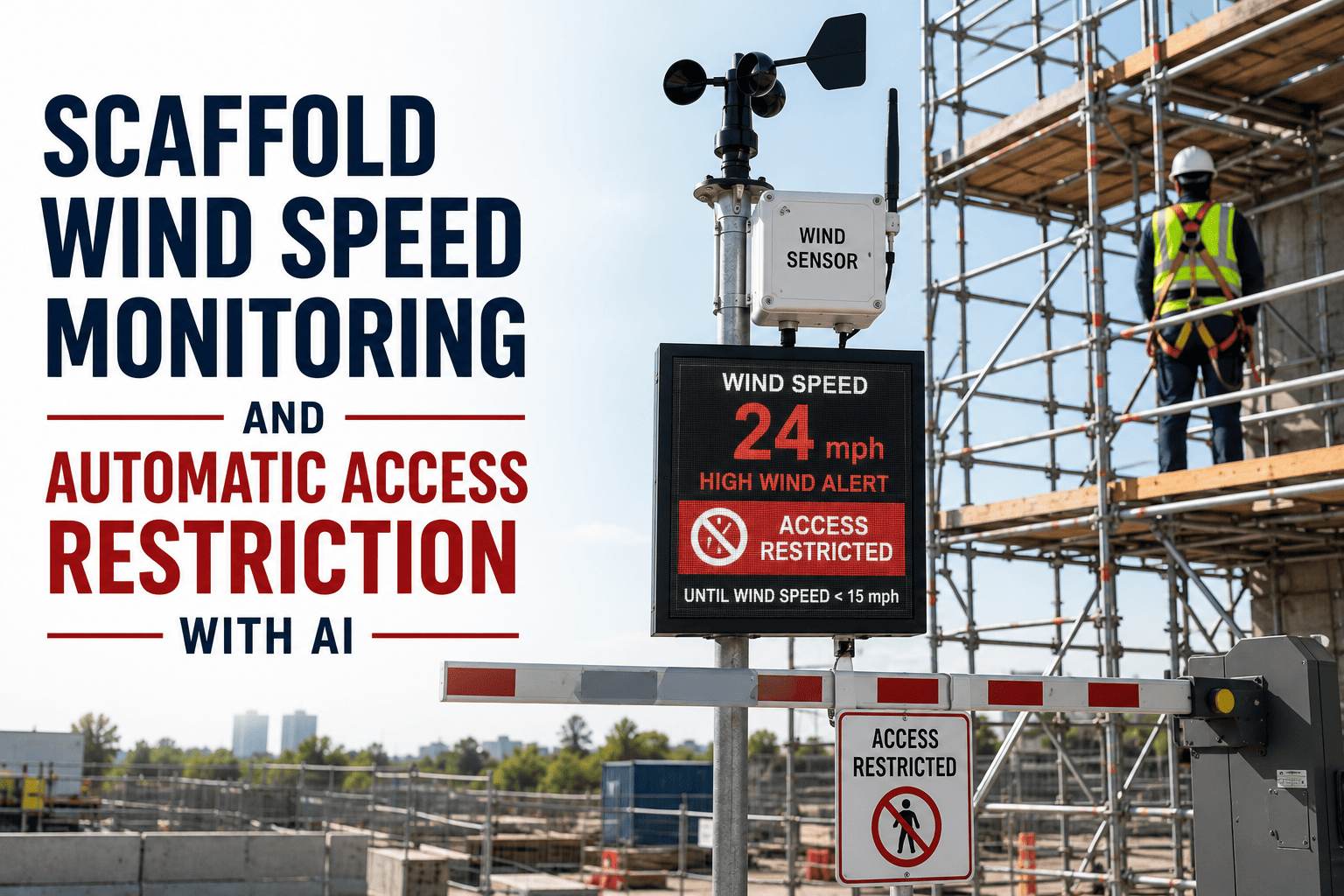
A gust doesn't need to be dramatic to put someone on a scaffold in danger, it just needs to hit a platform sixty feet up while a worker is leaning out to reach a joint, holding a sheet of plywood, or standing on a suspended stage with nothing but a tie-off between them and the ground. OSHA's own standard, 29 CFR 1926.451(f)(12), prohibits scaffold work during storms or high winds unless a competent person determines it is safe and workers are protected by fall arrest systems or wind screens, but that decision usually rests on someone checking a phone weather app that reflects conditions at a ground-level airport sensor miles away, not what is actually hitting the platform right now. AI-based wind monitoring closes that gap by measuring conditions at scaffold height in real time and automatically restricting access before a gust becomes an incident, and you can book a demo to see how the restriction logic actually triggers.
The Weather App Says It's Fine. The Scaffold Sixty Feet Up Says Otherwise.
iFactory correlates live wind data with scaffold height, configuration, and exposed surface area to automatically restrict access the moment conditions cross a safe threshold, replacing a judgment call based on ground-level weather with a decision based on what is actually happening at the platform.
Wind Is Rarely the Headline Cause, But It Is Almost Always Present
Falls account for roughly 38.5 percent of all construction fatalities according to Bureau of Labor Statistics data, and wind is consistently one of the aggravating factors investigators find once they look past the immediate cause. A worker does not usually fall because the wind blew them off a platform outright, the wind destabilizes a load, catches a tarp or a sheet of material, sways a suspended stage, or simply throws off balance at the exact moment a fall protection anchor point is being transferred. None of that shows up in an incident report as "wind," it shows up as a fall, a struck-by, or a dropped-object event, which is why wind-related scaffold risk is consistently underestimated relative to how often it actually contributes.
Four Wind Bands, Four Different Obligations Under the Standards
The regulatory picture is not a single number, it is a ladder of thresholds that apply depending on the equipment and the activity. Understanding where a given wind reading falls on that ladder is exactly the judgment call that gets made too slowly, or too late, when it is left to a phone check between tasks.
Why the Reading on Someone's Phone Is Not the Reading That Matters
A wind speed check pulled from a weather app reflects a sensor at a nearby airport or a regional station, usually measured at a standard 10-meter reference height over open terrain. A scaffold is neither at that height nor in that terrain, and the gap between the two readings is where the actual risk lives. That gap is not a rounding error either, on a taller structure the difference between a regional reading and the actual condition at the working platform can be the difference between a routine shift and a threshold crossing that should have stopped work an hour earlier.
Stop Making Wind Calls From a Forecast That Was Never Measuring Your Scaffold
See how iFactory reads actual conditions at scaffold height and configuration, not a regional average, and turns that reading into an automatic access decision your crew doesn't have to guess at.
From Live Wind Reading to Automatic Access Restriction in Five Steps
The system does not replace the competent person's authority to make the final call, it makes sure that call is triggered by accurate, height-specific data the moment conditions change, instead of whenever someone next remembers to check. That shift, from a periodic manual check to a continuous automated read, is what closes the exposure window between a wind shift starting and someone on the ground actually noticing it.
Six Data Points the System Watches on Every Active Scaffold
Restricting access on wind speed alone would miss most of what actually determines risk. The system tracks the combination of factors that together decide whether a given wind reading is a non-issue or a reason to clear the platform.
Manual Wind Judgment vs. Automated Restriction
Both approaches depend on the same underlying regulatory thresholds. The difference is in how fast a threshold crossing is detected and how consistently the restriction actually gets enforced once it is.
| Decision Point | Manual Judgment | Automated System |
|---|---|---|
| Wind data source | Regional forecast or a handheld anemometer check | Continuous readings correlated to actual scaffold height |
| Check frequency | Whenever someone remembers to look | Continuous, with instant alerts on threshold crossing |
| Sail effect from sheeting | Rarely factored into the wind speed judgment | Built into the effective load calculation automatically |
| Gust detection | Easy to miss between periodic checks | Captured continuously alongside sustained readings |
| Access enforcement | Depends on the message reaching every crew in time | Zone access automatically flagged and blocked |
| Compliance record | Reconstructed after the fact if questioned | Every threshold event and override logged automatically |
What Changes When the Restriction Happens Automatically
A mid-rise renovation project has crews working a suspended scaffold on the leeward side of the building most of the morning, sheltered from the prevailing wind. By early afternoon the wind shifts and starts funneling between the structure and an adjacent building, and the ground-level forecast the site safety officer checked at the start of the shift still reads a comfortable 15 mph. With manual monitoring, nobody re-checks conditions until a foreman happens to notice the platform swaying, by which point the localized gust at that specific corner has already been well above the point where protective measures should have kicked in, and the crew has been exposed for an unknown stretch of time before anyone calls it.
With AI wind monitoring running the same site, the height-corrected reading for that specific zone crosses the protective-measures threshold the moment the wind shift begins, and the system flags the zone and notifies the competent person before the swaying becomes visible from the ground. The crew is directed to descend, the zone shows as restricted for anyone else approaching it, and the entire sequence, from the threshold crossing to the notification to the all-clear once wind drops back down, is logged automatically. The wind did exactly the same thing in both scenarios, the only difference is how long the exposure lasted before someone knew. That difference is measured in minutes of unnecessary exposure on one side and an automatically documented, defensible decision on the other, which is exactly the kind of gap that shows up in an incident investigation report if the outcome had gone differently.
Common Questions About Automated Wind Monitoring for Scaffolds
Does automatic access restriction override the competent person's authority?
No. The system flags a zone as restricted the moment a configured threshold is crossed, but the competent person is notified immediately and retains full authority to review the specific conditions and document a site-specific override where that is genuinely justified, consistent with how 29 CFR 1926.451(f)(12) already places that judgment call with a qualified individual on site. What changes is the speed and consistency of the initial flag, not who holds final decision-making authority. Book a demo to see the override workflow in action.
How does the system account for wind being stronger at scaffold height than at ground level?
The model applies a height correction to raw wind readings based on the actual elevation of each scaffold zone, reflecting the well-documented effect where surface friction near the ground slows wind relative to conditions higher up. Combined with local terrain and building-funneling factors specific to the site, this produces an estimated effective wind speed at the platform rather than relying on a single ground-level or regional reading that was never measuring conditions at height in the first place.
Does the system factor in wind screens, tarps, and debris netting when calculating risk?
Yes. Screening and sheeting materials significantly increase the surface area exposed to wind, which is exactly the sail effect that can make a fully sheeted scaffold unsafe at a wind speed a bare frame would tolerate without issue. The system tracks current screening status per zone and factors that into the effective load calculation, rather than evaluating wind speed alone as if every scaffold configuration presented the same exposure. Contact support to review how screening configurations are set up for your scaffold types.
What happens to workers who are already on the scaffold when a restriction triggers?
When a zone crosses a restriction threshold, workers already on that platform receive an immediate alert directing them to descend, alongside the notification sent to the competent person. New access to the zone is blocked at the same time, so anyone approaching afterward sees the restricted status before climbing rather than finding out only when someone tells them in person. The goal is to shorten the exposure window for anyone already at height, not just prevent new exposure.
Can this system be configured to different wind thresholds for different scaffold types on the same site?
Yes. A suspended two-point system, a supported frame scaffold, and a mobile tower do not carry the same wind exposure profile, and the threshold ladder can be configured per scaffold type and per zone rather than applying one blanket wind speed limit across an entire jobsite. This lets a site reflect the actual guidance that applies to each configuration instead of defaulting to the most conservative number for every scaffold regardless of type. Book a demo to see threshold configuration for your specific scaffold mix.
Don't Wait for the Platform to Sway Before Anyone Checks the Wind Again
iFactory reads live, height-corrected wind conditions on every active scaffold zone and restricts access automatically the moment a threshold is crossed, so the decision is made by data instead of by whoever last happened to look at a forecast.