Mechanical Integrity is consistently one of the most-cited elements of OSHA's Process Safety Management standard, trailing only Operating Procedures across decades of enforcement data — and most of those citations aren't for broken equipment, they're for gaps in how facilities verify and document that equipment was inspected at all. Of the citations issued under 29 CFR 1910.119(j), roughly 41 percent trace to Written Procedures and another 30 percent to Inspection and Testing, meaning seven in ten Mechanical Integrity findings come down to paperwork and scheduling discipline rather than a piece of hardware actually failing. For a facility running hundreds of PSM-covered assets across six regulated equipment categories, keeping that paperwork current by hand is where most programs quietly start to slip. See how iFactory's mechanical integrity tracking keeps inspection schedules, deficiency closure, and documentation aligned automatically.
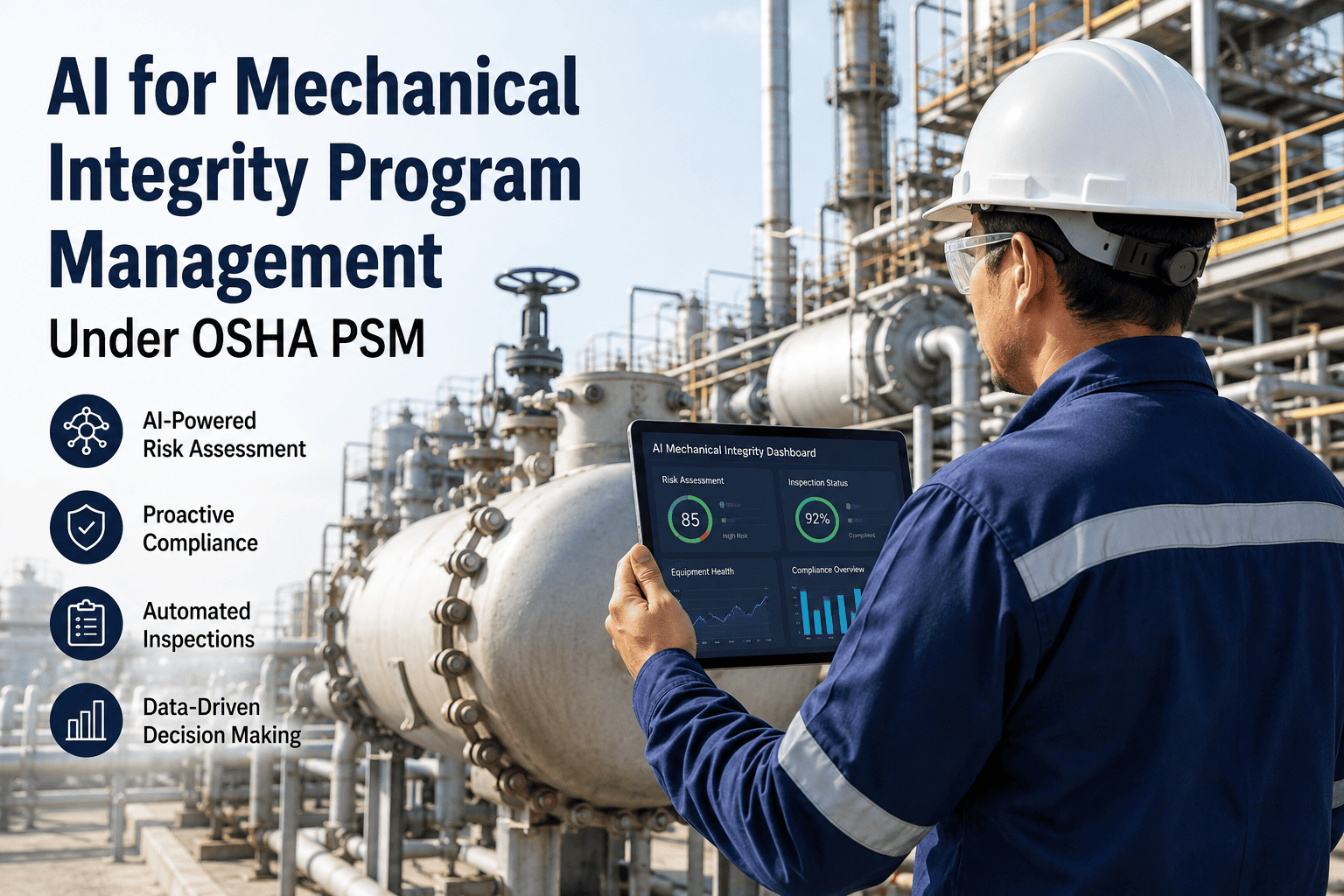
AI for Mechanical Integrity Program Management Under OSHA PSM
Inspection scheduling, deficiency closure tracking, and audit-ready documentation for every category of equipment covered under 29 CFR 1910.119(j).
Why the Category List Matters More Than It Looks
It's tempting to treat the six-category list as a formality — of course pumps and pressure vessels are covered, that's obvious. The part that trips up real programs is scope creep at the edges: a control valve that's technically part of a piping system, an alarm that's wired into an emergency shutdown loop, a small utility pump that feeds a covered process intermittently rather than continuously. None of these are exotic edge cases; they're the ordinary equipment that ends up missing from the covered equipment list because nobody re-checked the boundary when the process was modified.
That's also why the covered equipment list under 1910.119(j)(1) isn't a one-time exercise. Every management-of-change review that touches process equipment should trigger a check against the MI inventory — does this new or modified asset now fall under one of the six categories, and if so, has an inspection interval and written procedure been assigned before it enters service. Programs that treat the equipment list as something built once during initial PSM implementation, rather than something MOC keeps current, are the ones that show up in an audit with equipment nobody remembered to add.
Six Equipment Categories Covered by 1910.119(j)
Mechanical Integrity is one of fourteen elements in the full PSM standard, but the equipment it governs falls into a specific, narrower list — six named categories under 1910.119(j)(1). Any process equipment identified as PSM-critical in your process safety information must fall into one of these, with an inspection and testing program to match.
Pressure Vessels & Storage Tanks
Governed by API 510 and API 653 inspection intervals — external checks on a multi-year cycle, internal inspections tied to corrosion rate and risk-based adjustments.
Piping Systems
Includes piping components such as valves, fittings, and flanges — inspected under API 570, with thickness monitoring at points identified as corrosion-prone.
Relief & Vent Systems
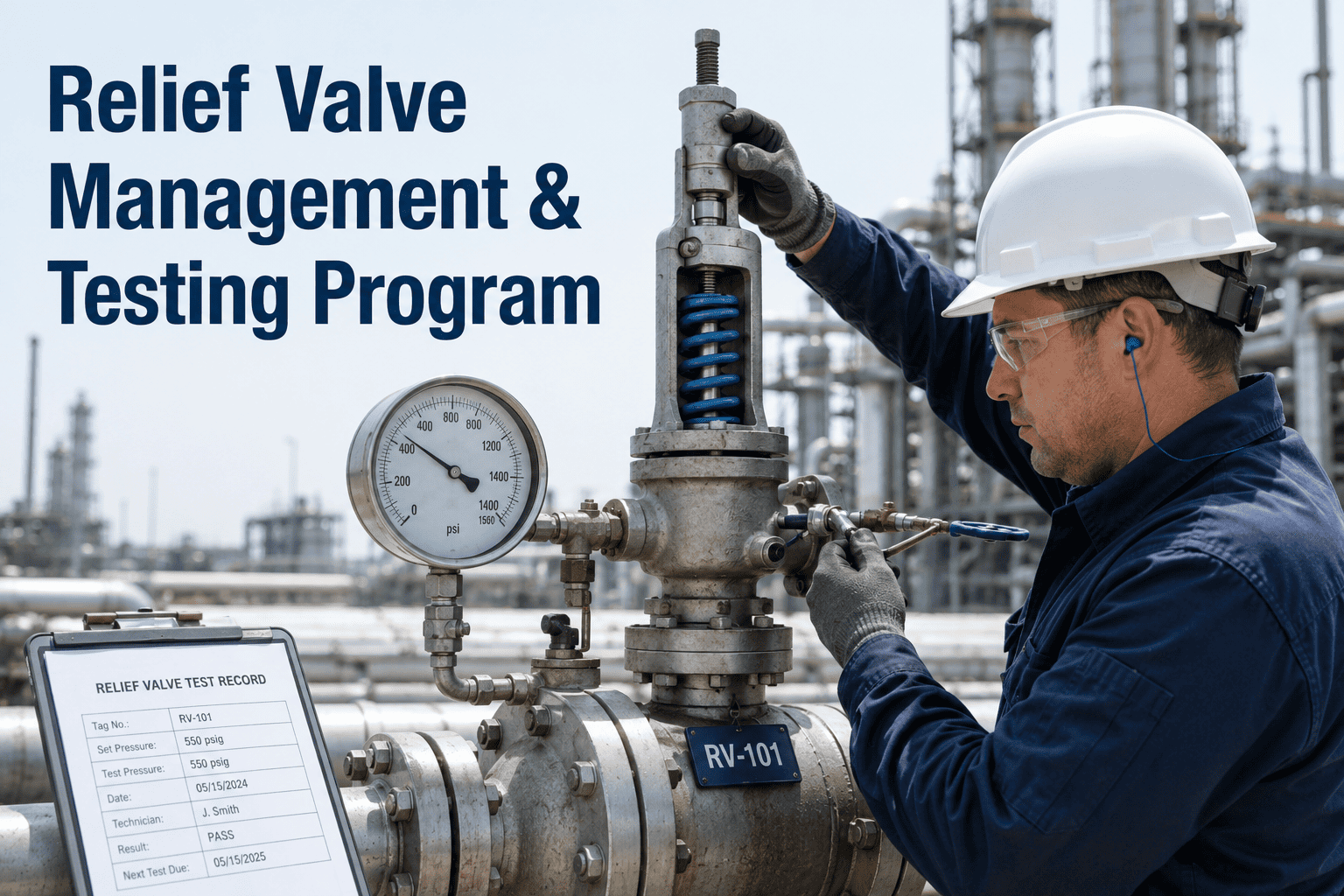
Pressure relief devices and vent paths that must actuate correctly under upset conditions — tested and certified on a defined recurring schedule.
Emergency Shutdown Systems
The last line of defense when a process deviates outside safe limits — functional testing verifies the system actually trips when called on.
Controls
Monitoring devices, sensors, alarms, and interlocks — calibration and function checks confirm the instrumentation layer is reporting what it claims to report.
Pumps
Rotating equipment moving hazardous process fluid — condition monitoring and preventive maintenance intervals set from manufacturer data and operating history.
The Six Requirements Inside 1910.119(j)
Beyond naming the equipment, the standard lays out exactly what a compliant program has to do for each category — and this is where most of the citation data actually concentrates, since a program can own the right equipment list and still fail on how it documents the work. Each of the six requirements below maps to a distinct part of the enforcement record, and understanding which one is weakest in your own program is usually a faster path to closing risk than treating "Mechanical Integrity" as one undifferentiated compliance task.
Application: The Covered Equipment List
Defines which of the six categories apply and builds the master inventory that every inspection schedule and deficiency record ties back to.
Written Procedures
Documented maintenance procedures for each equipment category, referencing recognized and generally accepted good engineering practice — the single largest source of MI citations.
Training for Process Maintenance Activities
Maintenance personnel trained on the process, its hazards, and the specific procedures for the equipment they service — a common gap where technicians rotate across multiple PSM-covered units.
Inspection and Testing
Frequencies consistent with manufacturer recommendations and good engineering practice, performed by qualified personnel, with results documented against each specific asset — the second-largest citation source.
Equipment Deficiencies
Deficiencies outside acceptable limits must be corrected before further use, or an interim measure documented — the requirement that turns an inspection finding into a tracked, closeable action.
Quality Assurance
New and replacement equipment must be suitable for the process application, installed correctly, and consistent with design specifications before it enters covered service.
What an Overdue Program Actually Costs
The direct penalty exposure from a Mechanical Integrity citation is real — PSM violations can carry per-instance fines that scale quickly once an inspector finds one gap and starts checking whether it's isolated or systemic across the equipment list. But the fine is rarely the largest cost. A facility that can't produce clean deficiency-closure records during an audit typically ends up in an extended document-production cycle, pulling years of maintenance history out of email threads, shared drives, and departed employees' spreadsheets to answer a single inspector question. That reconstruction effort, spread across process safety engineers and maintenance planners pulled off their normal work, often costs more in labor hours than the eventual fine.
The harder-to-quantify cost sits downstream of the paperwork entirely: a genuinely overdue inspection on a pressure vessel or relief device is exactly the kind of gap that, in the rare case it coincides with an actual equipment degradation, turns a routine finding into the root cause line in an incident investigation report. Regulators frequently point back to catastrophic incidents involving unregistered or poorly documented PSM facilities when explaining why enforcement has tightened in recent years — a reminder that the paperwork requirement exists because the equipment behind it is genuinely hazardous, not because OSHA enjoys auditing spreadsheets.
There's also a quieter cost that rarely makes it into a compliance memo: the erosion of trust between the process safety team and operations when a documentation gap surfaces late. A missed inspection date discovered during a self-audit is a correction. The same gap discovered by an OSHA inspector, or worse, after an equipment failure, reframes every other record in the program as suspect until it's individually re-verified — turning what should have been a routine finding into a full program review that consumes months rather than weeks.
Why Deficiencies Stall Between "Found" and "Closed"
An inspection finding isn't a citation risk by itself — an unclosed one is. OSHA's own audit guidance calls for a tracking system that shows status, ownership, and a documented closure path for every deficiency, precisely because the gap between identifying a problem and proving it was fixed is where most programs lose the paper trail.
Finding logged, no corrective action assigned yet — the highest-risk state if it sits here past its due date.
Work order issued and owner assigned, but repair or interim measure not yet verified complete.
Past its target closure date with no documented interim measure — the exact pattern OSHA audit guidance flags first.
Corrective action completed, re-inspected, and documented with the record an auditor will ask to see.
Stop Managing Deficiency Status in a Spreadsheet
iFactory schedules inspections against RAGAGEP intervals, logs every finding against the specific asset, and tracks each deficiency from open to closed-and-verified — the exact trail an OSHA auditor asks to see.
A Scenario: The Overdue Thickness Inspection Nobody Noticed
A mid-size chemical facility running roughly 800 pieces of PSM-covered equipment across two process units managed its Mechanical Integrity schedule through a shared spreadsheet, maintained by a rotating cast of maintenance planners over several years. The equipment list itself was accurate — every pressure vessel, relief device, and piping run had a row. What broke down was the update discipline: when a planner left or an inspection got rescheduled around a turnaround, the spreadsheet's next-due date sometimes didn't get updated to reflect the actual last inspection performed.
A routine internal compliance audit ahead of the facility's three-year PSM review found 31 pieces of covered equipment with inspection dates that had silently lapsed — some by a few weeks, one storage tank by over a year, because its API 653 external inspection had been rescheduled once and the new date was never entered against the master list. None of the equipment had actually failed. But under 1910.119(j)(4), an inspection performed outside the interval consistent with good engineering practice is itself a finding, independent of whether the equipment shows any physical sign of a problem. The facility closed the gap by re-inspecting all 31 assets within eight weeks and moved its scheduling off the spreadsheet entirely, onto a system that flags an approaching due date automatically rather than relying on someone remembering to check a row.
What made the finding especially uncomfortable for the facility's process safety team wasn't the count of lapsed assets — 31 out of 800 is a small fraction — it was that the spreadsheet had looked complete the entire time. Every asset had a row, every row had a date, and a quick glance during a status meeting would have shown a fully populated schedule. The gap only became visible once someone cross-referenced the "next due" column against the actual inspection completion records buried in separate maintenance files, a step the facility hadn't built into its routine review cadence. That's the specific failure mode automated scheduling is designed to close: the system calculates each next-due date directly from the last verified inspection record, so a missed manual update can't quietly produce a schedule that looks current without actually being current.
Manual MI Tracking vs. AI-Assisted Program Management
The distinction that matters most isn't speed, though automated scheduling is faster — it's that a spreadsheet trusts whoever last touched it to have gotten the update right, while an automated system derives the next-due date from the inspection record itself. That single structural difference is what turned a 31-asset gap that took a dedicated audit to surface into something that would now flag on its own before an inspection date ever lapses.
Five Questions to Ask About Your Current MI Program
Can you produce, in minutes, a list of every covered asset with an inspection overdue against its RAGAGEP interval?
Does every open deficiency have a documented owner, target closure date, and interim measure if it's past due?
Are maintenance personnel trained records tied to the specific PSM-covered process they service, not just a general training log?
When a RAGAGEP standard updates its recommended interval, does that change reach every affected asset, or only the ones someone remembers to check?
Could you hand an auditor a closed-loop record — finding, corrective action, re-inspection — for any deficiency from the past three years on request?
Frequently Asked Questions
Why is Mechanical Integrity cited so often if the equipment itself is usually fine?
Enforcement data shows the large majority of Mechanical Integrity citations trace to documentation and process gaps rather than defective equipment — 41 percent to written procedures and another 30 percent to inspection and testing records. OSHA's inspectors are typically verifying that a facility can prove its program is being followed, not personally finding a corroded vessel on the spot, which is why paperwork discipline matters as much as the physical maintenance work itself. Visit support to see how automated scheduling closes that documentation gap.
Does 1910.119(j) apply to all maintenance activity, or only specific equipment?
Mechanical Integrity applies specifically to the six equipment categories the standard names — pressure vessels and storage tanks, piping systems, relief and vent systems, emergency shutdown systems, controls, and pumps — where that equipment is identified as PSM-critical in your process safety information. General facility maintenance outside those categories isn't governed by 1910.119(j), though many facilities extend similar documentation discipline to non-covered assets as good practice.
How often does OSHA require Mechanical Integrity inspections?
The standard does not set a single universal interval — it requires frequencies consistent with manufacturer recommendations and recognized good engineering practice, adjusted more frequently if operating experience shows it's warranted. In practice this means referencing standards like API 510 for pressure vessels or API 653 for storage tanks, which specify their own interval ranges based on inspection history and corrosion rate. Book a demo to see how interval-specific scheduling maps to your equipment list.
What happens if a deficiency is found but can't be fixed immediately?
Under 1910.119(j)(5), equipment outside acceptable limits must be corrected before further use, unless the facility documents that other measures ensure safe operation in the meantime. That interim measure — reduced operating pressure, increased monitoring frequency, or a compensating safeguard — has to be documented and tracked to the actual corrective action's completion, not treated as a permanent substitute for the fix.
Can a computerized maintenance system alone satisfy Mechanical Integrity documentation requirements?
A CMMS or EAM platform with PSM-aware functionality substantially reduces the documentation burden, but the software has to actually map to the standard's requirements — inspection scheduling against RAGAGEP intervals, deficiency tracking through to closure, and training records tied to specific covered processes — rather than functioning as a generic work order log. The system needs to produce the specific audit trail an OSHA inspector will ask for, not just store maintenance history in general. Contact support to see how iFactory maps to each subsection of 1910.119(j).
Bring Your Mechanical Integrity Program Into One System
iFactory tracks inspection scheduling, deficiency closure, and training records against every equipment category covered under 1910.119(j) — so your next audit starts with a pre-built report instead of a reconstruction project pulled together from spreadsheets and file folders.